Blog published in Buying property abroad
Share
Top Mediterranean property portals for buying a vacation home in 2025
Find the best country-specific and international platforms for your search. Includes a 7-step workflow for shortlisting, verifying, and buying safely.

Choosing where to look is the first real decision in buying a Mediterranean vacation home. No single website covers every market well, and the portal that works best for a villa in Andalusia won't necessarily help you find a stone farmhouse in Puglia or an island apartment in Croatia.
This guide helps you pick the right portal or portals for each country, then walks you through a repeatable process to search, shortlist, arrange viewings, and prepare for legal checks. It's written for international buyers, including retirees and near-retirees, who are doing careful research, may not speak the local language, and want a trustworthy workflow.
What you'll end up with: a short list of portals matched to your target countries, a shortlist spreadsheet of verified properties, and a clear list of questions for your local lawyer and tax adviser.
Difficulty: Moderate. Time: About 2 to 3 hours to set up your search system, then a few weeks of part-time work to shortlist and verify.
You'll need:
- A budget range, including a buffer for purchase costs
- A spreadsheet tool (Google Sheets or Excel)
- A browser translation tool
- A folder for screenshots and saved emails
How to use this guide: Start with the top 10 table, jump to your target country's pick, then follow the seven-step workflow. The checklists at the end are worth printing.
The top 10 property platforms for Mediterranean vacation homes
Portals fall into two groups. International aggregators collect listings from many countries in one place, which makes them handy for comparing markets. Country-specific portals tend to have the fullest local inventory, but their interface and listing text are often in the local language.
Use both. Aggregators help you narrow down countries, and local portals help you confirm you're seeing the whole market.
| # | Platform | Type | Best for | Watch out for |
|---|---|---|---|---|
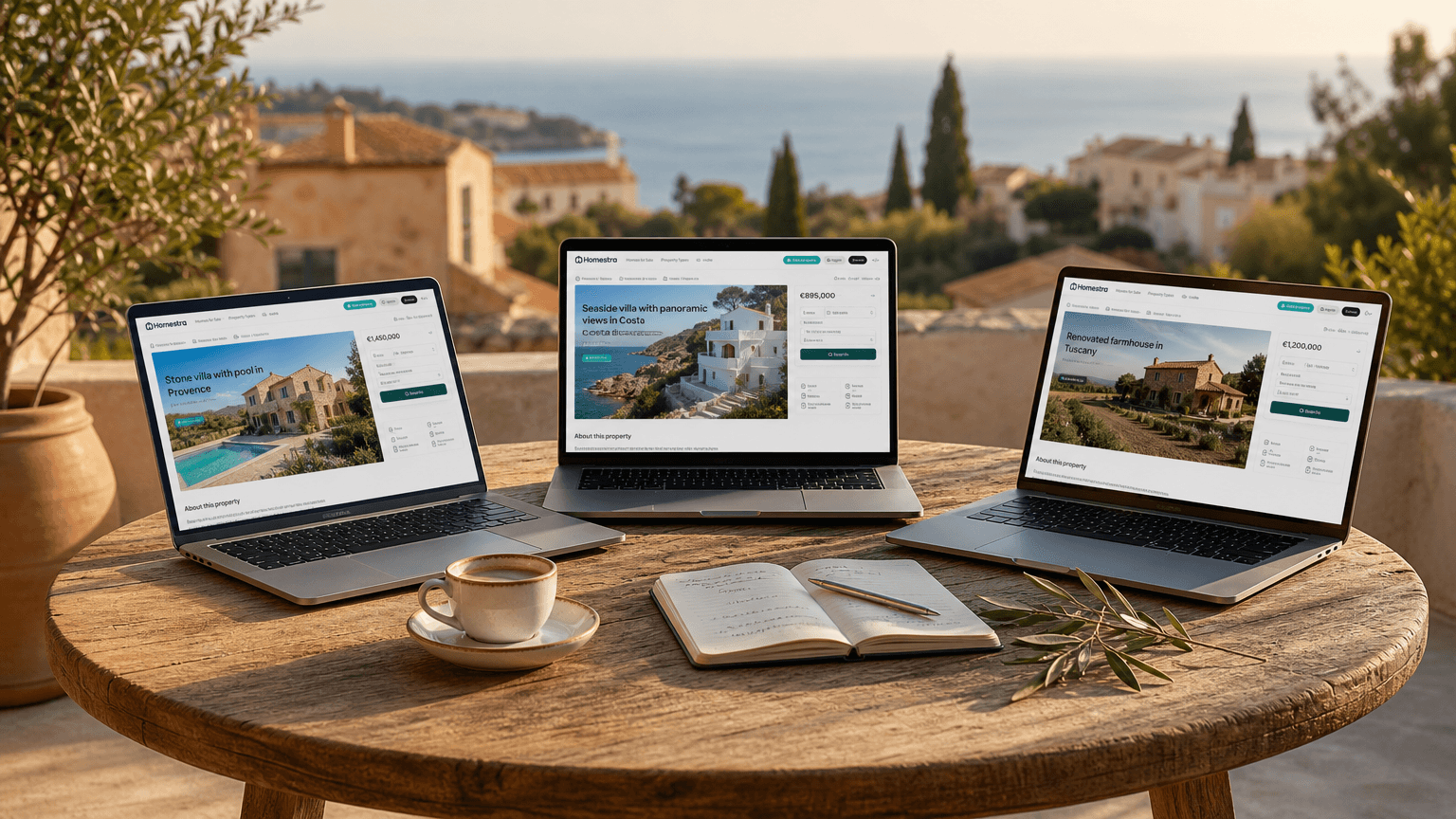
| 1 | Homestra | International aggregator | Second-home searches across multiple European countries from one English-language platform, with 200,000+ properties and local market insights | Focused on European markets, so check coverage for your specific country and region before relying on it alone |
| 2 | Idealista | Country portal (Spain, Portugal, Italy) | The deepest mainstream inventory in Spain | Many listings are written for local buyers, so you'll need translation for details |
| 3 | Kyero | International aggregator | English-language browsing, especially in Spain | Coverage varies by country, so confirm it before relying on it outside Spain |
| 4 | Green-Acres | International aggregator | France-rooted search with a wide international reach | Listing depth differs a lot by country |
| 5 | Rightmove Overseas | International aggregator | A familiar interface for UK buyers and a big country index | Mostly a navigation layer, with limited buyer guidance |
| 6 | Properstar | International aggregator | A global search that includes smaller Mediterranean markets | Check each listing's original source and date |
| 7 | JamesEdition | International luxury marketplace | Premium and luxury villas | Narrow by design, and not meant for modest budgets |
| 8 | Immobiliare.it | Country portal (Italy) | Italian local inventory, including rural and village homes | Mostly Italian-language, with agent-driven descriptions |
| 9 | SeLoger | Country portal (France) | Large French agent inventory | French-language interface, and agency fees can be unclear |
| 10 | Spitogatos | Country portal (Greece) | Greek local listings, including islands | Duplicates across agencies are common |
A few notes on how to read this. Rightmove Overseas describes itself with a "Most Popular Countries" grid, regional country links, country guides, hot properties, and a promotional line claiming "over 9 million searches a month." That makes it a good front door, though the page is mainly an index rather than a buyer education resource. You'll still need your own process, which is what the rest of this guide provides.
Portal coverage and language options change, so spend five minutes on each platform's own "about" or help page to confirm the countries and languages it currently supports. If you want a wider comparison, our roundup of European property portals goes deeper on national depth and cross-border discovery.
A Place in the Sun is another name you'll see often. It's better known as a media brand and event organizer than a listings database, so treat it as inspiration and use the portals above for actual searching. Portugal and Malta also come up in many Mediterranean searches. Idealista covers Portugal, and many of the aggregators above list both markets, but the country picks below stay focused on the seven markets in this guide.
Country-by-country picks: which portal to use where
For each country, you'll see one to three suggestions and a single "if you only use one" pick. Cross-check anyway. The same property is often listed on several portals at different prices or with different photos, and comparing them is a quick way to spot problems.
Spain
Spain is the easiest market to research online, thanks to a large, mature portal ecosystem.
- Idealista for the broadest local inventory
- Kyero for English-language browsing
- Homestra when you want to compare Spain against France or Italy in the same search
If you only use one: Idealista, with browser translation switched on. For a regional breakdown, see our guide to Spanish property websites, which also covers Fotocasa, Habitaclia, and Pisos.com.
France
- SeLoger for large agent inventory
- Green-Acres for an international-facing interface
- Homestra for comparing French regions with Spain or Italy
If you only use one: SeLoger for completeness, Green-Acres if you'd rather browse in English first.
Italy
- Immobiliare.it for local depth, including rural and village properties
- Idealista, which also covers Italy
- Homestra for multi-country comparison
If you only use one: Immobiliare.it. Italian listings often describe a property's condition and layout in brief shorthand, so translate descriptions and ask the agent for a floor plan.
Greece
- Spitogatos for local inventory
- Kyero, if its current Greece listings cover your area
- Properstar or Green-Acres for island and coastal cross-checking
If you only use one: Spitogatos. Duplicates are common here because several agencies often list the same property, so track every listing by address and photos, not by URL.
Croatia
- Green-Acres for international-facing Croatian listings
- Properstar for a global search that includes Croatia
- Local classifieds such as Njuškalo for domestic listings, with translation
If you only use one: Green-Acres to begin, then confirm availability with a local agent. Foreign-ownership rules differ depending on your citizenship, so ask a Croatian lawyer before you get attached to a property.
Turkey
- Properstar for international browsing
- Local portals such as Sahibinden or Hepsiemlak for domestic inventory
- JamesEdition for luxury coastal properties
If you only use one: Properstar for first-pass research, then a local licensed agent for anything on your shortlist. Turkey has its own foreign-purchase steps, including valuation requirements and title deed (tapu) registration, so a local lawyer is essential.
Cyprus
- Rightmove Overseas, which is well known to UK buyers
- Bazaraki for local classifieds
- Properstar or Green-Acres for cross-checking
If you only use one: Rightmove Overseas to browse, then verify with a Cyprus-based lawyer. Non-EU buyers may need government permission to purchase, so confirm your situation early.
Choosing a platform based on what you want
You don't have to guess. Match your main goal to the right type of portal.
"I want coastal lifestyle and plenty of options"
Use a country portal with strong local inventory, and filter by region, distance to the sea, and amenities. Then use an aggregator to spot towns you hadn't considered. A multi-country platform such as Homestra is useful at this stage because you can compare Spain, France, and Italy side by side. Our guide to multi-country search on Homestra shows how to set up one filter recipe for all three.
"I want investment-grade comparables"
Look for portals with detailed listing data, such as size, year built, and price history, plus local market context. Be realistic about what listings can tell you. Asking prices aren't sale prices, and a portal can't show you a property's legal status or true condition. Use listings to build a price-per-square-meter range for a town, then ask a local agent or valuer to confirm what homes actually sold for.
"I'm worried about maintaining a home from a distance"
Choose portals that show agent details clearly and make it easy to contact them quickly. Responsiveness is a useful early signal. An agent who answers in a day during your search will probably be easier to work with when you need help later. Ask each agent whether they also offer property management, and get references.
"I need language support"
Pick a portal with an English interface, then test it: translate three listings and see whether the details are clear. Our guide to searching without local language skills covers translation tools and agent outreach in more detail. A simple email template helps too (see Step 5).
Step-by-step: search, shortlist, view, and check
Step 1: Set your non-negotiables
Write down the limits that won't move before you open a single portal.
- Budget range, including purchase costs (taxes, notary and legal fees, and agent fees where applicable). Costs vary by country, so ask a local lawyer for an estimate.
- Property type (apartment, townhouse, villa, farmhouse).
- Maximum distance to the coast, airport, and hospital.
- How long you plan to stay each year, and whether you may become a resident.
- Your tolerance for renovation.
Checkpoint: You should have a one-page summary you could hand to an agent.
Step 2: Search with one repeatable filter recipe
Apply the same filters on every portal: price range, property type, bedrooms, and region. Then record the results in the same format each time.
Common snag: Portals label property types differently. A "chalet" in one country is a "villa" in another. If results look thin, widen the type filter instead of the price.
Checkpoint: After this step you should have 15 to 25 saved listings across at least two portals.
Step 3: Build a shortlist spreadsheet
Create one row per property with these columns:
- Listing URL and portal name
- Asking price and date you saw it
- Size (interior and plot), and year built
- Taxes, communal fees, or charges mentioned
- Agent name, agency, and contact details
- Red flags and notes
Take a screenshot of every listing you add. Listings change or disappear, and your screenshot is your record of what was advertised.
Checkpoint: Your shortlist should be down to 5 to 8 properties.
Step 4: Verify availability and basic facts
Email each agent with a short, specific message. For example:
Hello, I'm interested in the property at [address/reference]. Could you confirm that it's still available, the asking price, and the registered built area? Please also tell me whether there are any known issues with title, permits, or communal charges. Thank you.
Run the message through translation, and send it in the local language if you can, with the English version underneath.
Common snag: Duplicate listings. If two agencies show the same house at different prices, ask both whether they hold an exclusive mandate. Be cautious if either can't answer.
Warning: Never send a deposit or any money at this stage. A genuine agent won't ask for one before you've viewed the property and engaged a lawyer.
Checkpoint: You should have verified agent responsiveness. Drop any property where no one replies within a few business days.
Step 5: Arrange viewings and remote inspections
If you can't travel yet, ask for a live video tour, current photos with a dated newspaper or phone screen in frame, and a floor plan. When you do travel, group your viewings into a single trip and book them in advance.
Before you go, request:
- The latest utility bills (to confirm connection and typical costs)
- The communal fee statement, if the property is in a complex
- Any renovation or building permits
Checkpoint: After each viewing, add notes to your spreadsheet the same day: condition, noise, access, neighbors, and anything the agent said that you want confirmed in writing.
Step 6: Run legal checks with local professionals
This is the step portals can't do for you. A listing doesn't tell you who legally owns the home, whether there are debts against it, or whether extensions were permitted.
Hire an independent lawyer in the country where you're buying, not one recommended solely by the seller's agent. Ask them to check:
- Who holds title and whether the seller has the right to sell
- Mortgages, liens, or other encumbrances registered against the property
- Building permits and permitted use
- Local taxes, ongoing costs, and the tax position on resale
- Inheritance rules, which differ by country and may affect your family
The legal process varies. In Spain, for example, you'll need an NIE (foreigner's tax ID) and your lawyer will typically request an official land registry extract. France uses a notary and a preliminary sales contract with a statutory cooling-off period for buyers. Italy and Greece also use notaries, with their own registry and cadastral checks. Our step-by-step guide to buying property in Spain lays out a ten-stage sequence that shows how detailed these processes get.
Checkpoint: You should have a written summary from your lawyer, with open questions listed.
Step 7: Compare offers and close with a paper trail
Keep every agreement in writing. At each stage, ask for the document that matches it:
- Before an offer: the lawyer's title and encumbrance report
- At reservation: a written reservation agreement stating whether the deposit is refundable
- At the preliminary contract: the full contract in a language you understand, or a certified translation
- At completion: the final deed, proof of payment, and registration confirmation
Warning: Avoid transferring large amounts by wire unless your lawyer has confirmed the recipient account and the purpose of the payment, ideally through a lawyer's client account or escrow. Fraudsters sometimes impersonate agents or lawyers by email, so verify bank details by phone using a number you found independently.
Checklists for buying through online portals
Portal habits
- Screenshot every listing you shortlist, with the date visible
- Save the agent's name, agency, and license or registration number if shown
- Keep all emails in one folder
- Note any translation assumptions, such as terms you weren't sure about
- Compare every shortlisted property on at least two portals
Legal and tax basics (confirm with local advisers)
- Confirm who holds title
- Verify encumbrances and debts
- Check permits and permitted use
- Estimate purchase taxes and annual property taxes
- Ask about rental rules if you might let the home
- Review inheritance and succession rules, and consider your home country's tax rules too
Practical due diligence
- Utilities: connected, metered, and in whose name
- Communal charges, reserve funds, and upcoming repairs
- Renovation history and any unfinished work
- Water supply, drainage, and flood or wildfire exposure in coastal areas
- Insurance availability and cost
Safety
- No money before a lawyer has reviewed the paperwork
- Verify agents and bank details independently
- Never sign a contract you don't understand
- Be wary of deals that are urgent, unusually cheap, or demand secrecy
If something goes wrong
Nobody replies to your emails. Try the agency's phone or WhatsApp number, and send a short message in the local language. If there's still no response, move on.
A listing disappears. It may be sold or withdrawn. Check your screenshot, then ask the agent whether a similar property is available.
Prices differ between portals. Ask the agent which price is current and whether any fees are added. Record the answer in writing.
You can't tell what a term means. Don't guess. Ask your lawyer. Words like "habitable area," "plot," and "cadastral value" can mean different things in different countries.
Next steps
You now have a portal shortlist, a search method, a verification routine, and a set of legal and safety checks. Pick one or two target countries, run your Step 2 search on an aggregator and a local portal, and see how your shortlist looks after a week.
When you're ready to compare several European markets at once, you can browse Homestra to search second homes across countries, and our buying property abroad library has further guides on financing and legal steps. Then contact a local lawyer and tax adviser in your top country and ask for a realistic timeline. It's the single most useful call you'll make.
Share