Blog published in Buying property abroad
Share
Buying a second home in Europe as an expat: 2026 step-by-step guide
Learn how to buy a second home in Europe as an expat. Get an 8-step process, cost breakdowns for Portugal, Spain, Sweden, Italy & France, plus due diligence checklists.

Buying a second home in Europe as an expat is one of the most rewarding property decisions you can make. It can also be one of the most complex. The European Union has no single property code. Each country runs its own land registry, applies its own transfer taxes, and operates its own contract law. A purchase in rural Sweden follows a completely different legal sequence than one in southern Spain or coastal Portugal, and neither process closely resembles buying in Italy or France.
That complexity shouldn't put you off. What it should do is prompt you to approach the process the same way any experienced cross-border buyer does: with a clear understanding of each stage, verified cost estimates, qualified professionals on the ground, and a due diligence checklist you work through before you commit.
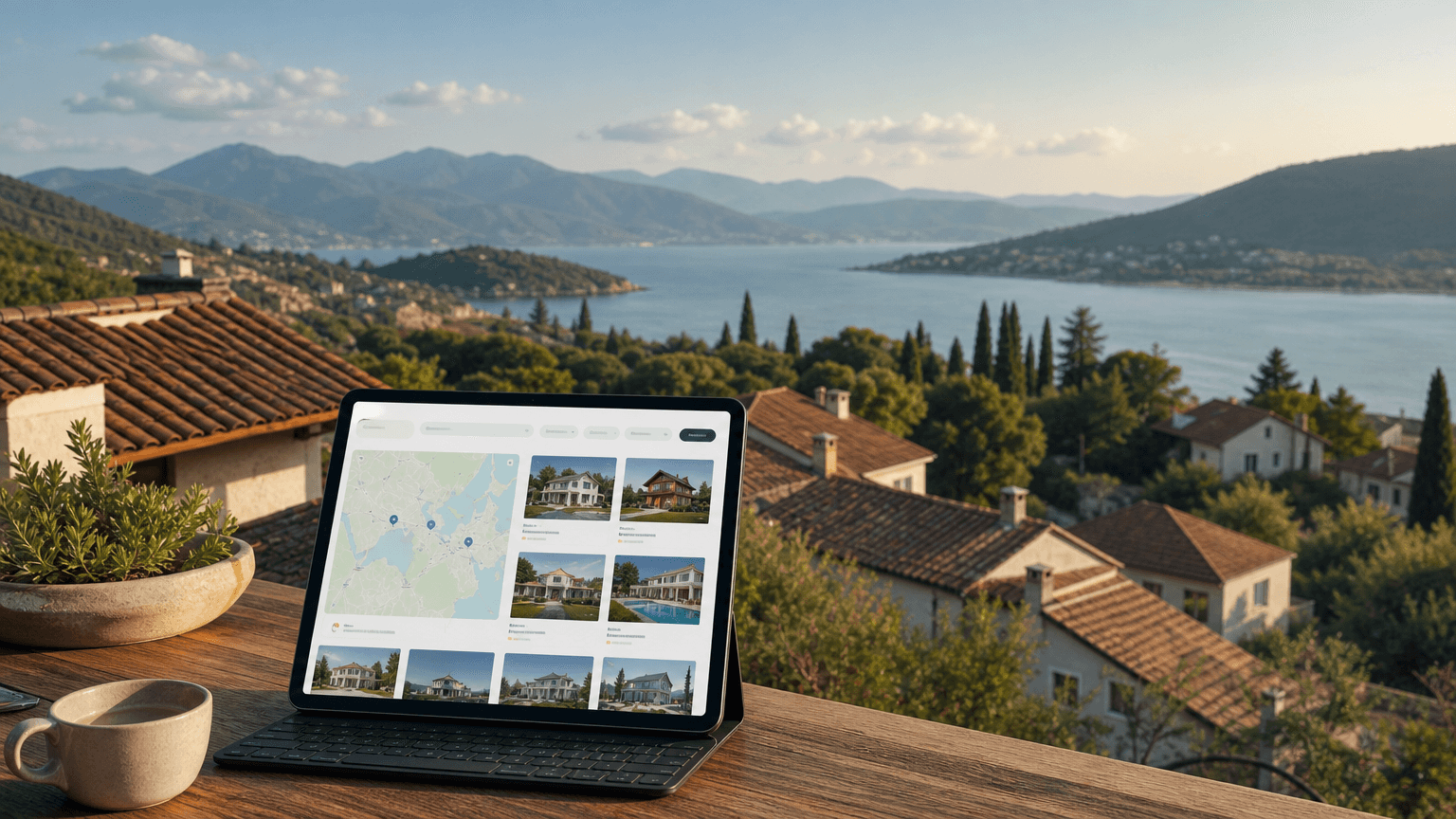
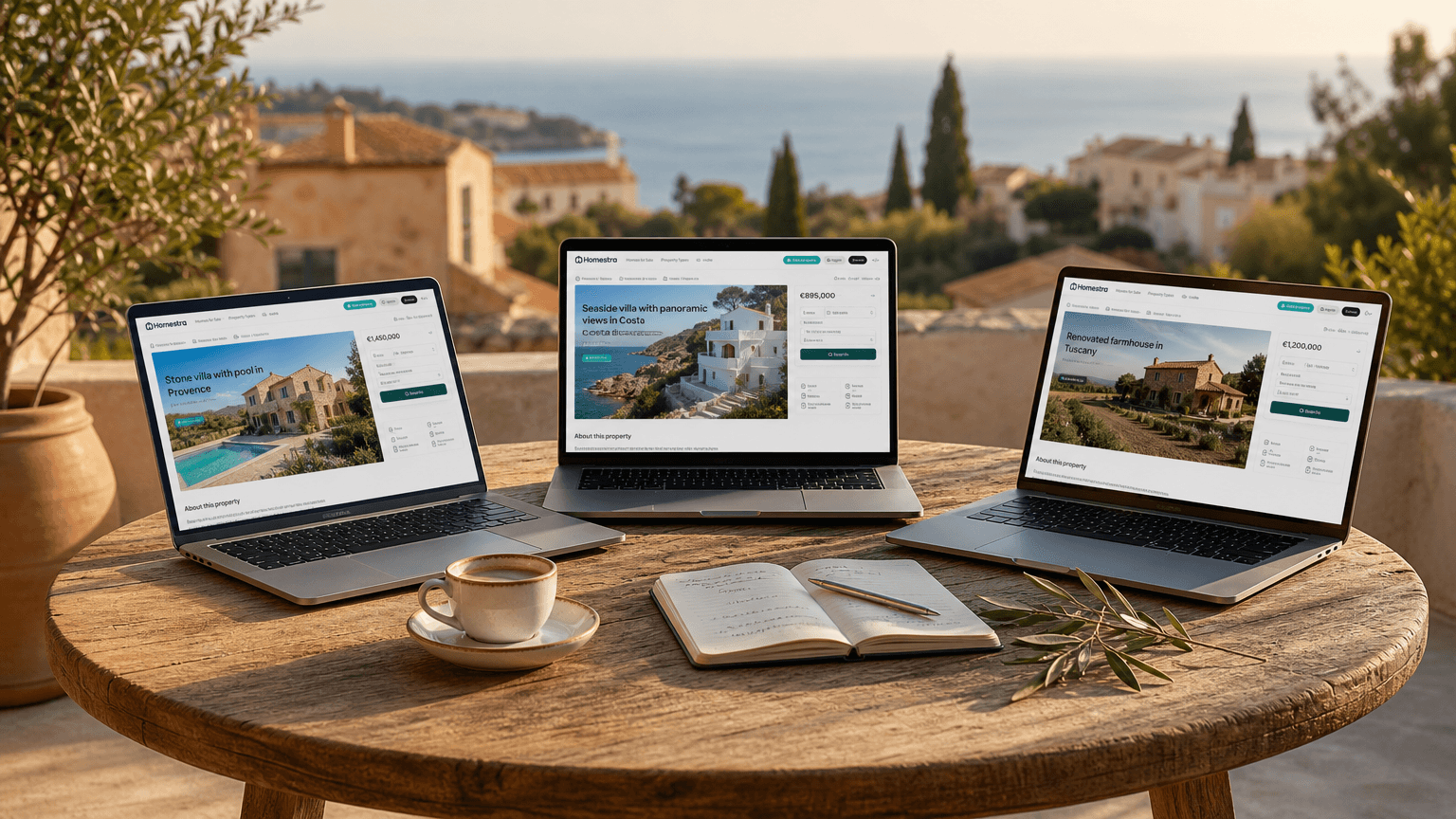
This guide covers the full journey. Whether you're searching listings across Homestra's catalog of over 200,000 European properties or already negotiating a specific property, the steps below apply.
One critical point before anything else: buying property in Europe does not grant you residency or a visa. As Homestra's detailed guide to buying a vacation home in Sweden makes clear, non-EU citizens who own property in Europe remain subject to Schengen entry limits just as they would without that property. This is a frequent misconception, and confusing the two can seriously disrupt your plans.
The eight-step buying process for non-residents
Step 1: Plan your purchase with honest numbers
Before you search, get specific about your goals. Are you buying a personal vacation home, a rental investment, or a property you intend to retire to eventually? The answer changes your tax position, your financing options, and even which countries make practical sense.
Run a rough budget that includes acquisition costs (typically 8-15% above the purchase price, depending on country), ongoing costs like annual property tax and insurance, and any financing costs. Do this before you fall in love with a property.
Step 2: Build your local team
You need at least three professionals: a licensed estate agent or buyer's agent familiar with the local market, a lawyer or notary who handles property transactions for non-residents, and an independent property inspector. In countries like France and Spain, a notary is a compulsory part of the closing process. In Sweden, a licensed estate agent (fastighetsmäklare) performs many of the coordination functions. Where the contract language isn't your first language, add a certified translator.
Ask each professional for references from other foreign buyers specifically. The process for a non-resident involves different steps, documents, and tax registrations than a domestic purchase.
Step 3: Search and qualify properties
Use a platform like Homestra to filter across countries and property types, then do a second layer of qualification before viewing: confirm the property is legally registered, check for any planning/zoning restrictions, and verify that utilities are connected or legally connectable. Rural and coastal properties sometimes carry informal arrangements that create problems during due diligence.
Step 4: Making an offer
How offers work varies by country. In Sweden, bidding typically happens through the estate agent in a transparent process and the offer is verbal until a written contract is signed. In Spain and Portugal, a written offer (often formalized quickly into a deposit contract) is more common. Your lawyer should review any offer document before you sign.
Step 5: Due diligence
This is where purchases succeed or fail for foreign buyers. Run your title search, commission an independent structural inspection, and verify all utility connections and permits. More on this in a dedicated section below.
Step 6: Contract stage
Most European countries have at least two contract stages: a preliminary or reservation agreement followed by a final deed. The preliminary contract is typically binding once signed and deposit paid. Confirm with your lawyer exactly when you become legally committed and what the exit clauses are if defects surface.
Step 7: Deposit and payment
A deposit of around 10% of the purchase price is standard in many markets at contract signing, often due within 10 days, with the remaining balance payable at final closing. Wire transfers for large amounts should only be sent to accounts you've verified through multiple independent channels. Verify bank details directly with your lawyer by phone before any transfer; do not rely solely on emailed payment instructions.
Step 8: Closing and registration
Final closing typically happens before a notary (or equivalent official), who certifies the deed and initiates registration with the land registry. In Sweden this step is called lagfart and involves stamp duty of 1.5% of the purchase price or assessed value, whichever is higher, plus a fixed registration fee of 825 SEK (per Homestra's Sweden guide, published February 2026). Request a certified copy of your registered deed and confirm the land registry entry in your name.
Realistic timeline from search to keys
Most non-resident purchases take between 2 and 6 months from the first serious offer to key handover, depending on whether financing is involved, how quickly due diligence resolves, and whether any contract complications arise. Cash purchases with clear title can close faster; financed purchases or those with planning complications take longer.
| Milestone | Typical timing |
|---|---|
| Property search and shortlisting | 2-8 weeks |
| Offer accepted | Week 1-2 after shortlist |
| Inspection and due diligence | 2-4 weeks post-offer |
| Preliminary contract + deposit | Concurrent with or just after due diligence |
| Financing approval (if applicable) | 4-8 weeks from application |
| Final deed signing | 1-3 months after preliminary contract |
| Land registry confirmation | 2-6 weeks post-closing |
Remote buyers should add time for document shipping, apostille/notarization steps, and power of attorney arrangements. Build two to three trips into your travel plan: one for property inspection, one for contract signing (or earlier if your power of attorney isn't in place), and one for key handover or closing.
Costs to expect: taxes, fees, and ongoing expenses
Transaction costs vary significantly by country and property type. Here are verified figures for key markets as of 2026:
Portugal: Non-resident buyers of urban residential property pay a flat IMT (Imposto Municipal sobre Transmissões) rate of 7.5% under Decree-Law 97/2026 (per imtcalc.pt and related official sources). An additional stamp duty of 0.8% applies. If you finance with a bank mortgage, further stamp duty applies to the loan itself. Get a written fee estimate from your notary and lawyer before exchange.
Spain: The tax structure depends on whether you're buying a resale or new-build. New-build properties attract VAT (IVA) and a stamp duty known as AJD (Actos Jurídicos Documentados). Resale properties are subject to ITP (Impuesto sobre Transmisiones Patrimoniales), a transfer tax that varies by autonomous region. Rates differ materially between, say, Andalusia and Catalonia, so confirm the exact rate for your specific location with a Spanish tax lawyer or gestor.
Sweden: The land registration (lagfart) step costs 1.5% of the higher of purchase price or assessed value, plus a 825 SEK registration fee. Capital gains on sale are taxed at 22% for non-residents. Rental income is subject to SINK, a simplified withholding tax for non-residents. As of 2026 that rate is 22.5%, reduced from 25% in prior years. Rental income below 40,000 SEK annually may benefit from a standard deduction; verify the current threshold with the Swedish Tax Agency (Skatteverket).
Italy: The main transfer tax on resale residential property for non-residents who don't qualify as first-home buyers is the imposta di registro, typically at 9% of the cadastral value (which is often lower than market value). VAT applies instead of registro for new-build purchases from developers. Notary fees, agency commission, and land registry fees add further costs.
France: Notary fees (frais de notaire) on resale properties typically run 7-8% of the purchase price and include several taxes, duties, and the notary's own fee. New-builds attract lower notary fees (around 2-3%) but VAT applies instead of transfer taxes.
Beyond acquisition costs, budget for annual property tax (IBI in Spain, taxe foncière in France, fastighetsskatt in Sweden), buildings insurance, maintenance reserves, and the ongoing costs specific to the property type. Rural properties with private wells, septic systems, or long private roads carry higher annual upkeep than urban apartments. Seasonal homes need winterization planning, and emergency access arrangements if you're not local.
Don't overlook your tax obligations in your home country. Many countries tax worldwide rental income and capital gains, though double-taxation treaties often limit what you pay in total. A cross-border tax advisor who specializes in your specific country pair is worth the cost before you buy.
Due diligence: title, surveys, and what to inspect
Swedish property law includes a concept that applies broadly across European markets: the buyer's "duty to investigate" (undersökningsplikt). Per Homestra's Sweden guide, if defects could reasonably have been found through a proper inspection, you may have limited recourse against the seller. Most European legal systems carry some version of this principle. It means you cannot rely on the seller's disclosures alone.
Title and ownership checks: Your lawyer should verify the full land registry entry, confirm no encumbrances or unpaid liens, check for easements that affect use, and review any shared access arrangements. For properties in estates or with multiple heirs, confirm that all legal owners have consented to the sale.
Physical inspection checklist:
- Structural integrity: foundations, load-bearing walls, roof condition
- Water ingress, damp, and mold (especially in older rural buildings)
- Electrical system: compliance with current local codes, panel capacity
- Plumbing: pipe materials, condition, hot water system
- Heating: boiler age and service history, fuel storage if oil/gas
- Windows and insulation: energy performance, any illegal modifications
Rural and remote property systems:
- Private well: water quality test, pump condition, flow rate documentation
- Septic or effluent system: permit status, last emptying date, proximity to water
- Road access: is it private or maintained by municipality? Snow clearing responsibility?
- Planning/building permits: do all structures have legal permits? Particularly relevant in southern European markets where illegal extensions are common
Contractual diligence: Confirm which fixtures, fittings, and appliances are included in the sale price. Agree possession date in writing. Understand the penalty terms if either party withdraws after deposit payment.
Who you need on your team
Estate agent or buyer's agent: The seller's agent works for the seller. If you want independent representation, engage a buyer's agent who is contractually obligated to represent your interests. In some markets, one agent represents both parties; confirm the arrangement before proceeding.
Lawyer or solicitor (not only the notary): In France and Spain, the notary is a public official who certifies the deed but doesn't typically provide legal advice to the buyer. In complex transactions, engaging your own independent lawyer is money well spent, particularly for rural land, inherited properties, shared access arrangements, or any situation where the title isn't clean.
Certified translator: If you don't speak the local language fluently, have your contract translated before signing, not after. Mismatches between what you understood and what the contract says are common sources of post-closing disputes.
Independent inspector: Qualifications vary by country, but look for someone who carries professional indemnity insurance and who will provide a written report suitable for supporting negotiations or claims. Don't use an inspector recommended exclusively by the selling agent.
Remote safeguards: Verify every professional's credentials through official registries (estate agent licensing bodies, bar associations, notary chambers). Use secure document-sharing platforms. Confirm all bank details for payment transfers through a phone call to a verified number, not just by email.
Financing as a non-resident
Getting a mortgage as a non-resident is possible but harder than buying domestically. Most European banks apply stricter loan-to-value limits for non-residents, often lending 60-70% of purchase price rather than the 80-90% available to residents. You'll need to demonstrate stable income, typically through two years of tax returns, pay slips or audited accounts if self-employed, and provide documentation in a format the lender can verify.
Some international banks and specialist cross-border lenders offer non-resident mortgage products, but their rates and terms vary considerably. Currency risk is a real consideration: if your income is in US dollars or pounds sterling and your mortgage is in euros, exchange rate movements affect your repayment costs.
Before making an offer on any property, have a clear answer to these questions:
- Do I have a confirmed financing path (cash or mortgage pre-approval in principle)?
- Have I confirmed the down payment requirement in this specific country?
- Do I have a local bank account for transferring funds and paying ongoing costs?
- Have I factored in the full acquisition cost (purchase price plus all taxes and fees) in my financing plan?
In Sweden specifically, non-resident buyers who don't have an established relationship with a Swedish bank can face challenges opening the local account needed for property transactions. Starting that banking relationship early, ideally before you identify a property, saves delays later.
Buying remotely: a practical workflow
Remote purchases are feasible, but they require more structure than an in-person purchase.
The single most important legal tool is a power of attorney (POA). A properly executed, apostilled POA authorizes a local representative, typically your lawyer, to sign documents, pay deposits, and complete closing on your behalf. Requirements for valid POAs vary by country; some require notarization in your home country followed by an apostille. Get this in place early.
For property inspections, insist on a live video walkthrough with your inspector, not just a written report. Video walkthroughs let you ask questions in real time and focus on specific concerns. Schedule them during daylight hours with good weather when possible, so structural and moisture issues are easier to spot.
Document verification remotely: every document your lawyer sends you for signature should be reviewed in its original language (with certified translation) before you sign. Don't sign anything based solely on a verbal summary.
Wire fraud is a real risk in property transactions. Before transferring any funds, call your lawyer or notary on a number you've previously confirmed (not the one in an email footer) and verify the exact account details. Banks and legal offices occasionally have their email systems compromised, and fraudulent payment instructions are a known attack vector in international real estate transactions.
After purchase, organize property management before you leave: a local property manager or trusted local contact for emergency access, a winterization schedule if the property is in a cold climate, and a maintenance vendor list for plumbing, heating, and electrical.
FAQ for expat buyers
Does buying property in Europe grant me residency or a visa? No. Property ownership and immigration rights are legally separate in every European country. In Sweden, for example, non-EU citizens who own a property remain subject to standard Schengen 90/180-day limits. Some countries offer separate "golden visa" investment visa programs, but these have specific investment thresholds, requirements, and conditions that go well beyond simply buying a home. Consult an immigration lawyer if residency is part of your goal.
Can non-EU citizens buy property across Europe? Generally yes, in most countries and for most property types. The EU has no blanket restriction on non-EU property ownership. However, some countries restrict foreign ownership of agricultural or forestland, and specific legal structures may be required in some cases. Rules change, so verify the current position in your target country before proceeding.
What documents will I need as a non-resident? The standard list typically includes a valid passport, a tax identification number in the purchase country (NIE in Spain, NIF in Portugal, personnummer equivalent in Sweden), proof of funds or mortgage in principle, and possibly proof of source of funds. Your lawyer will provide a country-specific document checklist.
How long does the process take? Most non-resident purchases take 2 to 6 months from accepted offer to completed registration. Financed purchases or those with complicated title situations take longer. Budget more time than you think you need.
Who pays what at closing? This varies by country and is subject to negotiation. In Spain, buyer-paid taxes are clear (ITP or IVA/AJD), but agency fees can be paid by either party depending on local custom. In France, the notary fees are traditionally paid by the buyer. Confirm the breakdown explicitly in your purchase contract.
Can I complete the purchase without visiting? Yes, if you have a valid power of attorney in place. However, visiting at least once for the physical inspection and once for contract signing (or key handover) is strongly advisable. A property that looks good in photos or on a video call sometimes presents issues only visible in person.
What happens if defects are found after contract signing? This depends on the contract terms and what was known or knowable before signing. As Swedish law illustrates, buyers who fail to inspect thoroughly may find recourse limited because the duty to investigate falls on them. Some countries allow contract rescission for undisclosed hidden defects. Your lawyer should explain the specific remedies available in your purchase country before you sign.
Can I rent the property, and what are the tax implications? Yes, in most countries, but rental income generates tax obligations in the country where the property sits. In Sweden, non-residents who rent out their property are subject to SINK at 22.5% (as of 2026), with rental income below 40,000 SEK benefiting from a standard deduction. In Portugal and Spain, non-resident rental income is also taxed, and you may have reporting obligations in your home country. Some short-term rental regulations at municipal level (particularly in Spain and Portugal) also apply. Get advice from a cross-border tax specialist who knows both your home country and the purchase country before you list a property on any rental platform.
Buying a second home in Europe as a non-resident buyer takes real preparation, but the process is well-defined in each country. The buyers who run into problems are almost always the ones who relied on the seller's information rather than their own inspections, skipped independent legal counsel, or moved too fast from offer to contract without verifying costs.
Take the time to build your team, understand the full cost picture, and run proper due diligence. The rest follows from that foundation.
Share