Mid-term rental Europe: a practical guide for expats and remote workers
Learn how to find a European mid-term rental with country-specific legal frameworks, search platforms, negotiation tactics, and a detailed checklist to avoid deposit disputes and hidden costs.

Finding a mid-term furnished rental in Europe sits in an awkward gap: too long for a hotel booking, too short for a standard annual lease. This guide walks you through every step, from defining what you're actually looking for to signing a contract you understand. By the end, you'll know which platforms to use, how to filter listings efficiently, what to ask landlords before paying a single euro, and which legal frameworks apply in the countries you're most likely to target.
Who this is for: expats, remote workers, professionals on assignment, students on exchange, or anyone scouting a city before purchasing a property abroad.
Prerequisites: a clear sense of your target country, your move-in and move-out dates, and a basic budget range.
Estimated time to complete the process: 1 to 3 weeks from research to signed contract, depending on market demand and your flexibility.
What a mid-term rental actually means (and why the label on the listing may not match)
A mid-term rental generally covers stays between one and six months, though the range extends to roughly 12 months in some markets. It sits between short-term stays (days or weeks, typically booked via Airbnb or hotel platforms) and long-term tenancies (nine months minimum for students in France, one year or more for standard furnished leases, or even longer for unfurnished contracts).
Three profiles typically drive demand for this format:
- Professional relocation or assignment: a manager posted to a new city for four months, a consultant on a six-month project.
- Study or training: a graduate on an exchange semester, a professional completing a certification program.
- Pre-purchase scouting: an international buyer spending three to six months in a target city before committing to a property purchase.
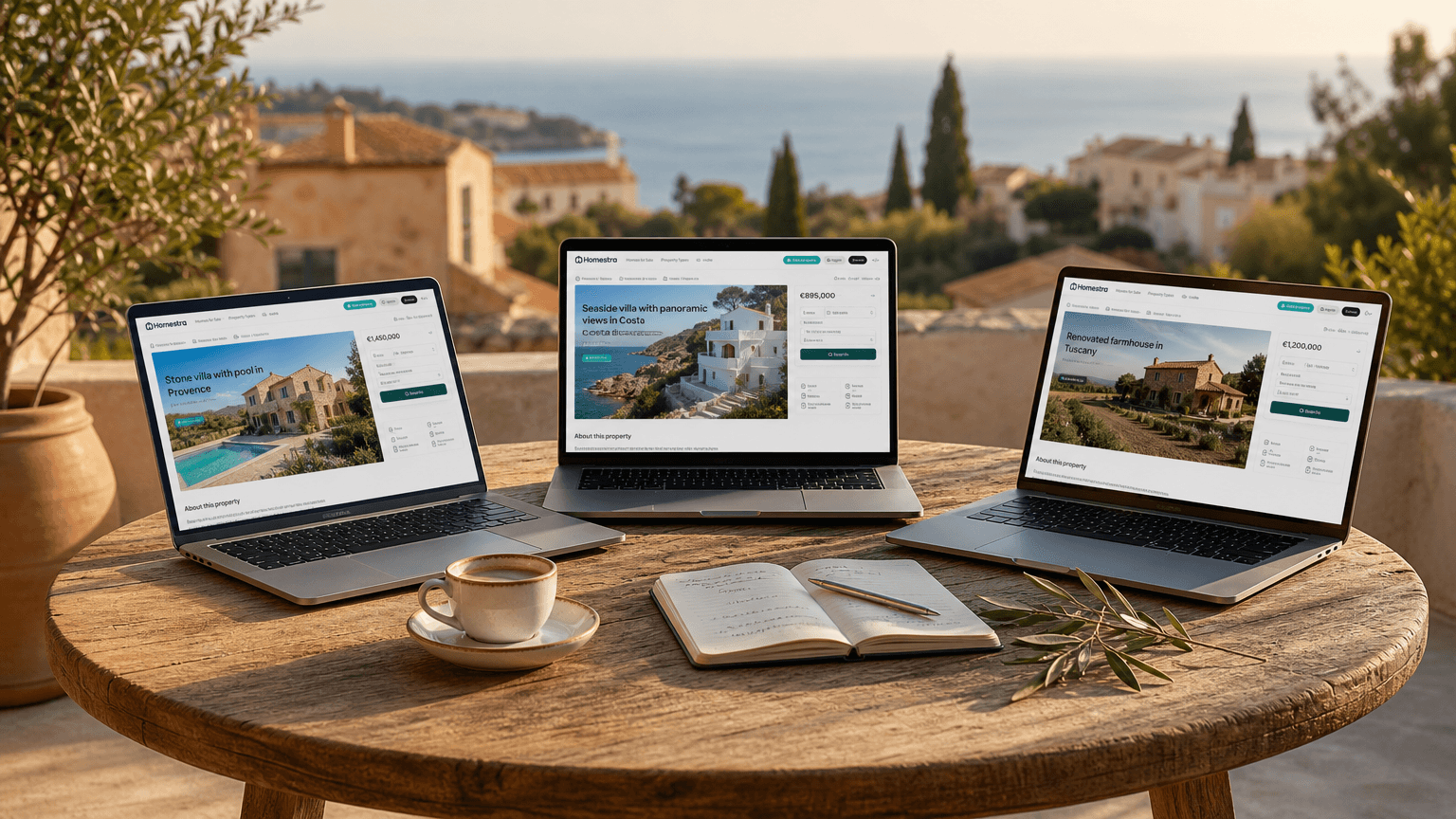
The third profile is increasingly common among Homestra's users, who explore European markets across more than 200,000 listed properties before deciding where to put down roots. Renting mid-term first is a practical way to test a neighborhood, understand local prices, and avoid a rushed buy.
One warning worth repeating: the words "mid-term" or "medium duration" on a listing are marketing labels, not legal classifications. The actual contract type, its duration, and its renewal rules are what matter legally. Always read the contract before transferring any money.
Mid-term vs. short-term vs. long-term: which format fits your situation
Short-term rentals (booked by the night or week) are expensive per day and rarely provide the administrative stability you need if you're registering a business address, applying for local services, or simply living normally. For stays beyond three weeks, the daily cost typically exceeds a monthly furnished rental by a significant margin.
Long-term leases (nine to twelve months and beyond) offer security, but they lock you in. Breaking a French bail meublé classique early, for example, requires one month's written notice and can cost money if you leave within the first few weeks. If your stay is genuinely uncertain or capped by a work contract, a long-term lease creates unnecessary friction.
Mid-term rentals are the right choice when:
- Your stay is confirmed for 1 to 9 months with defined start and end dates.
- You're working remotely and want a proper home setup rather than a serviced room.
- You're evaluating a city or region before purchasing a property.
- You need a furnished apartment without the overhead of buying furniture, opening a long-term utility contract, or managing a security deposit at the scale of a standard lease.
Where mid-term rentals become less practical: if your dates are genuinely fluid (you don't know if you'll stay two months or seven), some contracts won't accommodate that uncertainty cleanly. In those cases, you may face a choice between paying for unused time or negotiating an exit clause upfront.
Where to search: platforms, agencies, and direct channels
Your search should run on two parallel tracks simultaneously.
Track 1: Specialized platforms for volume and speed
Platforms focused on furnished mid-term rentals in Europe include Spotahome, HousingAnywhere, Wunderflats (strong in German-speaking markets), and Nestpick. Airbnb's "monthly stays" filter also surfaces furnished apartments priced for longer stays, though the contractual format varies significantly by listing.
When evaluating any platform, check four things before you even look at individual listings: fee transparency (some platforms charge tenants a service fee on top of rent), verification practices (are listings manually checked or self-reported?), contract templates (does the platform provide a standard agreement or leave it to the landlord?), and cancellation policy (what happens if the landlord cancels after you've paid a deposit?).
Track 2: Local agencies and direct landlords for clarity and negotiation room
Real estate agencies that specialize in furnished rentals often hold inventory that never reaches the big platforms. In France, agencies like Lodgis operate specifically in this space. In Spain, local inmobiliarias managing furnished apartments for professionals are worth contacting directly. In the UK, "serviced accommodation" providers and residential letting agents both cover the mid-term market, but under different legal frameworks (more on that in the country FAQ below).
When searching directly, your keywords matter. In French markets: "location meublée moyenne durée," "appartement meublé 3 mois," "bail mobilité." In English-speaking or international contexts: "furnished mid-term rental," "serviced apartment," "monthly furnished rental Europe." In Spanish: "alquiler temporal 2 meses," "alquiler temporal 11 meses," "piso amueblado temporal." In German: "möblierte Wohnung monatlich," "Kurzzeitmiete."
The practical recommendation is to run both tracks at the same time. Platforms give you speed and comparison volume; direct agency contact gives you access to better-quality inventory, clearer contract terms, and real negotiation potential.
How to filter listings before wasting time on inquiries
Once you have a pool of 15 to 20 listings, filter them systematically rather than going by first impressions. Score each listing on these five criteria:
- Property fit: Does the size, location, and furnishing match your actual needs? Check photo quality critically. Listings with only two or three photos or with wide-angle shots that hide room dimensions should be questioned.
- Duration match: Does the listing explicitly state availability for your exact start and end dates? "Available from" without an end date, or "minimum 1 month" without a stated maximum, requires clarification.
- Verified total monthly cost: Rent alone is not the cost. Add utilities (electricity, gas, water), internet, building charges (charges de copropriété), and any mandatory platform fees. Then amortize the security deposit over your stay to get a true monthly figure.
- Contractual clarity: Is the contract type named? Is there a move-out procedure described? Are renewal and early exit conditions stated?
- Remote arrival compatibility: If you're arriving from abroad, can you check in remotely? Is there a key lockbox, digital code, or concierge? Confirm this in writing before committing.
A simple scoring approach: rate each listing 1 to 3 on each criterion. Any listing scoring below 10 out of 15 probably requires too much uncertainty tolerance.
Common hidden costs to verify explicitly:
- Security deposit (dépôt de garantie): often one to two months' rent for furnished properties
- End-of-stay cleaning fee: sometimes included, sometimes added separately
- Platform service fee: can range from a flat booking fee to a percentage of the total rent
- Local tourist or housing taxes, if the property has a hybrid classification
- Parking or storage, if mentioned as "available" but not included
Message template for contacting a landlord or agent
The first message you send sets the tone. Keep it professional, specific, and efficient. Here is a ready-to-use template:
Subject: Inquiry for furnished rental, [dates], [city/neighborhood]
Hello,
I'm interested in your furnished apartment listed at [address or listing reference]. My planned stay runs from [start date] to [end date] ([X] months total).
Before proceeding, I'd appreciate confirmation on the following:
*
- Is the property available for those exact dates?* 2. What is the total monthly cost including utilities, internet, and any building charges? 3. What type of contract is used (bail mobilité, bail meublé classique, other)? 4. What is the security deposit amount, and how is it returned at the end of the stay? 5. What is the move-in procedure, particularly if I'm arriving from abroad? 6. Is an inventory and check-in/check-out inspection included?
I'm a [brief professional description, e.g., "consultant on a six-month assignment" or "remote worker relocating temporarily"] and I'm happy to provide proof of income and identity documents upon request.
Thank you for your time. I look forward to your reply.
For remote searches, add this to the message: "As I'm not currently in [city], could you arrange a video walkthrough of the property before I submit a formal application? I'd also like to receive a copy of the contract template in advance."
Never pay a deposit or dossier fee before receiving: (a) a signed or initialed contract draft, (b) the landlord's identity verification or agency registration details, and (c) written confirmation of all the points above.
How to negotiate price and duration
Negotiation is possible in most mid-term markets, with two exceptions: high-demand seasonal markets (coastal cities in summer, ski areas in winter), and contracts with strict legal frameworks (the French bail mobilité, for example, has a rigid duration structure that cannot simply be extended).
The most effective negotiation tactic is to anchor on total cost, not monthly rent. If a landlord won't move on the headline rent, ask whether internet, a monthly parking spot, or end-of-stay cleaning can be included. These add real value without requiring the landlord to change the advertised price.
A duration extension offer can also work. Saying "I'm interested in five months instead of three, if the internet and utilities are confirmed as included" shifts the conversation productively. Landlords typically prefer longer stays with fewer turnover costs, so offering more time in exchange for better conditions is a credible trade.
One practical approach: propose a confirmed commitment for a longer period (say, six months) conditional on the contract including specific provisions. Put this proposal in writing, and give the landlord 48 hours to respond. That deadline prevents the conversation from drifting.
When negotiation is unlikely to work: if the market is tight (Paris, Amsterdam, Lisbon in September), if the listing has been live for fewer than 48 hours, or if the landlord explicitly states the price is fixed. In those cases, make a quick decision or move to the next listing.
Administrative checklist before signing
Treating this step seriously separates renters who have smooth stays from those who face disputes over deposits or utility bills.
Documents you'll typically need to provide:
- Valid government-issued ID (passport preferred for international moves)
- Proof of income or employment: three recent payslips, or an employer letter, or a work contract
- Bank details (RIB in France, or equivalent IBAN-based statement)
- In some countries, a guarantor or a guarantee scheme (Visale in France, for eligible tenants)
What to confirm in writing from the landlord:
- Which utilities are included and which are metered separately
- Internet provider and confirmed connection speed (not just "Wi-Fi available")
- Maintenance responsibility: who handles a broken appliance, a plumbing issue, a heating failure
- Whether a mandatory tenant liability insurance (assurance habitation) is required, and whether the landlord's own policy covers the property
Inventory and condition report (état des lieux): Insist on a dated inventory signed by both parties at entry and exit. This document is your primary protection if a security deposit dispute arises. If you're arriving remotely, ask for a video-documented inventory with timestamps before you confirm arrival. Without this, any pre-existing damage could be attributed to you.
Payment security: Pay by bank transfer with a clear reference (your name, the address, the period). Avoid cash payments, PayPal-style transfers with no formal reference, or wire transfers to personal accounts before you have a signed contract in hand. Legitimate landlords and agencies don't require unusual payment routes.
Country-specific legal frameworks: what to verify
This section provides reference pointers. It is not legal advice. For any formal rental, verify the applicable rules with official local sources or a qualified professional.
France: the bail mobilité
France has a specific contract type designed for mid-term furnished rentals: the bail mobilité (mobility lease), introduced by Article 107 of the LOI ELAN n° 2018-1021 of November 23, 2018 (Legifrance). Key confirmed facts:
- Duration is set freely between 1 and 10 months, with the exact duration written into the contract at signing (Lodgis).
- The lease is strictly non-renewable and non-reconductible: it cannot be extended or rolled over into a new bail mobilité (Service-Public, Legifrance).
- It is reserved for tenants in a specific mobility situation: professional training, higher education studies, apprenticeship, internship, voluntary service, or professional assignment. The tenant must confirm eligibility in the contract (Action Logement).
- No security deposit (dépôt de garantie) is required under a bail mobilité, though Visale guarantees may apply.
Outside of the bail mobilité, standard furnished leases run for one year (or nine months for student tenants), as noted by UNPI. If a landlord offers you a "mid-term" contract in France that doesn't match either format, ask explicitly what legal framework governs it.
Belgium
Furnished rental agreements in Belgium can fall under several legal regimes depending on the region (Flanders, Wallonia, and Brussels each have distinct rental legislation) and whether the property is the tenant's primary residence. Short and mid-term furnished stays that don't establish primary residency typically operate under different rules than long-term residential leases. Verify the applicable regional regulation and the contract type before signing. The Direction du Logement in each region publishes official guidance.
Spain
In Spain, "alquiler temporal" (temporary rental) contracts must be justified by a genuine temporary circumstance, such as a work assignment, studies, or a transitional housing need. If the tenant's true intention is to establish habitual residence, a court could reclassify the contract as a long-term residential lease (arrendamiento de vivienda habitual), with stronger tenant protections. The rental duration for temporary contracts is not capped the way France's bail mobilité is, but the reason for temporality should be stated clearly in the contract. Check the current Ley de Arrendamientos Urbanos (LAU) as amended and consult a local professional for contract structuring.
United Kingdom
In the UK, the legal classification of a rental depends on what the arrangement actually is, not what it's labeled. A "serviced apartment" booked through a hospitality-style provider typically falls under a licence to occupy or a contractual agreement, not a standard assured shorthold tenancy (AST). An AST, on the other hand, brings with it specific deposit protection obligations: according to Citizens Advice, it is illegal for a landlord to charge a deposit exceeding five weeks' rent (or six weeks if annual rent exceeds £50,000), and the deposit must be held in a government-approved tenancy deposit scheme. Before signing any UK mid-term agreement, establish the contract type clearly and verify deposit protection requirements accordingly.
Disclaimer: The information above reflects publicly available legal sources as of mid-2026 and is provided for informational orientation only. Laws change, and local application varies. For any real rental transaction, consult official government sources or a qualified legal professional in the relevant country.
Practical pitfalls to avoid
Four mistakes account for the majority of mid-term rental problems for international renters:
- Paying before receiving a signed contract. Regardless of platform, agency, or referral, no money should move without a signed agreement in hand. This applies to both the deposit and the first month's rent.
- Confusing the listing label with the legal contract type. An apartment listed as "bail mobilité" must have a contract that matches the legal criteria, including tenant eligibility and maximum duration. If those elements aren't in the contract, it isn't a bail mobilité, regardless of what the listing says.
- Accepting verbal confirmations on utilities and charges. "Charges included" means nothing without a written breakdown of what is included. Get it in the contract or in a written addendum.
- Skipping the inventory. A missing or incomplete état des lieux is the single most common reason deposits are not returned. Document everything on entry, even if it's inconvenient.
Mid-term furnished rentals across Europe are a practical and cost-efficient option for international movers, professionals on assignment, and buyers scouting a market before purchasing. With the right process, the right questions, and a clear understanding of the legal framework in your target country, the search is manageable and the result predictable. The steps above give you the structure to do it methodically rather than reactively.
Share