Blog published in Buying property abroad
Share
How to buy a second home in Greece or Croatia as a non-EU buyer
Learn how to buy a second home in Greece or Croatia as a non-EU citizen. Step-by-step workflow, eligibility rules, taxes, and a buyer checklist to avoid costly mistakes.

Finding a second home in Greece or Croatia as a non-EU buyer is possible, but the order in which you do things matters more than it does for an EU citizen. Both countries allow foreign purchases, and both attach conditions that depend on your nationality, the location of the property, or both. A buyer who falls in love with a listing before checking those conditions can lose weeks, or pay a deposit on a property they cannot legally acquire.
This guide covers eligibility in each country, a single workflow that applies to both, the taxes and fees to budget for, payment practices that protect foreign buyers, and a practical method for searching and evaluating listings on Homestra. It does not cover residency programs in depth. Property ownership and the right to live in a country are separate questions, and Croatia, for instance, does not offer a residence-by-investment program (as noted in greek-invest.com's 2026 comparison).
A note on sources: tax rules, approval procedures, and restricted-area lists change. Where this guide cites an official body (AADE for Greece, gov.hr for Croatia), use that body's current page as the final authority and confirm details with a licensed local lawyer before you commit funds.
Can non-EU citizens buy property in Greece?
Yes, with a location-based caveat. Non-EU nationals can generally own real estate in Greece, but acquisitions in certain areas can require prior permission from the authorities. These are typically border regions and some islands or zones considered sensitive for security reasons. The exact boundaries are set by Greek law and administrative decisions, so they should be verified for the specific parcel rather than assumed from the island or region name.
What "restricted area" means in practice
A restricted or border-adjacent designation does not usually prohibit a purchase outright. It means a non-EU buyer may need an approval before the transaction can be completed. That has three consequences:
- The approval can add weeks or months to the timeline.
- It can change when you sign binding documents and when you transfer funds.
- It applies to the property's location, so two similar homes a short distance apart may be treated differently.
What to request before you make an offer
Ask the seller or agent, in writing, to confirm the following:
- Whether the property lies in an area where non-EU buyers need an approval, and which authority issues it.
- Whether the seller has the title documents and surveys needed to support an application.
- Whether the preliminary agreement can be made conditional on the approval being granted.
- Who bears the cost and risk if the approval is refused.
Have your Greek lawyer confirm the answers independently. An agent's assurance is not a substitute for a legal check of the parcel.
Golden Visa is a separate question
Greece's Golden Visa program links certain real estate investments to residence permits. It has its own thresholds, eligible areas, and documentation, and those rules have been revised more than once. If residency is part of your plan, rely on current official sources (AADE, the Greek migration authorities, Enterprise Greece) rather than third-party summaries. For a holiday home with no residency objective, you can skip it.
Can non-EU citizens buy property in Croatia?
Yes, but only under a reciprocity condition. According to the Croatian government portal gov.hr (page "Real estate purchase for foreign nationals"), the rules differ by buyer category. Citizens of EU and EEA member states and Switzerland are treated differently from citizens of other countries. A non-EU buyer needs approval from the responsible ministry, commonly referred to as reciprocity consent, before ownership can be registered.
How reciprocity works in plain language
Reciprocity means that Croatia allows citizens of another country to acquire real estate only if Croatian citizens can do the same in that country. This is why nationality is the first variable in your search. A buyer from one country may receive consent routinely, while a buyer from another may face a more involved assessment. The ministry evaluates the matter, and you should not assume that a neighbor's or colleague's experience will match yours if you hold a different passport.
If you hold more than one citizenship, ask your lawyer which one is best used for the application, and make sure the passport details are consistent across every document.
Timeline implications
Because the consent is required for registration of ownership, the practical question is when to apply. Depending on how the transaction is structured, the application may be filed after a preliminary contract is signed or earlier. A well-drafted preliminary contract should state that the sale is conditional on the ministry's consent, and should say what happens to your deposit if consent is refused. Do not let a seller push you into an unconditional contract with a promise that consent is a formality.
Restricted-property considerations
Certain categories of property, such as agricultural land, forest land, protected areas, and land in border or sensitive zones, are regulated more tightly than a standard residential apartment or house. The specifics depend on current legislation and the property's classification in the land records, so treat any category as a flag for additional legal review, not as a rule you can assess from a listing. Ask the seller or agent how the parcel is classified, and ask your lawyer to check it against the land register and cadastre.
What to ask before paying reservation money
- Is the property classified as residential construction land or a building, or does it include agricultural or other regulated land?
- Is the seller the sole registered owner, and are there mortgages, liens, or co-owners?
- Does the building have a valid use permit, and does the built structure match the permit?
- Will the reservation agreement be refundable if reciprocity consent is refused?
- Who holds the reservation money, and under what written terms?
One buying workflow for both countries
Greece and Croatia differ in detail, but the sequence of a foreign purchase follows the same logic. The table below summarizes it, and the sections after it explain each stage.
| Step | What happens | Main risk for non-EU buyers |
|---|---|---|
| 1. Due diligence | Review title, location status, permits | Missing a restriction or approval requirement |
| 2. Reservation | Property is held while checks proceed | Non-refundable deposit with unclear terms |
| 3. Preliminary contract | Terms, price, and conditions are set | Unconditional commitment before approval |
| 4. Approval or consent | Required for some buyers or locations | Delay, refusal, or funds locked up |
| 5. Notary contract | Final contract signed before a notary | Language gaps, power-of-attorney errors |
| 6. Land registry | Ownership is registered in your name | Unregistered or defective title |
| 7. Post-closing | Tax registration, utilities, records | Missed filings and unpaid utility accounts |
Step 1: due diligence
Before you reserve anything, request the documents that prove the seller can sell and that the property can be sold to you. Typically these are the ownership title, an extract from the land registry or cadastre, building permits and use permits, a record of any mortgages or encumbrances, and proof of paid property taxes and community charges. Delays commonly arise when the seller's documents are incomplete or when the building does not match the permitted plans.
Step 2: reservation
A reservation takes the property off the market for a defined period. Keep it short, written, and conditional on the due diligence results. Pay only into a account whose holder is identified in the agreement, and keep a bank record of the transfer.
Step 3: preliminary contract
This document fixes the price, the payment schedule, the handover date, and the conditions that must be met before closing. For a non-EU buyer, the most important conditions are the required approval (a Greek permit for a restricted area, or Croatian reciprocity consent) and the clearance of any liens. The contract should also say what happens to deposits if a condition fails.
Step 4: approvals and consents
If an approval applies, your lawyer files it, and you wait. You will need certified copies of your passport, and often translated or apostilled documents. Delays arise from incomplete applications, inconsistent name spellings between documents, and slow responses from the issuing authority.
Step 5: the notary contract
The final contract is signed before a notary, and the notary's role and the contract's legal effect vary by country. If you cannot attend in person, a power of attorney can allow a representative to sign on your behalf, but it must be drafted, notarized, and legalized correctly for the country in question. Insist on a certified translation of anything you sign in a language you do not read fluently.
Step 6: land registry
Ownership is secured by registration, not by signing alone. In Greece, the transaction is registered in the land registry or cadastre system, and in Croatia, in the land register. Confirm that your lawyer will file promptly after signing and will send you the registration confirmation.
Step 7: post-closing
After closing, arrange tax registration where required, transfer utility contracts into your name, and keep a complete record of the contract, receipts, tax filings, and registry documents. Appoint a local contact or property manager if you will be away for long periods.
Sequencing: when approval changes the timing of money
The key sequencing rule is that money should follow legal certainty. If approval is required, avoid transferring the full price until the approval is granted or the contract clearly protects you if it is not. A modest reservation deposit held on written, refundable terms is reasonable. Large payments before consent are not. Local legal support is not optional at steps 3 through 6, since errors in those stages are the hardest to reverse.
Taxes, VAT and transfer fees to budget for
Greece: transfer tax
According to the Greek tax authority AADE (page "Real Estate Transfer Tax"), the transfer tax is calculated at 3% plus a 3% levy. AADE's guidance also addresses contracts executed abroad and explains how the tax declaration is submitted, including through the digital myPROPERTY platform. In practice, the levy is commonly applied to the amount of the tax rather than to the property value, which produces a combined effective rate of roughly 3.09%. Confirm the current basis on the AADE page.
An illustrative example, using a hypothetical taxable value of EUR 200,000:
- 3% of EUR 200,000 = EUR 6,000
- 3% levy on EUR 6,000 = EUR 180
- Total transfer tax = EUR 6,180
The taxable value is generally the higher of the contract price and the official tax (objective) value of the property, so a low contract price does not necessarily lower the tax. Your lawyer or accountant should calculate the figure from current data before you sign.
Notary, lawyer, and land registry charges are additional. Request a written estimate that lists each item.
Greece: primary residence exemption
AADE describes an exemption for the purchase of a primary residence, subject to conditions and monetary thresholds. It is designed for buyers who will live in the property as their main home. A holiday home normally does not meet that purpose, so do not build the exemption into a second-home budget. If you believe you qualify, ask your tax adviser to check each condition against the current AADE text.
Croatia: transfer-related taxes and professional fees
Croatian costs generally consist of tax on the transfer, notary and court or land-registry fees, and legal and agency fees. The exact rates and the tax base depend on the type of transaction, so obtain a written cost estimate from a Croatian lawyer for your specific property before signing the preliminary contract. This guide does not state percentages for Croatia because they should be taken from current official sources and applied to your case.
Transfer tax vs. VAT: where buyers get confused
Buyers often assume that every purchase carries both a transfer tax and VAT. In general, the two apply to different kinds of sales: resale of existing property is typically handled under transfer tax rules, while a first sale of a newly built property by a developer is typically handled under VAT rules, and the two are not meant to be stacked on the same transaction. The classification depends on the property's status and the seller's situation.
To avoid surprises:
- Ask the seller in writing whether the sale is subject to VAT or transfer tax.
- Look at the draft contract and any developer invoice to see how the price is stated (net or gross of VAT).
- Ask your lawyer to confirm which regime applies in your country and for your property.
Financing and payment considerations for foreign buyers
Many non-EU buyers pay in cash or with funds from a home-country mortgage or equity. Local banks may lend to non-residents, but terms vary and are often more conservative, so treat local financing as something to confirm with a lender early, not to assume.
Documents banks and notaries ask for
- Proof of funds: recent bank statements and, where relevant, a bank reference letter.
- Source-of-funds records: sale documents, savings history, or other evidence of where the money came from.
- Identity documents that match the name on every contract exactly.
- Certified translations where documents are not in the local language.
Anti-money-laundering checks are routine. A clear transaction trail from your account to the seller's account, or to a designated lawyer's or notary's account, makes closing faster.
A milestone approach to payments
- Reservation deposit: small, written, refundable if due diligence or approval fails.
- Preliminary contract payment: tied to conditions in the contract, with the refund terms stated.
- Balance at closing: paid when the notary confirms that the conditions are met and the title is clean.
Where a lawyer or notary can hold funds in a client account until registration steps are complete, ask whether that option exists. If it does not, use the contract wording to protect yourself.
Currency and timing
Exchange rates move between reservation and closing. Rather than predicting rates, plan for the process: arrange your international transfer well ahead of closing, keep the bank confirmations, and ask your bank about transfer limits and documentation for large sums.
Planning for rental income
If you intend to rent the property when you are away, check three things before purchase: whether short-term rentals are permitted in that building or municipality, what registration or licensing the local authority requires, and how rental income is taxed. These requirements are local and change, so confirm them with a lawyer or accountant and do not rely on an advertised "rental potential."
How to find and evaluate second homes on Homestra
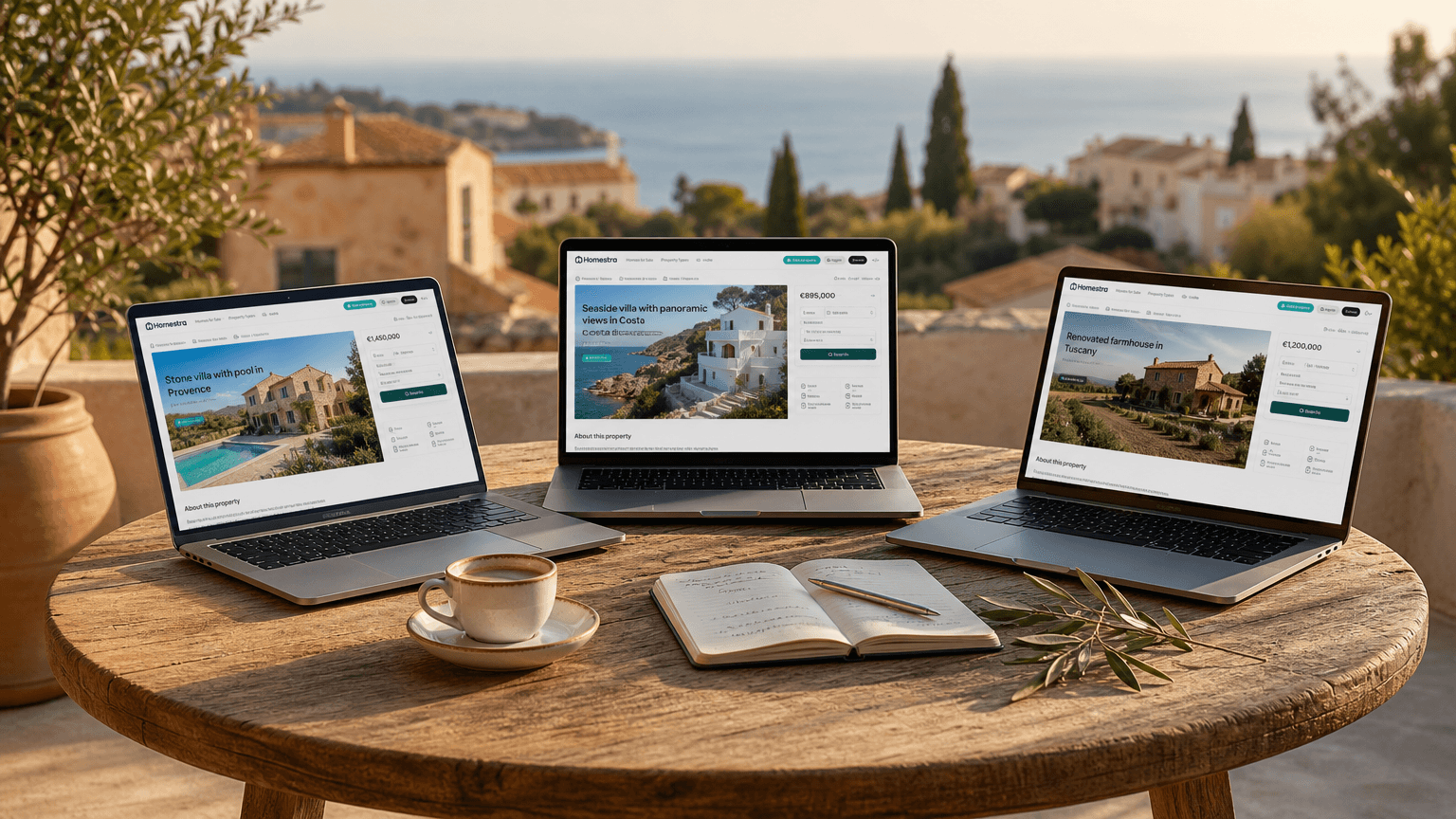
Homestra lists more than 200,000 properties across Europe, including Greece and Croatia, with search tools designed for international buyers. A workable process for non-EU buyers has five steps.
- Define the use. Decide whether the home is for summer holidays, year-round stays, or eventual retirement. This determines the climate, access, and infrastructure you need.
- Filter by country, property type, and budget. Start with apartments, houses, or villas in your price range, and keep the budget below your total ceiling to leave room for taxes and fees.
- Shortlist by legal complexity. Favor properties in standard residential locations first. Mark any listing near a border, on a small island, or on agricultural or protected land as needing legal review before you spend time on it.
- Request documents through the listing contact. Ask for the title, registry extract, permits, and a written statement on approval requirements.
- Complete due diligence before any payment. Have your lawyer review everything before you sign a reservation or contract.
Evaluation criteria for the listing page
Detailed listing pages and local market information help you compare properties on more than price. When reading a listing, check these points:
- Ownership history and whether the seller is the registered owner.
- Match between the advertised size and the permitted, registered area.
- Condition of the roof, damp, plumbing, and electrics, with an independent survey if possible.
- Utility access: water source, electricity, sewage, and internet.
- Winterization needs, if you plan to visit outside summer: heating, insulation, and whether the area stays open and serviced in the cold months.
- Access and infrastructure: road quality, distance to the nearest airport, hospital, and supermarket, and ferry schedules for islands.
- Ongoing costs: local property taxes, building charges, and maintenance.
Working with local agents and lawyers
Hire your own lawyer, independent of the seller and the agent. Ask for a fee quote in writing, a list of steps with estimated timelines, and confirmation of who will attend the notary signing. Keep every instruction and answer in email so you have a record. Ask the lawyer to confirm the points in this guide that depend on current local law: approval requirements, tax figures, and registration steps.
Buyer checklist and document request list
One-page checklist
- Confirm location status and whether an approval or consent is required.
- Verify seller identity and title through the land registry.
- Request permits and check that the building matches them.
- Sign a short, refundable, written reservation.
- Sign a preliminary contract with conditions for approval and clear title.
- Obtain the approval or consent where required.
- Transfer funds with a documented trail.
- Sign the final contract before the notary, with translation if needed.
- Confirm land registry registration in your name.
- Complete tax filings and set up utilities and records.
Greece addendum
- Ask whether the property is in an area requiring approval for non-EU buyers.
- Have your adviser calculate the transfer tax (3% plus the 3% levy) on the correct taxable value.
- Check how the tax declaration will be submitted through AADE's myPROPERTY platform, including when the contract is signed abroad.
- Do not count on the primary-residence exemption for a holiday home.
Croatia addendum
- Confirm that your nationality qualifies under the reciprocity rules and identify the responsible ministry.
- Make the preliminary contract conditional on reciprocity consent.
- Prepare the documents listed on gov.hr, with certified copies and translations.
- Obtain a written estimate of taxes and fees from a Croatian lawyer.
Documents your lawyer should request
Title deed and registry extract, cadastral plan, building and use permits, proof of paid taxes and utilities, mortgage and lien search, seller's identity documents, and any condominium or building-association statements.
Frequently asked questions
Does reciprocity depend on my nationality? Yes. In Croatia, non-EU buyers need ministry approval based on reciprocity, so the outcome depends on your citizenship.
Do I need an approval before signing? It depends on the country and the property. In Croatia, consent is required for non-EU buyers. In Greece, it applies to certain restricted areas. Either way, make the contract conditional on approval, and do not make large payments until the position is clear.
What taxes apply? In Greece, AADE describes the transfer tax as 3% plus a 3% levy. In Croatia, transfer-related taxation and professional fees apply, and the correct regime (transfer tax or VAT) depends on the type of sale. Get a written estimate from a local lawyer.
How do I confirm eligibility for exemptions? Check the conditions and thresholds on the official tax authority page, and have a local adviser apply them to your situation. Do not rely on a seller's or agent's statement.
Can I rent the property? Often yes, but short-term rentals are regulated locally. Check registration, licensing, and tax rules before you buy.
Does buying a home give me residency? Not automatically. Croatia has no residence-by-investment program, and Greece's Golden Visa has separate conditions that should be confirmed from official sources.
Start with the legal question, then the listing
The buyers who finish a Greek or Croatian purchase without trouble tend to ask the legal questions first: is my nationality eligible, does this location need an approval, and who will confirm it in writing. The search itself is the easier part. Homestra's search tools, detailed listings, and local insights let you narrow the field quickly, and the workflow above helps you decide which properties deserve a lawyer's time. Browse Greek and Croatian listings at homestra.com, shortlist with the legal checks in mind, and bring the document list in this guide to your first conversation with a local lawyer.
Share