Houses For Sale In Sweden

Houses for sale in sweden - homestra offers the largest amount of european real estate with over 200,000+ properties, find any type of property within your budget from villas to country homes. buy or rent your perfect home in europe.

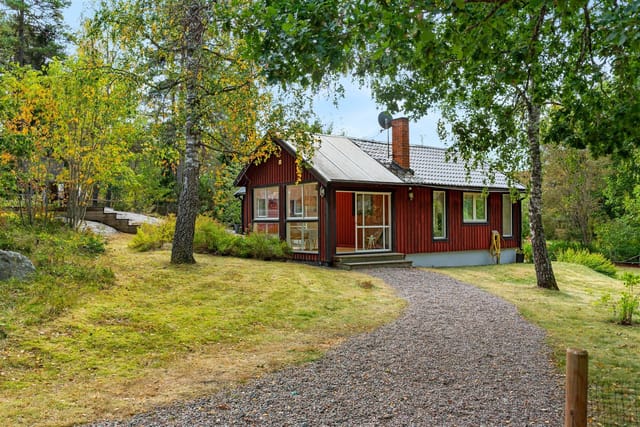
On a quiet Tuesday morning in late June, you crack open the kitchen window at Gårdsvägen 2 and catch the faint salt smell rolling in off the Kattegat. The robotic mower is already doing its rounds across the grass. You've got nowhere to be until you feel like it. That's the whole point. Skummeslövsstrand sits on the Halland coast of southwestern Sweden, roughly halfway between Halmstad and Båstad — two towns that between them cover every practical need you'll ever have, from IKEA runs to Michelin-starred dinners. But the strand itself is a different pace entirely. A tight-knit summer community that swells with Swedish families every July, then exhales into a quieter, genuinely peaceful neighbourhood the rest of the year. The kind of place where you recognise faces at the local pizzeria on Strandvägen before the end of your first week. The house on Gårdsvägen dates to 1957 and carries just enough of that era — the compact, considered proportions of post-war Swedish construction — without feeling dated. It's been properly updated: new bathroom, fresh interior surfaces throughout, and a modern heat pump installed that handles both heating and cooling efficiently. This isn't a project property. You can arrive with luggage and start living. The winterisation work done here means the house holds warmth through a February coastal storm without fuss, which matters if you're thinking about long weekends in the off-season or using it as a genuine second home across all four seasons. Sixty square metres sounds modest on paper, and it is — but the layout earns every centimetre. The living area and kitchen work as a single open space, and the two bedrooms sit quietly toward the back. Large windows pull in the Swedish summer light ... click here to read more

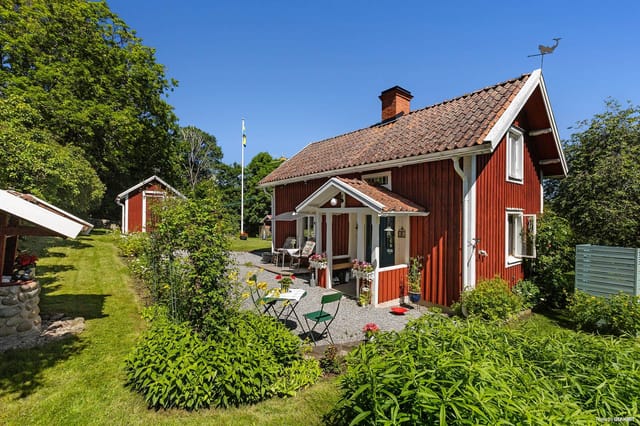
Exterior view of the house and garden

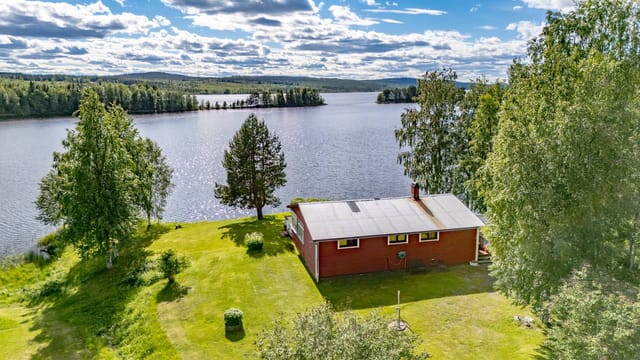
Stand on the plot at Måsvägen 31 on a Tuesday morning in late May and the birch trees are already full and loud with wood pigeons. The water is just 500 meters away—you can't see it yet through the pines, but you can smell it. That particular mix of cold saltwater and sun-warmed granite that defines the Stockholm archipelago. This is Strömma, a quiet fold of Värmdö municipality where you don't arrive accidentally. You come because you've heard about it from someone who has a place out here and won't stop talking about it. The house itself was built in 1958 and it shows its age in all the right ways—solid bones, a low roofline that sits comfortably in the landscape, and windows that frame the surrounding greenery like paintings. Forty-three square meters, two bedrooms, one bathroom. It's compact, but it's fully winterized, which in this corner of Sweden means something real: you can be here in February when the ice on the canal turns blue-white and the thermometer drops below minus ten, and the house holds warmth. Swedes build for winter the way coastal Italians build for earthquakes. This place has been doing its job for over sixty years. What makes Måsvägen 31 genuinely different from most holiday properties in this price range isn't the house—it's the land and what you can do with it. The plot runs to 2,925 square meters, which is a serious piece of ground. It backs directly onto a large public green area, so the sense of space extends far beyond the legal boundary. And the building rights here are unusually generous: up to 250 square meters of building footprint (BYA), a total gross floor area of 360 square meters across all floors, a permitted height of 6.5 meters, plus additional outbuildings up to 80 square meter ... click here to read more

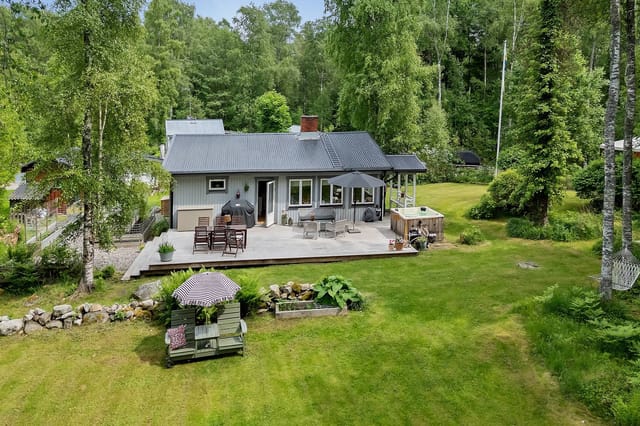
Front view of the house and garden

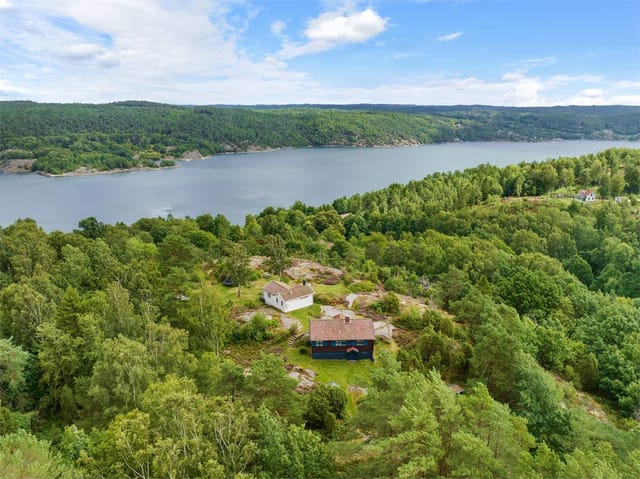
Early on a July morning, before anyone else on Estvägen has stirred, you walk the fifty steps down through the trees to Älgö's little beach and drop into water so clear you can count the stones at your feet. The pine forest is still exhaling the cool of the night. That's the daily opener here — and it's yours every summer for the rest of your life. Älgö sits in Stockholm's inner archipelago, four kilometers from Saltsjöbaden, which means you get the genuine Swedish island experience without surrendering urban convenience. The island is small enough that everyone waves to each other on the gravel tracks, yet large enough to disappear into the woods for a proper hour-long run without crossing your own path. It's the kind of place that sounds almost too good when you describe it to friends back home, until they come and see it themselves. The property at Estvägen 20 is positioned at the end of a quiet cul-de-sac, with forest pressing in on three sides. There are no through-traffic sounds, no overlooking neighbors. What you do hear: woodpeckers in the spruce, the distant clang of rigging from boats moored at the island's small jetty, and on clear evenings in late August, the faint percussion from the jazz evening that Saltsjöbaden's Grand Hotel still hosts on its terrace across the water. The plot itself stretches across 2,101 square meters — a proper piece of land for this part of the archipelago — and the sun tracks it from east to west without interruption, so somewhere on the property is always warm between May and September. The existing house is a 1957 Swedish sommarstuga of 28 square meters. Compact, functional, honest. It has the character of a building that has been genuinely used and genuinely loved: the kind of ... click here to read more

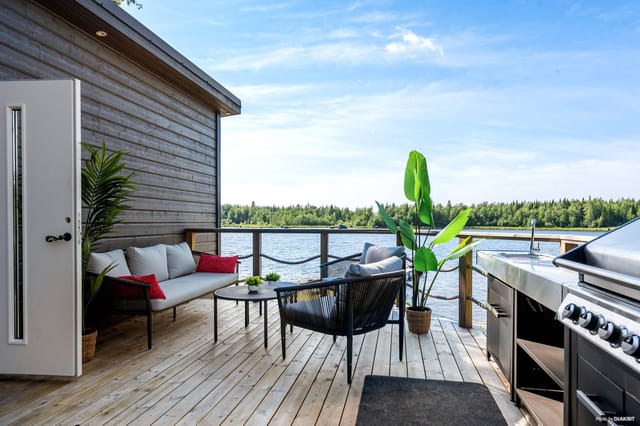
Exterior view of the holiday home and garden

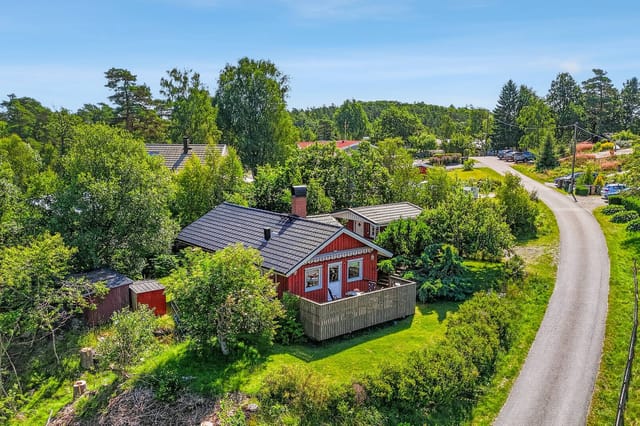
Imagine waking up on a Saturday morning in September, the smell of pine drifting in through the bedroom window, the surface of Bullaresjön completely still. You pull on a sweater, put coffee on, and stand at the kitchen window watching the mist lift off the water. That's not a fantasy—that's a Tuesday here at Klageröd 5, in one of Bohuslän's quieter, less tourist-trampled corners. Bullaren sits in Tanums kommun, about 20 kilometers inland from the dramatic granite coastline of the Swedish west coast. If you know the area, you already know why people keep coming back. If you don't, here's the short version: it's the kind of place where your phone starts feeling irrelevant by mid-afternoon. The house itself is a single-story 78-square-meter property in solid condition—renovated, clean, and genuinely move-in ready. Two bedrooms, one well-fitted bathroom with a proper shower, and an open-plan living and dining area built around a wood-burning fireplace. That fireplace isn't decorative. Come November, when the temperature drops and the lake turns gunmetal grey, it's the center of the whole house. Evenings are spent there. Long weekends are organized around it. There's a reason Swedish interior culture puts such stock in the concept of eldstad—a real fire changes the character of a room entirely. The kitchen has been updated without losing the practical, unfussy character that Swedish country homes do so well. Enough counter space to actually cook a proper meal—and you will, because the local food culture here is built around doing exactly that. The village store in nearby Östad stocks local honey, smoked meats, and seasonal produce. In summer, the roadside stands along Route 163 sell strawberries and new potatoes by the ki ... click here to read more

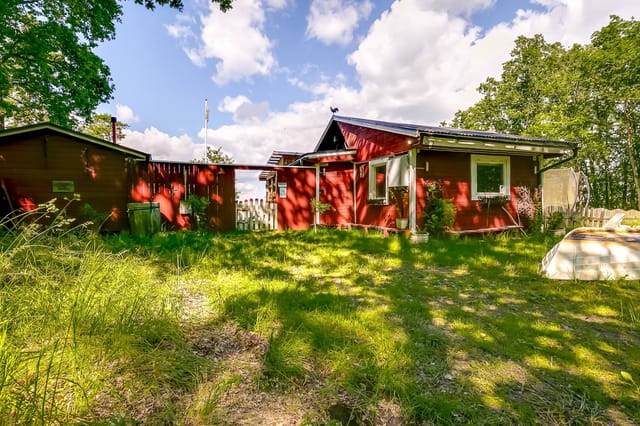
Front view of the house and garden

Picture a Saturday morning in late June. The Swedish sun has been up since four, and by the time you pull on your jacket and step onto the wrap-around terrace with a mug of coffee, the birch forest at the edge of the garden is already doing that thing it does in Södermanland summers — throwing long gold light through the leaves while the air smells faintly of pine resin and damp earth. Lake Långhalsen is a four-minute walk down the path. Nobody else is awake yet. This is Utterspåret 11. It's a compact, honest house — 57 square meters built in 1979, maintained with genuine care, and set on a 1,620 square meter plot that gives you the kind of breathing room that's increasingly hard to find at this price point in Sweden. Two bedrooms, one bathroom, a kitchen that works, and a living room anchored by a wood-burning stove that you'll use far more than you expect once October settles over Nyköping and the lake mist starts rolling in each morning. The stove isn't decorative. Come winter, it's the heart of the house. The terrace wraps the exterior and has both open and covered sections — a deliberate design that Swedes know well. You want sun in May when the temperature is still erratic. You want shade in July when it isn't. You want cover in August when the afternoon rain passes through. The terrace handles all of it, and it's large enough for a proper outdoor table, a couple of sun loungers, and whatever outdoor project you get absorbed in over a long weekend. The plot itself borders forest on one side, with no immediate neighbours on that flank. The garden is flat, open, and generous — room for a vegetable patch, a trampoline, a fire pit, a hammock between the birches. The side building currently runs as a small workshop a ... click here to read more

Exterior view of Utterspåret 11

Picture this: it's a Saturday morning in late September, the birch trees along Kantarellvägen have gone full gold, and you're sitting on a wide timber terrace with a mug of coffee watching mist lift off Nedingen lake. No traffic noise. Just the faint knock of a rowboat against a dock somewhere down the hill, and the occasional rustle of something moving through the undergrowth at the edge of your 1,958-square-meter garden. This is the rhythm of life at Fornbo Kantarellvägen 58 — and it's about 100 kilometers from Stockholm's Centralen station. The house sits on a peninsula that juts into Nedingen, one of the cleaner and quieter lakes in Södermanland, within the well-established Fornbo recreational community. It was built in 1980 and has been kept in genuinely good condition — this isn't a project property requiring gut renovation before you can enjoy a single weekend. The structure is solid, the winterization means you can use it from January ice to December snow, and municipal water and sewage connections spare you the headaches that come with private wells and septic systems on older Swedish holiday properties. Move in, turn the key, light the fire. That fireplace deserves a moment. The living room has large windows that face toward the water, and on evenings when the temperature drops, the fireplace does real work — not decorative work, but actual warmth-producing work that makes the room feel like somewhere you'd genuinely want to spend three hours after a day of hiking. The living area flows naturally, 65 square meters used efficiently without feeling cramped, and the kitchen is practical and well-equipped for the kind of cooking that happens at a lake house: big pots of elk stew, fresh-caught perch fried in butte ... click here to read more

Exterior view of the winterized holiday home

Step outside on a July morning and the first thing you notice is the smell of warm pine resin. Not the synthetic kind you find in a candle — the real thing, rising from the forest floor as the sun climbs over the eastern gable of this 1969 house in Havängs Sommarby. The birds are already going. Somewhere down the lane, a bicycle bell rings once and fades. This is what summer sounds like in Österlen. Havängsvägen 6 sits on a freehold plot of 1,289 square meters in one of the genuinely rare corners of Swedish coastal property — Havängs Sommarby, a small community tucked between Kivik and Brösarp on the Skåne coast. Freehold plots in this particular village are uncommon. Most of the surrounding vacation properties sit on leasehold land, which makes this one a different proposition entirely for buyers who want clean, uncomplicated ownership. The same family held it for over fifty years. That kind of tenure tells you something about a place. The house runs to 79 square meters across one and a half floors, sensibly arranged with two bedrooms on the ground level, both catching morning light through south- and east-facing windows. The open living room pulls you in with original wooden floors and a proper fireplace — the kind that makes an October weekend here feel genuinely cosy rather than just possible. There's something quietly satisfying about a house that still has its original bones intact. The spiral staircase leads up to a third bedroom tucked into the eastern gable, and beyond that, an attic space with real potential for conversion if the family grows or the guest list expands. The kitchen is compact but works well — room for a small table, good light, the kind of setup where breakfast happens unhurriedly and nobody ... click here to read more

Exterior view of the house and garden

The first thing you notice on a summer morning here is the light. By seven o'clock it's already cutting low and golden across Bräckeviken, bouncing off the water and right through the kitchen window while the wood-burning stove crackles to life. That's the rhythm of a day at Vårviks-Backa Bräcke 1 — unhurried, deeply Swedish, and utterly removed from the noise of ordinary life. Set on a 5,510-square-metre plot in the Dalsland region of western Sweden, this 1840s farmstead sits just 150 metres from the calm inlet of Bräckeviken, which feeds directly into the celebrated Dalsland Canal. The canal — a 250-kilometre waterway connecting dozens of lakes across Värmland and Dalsland — is one of Scandinavia's great slow-travel routes, and having it practically at your doorstep changes the texture of daily life in ways that are hard to overstate. You can kayak from the property's public jetty to the next village before breakfast. You can watch narrowboats drift past in the evening from the terrace, awning cranked out, glass in hand. The main house is 110 square metres of considered, authentic renovation. The original structure from 1840 has been kept honest — thick walls, low doorways, the kind of spatial logic that only comes from buildings that have weathered nearly two centuries of Swedish winters. Walk into the kitchen and the centrepiece is a traditional wood-burning stove with a proper baking oven. Not decorative. Actually used. The smell of fresh bread on a Sunday morning in here is reason enough to buy the place. The living room is anchored by a Royal Viking fireplace, a cast-iron Swedish classic that throws serious heat and creates the kind of amber glow on a November evening that you'll remember long after you've gone ... click here to read more

Main house and garden with lake view

The first thing you notice on a July morning is the light. It comes off Valdemarsviken early — pale gold, almost white — and it finds its way through those big water-facing windows before most people are awake. You're standing in the kitchen, the wood stove ticking with the last of last night's birch logs, and the bay is out there doing that glassy, still thing it does before the wind picks up. That's the daily reality of owning Lövudden Kaptensbostället. Built in 1909 as a captain's residence, this four-bedroom house carries its age well. Not in a dusty, museum way — the original pine floors still have their warmth, the paneled walls still have their craft — but in the way that a well-sailed boat does. Things were built to last here. The bones are honest. Set on a 1,909 square meter plot at the edge of Lövudden, the property sits just 50 meters from the shoreline on Valdemarsviken, the long sheltered inlet that cuts into the eastern Östergötland coast. The plot itself is thick with mature trees — mainly birch and pine — that create a natural screen between you and the outside world. Somewhere in there, wood pigeons call back and forth through the afternoon. The garden has multiple spots where you can watch the water change color through the day, from silver-grey at dawn to deep blue by afternoon to something almost copper when the sun drops behind the ridge. The house stretches across 107 square meters of thoughtfully arranged living space. A later extension gave the ground floor a proper living and dining room with large windows that frame the bay like a painting you never get tired of. This is the room where winters happen — long dark evenings with the wood stove going, candles on the table, the kind of coziness th ... click here to read more

Front view of Lövudden Kaptensbostället

Step outside on a September morning and the air carries something you can't quite name at first — pine resin, damp earth, the faint sweetness of ripening apples from the three old trees at the edge of the lawn. The forest starts just beyond the fence line, and somewhere in there a woodpecker is hammering away at a birch. This is Norra Källbomark 40, a 130-year-old Swedish country house sitting on over a hectare of land outside Byske, and mornings here feel nothing like anywhere else. Built in 1891 and standing in genuinely good condition, this 1.5-story house has the solid bones of late 19th-century Swedish rural construction — thick walls, wooden floors that creak in the right places, windows that frame the surrounding meadows like paintings you never get tired of looking at. The 80 square metres of living space is arranged across two to three bedrooms depending on how you use the upper half-storey, a living room, and a functional kitchen that gets good afternoon light. It's the kind of layout that doesn't waste space on formality. You cook, you eat nearby, you move outside. And outside is really the point. Over 10,000 square metres of plot means you have genuine room to breathe — to grow things, to let children run without watching the edge of a terrace, to set up a proper vegetable garden or just leave most of it as the open meadow it already is. The three apple trees produce reliably each autumn; last year's crop was enough for sauce, cider, and still giving away bags to neighbours. The traditional barn at the back is built for purpose — storage, a workshop, a place to keep firewood bone dry through a Swedish winter. The separate sauna building is not a luxury add-on here. It's a Thursday evening, a Sunday afternoo ... click here to read more

Front view of the house and garden

The first thing you notice on a summer morning at Pålviksvägen 28 is the quiet. Not the dead quiet of an empty place, but the alive kind — pine resin warming in the sun, a woodpecker working somewhere deeper in the trees, the faint glitter of the Baltic just visible through the spruce. Three hundred meters to the water, and not a single car passing your door. That's the daily reality of this year-round holiday home in Harkskär, on the southern edge of Gävle's extraordinary archipelago. Sweden's High Coast gets most of the international press, but the Gästrikland shoreline around Utvalnäs and Harkskär has been the quiet obsession of Stockholm weekenders for generations. Good reason. The archipelago here is gentler than the rugged north — low granite skerries, calm sheltered inlets, water that warms enough by July for actual swimming rather than just the intention of it. The local Gammel Annabadet is a proper old-fashioned bathing spot, with wooden jetties and the kind of unpretentious summer-Sweden energy that's increasingly hard to find closer to the capital. The property itself sits at the end of Pålviksvägen — literally the last address on a no-through road — on a southwest-facing plot of roughly 2,383 square meters. That size matters. It means genuine privacy from neighbors, a proper mix of maintained lawn and natural forest that you walk through rather than just look at, and terraces that catch the evening light until surprisingly late in a Nordic summer. June evenings here, the sun barely touches the treeline before 10pm. You can sit on the main deck with a glass of something cold and watch the light do things to the forest that don't happen anywhere south of the 60th parallel. The main house was built in 1964 an ... click here to read more

Main house and garden view

Early morning in Dalsland, the mist still sitting on Östebosjön, and you're already down at the private jetty with a coffee in hand. The rowboat knocks gently against the wood. A heron lifts off from the reeds across the water. This is what you came for — and at Ryr Stommen 6, it's yours every single day you choose to be here. Köpmannebro sits in the heart of Dalsland, a corner of western Sweden that serious nature lovers have known about for decades but that somehow stays off the radar of the crowds. The Dalsland Canal — one of Scandinavia's most celebrated inland waterways, stretching more than 250 kilometres through a chain of interconnected lakes — runs right through this landscape. Östebosjön is part of that system. From the garden at Ryr Stommen 6, you look directly out over it. The house itself was built in 1970 and sits on 1,480 square metres of land in the hamlet of Ryr, just outside the small town of Köpmannebro in Mellerud Municipality. Fifty-nine square metres of living space, two bedrooms, one shower room. Nothing excessive. But there's a layout logic here that works — the kind of thing you only appreciate once you've actually lived in a place. The living room anchors everything, with its wood-burning stove pushing out heat on grey November afternoons while the large windows frame the lake outside. You're never really indoors here, even when you are. The kitchen is practical and light, with a dedicated dining corner that doubles as the best seat in the house on weekday mornings when the sun hits the water at an angle and turns the whole lake silver. A staircase descends from the property directly to the lakeside and the private jetty. In summer, that staircase gets used a lot. Swedes take cold-water swimm ... click here to read more

Front view of the house and garden

Early morning in Grovstanäs, and the light does something extraordinary. It comes off the water — just 150 meters down the path — and hits the upper floor of the house at an angle that fills the L-shaped living room with the kind of gold you can't manufacture with interior design. By the time the coffee is ready, you're sitting in a bay window with a view of the garden, listening to nothing in particular. That's the rhythm this place sets from day one. Edsviksvägen 32 sits quietly at the end of a cul-de-sac on the Grovstanäs peninsula, one of the lesser-known gems tucked into the Stockholm archipelago north of the city. It's not a secret exactly — locals know it well — but it hasn't been overrun the way some coastal spots closer to Stockholm have. The community here has its own boat harbors, a boules court, a football field, and walking trails that cut through the pine and birch toward the rocky shoreline. It has the feel of a place people have protected on purpose. The main house covers 88 square meters across the entrance level, with an additional 45 square meters of finished basement below — 133 square meters total. The upper floor layout is open and well-proportioned: that generous living room, a proper kitchen with enough counter space to actually cook in, a dining area in the bay window that catches afternoon sun, a large bedroom, and a shower room. It's a floor plan that works for two people or easily absorbs a family for a summer. Nothing about it feels cramped or compromised. Downstairs, the basement opens up the possibilities considerably. There's a large family room down here that, with a partition, becomes two additional sleeping areas — useful if you're hosting more guests than the guest house can handle. ... click here to read more
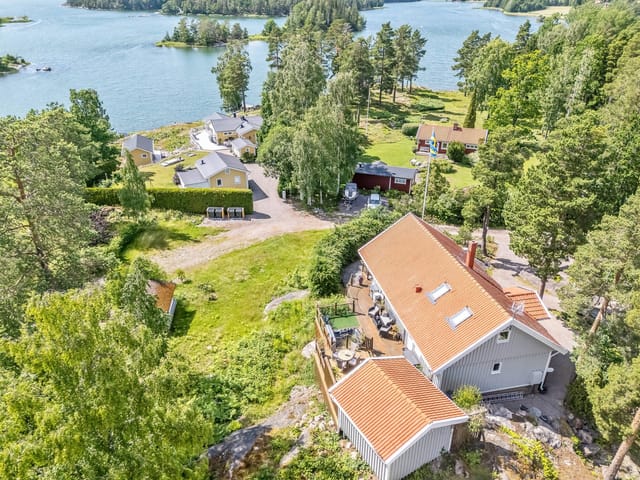
Front view of the house and garden

Early on a July morning, before the rest of Sjömansvägen stirs, you can walk the hundred meters to Lake Jämten in bare feet on warm tarmac, towel over your shoulder, and have the water entirely to yourself. That's the kind of morning this place is built for. No queues, no noise, just pines and still water and the occasional heron lifting off the far bank. Sjömansvägen 5 sits in the Loviselund fritidsområde — a well-established recreational community tucked into Södermanland's lake district, about 120 kilometers southwest of Stockholm and a comfortable six kilometers from the market town of Flen. The plot is big. Really big. At 2,595 square meters, it feels more like a small estate than a holiday lot, with mature forest pressing right up to the boundary on one side and a gentle sense of openness on the other. In a region where well-placed leisure properties are quietly becoming harder to find, that kind of land footprint matters. The main house was built in 1984 and spreads across 65 square meters on a single level. Single-storey living here isn't a compromise — it's a genuine quality-of-life feature. No stairs to navigate when you're carrying groceries from Flen's ICA Supermarket, no awkward levels when grandparents visit, no hunting for light switches in the dark after a late evening on the west terrace. The layout is direct: hallway with a generous walk-in closet that doubles as a sleeping alcove for a third guest, a proper bedroom, a light-filled living room, and a functional kitchen with the essentials already in place — fridge-freezer, stove, cooktop, water heater. The living room opens directly onto a covered terrace facing east, and there's something quietly addictive about drinking your first coffee out there ... click here to read more
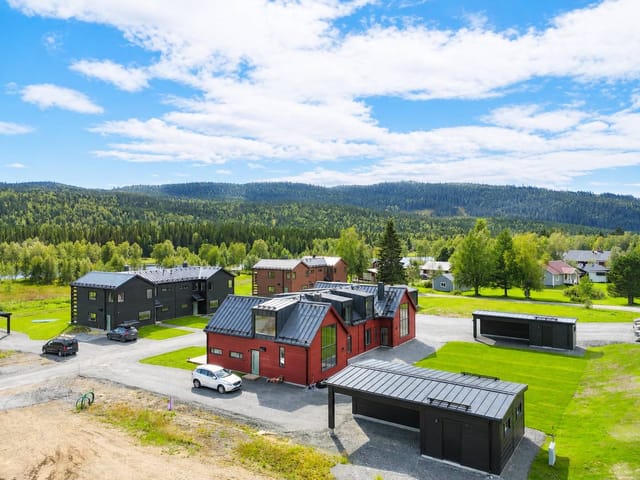
Front view of the house and garden

Step out the front door at seven in the morning and the only sound is birdsong. The dew is still sitting on the grass, the lake is just visible through the pines, and the coffee you left on the kitchen counter is already pulling you back inside. That's the rhythm of life at Dalvägen 8, and once you've felt it, a weekend trip to Sala will never feel like enough. This is a one-bedroom house on a 2,738-square-metre plot in the Ljömsebo area, roughly 15 kilometres outside Sala in central Sweden. It's priced at 104,500 EUR — the kind of number that makes people do a double-take, and rightly so. Properties like this, with a separate guest cottage, multiple outbuildings, and direct proximity to a lake with a proper swimming dock, don't surface often. The area has quietly shifted from a purely seasonal destination to a place where people actually live year-round, and that transition has made the local community feel grounded and real rather than the ghost-town-in-November type. The main house was built in 1974 and carries that particular solidity you find in Swedish timber construction from that era — a wooden facade, metal roof, walls that have been professionally re-insulated as recently as 2023 and 2024. Inside, the layout is compact but thought through: two rooms plus a kitchen, one bedroom, and a living area that opens directly onto a southwest-facing terrace. Southwest matters here. Swedish summers are long on light but short on calendar, so catching the afternoon and evening sun from late April through September is not a small thing. The terrace faces the right way to make that happen every single day. Heating is handled three ways: an air heat pump as the workhorse, electric radiators as backup, and a fireplace for th ... click here to read more
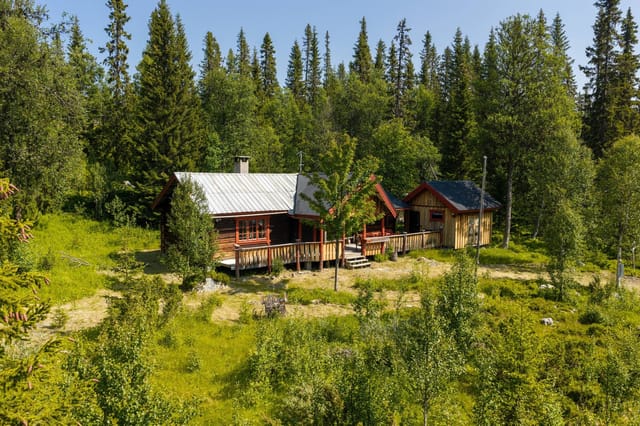
Front view of the house and garden

Stand on the terrace at Hällebäck 642 on a clear September evening and you'll understand immediately why people fall so hard for this particular corner of the Swedish west coast. The Gullmarn fjord catches the last of the light below you, the Stångenäset peninsula stretches out in the middle distance, and the birch forest on the hillside has just started turning gold. It's quiet up here — genuinely quiet — apart from the occasional sound of water and wind moving through the trees. This is a 108-square-metre house on the elevated terrain of Bokenäs, a peninsula jutting out between the fjord and the sea north of Uddevalla. Built in 1953 and carefully updated since, it sits on a 1,382-square-metre plot at a height that gives it uninterrupted westward views — the kind you normally only find on properties that cost three times as much. What makes this particular spot work so well is the way the hill opens up exactly where the house sits. Forest on three sides, open sky to the west. You get privacy and panorama at the same time, which in this part of Bohuslän is genuinely hard to find. The interior has been laid out with real intelligence. The kitchen and living room share an open-plan space at the heart of the house, with large windows pulling that fjord view straight into your daily life. Morning coffee here is accompanied by whatever the water is doing that day — glassy and pale in early spring, dark and restless in November, blindingly bright on a July afternoon. The terrace comes off this main living space and feels, from certain angles, like it's floating above the canopy. Evenings out there with a bottle of something cold and the sun going down over the fjord are the kind of thing you'll describe to friends back home ... click here to read more
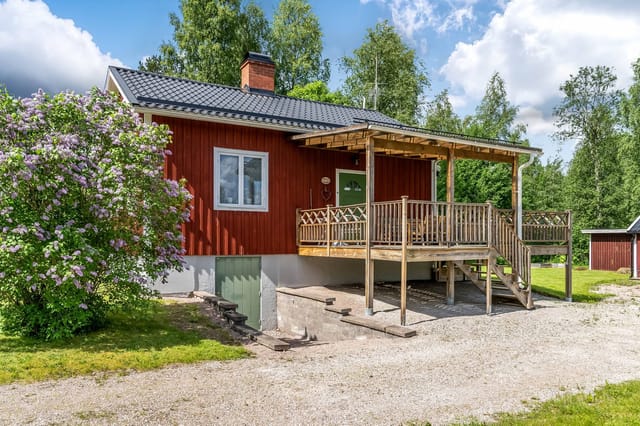
Exterior view of Hällebäck 642

Step out onto the back deck on a Saturday morning in July and you'll understand immediately. The smell of pine warming in the sun, the faint splash of someone diving off the rocks at Säbyviken a few minutes' walk down the trail, and nothing — genuinely nothing — competing for your attention. Platåslingan 25 on Ingarö sits at that rare intersection of true Swedish archipelago wilderness and real, year-round livability. It's not a summer cottage you winterize and abandon in October. People actually live here, all year, and you can feel it. The house itself was built in 1972, and it has that honest, no-fuss Scandinavian practicality that holds up remarkably well. At 47 square meters, it doesn't try to be more than it is — compact, well-planned, and genuinely comfortable. The open fireplace in the living room is the anchor of the whole place. Come February, when frost edges the birch trees outside and the archipelago goes quiet and still, that fireplace stops being a feature and starts being the point. You light it after a ski track session out on the frozen inlets, pour something warm, and the room closes around you in the best possible way. Large windows pull in more light than you'd expect for a structure this size. The kitchen sits open to the living area — practical for actual cooking, not just aesthetic — and the two bedrooms are calm, private, and sensibly proportioned. One bathroom with shower. Everything where it should be, nothing extraneous. What makes this property genuinely unusual for its price point is the land and the secondary structure. The plot runs to 2,914 square meters, much of it characterful bedrock and mature Swedish forest — the kind of granite-and-pine combination that defines the Värmdö coastli ... click here to read more
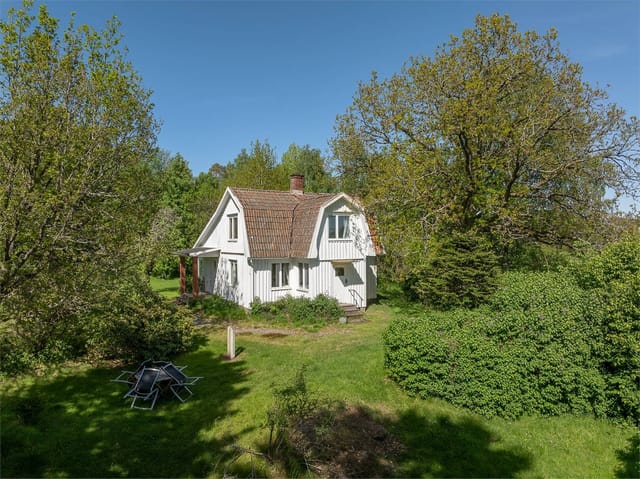
Front view of the house and woodland plot

Step outside on a July morning and the plum tree by the terrace is already warm from the sun. The apples are weeks away from being ready. Somewhere across the green, a couple of kids are kicking a ball around the football pitch that borders the property. You've got coffee brewing inside. This is Fållökna — and it feels a long way from any city, even though Stockholm is under two hours away. This single-storey holiday home on Uvbergsvägen sits on a plot just over 2,000 square metres on the northern shore of Lake Nedingen, right in the geographical centre of Sörmland. That combination — water close by, forests behind, a working community around you — is exactly why Swedish families have been buying second homes in this part of Flens kommun for generations. Supply here is genuinely limited. Properties on the Nedingen shore don't come up often. The house itself covers 55 square metres sensibly. Two bedrooms with wooden floors, a living room anchored by an open fireplace with an insert, and a kitchen with a ceramic cooktop and combined fridge-freezer. Nothing flashy, nothing broken. The bathroom has wall cladding, a shower, and connects to the municipal water and sewage system — no well to maintain, no septic surprises. Fibre internet is already installed, which matters more than people expect when they're working remotely for a week or letting the kids stream something on a rainy afternoon. The living room earns its keep. Large windows pull in the garden light, and when you light the fire on a cool September evening after a day walking the Lagnö nature reserve trails, the wooden floor glows and the room genuinely earns the word cosy without needing any help from interior design. The west-facing covered terrace off the mai ... click here to read more
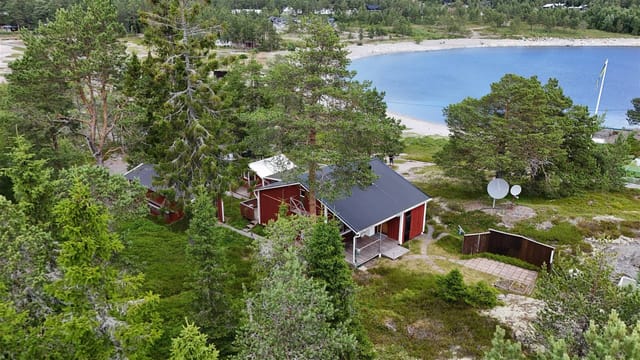
Front view of the house and garden

The first thing you notice on a July morning at Havsörnsstigen 28 is the light. It comes in low and golden through the trees on the east side of the plot before eight o'clock, falls across the wooden decking, and turns the whole garden into something worth waking up early for. You pour coffee. The sea is a three-minute walk down the lane. You can smell it before you see it. This is Södra Rörvik — a quiet residential pocket on the island of Väddö, tucked into the Roslagen archipelago about 100 kilometres north of Stockholm. People who know this stretch of the Swedish coast tend to keep it to themselves. The tourist crowds that flood Norrtälje town in summer somehow never quite reach here with the same intensity. The roads stay calm. The swimming cove stays clean. The neighbours wave but don't intrude. It has the particular Swedish quality of feeling genuinely unhurried in a way that coastal spots twice the price rarely manage. The house itself was built in 1964 — a classic Swedish sommarstuga in character, but extended and maintained into something that functions comfortably as a year-round home. At 69 square metres across four rooms, it's compact without feeling cramped. The living room carries the space confidently, with large windows that frame the garden rather than just letting light in — there's a difference, and here it matters. A wood-burning stove sits in the corner, and by late September when the evenings sharpen and the birch leaves go gold, it earns its place. The kitchen connects directly to the living space in a way that makes cooking feel social rather than isolated. Nothing fancy, but everything you actually need when you're spending summers here with people you like. Three bedrooms sleep the family com ... click here to read more
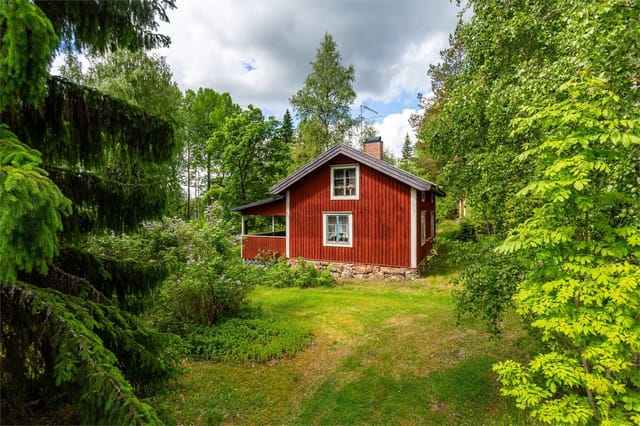
Front view of the holiday home

Early morning in Tived, the mist sits low over the pines and the only sound is birdsong and the faint lap of water from Lake Unden, just a four-minute walk down the road. You pull on a jacket, step off the wooden porch, and that's your commute. That's the life this place offers. Kungsbacken 4 is a 1965 Swedish fritidshus — a proper country cottage — set on a generous 1,831-square-metre plot in one of central Sweden's most quietly compelling corners. Two bedrooms, one bathroom, 51 square metres of warm, practical living space, and enough garden to lose yourself in for a whole afternoon. The price is 99,500 EUR. For what you get — a turn-key holiday home on the edge of a national park, fully furnished, beside a lake — that's a serious value proposition. The house itself is in good condition, well-maintained by the current owners and honest about what it is: a proper Swedish country retreat, not a showroom. The interior is bright, with windows that pull the treeline right into the living room. Large mature trees ring the garden, giving the kind of natural privacy that newer developments spend years trying to fake with fences and hedges. The kitchen is functional and ready to use from day one, and because the sale includes all furniture, there's no logistics headache — you arrive, you unpack a bag, you start living. Lake Unden is 450 metres from the front door. One of the cleanest lakes in Västra Götaland, Unden is fed by cold, clear springs and surrounded almost entirely by forest. In summer, the swimming is exceptional — families from the nearest towns drive an hour to reach what you'll have on your doorstep. Pike and perch fishing are taken seriously here; the local tradition is to head out just after sunrise, before t ... click here to read more
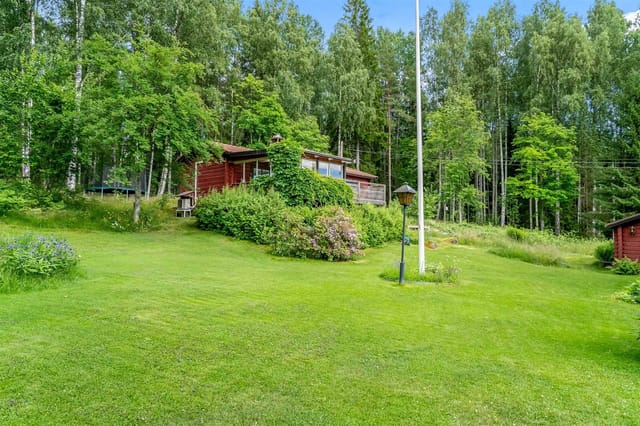
Front view of the cottage and garden

Early on a July morning, the forest around Ljungsjömålavägen is so quiet you can hear a pike break the surface of Lake Mien a kilometre down the road. The coffee's on, the kitchen window is cracked open, and the air coming through smells of pine resin and cool water. That's the kind of morning this place was built for. Completed in 2023, this three-bedroom holiday house sits on a 1,175 square metre plot in Bökemåla, a small community north of Karlshamn in Blekinge — Sweden's southernmost mainland county and one of the country's most underrated corners for a second home. The house is genuinely new, so you're not walking into someone else's renovation backlog. The bones are solid, the materials are fresh, and the energy performance reflects modern Swedish building standards. For an international buyer looking for a move-in-ready Swedish vacation home without the project headaches, that matters. The ground floor opens into a kitchen and living room that share the same open space. Large windows pull light in from the garden side, and the room has the kind of easy proportions that make it work both as a family gathering point and a quiet reading spot when everyone else is out by the lake. The kitchen itself is functional without being fussy — proper counter space, good storage, a layout that doesn't make cooking for six people feel like a military exercise. Two bedrooms sit off the entrance floor, both looking out onto the surrounding green. Upstairs, the attic level holds a third bedroom: a bit more private, a little more tucked away, good for teenagers or guests who appreciate their own corner of the house. A dedicated room on the main floor is pipe-ready for a future bathroom — the groundwork is done, the connections ar ... click here to read more
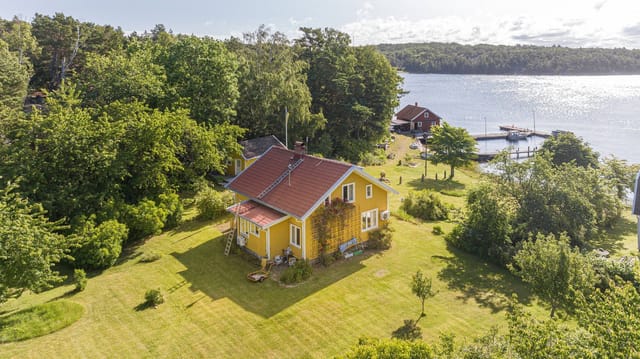
Exterior view of the holiday home

On a still Saturday morning at Sågbacken 20, you pour coffee in a compact kitchen, crack open the terrace door, and the air that comes in smells like pine resin and lake water. That's the whole point of this place. No traffic noise, no neighbour's TV through the wall — just the occasional woodpecker working away somewhere in the trees behind the garden. It's forty square metres of main house, a separate guest cottage, and 749 square metres of land sitting roughly 300 metres from the edge of Lake Mälaren. Simple on paper. Quietly extraordinary in practice. Bro is one of those Swedish addresses that locals tend to keep to themselves. Sitting in Upplands-Bro municipality, about 40 kilometres northwest of Stockholm, the area hugs the northeastern shore of Lake Mälaren — Sweden's third-largest lake and arguably its most atmospheric, edged with medieval church ruins, small islands, and sailing routes that unfurl for hundreds of kilometres. The E18 motorway puts you at Kungsängen station in under ten minutes, and from there the commuter train runs directly into Stockholm's central station in roughly 35 minutes. You can be eating lunch at Östermalm's food hall and back on the terrace in time for sunset. The house itself was built in 1971 and sits in solid, well-maintained condition. At 40 square metres, the layout is efficient without feeling tight — something Swedish summer house design tends to get right. The bedroom is fitted with built-in wardrobes, keeping clutter off the floor. The living room doubles as a flexible second sleeping space if you need it, with room for a daybed alongside a proper dining setup, and a certified open fireplace anchors the room. On the first cool September evening of the year, when the nights s ... click here to read more
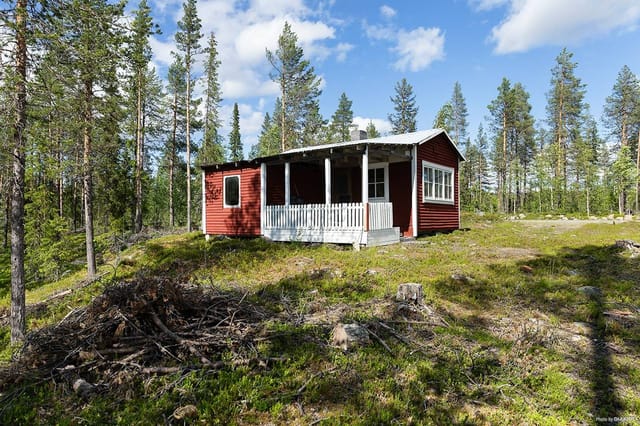
Front view of the holiday home and terrace

Step outside on a July morning and the first thing you notice is the light. Out here on Yxlan, it hits differently — bouncing off Yxlömaren lake just 350 metres down the track, filtering through the old apple trees at the garden edge, warming the west-facing terrace before most of Stockholm has had its first coffee. That terrace, with its outdoor spa already in place, is where you'll spend a disproportionate amount of your time here. Trust that. Yxlan sits in the northern Stockholm archipelago, part of Norrtälje kommun, and it carries that particular quality of Swedish island life that people from the city spend years trying to find. Not the polished resort version. The real kind — where a country store in Köpmanholm sells pickled herring and the ferry to the mainland runs on a timetable that politely refuses to rush you. The island is connected by road and by Waxholmsbolaget ferry from Yxlövik, a few kilometres from Österviksvägen, plus Bus 632 runs several times daily between the island and the mainland. Practical, quiet, close enough to everything, far enough from the noise. The house at Österviksvägen 44 was built in 1955 and has been brought up to year-round standard — proper insulation, heating systems that handle a Swedish February without complaint. That matters more than people expect when they first start thinking about archipelago property. A summer cabin is one thing. A place you can escape to in November, light a fire, and watch the frost settle on the meadow outside — that's a different category entirely, and this property sits firmly in it. Inside, the layout is compact but genuinely usable. Three rooms plus kitchen spread across 66 square metres: a kitchen with a dedicated dining nook that handles four ... click here to read more
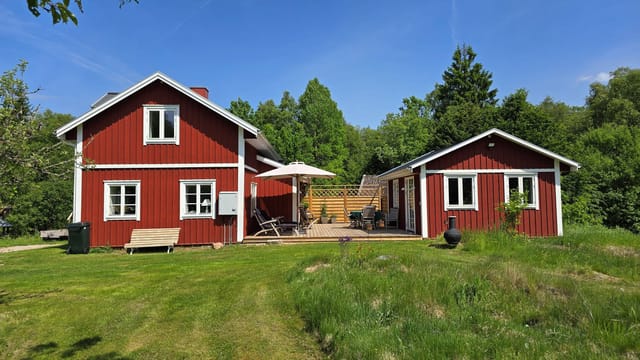
Exterior view of the house and garden

Late afternoon on a July Saturday, the southwest sun pours through the glass-enclosed patio and turns the pine floorboards a deep amber. You've just come back from Björknäs's little beach — kids still sandy, everyone hungry — and the kitchen smells of whatever went into the cast-iron pan twenty minutes ago. That's the rhythm this house runs on. Easy, unhurried, genuinely Swedish. Björknäs sits inside Roslagen, the long, ragged stretch of coastline northeast of Stockholm that locals have been quietly escaping to for generations. It's not the flashy archipelago of postcards — it's better. Unpretentious timber cottages tucked between birch stands, narrow lanes that end at sheltered coves, the smell of pine resin on a warm afternoon. The community here is tight enough to feel like a village but relaxed enough that nobody bothers you. The kind of place where your neighbours wave from their garden and then leave you alone. The house itself was built in 1972 and sits on a 1,765 square metre plot — a genuinely generous footprint for this part of Roslagen. There's a real sense of privacy here. The garden mixes mown lawn with wilder natural patches that attract butterflies and the occasional hedgehog, and sunlight tracks across it for most of the day given the open southwest aspect. In June, when the Swedish light goes on until 10pm, evenings out here take on a quality that's hard to describe to anyone who hasn't sat in Scandinavian summer dusk with a cold drink and nowhere to be. Inside, 48 square metres sounds compact on paper. In practice, the layout uses every centimetre thoughtfully. The kitchen was completely gutted and rebuilt in 2019 — new cabinets, new surfaces, proper appliances — and it connects directly to that glas ... click here to read more
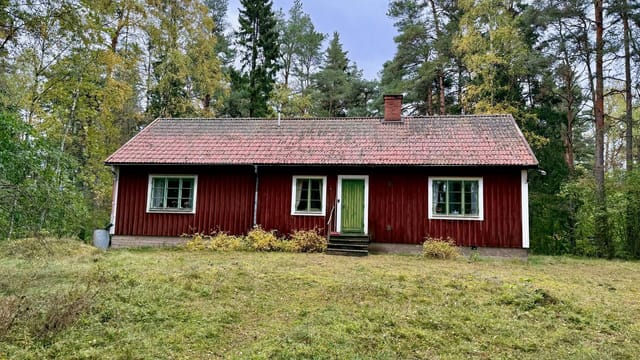
Exterior view of the timber house

The coffee tastes better on this terrace. Something about the birch trees filtering the early morning light, the faint smell of salt air drifting up from Herräng's rocky shore just around the corner, the silence that isn't really silence at all — it's wood pigeons, rustling leaves, the occasional distant outboard motor. You're 350 meters from the sea. It feels like another world entirely. Råvikskroken 1 sits on a generous 2,156-square-meter plot in one of the most quietly coveted pockets of the Stockholm Archipelago. Herräng is not one of those over-photographed Swedish villages that ends up on every travel blog. It's known among those who know — jazz musicians, archipelago regulars, Stockholm families who discovered it decades ago and have been coming back every June since. The Herräng Dance Camp, one of the world's most famous swing jazz festivals, has called this village home for over 40 years. In summer, the sound of live brass carries on the wind and the village takes on a warm, international energy before settling back into its natural quiet. If you want the untouched archipelago without the weekend crowds of Vaxholm or Grisslehamn, Herräng is exactly where you end up. The house itself was built in 1978 and has been kept in good condition — this isn't a renovation project, it's a property you can start enjoying immediately. At 78 square meters across two bedrooms and one bathroom, the layout is compact but genuinely livable, the kind of floor plan that feels right rather than just adequate. The living and dining area opens up around a fireplace that earns its keep every single autumn weekend, when the evenings drop fast and the archipelago turns copper and rust. Large windows pull in the garden and the surroundin ... click here to read more
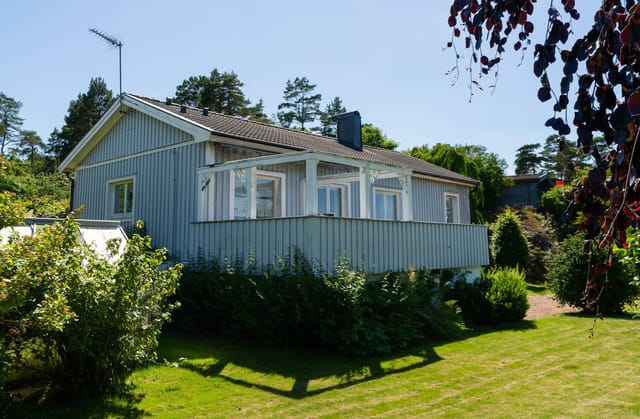
Front view of the holiday home

The first thing you notice on a summer evening at Hysängsvägen 36 is the light. It comes low and golden off the Furusundsleden strait, cuts through the pine trees, and lands across the west-facing deck in a way that makes you want to pour something cold and simply sit. That's the rhythm of life on Yxlan — unhurried, quiet in the best possible sense, and astonishingly close to Stockholm. Yxlan is one of the outermost accessible islands in the Norrtälje archipelago, connected to the mainland by a free car ferry that runs year-round. It's not the kind of place that ends up on tourist lists. Swedes who know the archipelago well tend to keep it to themselves. The island sits where the inner skerries give way to open Baltic water, and on clear mornings you can smell the sea before you even step outside. The property on Hysängsvägen sits in the Hysängen area, a pocket of the island where the plots are generous and the neighbors are close enough to wave to but far enough that you can't hear their conversations. The main house is 72 square meters — not large, but used well. The open-plan living room and kitchen share a single bright space with big windows on the western side, which means afternoon light fills the room naturally without any effort on your part. Direct from the living room, a large wooden deck stretches out to meet the garden. The deck is where you'll spend most of your time in June, July, and August — eating, reading, watching the light change. It faces west, which in the Swedish archipelago summer means you're outside until ten at night without a jacket. Two bedrooms in the main house keep things practical. They're quiet rooms, good for sleeping deeply after a day on the water or a long hike through the island ... click here to read more
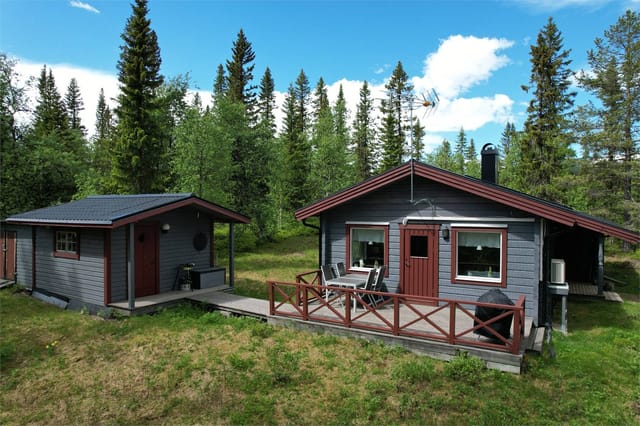
Front view of the main house and garden

The first thing you notice at Stenholmen 12 is the silence — or rather, the specific kind of sound that passes for silence out here: water moving against granite, a cormorant somewhere off the rocks, the creak of a wooden pier in the morning swell. You're standing on the southwestern tip of Stenholmen, coffee in hand, watching the light come up over Dalarö Ström, and already the thought of going back to the city feels faintly absurd. This is a house that has been doing this to people since the 1890s. Built during the era when Stockholm's upper classes first discovered the southern archipelago and began erecting their beloved sommarvillor along these shores, the main house has been carefully maintained through more than a century without losing the bones that make it special. The 65-square-metre layout across three rooms is modest by modern standards — two bedrooms, a living room, one bathroom — but out here, you don't live inside. The large windows frame the sea on multiple sides, and the sun-drenched timber terrace jutting off the house faces the water directly. Evening sun hits that terrace well past nine in July. You'll eat most of your meals there. The plot itself is genuinely unusual. At 5,154 square metres total, of which 2,186 square metres is classified water area, the property reaches directly into the sea. Rocky outcrops drop into a protected bay that's deep enough to moor several sailboats at the private piers. The terrain rises and folds across the lot, giving you different private corners — a flat spot for a deck chair in the afternoon, a high point that opens up a long view toward Dalarö Skans fortress to the south. No two spots on this property feel the same. The sauna building by the water is where th ... click here to read more
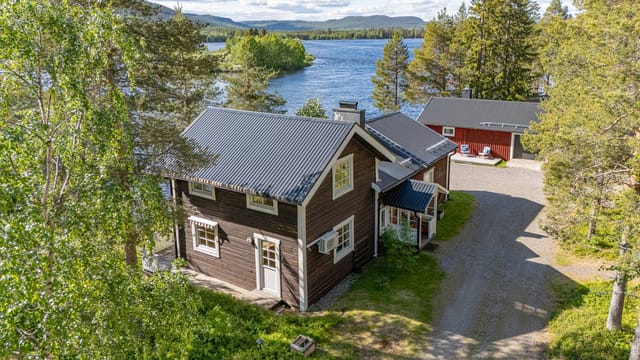
Seaside house with terrace and sea view

The first thing you notice on a July morning at Mistralvägen 4 is the light. It comes sideways through the pines, catches the wooden floors, and lands on the kitchen table in a way that makes you want to sit down and stay forever. Then the smell hits — salt air and warm timber and something faintly floral from the plot outside. You haven't even made coffee yet. This 1958 holiday home in Gotlands Tofta is one of those rare finds: a proper old Swedish sommarhus on a genuine plot of 2,449 square meters, priced honestly, and sitting within easy reach of Tofta Beach — one of the longest and most loved stretches of sand on the entire island of Gotland. It's 61 square meters of authentic character distributed over one and a half floors, and every square meter earns its keep. Step inside and the living room does what good rooms do — it draws you in. Exposed ceiling beams, wide wooden floorboards, a fireplace insert that crackles to life in late September when the tourists have gone and the island belongs to you. The large windows look out toward the sea — not a full panorama, but a real, honest glimpse that reminds you exactly where you are. On clear evenings, the light off the water turns everything amber. The kitchen sits next to the living room, functional and unhurried, with enough bench space to put together a proper meal. Gotland is serious about its food: local lamb from the heathland, saffron pancakes from the Saturday market in Visby, chanterelles picked from the woods just down the road in August. A kitchen like this — practical, with room for a dining table — is where those ingredients come to life. A walkthrough room with built-in wardrobes handles the coats and kayak gear and everything else that accumulates duri ... click here to read more
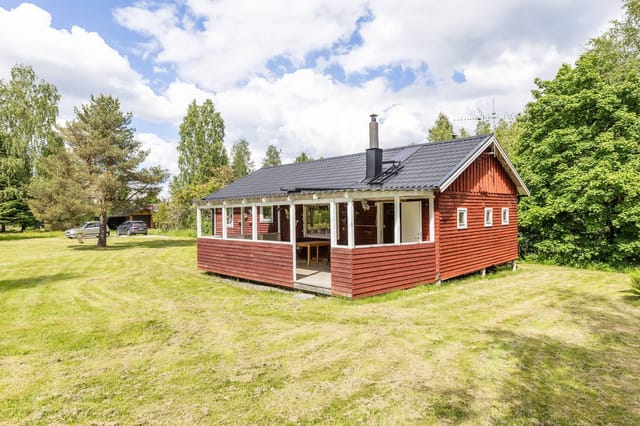
Front view of the house and garden

On a still morning in late June, the lilac hedge at the front of Citadellvägen 37 fills the air with something that stops you mid-step. You stand there a moment, coffee in hand, listening to the sound of a neighbor's trowel working the soil two plots over, a distant church bell somewhere toward the center of Landskrona, and underneath it all — almost nothing. Just wind in the birch leaves. This is what daily life looks like at one of Sweden's most storied colony communities, and it's considerably more addictive than it sounds on paper. Citadellet's allotment colony is genuinely old. Built in 1929 and rooted in Sweden's deep tradition of trädgårdskoloni living, the area around Citadellvägen feels lifted out of another era — in the best possible way. The winding footpaths between plots are narrow and unhurried. The cottages are small and individual. The gardens are lavish, seriously tended, and strikingly varied: one plot is a riot of dahlias, the next a productive kitchen garden with tidy rows of runner beans and dill. Nobody is rushing anywhere. The cottage at number 37 sits on approximately 500 square meters of garden and comes in at 37 square meters of interior space — compact, honest, and designed around what actually matters. Step inside and you're met with a living area that does double duty as a sleeping space, a double bed tucked into the room in a way that feels intentional rather than improvised. Light comes in well. The mood is calm. A few steps down — the floor level drops, which gives the kitchen its own distinct character — you find a room lined with warm wooden paneling and wooden floors that have clearly been looked after. It smells faintly of pine. The kitchen is small but genuinely functional, the kind ... click here to read more
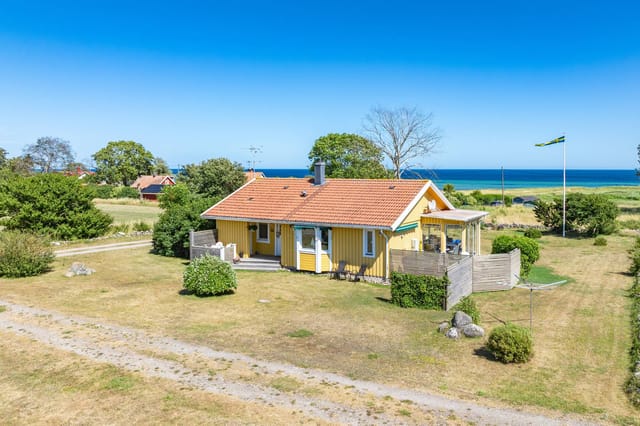
Exterior view of the garden cottage

Picture this: it's a Saturday morning in late June, and the smell of ripe cherries drifts in through the kitchen window at Tredje Gatan 5. The garden is already warm. You step outside in bare feet, pick a handful of fruit straight off the tree, and walk down toward Lake Båven with a thermos of coffee before most of the village has stirred. This is what owning a second home in Sparreholm actually feels like—unhurried, real, rooted in the Swedish countryside in a way that no city apartment can replicate. The house itself sits on Tredje Gatan, a quiet residential street in the heart of this small Södermanland community, about 100 kilometres southwest of Stockholm. It's a single-storey home with a basement, 71 square metres of living space, and a 760-square-metre plot that wraps around it with the kind of gentle, lived-in character that takes years to cultivate. Apple, cherry, plum, and pear trees dot the garden—not as ornamental decoration, but as working trees that produce real fruit through the summer and into autumn. Summer water supply runs from May through October for irrigation, so keeping the garden going doesn't demand heroic effort. Recent years have seen solid investment in the fabric of the building. A new air-to-water heat pump was installed, the electrical system was rewired, and interior surfaces were freshly painted and updated. These aren't cosmetic upgrades—they're the kind of infrastructure work that makes a home genuinely comfortable through a Swedish winter and energy-efficient year-round. The indoor climate is stable. You're not walking into a project; you're walking into somewhere that works. The layout is simple and honest. The main floor carries the living room, kitchen, dining area, two bedrooms, ... click here to read more
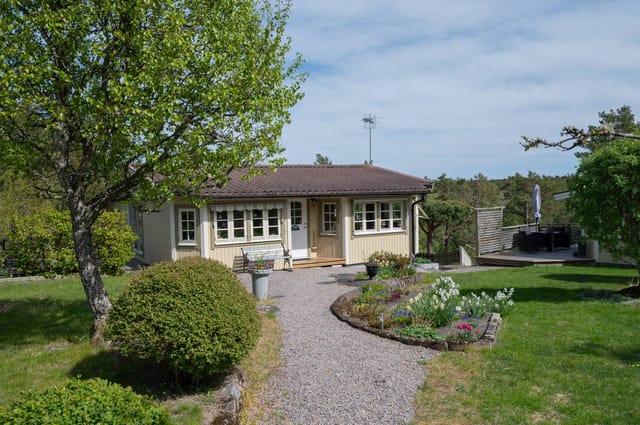
Exterior view of the house and garden

On a still July morning, you pull on your sandals and walk 250 meters down a quiet gravel path through the birch trees. The lake is glassy. You're the first one in. This is Yxtasjön, and it's essentially your front yard. That's the kind of daily rhythm Hägerbovägen 6 makes possible. A solid, well-kept 1965 house on a 3,680 square meter plot in Yxtaholm, one of the more quietly coveted pockets of Flen municipality in Södermanland — about 120 kilometers southwest of Stockholm along the E20. Three bedrooms, 104 square meters of living space, a wood-burning stove crackling in the corner come October, and more outdoor room than most people know what to do with. Swedes have been quietly holding onto places like this for generations. And they're not wrong to. The house itself is genuinely move-in ready. The interior has been freshly painted throughout — white walls that bounce light around the rooms rather than absorbing it. Large windows face the greenery, and on a summer afternoon the effect is something close to living inside a forest. The main living room is generous, anchored by a newer air-source heat pump that handles both heating and cooling efficiently across all four seasons, and the wood stove supplements it beautifully when January temperatures drop into the minus digits and you want actual warmth, not just circulated air. The kitchen has enough counter space to be functional, modern appliances, and real storage — not the kind of Swedish summer cottage kitchen where you're fighting over drawer space every morning. Three bedrooms sleep family and guests comfortably, and the bathroom covers everything you'd need for extended stays. Out back, the 3,680 square meter plot is the real conversation. Mature trees — mostl ... click here to read more
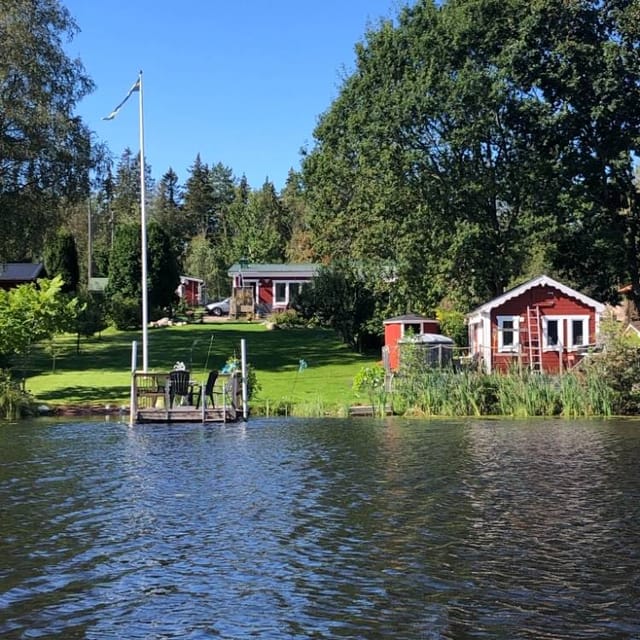
Front view of the house and garden

Step outside on a February morning and the cross-country ski trail is literally at the edge of the garden. No bus, no car park, no queue. Just fresh tracks across the marsh and the kind of cold air that makes your lungs feel alive. That's the daily reality at Kremlavägen 5 in Lindvallen — one of the most practical, genuinely versatile mountain properties to come onto the market in Sälen's prime ski zone in years. Sälen doesn't get the international attention it deserves. Swedes know it well — this is where the Vasaloppet ski race ends its 90-kilometer journey from Sälen to Mora every March, drawing 15,000 skiers and creating an atmosphere unlike anything else in Scandinavia. But beyond that iconic event, the wider Lindvallen area operates at full pace from November through April, with downhill slopes, lit cross-country tracks, and the ski-and-swim bus running circuits that connect the valley's resorts. In summer, the same roads and trails flip their purpose entirely: mountain bikers take over, hikers tackle the marked routes up towards Städjan and Nipfjället, and the long Nordic evenings stretch past 10pm. The property itself sits in the Gubbmyren part of Lindvallen, which matters because this pocket of the valley has managed to hold onto its natural character. The marsh that runs alongside the garden isn't just scenery — it's where the cross-country groomed track passes directly, making ski-out access a literal fact rather than a marketing stretch. On still mornings you hear reindeer moving through the birch trees on the far side. In peak autumn, the marsh turns rust and amber, and the smell of cold peat drifts in through the kitchen window. The house is split across two connected residential units totalling 111 squa ... click here to read more
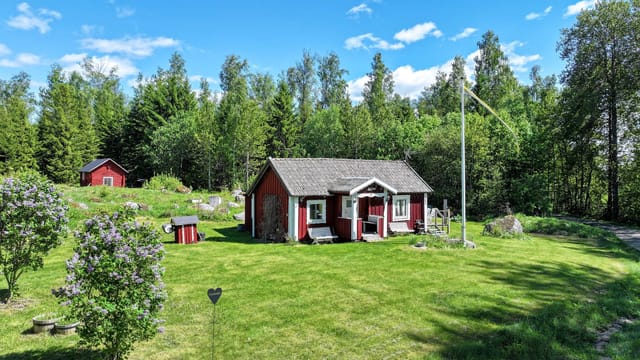
Exterior view of the house in winter

The first thing you notice on a summer morning at Skyttsveden 39A is the light. It comes in low through the big windows, catches the surface of Lake Väsman about 150 meters down the slope, and turns the whole room the color of warm honey. By eight o'clock you're already pulling on your shoes for the walk to the water. That's just life here — quiet, unhurried, and genuinely good. Sunnansjö sits in Dalarna, the province that Swedes themselves treat as the country's emotional heartland. Midsommar is taken seriously here. Maypoles go up in the meadows, fiddle music drifts across the water, and the smell of wild strawberries and woodsmoke is so thick you could bottle it. This isn't a region performing its identity for tourists — it's just how things are. Owning a holiday home in this part of Sweden means buying into a way of life that most people only read about. The house itself was built in 1983, single-storey and solid, and it's been looked after with obvious care. Freshly renovated, it has solid wooden floors throughout, pale walls that stay cool even in July heat, and a layout that makes the most of every one of its 54 square metres. Two bedrooms sit on the entrance level — one easily doubles as a study or reading room — and above the main living space there's a sleeping loft that kids immediately claim as their own. The loft isn't counted in the official floor area, which means the actual usable space feels noticeably larger than the figures suggest. The living room is the heart of things. The windows face the lake and on grey November afternoons, when the birch trees have dropped their leaves and frost is forming on the grass, the approved fireplace in the corner earns its keep completely. There's a new air-to-air h ... click here to read more
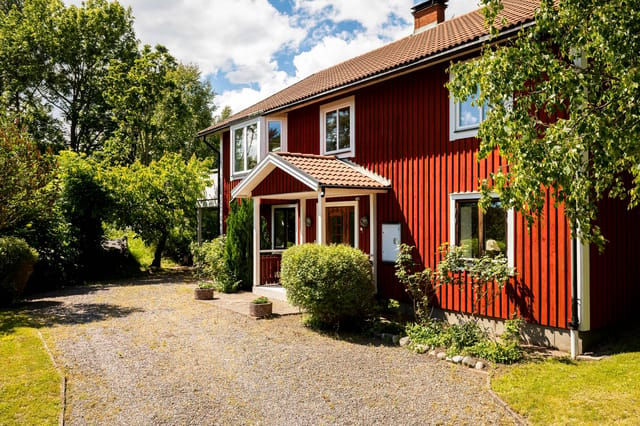
Front view of the house with garden and lake in the background

The first thing you notice on a Friday evening arrival is the silence. Not the uncomfortable kind—the kind that has depth to it, layered with the creak of pine, the distant pull of the Lagan river, and maybe a woodpecker going at a birch somewhere in the 5,000-square-meter plot that's entirely yours. You cut the engine, step onto the gravel, and already the week behind you starts to dissolve. Skogsstugan—"the forest cottage"—at Putsered 64 outside Knäred is the kind of second home that Swedes have quietly kept to themselves for generations. A proper year-round house, not a draughty summer shack. Built in 1974 and significantly extended in 1996, the 77-square-meter main home has been maintained with real care: quality Traryd insulated windows, a bathroom that was fully renovated in 2011, a heat pump installed for modern efficiency, and a Vissenbjerg wood-burning stove that makes winter weekends here genuinely cozy rather than just survivable. The wooden floors, paneled ceilings with wainscoting, and wallpapered walls give the interior a Scandinavian warmth that you don't get from places renovated to look like an IKEA showroom. This is a home with character that's earned rather than staged. The open-plan living room, dining area, and kitchen form the social heart of the house. Large panoramic windows and double patio doors—new ones, high quality—open directly onto a stone-paved terrace laid in Öland limestone. On summer mornings, that terrace catches the light early. The covered section, roughly 12 square meters, has an outdoor kitchen, which means you're frying fish straight from the Lagan regardless of what the weather's doing overhead. The Kvik kitchen inside, fitted during the 1996 extension, comes with wooden counte ... click here to read more
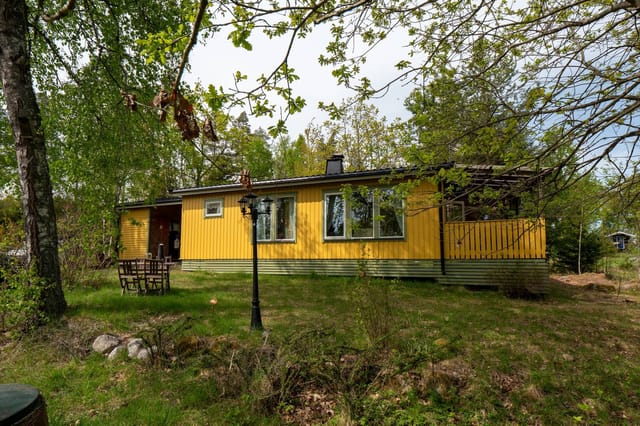
Front view of Skogsstugan Putsered 64

Stand at the kitchen window on a October morning and watch the mist lift off the birch trees at the edge of your nearly nine-thousand square metre lot. The wood stove in the corner is already ticking with warmth. The coffee is on. Beyond the treeline, Lake Summeln sits about a three-minute walk away, still and grey-green, waiting. This is the particular kind of quiet that people from Stockholm or Amsterdam or Hamburg spend years trying to find—and here it already comes with the house. Rud Byggningen is a 1909 farmstead-style home on the outskirts of Säffle in Värmland, Sweden's great inland lake county. The building has the solid, unhurried bones of Swedish rural construction from that era: thick walls, steep roof, a floor plan that was designed around actual living rather than architectural showmanship. Over the decades it's been updated carefully rather than gutted—the 2022 bathroom renovation brought in clean, contemporary fittings without turning the place into something soulless, and a newer air-source heat pump keeps running costs sensible year-round. The original wood-burning stove in the hallway, though? That stays. There's no good reason to remove the one thing that makes January feel like a pleasure rather than an endurance test. The house runs to 108 square metres of main living space across four rooms plus kitchen, with an additional 48 square metres of secondary space—utility rooms, storage, the kind of square footage that quietly absorbs the overflow of family life. Three bedrooms sit at the upper level, each genuinely private, each with the countryside view that you stopped noticing after a while when you first moved in but that visitors always comment on immediately. The attic is unfinished, which sound ... click here to read more
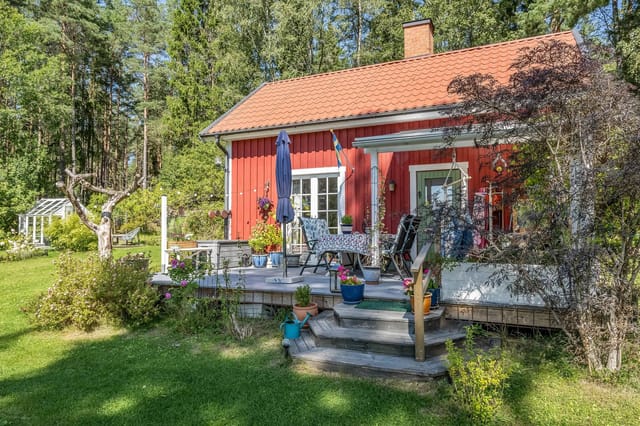
Exterior view of Rud Byggningen

Picture this: a midsummer Saturday, and you're sitting on a wide southwest-facing wooden deck with a cup of coffee that's gone slightly cold because you kept getting distracted by the light. It does something particular here in Strömstad — bounces off the open landscape behind the house, turns everything amber by late afternoon, and just refuses to let you go inside. That's the daily reality of owning this 1930s house at Stora Ytten Karlslund, and it's the kind of thing you can't fully appreciate until you've experienced it yourself. Built in the 1930s and kept in genuinely good condition, this is a two-bedroom wooden house with 90 square meters of living space sitting on a 975-square-meter plot. Not a renovation project. Not a compromise. A proper Swedish house with original wooden floors, period architectural details, and the kind of proportions that newer builds just don't replicate — rooms that feel considered rather than squeezed. The large windows weren't put there for the listing photos. They're there because someone who built this place understood that Scandinavian light is precious, and you catch every last beam of it when you can. The layout is practical without being rigid. Two bedrooms handle the sleeping comfortably, and the third room flexes well — home office one weekend, guest room the next, quiet reading corner the one after that. The kitchen opens directly onto the garden deck, which matters more than you'd think. Breakfast outside in August, herb pots on the railing, someone grilling something that smells good from next door — that's the rhythm of this place in summer. The bathroom has been updated with modern fixtures while the rest of the house keeps its older bones intact, which is exactly the bal ... click here to read more
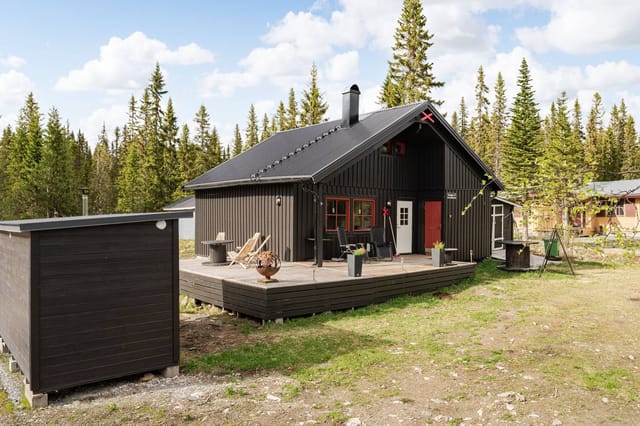
Exterior view of the house and garden

Picture this: it's seven in the morning, the air smells of pine resin and salt, and you're walking barefoot across sun-warmed granite toward the water with a coffee in hand. That's not a fantasy — that's a Tuesday in July at Bastuvägen 20. Resö is one of those places that Swedes quietly keep to themselves. A small island off the Bohuslän coast in Tanum municipality, connected to the mainland by a bridge, it sits right alongside Kosterhavet — Sweden's first and only marine national park. The water here is some of the clearest on the entire west coast. Local fishermen still pull langoustines and prawns from the Skagerrak, and you can buy them straight off the boat at the harbor before lunch. That kind of detail tells you everything about what life on this island actually feels like. The cottage at Bastuvägen 20 was built in 1970 and covers 64 square meters across a layout that makes sensible use of every room. Three bedrooms, a living room, a proper kitchen, and one bathroom — nothing wasted, nothing missing. Large windows and glass doors pull the outside in. On a clear summer morning, light floods through the glass and hits the timber walls in a way that makes the place feel twice as big as it is. The traditional Swedish timber construction keeps things cool in summer and surprisingly snug when autumn rolls in off the water. The plot itself is 1,114 square meters — generous by any measure, and particularly so for an island property of this caliber. There are multiple seating areas scattered around the garden, each catching the sun at a different hour of the day. It's the sort of layout you discover slowly: one corner for morning coffee, another for evening wine when the light goes golden over the treetops. Children hav ... click here to read more
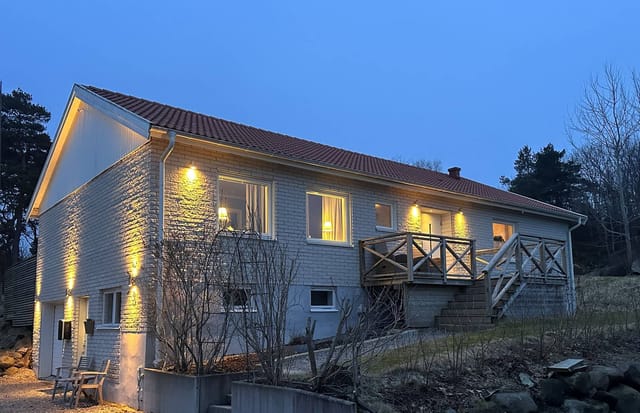
Exterior view of the house and garden

Early on a Saturday morning in late June, the light here does something unusual. It arrives soft and low through the birch trees, lands on the kitchen table, and just stays there. The canal is maybe six hundred meters down the road. You can hear it if the wind is right — not the sea itself, but the particular quiet that water brings to a place. That's what Måsvägen 16 feels like from the moment you walk onto the plot. Not a resort. Not a staged showroom. Just a genuinely good piece of Swedish archipelago land, with a solid little house on it, waiting for someone to decide what comes next. Strömma sits in the middle of Värmdö municipality, which stretches east from Stockholm into the Baltic archipelago along the E18 corridor. This is one of the most sought-after second-home areas in Sweden for a reason that locals rarely need to explain — you're thirty-odd kilometers from Sergels Torg, yet you're watching ospreys circle above the treeline. That contrast never gets old. The commuter boat from nearby Stavsnäs or the direct bus connections via Gustavsberg mean Stockholm isn't a schlep, it's just a decision. Most weekends, that decision gets delayed until Sunday evening. The property itself sits on 2,611 square meters of mostly natural plot — mature spruce, birch, and low-growing juniper framing a grassy open center that catches afternoon sun until well past eight in summer. The main house, built in 1959 and winterized for year-round use, covers around 50 square meters across four rooms. It's functional and honest. No grand renovation has been forced upon it, which means the bones are intact and the choices about what comes next are entirely yours. The guest house tucked on the plot adds flexibility immediately — use it for ... click here to read more
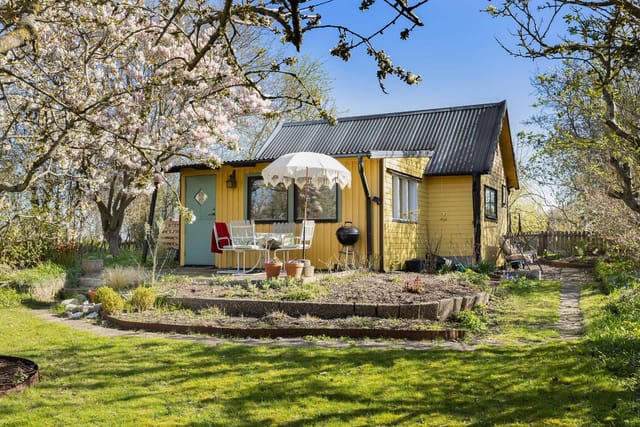
Front view of the house and garden

Step outside on a Saturday morning in October, the air sharp with the smell of pine resin and leaf smoke drifting from a neighbor's garden two fields over. The Lagan River catches the low autumn light about a ten-minute walk from your front door. You're at the end of a road — there is literally no through traffic — and the only sound is the occasional creak of the old apple trees along the garden edge. This is what 200 square meters of well-kept Swedish countryside living actually feels like at Grönö 3551. Built in the 1930s when Swedish rural construction was about permanence rather than speed, the house has the kind of bones that later decades couldn't replicate — solid framing, generous room proportions, and a relationship with natural light that feels genuinely considered. The large windows don't just let daylight in; they frame views of open countryside that change week by week through the seasons. Snowfall turns the 2,401-square-meter plot into something from a Carl Larsson painting in January. By June it's all long grass, wild strawberries along the fence line, and evenings that don't get properly dark until almost midnight. The owners have made the practical investments that really count. A modern air-to-water heat pump handles the heavy lifting on heating, backed by solar panels with battery storage that meaningfully cut running costs year-round. Two fireplaces — one in the main living area, one elsewhere in the house — mean you're never dependent on a single heat source, and they bring a particular kind of warmth that thermostats simply can't replicate on a February evening when the temperature outside drops to minus ten. The roof is recently replaced, which matters enormously in a Swedish climate where freez ... click here to read more
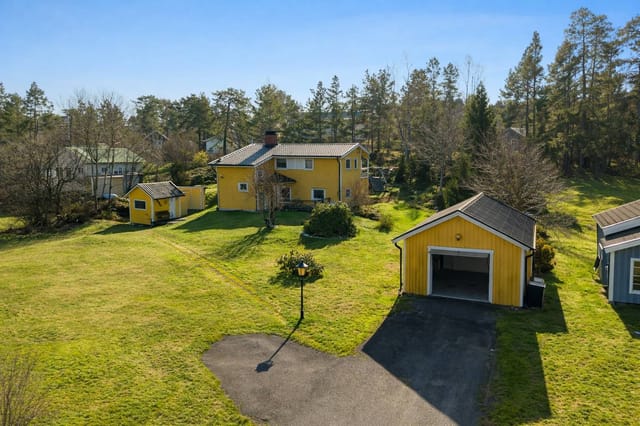
Exterior view of Grönö 3551

Early July mornings at this place have a particular quality. The mist sits low over Lake Nömmen, the water is glassy and completely still, and the only sound from inside the glazed conservatory is the occasional knock of a woodpecker somewhere deep in the birch trees behind the garden. You pour your coffee. You're not going anywhere in a hurry. That feeling — that specific, unhurried Swedish summer morning feeling — is what this cottage in Kristinelunds stugområde has been quietly delivering to its owners for decades. Sitting on a generous 770-square-meter plot in one of Vetlanda municipality's most established holiday home communities, this 60-square-meter house was built in 1960 and has been kept in genuinely good condition. It's not a project. You won't be calling contractors the week you arrive. Move in, open the windows, and start living the life you bought it for. The lake is 100 meters from the front door. Lake Nömmen is one of Småland's cleaner freshwater lakes — the kind where you can actually see the sandy bottom at the swimming spot, and where perch and pike fishing is taken seriously by the locals who've been doing it for generations. The private boat dock that comes with this property is the detail that changes everything. You don't have to share a communal slip, queue for access, or drag a kayak down a muddy bank. Your boat is there when you want it, full stop. Inside, the layout is honest and practical. The kitchen is well-equipped with real storage — enough bench space to actually cook a proper meal, not just heat something up. It opens into a living room where large windows frame the lake view and drag light deep into the room even on grey autumn afternoons. Two bedrooms handle a small family or a cou ... click here to read more
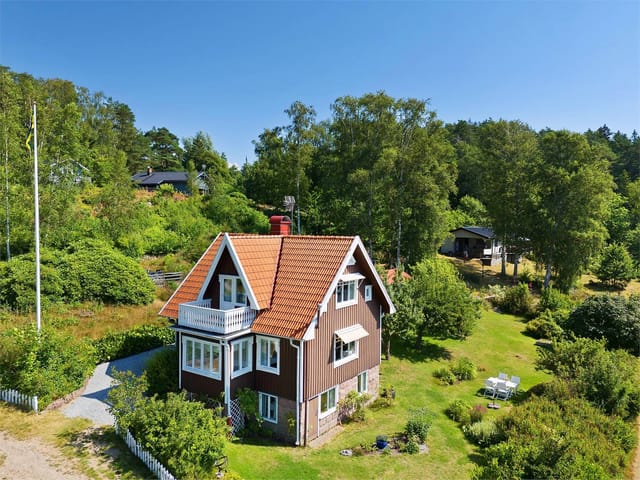
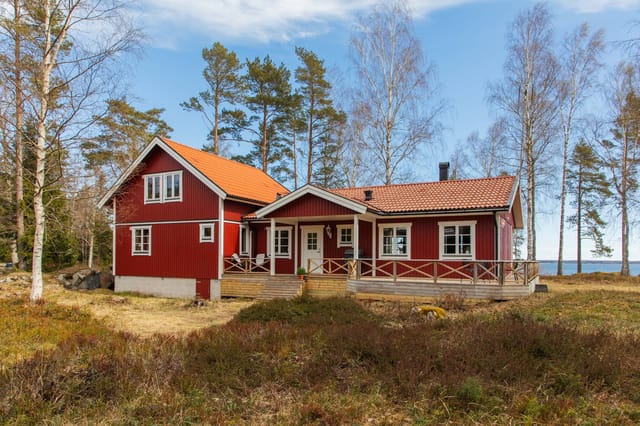
Exterior view of the holiday home