Blog published in Relocation
Share
Is Spain cheap to live in? Cost breakdown for 2026
Compare rent, groceries, utilities, and healthcare across Spanish cities. See sample budgets for singles, couples, and families in this detailed guide.

Spain is cheap to live in compared with the United States, the United Kingdom, France, Germany, and most of Northern Europe, but only if your city, housing type, and daily habits match the local cost structure. A couple in a mid-size city can live well on roughly €2,500 a month. The same couple in central Barcelona with a car and private schooling for the children can spend more than double that. "Cheap" depends on where you land.
This article treats affordability as two separate questions. The first is your monthly burn: what rent, utilities, food, transport, and healthcare actually cost. The second is purchasing power: whether your income, taxed under Spanish or foreign rules, covers that burn with room to spare. It uses city tiers, scenario budgets, and a stated methodology so you can adjust the numbers to your own situation.
Quick answer: where Spain is cheap and where it isn't
Spain's consumer price level sits roughly 10% to 15% below the EU average in recent Eurostat comparisons, and well below the Nordic countries, Ireland, and Germany. The gap is widest in restaurants, groceries, local transport, and services. It narrows in electricity, which is expensive by European standards, and in rent within the two largest metros.
A rough verdict by spending level:
- Low spend (€1,200 to €1,800 a month for a single person or couple): Realistic in Tier 3 and Tier 4 locations, or in outer neighborhoods of mid-size cities, if you cook at home and skip a car.
- Medium spend (€1,700 to €2,500): Comfortable in cities like Valencia, Seville, Zaragoza, or Alicante, including dining out weekly and private health insurance.
- Higher spend (€2,400 to €3,600 and up): Needed for central Madrid, Barcelona, Palma, or Málaga, particularly with a car, a larger apartment, or children in private school.
Value is strongest outside the city centers of Madrid and Barcelona. The figures here are modeled ranges built from official statistics, rental listing indices, and crowd-sourced benchmarks, and the sources section below explains how each is used.
How affordability varies by region
Four forces explain most of the price variation across Spain.
Rent elasticity. Spain's biggest job markets, Madrid and Barcelona, draw workers faster than new housing is built. Rents there respond to demand quickly, while inland provincial capitals with flat populations barely move.
Tourism pressure. Coastal cities and islands (Málaga, Palma, Alicante, Marbella, the Canary Islands) compete with short-term holiday rentals. Landlords can earn more from summer lets, which tightens the long-term supply and lifts prices.
Energy and climate. Electricity prices are the same national market, but consumption isn't. Madrid, Burgos, and Valladolid have cold winters and many homes without central heating. Seville and Córdoba have summers where air conditioning runs for months.
Local wages. Madrid and Barcelona pay more, which supports higher rents. Spanish workers in smaller provinces earn less, and landlords price accordingly.
A qualitative map of Spain's cost zones
Budgets stretch most in central Madrid, central Barcelona, Palma, and the prime districts of Málaga and Marbella. They compress in mid-size inland cities such as Valladolid, Salamanca, León, Zaragoza, and Granada, and in the interior provinces of Castilla-La Mancha, Extremadura, and Andalusia, where some of the lowest rents in Western Europe sit. Valencia and Seville land between the extremes: lower costs than the two big metros, with a full range of services, airports, and international healthcare.
City choice for retirees and remote workers
Retirees and remote workers have an advantage locals often lack: they can choose the location. Three decisions move the budget most.
- Neighborhood over city. A one-bedroom 15 minutes by metro from the center of Madrid or Valencia often costs 20% to 35% less than a comparable one in the core, and the quality of life is frequently better.
- Housing size. Spanish apartments are compact. Many couples are comfortable in 60 to 70 square meters, and each additional bedroom is a major rent multiplier.
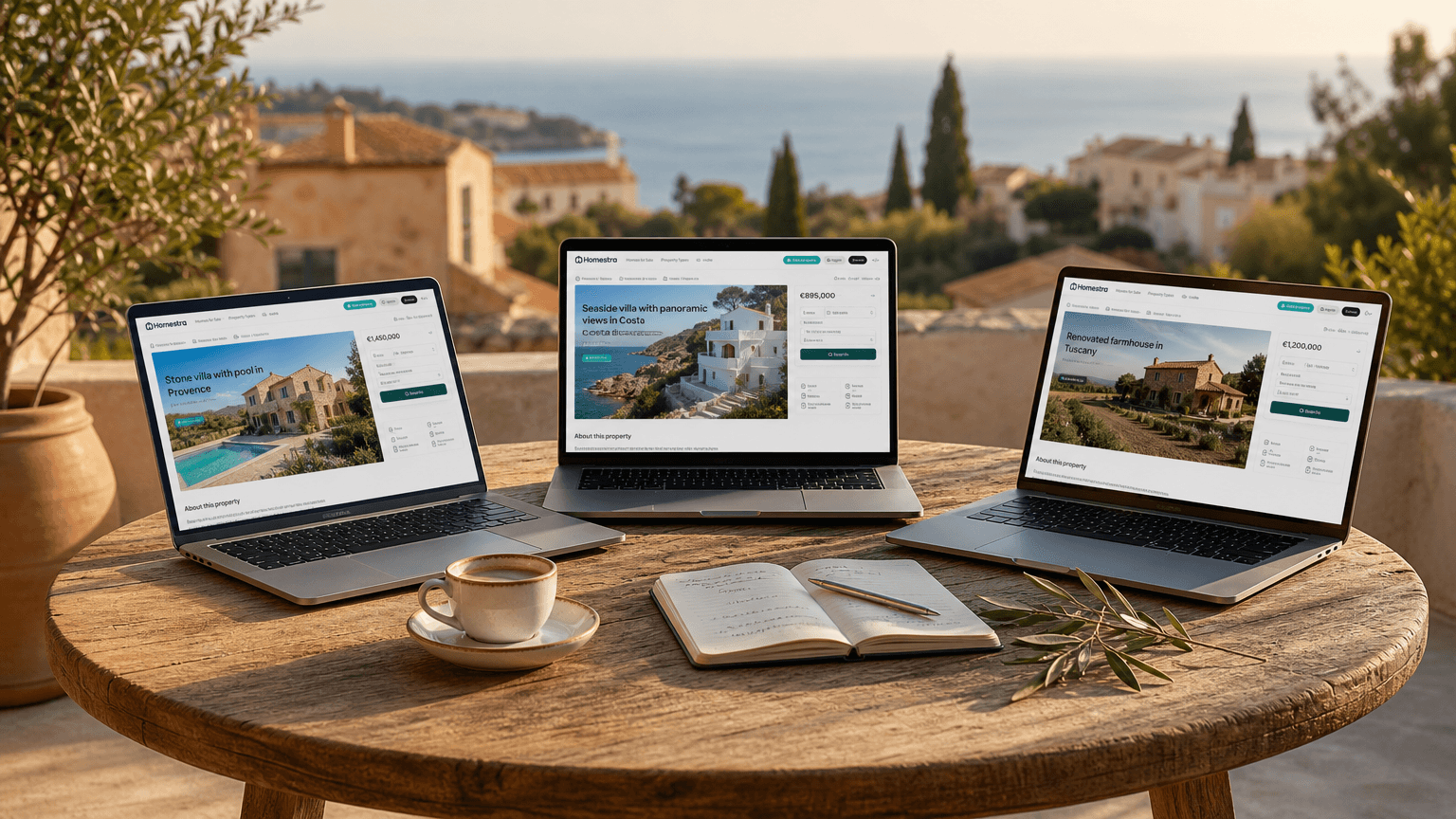
- Long stay versus short stay. If you spend six to eight months a year in Spain, a seasonal lease or an owned second home changes the math entirely. Browsing listings by city and property type on Homestra, which aggregates more than 200,000 properties across Europe, is a practical way to compare buying with renting in the same neighborhood before committing to either.
Average rent by city tier and housing type
Rent is the largest and most variable line in any Spanish budget. The table below groups cities into four tiers and gives monthly ranges for typical long-term, unfurnished or semi-furnished rentals. These are modeled ranges reflecting recent levels in the Idealista rental index and similar listing data. Idealista reported national averages in the range of €14 to €15 per square meter in recent periods, with Barcelona and Madrid at roughly €20 to €23, and the cheapest interior provinces at roughly €5 to €7. Listing prices move monthly, so check the live index for your target city before you finalize a budget.
| Tier | Example locations | Studio | 1-bedroom (central) | 1-bedroom (outer) | 2-bedroom (central) | 2-bedroom (outer) |
|---|---|---|---|---|---|---|
| 1 | Madrid, Barcelona | €900 to €1,300 | €1,100 to €1,600 | €850 to €1,200 | €1,500 to €2,300 | €1,100 to €1,600 |
| 2 | Valencia, Málaga, Seville, Bilbao, Zaragoza, Alicante | €550 to €850 | €700 to €1,100 | €550 to €800 | €900 to €1,500 | €700 to €1,000 |
| 3 | Valladolid, Salamanca, León, Albacete, Cáceres, Ciudad Real | €350 to €550 | €450 to €700 | €400 to €600 | €550 to €850 | €500 to €700 |
| 4 | Rural inland towns; smaller coastal towns | €300 to €500 | €300 to €500 | €300 to €450 | €400 to €650 | €400 to €600 |
Tier 4 coastal towns need a caveat. Long-term rents in places like the Costa del Sol, Costa Blanca, or Costa Brava can run at the Tier 2 level (€700 to €1,300 for a two-bedroom), while summer holiday lets in the same towns cost several times more. Many landlords offer lower "winter lets" from roughly October to May.
Rental realities for newcomers
- Deposits. Under the Urban Leasing Law (LAU), the legal deposit for a residential lease is one month's rent. Landlords can request additional guarantees, such as a bank guarantee or extra deposit, of up to two months.
- Agency fees. Since Housing Law 12/2023, landlords generally pay the rental agency's fees. Check that a fee isn't being passed on to you.
- Lease length. Standard residential contracts run five years (seven if the landlord is a company), but tenants can leave after six months with 30 days' notice. Contracts labeled "temporada" (seasonal) fall outside these protections, so read the type of contract carefully.
- Annual increases. Increases are tied to the IRAV index published by INE rather than to inflation directly. Catalonia and some other regions have also declared "stressed market" zones with additional rent controls.
- Furnishing. Spanish rentals are frequently unfurnished, sometimes without kitchen appliances or lighting fixtures. Confirm what's included, because furnishing an apartment is a real one-time cost.
Monthly living costs beyond rent
Utilities
Electricity is the cost that surprises people. Consumer electricity in Spain is priced above the EU's lowest-cost markets, and many homes rely on electric heating and, in the south, air conditioning. A couple in an apartment often pays €60 to €110 a month for electricity on average, with spikes above that in January and August. Water typically adds €15 to €30, and gas, if used, €10 to €30. Internet (fiber) runs about €25 to €40 and mobile plans €10 to €20 per line. A "basic" package of electricity, water, internet, and mobile for a single person lands near €110 to €140 a month. A "full" package with heating, air conditioning, and a larger home for a family is closer to €250 to €330.
Many apartment buildings also charge community fees (comunidad de propietarios), commonly €30 to €150 a month, which owners pay and tenants sometimes pay too. Ask before you sign.
Groceries and eating out
Supermarkets such as Mercadona, Lidl, Dia, Carrefour, and Aldi keep staple prices low, and fresh produce at local markets is often cheaper than in Northern Europe or the US. A single person who cooks at home typically spends €220 to €300 a month; a couple €380 to €550; a family of four €600 to €900. Eating out is the largest lever. A weekday lunch set menu (menú del día) is commonly €12 to €16 and includes a drink, while dinners at mid-range restaurants usually run €25 to €40 per person. A household that eats out four times a week will spend more on restaurants than on groceries.
Transport
Monthly unlimited public transit passes cost roughly €20 to €55 depending on the city, with deep discounts for youth and seniors. Cities such as Madrid, Barcelona, Valencia, and Seville are livable without a car. Outside the metros, a car becomes close to mandatory. Owning one adds fuel, insurance, annual tax, parking, and maintenance, easily €200 to €350 a month. That one item can separate a medium budget from a high one.
Healthcare for residents and non-residents
Spain's public system (Sistema Nacional de Salud) is available to people who contribute to Social Security, to pensioners with an S1 form from certain countries, and, after a qualifying period of registered residency, to others through the Convenio Especial. That program's monthly fee has been set at roughly €60 for people under 65 and €157 for those 65 and over. Eligibility rules change, so confirm them with the Spanish Social Security office (INSS) before relying on this.
Most visa categories for retirees and non-working residents, including the non-lucrative visa, require private health insurance with no co-payments and no waiting periods. Premiums depend heavily on age and insurer (Sanitas, Adeslas, DKV, and Asisa are the large providers), and a healthy person in their late 50s or 60s should plan for roughly €80 to €200 a month and get written quotes. Dental and vision are usually extra and are paid out of pocket in most cases.
Administrative extras
Budget for sworn translations, a gestor (administrative agent) to handle residency, tax filings, or vehicle paperwork, and a lawyer for property or inheritance matters. A gestor often charges €150 to €400 for a single procedure, and a good one frequently saves more than that by preventing rejected applications.
Sample budgets: single, couple, family
The budgets below are in euros per month and are designed for a Tier 2 city such as Valencia or Seville. No currency conversion is applied. Convert at the current rate from your bank or the European Central Bank's published reference rate on the day you plan the budget, because a rate quoted today won't hold for next year's cash flow.
| Profile | Low | Medium | High |
|---|---|---|---|
| Single | €1,170 | €1,700 | €2,370 |
| Couple | €1,700 | €2,470 | €3,630 |
| Family of four | €2,270 | €3,390 | €5,080 |
Here is how the medium budget breaks down:
| Line item | Single | Couple | Family of four |
|---|---|---|---|
| Rent | €850 | €1,050 | €1,300 |
| Utilities, internet, mobile | €140 | €170 | €260 |
| Groceries | €280 | €480 | €780 |
| Transport | €40 | €90 | €200 |
| Healthcare | €90 | €180 | €250 |
| Lifestyle buffer (dining, travel, entertainment) | €300 | €500 | €600 |
| Total | €1,700 | €2,470 | €3,390 |
To adjust for the tier: Tier 1 adds roughly €400 to €900 in rent for singles and couples, with groceries and dining up about 5% to 10%. Tier 3 removes about €250 to €450 in rent. Tier 4 inland towns can drop below the low budgets above, though healthcare access and travel costs partly offset the savings.
What scales with family size? Rent (an extra bedroom adds €200 to €400), groceries (nearly linear), healthcare (children are usually covered under public schemes if you qualify, but private coverage multiplies), and transport (a car becomes more likely). Public school is free, but extracurriculars, school lunches, and private or international school tuition sit in the lifestyle line and drive the high scenario. Tuition at international schools alone can be several hundred euros per child per month.
Salaries, taxes, and purchasing power
Affordability has a second layer that cost lists leave out. Spain's national minimum wage in 2025 was €1,184 a month in 14 payments, or €16,576 a year, and INE's wage structure survey puts average gross annual earnings around the high €20,000s. Rents in Madrid and Barcelona consume a large share of those wages, which is why Spanish headlines often describe housing as unaffordable even as visitors find the country cheap. Both statements are true because they rely on different incomes.
If your income comes from abroad, such as a US, UK, or Northern European pension, investment income, or a remote salary, you experience Spain's price level, not its wage level. That's the core of Spain's appeal for retirees.
Tax status changes the math
Residency determines which rules apply. Broadly, someone who spends more than 183 days in Spain in a calendar year, or whose center of economic interests is in Spain, is a tax resident and is taxed on worldwide income. Non-residents are taxed only on Spanish-source income, including a deemed income tax on owned property. Pensions, dividends, and capital gains follow different rules, and tax treaties (including the US-Spain treaty) can reduce double taxation. Special regimes, such as the "Beckham law" for certain workers relocating to Spain, offer a flat 24% rate on Spanish employment income up to €600,000 for up to six years, but they have strict conditions.
Do not rely on generic net-income figures from the internet. Get advice from a tax adviser who handles cross-border cases before you finalize either your residency plan or your budget.
Visa income thresholds are a floor, not a budget
The non-lucrative visa requires proof of income equal to 400% of the IPREM index, about €28,800 a year (around €2,400 a month) for a single applicant in 2025, with an additional 100% of IPREM per dependent. Consulates can change requirements, so confirm the current figure. The threshold roughly matches the medium-spend couple budget above, which helps explain why many retirees land in the mid-size city tier.
Data sources and methodology
Each source in this article does a different job.
- INE (Instituto Nacional de Estadística): official statistics on consumer prices, household spending patterns, wages, and the rent update index. INE anchors the question of how Spanish households actually spend.
- Eurostat: harmonized price-level comparisons across the EU, used for the Spain-versus-Europe context.
- BOE (Boletín Oficial del Estado): the legal source for rental law, deposit rules, tax regimes, and visa requirements.
- Idealista: the largest Spanish property portal, whose rental index reports asking prices by city, district, and province. Asking rents run somewhat above signed rents in competitive markets, so use them as a ceiling, not a guarantee.
- Numbeo: a crowd-sourced database useful for quick cross-checks of grocery, restaurant, and transport prices. Its sample sizes are uneven and it has no editorial verification, so it serves as a benchmark, never the sole authority.
Using several sources prevents a common mistake. A single crowd-sourced average for "Spain" blends Madrid with rural Extremadura and describes neither. The ranges here are modeled from the sources above and rounded, and they are deliberately presented as ranges. Figures were last reviewed in October 2026, and rental and energy prices should be rechecked against live sources before any major decision.
Tips to lower living costs in Spain
Housing. Look one or two metro stops outside the core. Ask about unfurnished versus furnished pricing, since the difference can be €100 or more. Negotiate a longer lease in exchange for a lower rent or a freeze on year-one increases. Avoid listings in dense tourist districts, where landlords price for holiday demand. If you're deciding between renting and buying, a platform like Homestra lets you filter by city, property type, and price and look at the neighborhood's market context before committing.
Utilities. Compare electricity retailers against the regulated PVPC tariff, and shift heavy use (laundry, dishwasher) to off-peak hours if your plan is time-of-use. Draft-proofing and efficient heaters cut winter bills more than any tariff switch. Budget for seasonal peaks and divide the annual total by twelve.
Food. Shop at one discount chain and one local market. Favor seasonal produce, and make the menú del día your main restaurant meal. Dinner out is where food budgets usually slip.
Admin and IT. Don't pay for duplicate telecom services, such as separate internet and mobile bundles from different carriers. Hire a gestor for residency, vehicle, or tax paperwork, because a rejected application or missed deadline costs more than the fee.
Transport. Use monthly passes and walk or cycle where feasible. If you need a car only occasionally, car rental or car-sharing costs less than ownership once you factor in insurance, tax, and parking.
FAQ for expats
Is Spain cheaper than the US?
For most households, yes, with exceptions in the biggest metros. Groceries, dining out, local transport, and services are typically cheaper, and healthcare is often far cheaper when public access or modest private insurance is available. Rent in central Madrid or Barcelona can approach mid-tier US city levels. A couple on the medium budget above (about €2,470) would find it hard to match the same housing, food, and healthcare costs in most comparable US cities.
What is the cheapest city in Spain for retirees?
There isn't a single answer. The lowest rents are in interior provincial capitals and towns (Tier 3 and 4), but retirees also need hospital access, an airport within reasonable distance, and an English-speaking support network. Cities like Valencia, Alicante, Málaga's outer neighborhoods, and Zaragoza balance cost with services. Compare by neighborhood and property type, not by city name alone.
How much should I budget for healthcare if I'm not eligible for the public system?
Plan for private insurance premiums of roughly €80 to €200 a month per person for adults in their late 50s and 60s, higher at older ages or with pre-existing conditions, plus out-of-pocket dental and vision. Get written quotes from at least two insurers, since age bands and exclusions vary.
What are the one-time costs when moving?
Use this checklist and fill in real quotes for your situation:
- Deposit (one month legally, plus any additional guarantee) and first month's rent
- Visa or residency application fees and the NIE foreigner ID fee
- Sworn translations and apostilles of documents
- Gestor or lawyer fees
- Health insurance paid upfront
- Furniture and appliances for an unfurnished rental
- Utility connection fees and deposits
- Vehicle purchase or import costs, if applicable
Buyers face a separate set. Transfer tax on resale homes runs roughly 6% to 11% depending on the region (new builds pay VAT plus stamp duty instead), and notary, registry, and legal fees typically add another 1% to 2%. After purchase come annual property tax (IBI) and community fees.
Does the cost of living change by season?
Yes. Electricity bills peak in winter and in midsummer. Coastal rents and short-term prices spike from June to September while winter lets drop. Holiday travel, fiestas, and festival periods raise dining and transport costs in many cities. Build a 12-month budget rather than extrapolating from a single month.
How do I keep rent from becoming a budget shock?
Choose a standard five-year residential contract rather than a seasonal one, confirm that annual increases follow the IRAV index, and check whether your area is a regulated stressed-market zone. Pick the neighborhood based on commute and services, not postcode prestige, and keep rent under roughly 35% to 40% of your net monthly income so that an energy-bill spike or a healthcare cost doesn't strain the rest of the budget.
Spain rewards the buyer or renter who does the arithmetic first. The country is affordable by Western standards when you pick a Tier 2 or Tier 3 location, size the home sensibly, cook most meals, and plan for energy and healthcare in advance. Run your own numbers against the ranges above, verify them against live listings, and test your shortlisted neighborhoods before you sign anything.
Share