Blog published in Buying property abroad
Share
Idealista vs Homestra: which is better for a Spanish second home
Compare idealista vs Homestra for finding a Spanish second home. Discover which portal offers better listings, search tools, and remote buyer support.

Most people shopping for a Spanish second home from abroad spend their first few weeks on the same task: scrolling. Hundreds of listings, mixed languages, photos of flats that were never going to suit a holiday home, and no clear sense of which ones are worth an email. The portal you choose decides how much of that scrolling you do, how reliable the data in front of you is, and how quickly you get from "interesting" to "booked viewing."
This article compares two portals that serve different jobs: idealista, Spain's dominant domestic marketplace, and Homestra, a cross-country platform built for second-home buyers. It covers what each does well, where each frustrates remote buyers, and how to use them through the stages of a real purchase. One point holds regardless of which you pick: no portal replaces local due diligence. Portals change what you can find and how efficiently you reach the viewing and legal checks. They don't change the need for those checks.
The short answer: idealista for Spain's mainstream stock, Homestra for second-home fit
If you want a single decision rule, here it is.
- Start with idealista if your priority is the widest possible view of Spanish stock, local price signals, and the ability to track a specific town or street closely.
- Start with Homestra if your priority is finding a home that fits a second-home lifestyle, searching in English, comparing Spain against other European options, and working through a process designed for remote buyers.
Most serious buyers end up using both, then converging on local verification. The rest of this article explains why, and how to run that process without wasting weeks.
What idealista and Homestra are built to do
idealista: Spain's high-volume domestic marketplace
idealista is a Spain-first portal. Its English homepage states it carries "more than 1.100.000 listings of flats and houses for sale or rent." That figure includes rentals, so the for-sale pool in any one town is smaller than the headline suggests, but the scale is still unmatched for Spain alone.
Beyond listings, idealista offers three things that matter to buyers:
- A saved-search alert service. According to idealista's Help Centre ("How to subscribe to the alerts service"), you save a search and are notified when matching listings appear or prices change.
- A free Property Valuator tool, documented in the Help Centre, that produces an estimated price. The same documentation distinguishes this online estimate from an official appraisal (tasación).
- A news section that publishes market statistics. One example is its article "How fast do homes really sell in Spain in 2026?", which reports that 13% of homes sold were on the market for less than seven days.
That last point matters for second-home buyers. If a meaningful share of desirable homes sell within a week, the speed at which you learn about a listing is a competitive factor.
Homestra: a second-home platform for international buyers
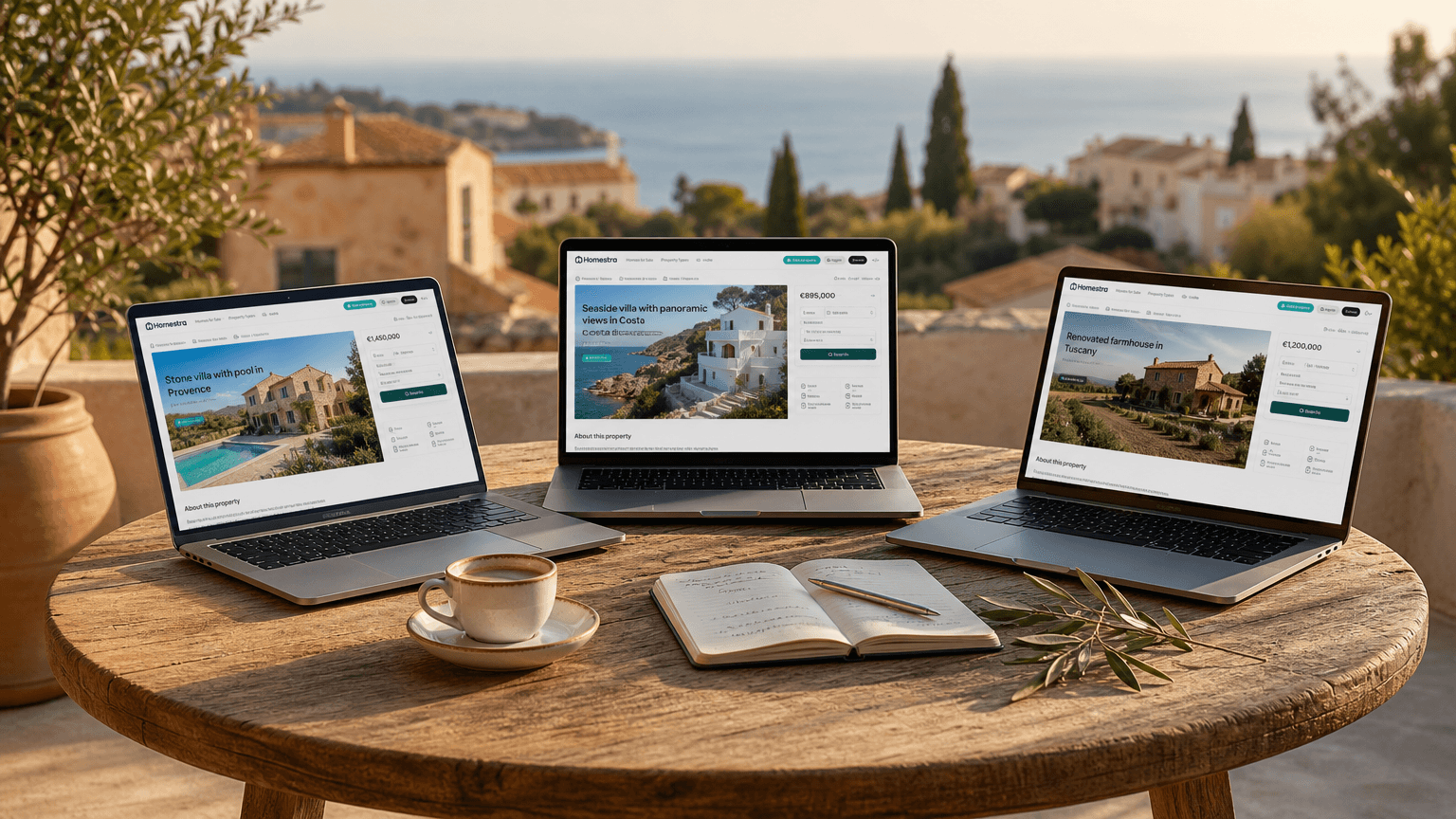
Homestra is built around a narrower audience: expats and international buyers looking for a vacation home, retirement property, or lifestyle purchase in Europe. The platform describes itself as Europe's #1 real estate platform for second homes and lists 200,000+ properties across multiple countries. Those figures cover the whole platform, not Spain alone. For a current Spain-specific count, check Homestra's Spain country page rather than relying on the pan-European number.
The practical difference is the lens. Listings are presented with lifestyle context and local insight, search is organized around the property types and price ranges second-home buyers typically use, and the experience is in English. Because it covers several countries, you can also compare Spain against Portugal, Italy, or France without learning a new portal each time.
More listings are not the same as more relevant listings
Volume is the most obvious difference between the two, and the least useful one on its own.
A portal with over a million listings includes everything: city-center flats priced for local owner-occupiers, investment lots, student rentals, garages, and commercial units. If you're hunting for a low-maintenance coastal townhouse, a village house with outbuildings, or a renovation project with sea views, a large share of what you scroll past is simply the wrong product. Filters help, but they only work as well as the data entered by each advertiser, and data quality varies from one listing to the next.
A curated second-home platform tends to show a different slice. You're more likely to meet rural fincas, coastal and golf-adjacent homes, renovation projects, and properties described with lifestyle in mind (walkability, climate, nearby airports, village character) rather than only square meters and floor numbers.
What you can miss by using only one portal
Exclusivity works in practical terms, not absolute ones.
- Using only idealista, you'll see the most mainstream Spanish stock, but you may spend a lot of time filtering out homes that don't match a second-home use case, and you'll be reading mostly Spanish-language descriptions written for local buyers.
- Using only Homestra, you'll get faster discovery for second-home typologies, but you won't see every ordinary resale flat in every Spanish town, and you'll want a second source for hyper-local price comparison.
Agents often advertise the same property on several portals, so overlap is common. The goal isn't to find "secret" listings. It's to pair a broad net with a well-matched one so you don't confuse one portal's inventory with the whole market.
How the search workflows differ for a remote buyer
Map search versus structured second-home filters
Map-driven search is excellent when you already know where you want to buy. Zoom into a coastal town, draw a boundary, and see what's on offer within a ten-minute walk of the beach. It's also how you spot price patterns by neighborhood. The weakness is that map-heavy interfaces can be hard to use when you're still deciding between regions, and they can crowd the screen with irrelevant results.
Structured filters work better in the discovery phase. Filtering by property type, price range, and location lets you compare several regions quickly before narrowing down. Homestra's filters and descriptions are designed for this phase, particularly for buyers who haven't yet decided between, say, Costa Blanca and inland Andalusia, or between Spain and another country altogether.
Saved searches and alerts: set them early
Alerts are the most underused tool in either portal. With idealista, the Help Centre describes saving a search to receive notifications on new matching listings and price changes. Given the sales-speed statistic above, a buyer who checks manually once a week will regularly arrive late to the best properties.
A practical way to set up alerts:
- Run a search with a deliberately narrow brief: one region, a realistic budget ceiling, and one or two property types.
- Save it, and set notifications to the most frequent option available.
- Create a second, wider search for comparison, so you learn what you give up by being strict.
- Review price-change alerts as seriously as new-listing alerts. A reduction on a property that has sat unsold for months is useful negotiating information.
Repeat the same logic on Homestra with your second-home criteria, and use the platform's alerts or favorites features so new inventory in your target areas reaches you without constant checking.
Valuation tools are a starting estimate, not a verdict
idealista's Property Valuator gives a quick estimate, and its own Help Centre separates that estimate from an official appraisal (tasación). Treat it the same way. It's useful for spotting a listing priced far above or below comparable homes, and for framing a first conversation. It can't see a damp ceiling, an unlicensed extension, a shared-well arrangement, or the condition of the roof.
For a purchase decision, a formal valuation or an independent survey of the specific building is the right tool. A mortgage lender will usually require its own valuation anyway. Use the online estimate as a sanity check, and keep the listing price, your own comparables, and the on-site inspection as the real inputs.
A remote buyer's workflow from shortlist to viewing
The portals differ most at the stage after you find a property you like. Here is a workflow that works on either, and what changes between them.
Step 1: shortlist five to eight homes, not thirty
Build a short list with a spreadsheet or notes file. For each property, record the link, asking price, size, plot size if relevant, year built, any stated community fees, and listing date. Record what you don't know as well, since the gaps become your first questions.
Step 2: contact sellers with structured questions
On idealista, you contact the advertiser (an agency or a private seller) through the listing's contact form. On Homestra, you reach out through the platform's contact flow for the listing. Either way, write one clear message rather than a vague "is this still available?" Ask for specifics (a template appears in the examples below).
Expect response times and languages to vary. Many Spanish agencies on a local portal operate mainly in Spanish, and a message in English may take longer or get a shorter reply. Writing in simple Spanish, or using an English-oriented platform where listings are set up for international inquiries, can save days.
Step 3: arrange viewings in clusters
Viewing trips are expensive in time and travel. Ask agents to line up several viewings across two or three days in one area, and ask for the property's complete documentation beforehand so you aren't reading paperwork in a car park.
Step 4: verify before you commit
Viewing a house you love is where buyers tend to relax. That's when the checklist matters most.
When to hire a local agent, and when to hire an independent lawyer
Portals connect you with sellers and their agents. The agent usually works for the seller's side of the transaction. As the buyer, you need your own representation for anything with legal weight. A simple decision tree helps.
Lower-risk property. A relatively recent apartment or townhouse in a managed community, clear ownership, no works needed, and a straightforward purchase. You may be comfortable relying on the selling agent for logistics, but an independent lawyer should still review the contract and run title checks. The cost is small compared with the purchase price.
Higher-risk property. Treat any of the following as a signal to bring in an independent lawyer (abogado) and a surveyor or architect before paying any deposit:
- An older house, a rural property, or a finca
- A renovation project, or any extension or outbuilding that may lack permits
- Shared access, shared water, or private wells and septic systems
- Inherited property with several owners
- Any mismatch between what the listing says and what the documents show
- Pressure to sign or pay a deposit quickly, before you've seen documents
A local buyer's agent, separate from the seller's agent, is worth considering when you're buying in a region you don't know, need negotiation support, or can't visit often. They can screen properties, attend viewings on your behalf, and flag issues that a photo won't show. Their incentives and fees differ from a listing agent's, so ask how they're paid.
What to verify before any deposit changes hands
Spanish purchases commonly proceed in stages. Legal sources such as Balcells Group's article "Buying a property in Spain: Requirements and Steps" describe the use of deposits and the contrato de arras (a deposit or earnest-money contract) as part of the staged workflow. It's common but not automatic, and its terms matter a great deal: what happens if you withdraw, what happens if the seller does, and what conditions must be met first. Have a lawyer read it before you sign.
Before you pay a reservation or arras deposit, confirm the following:
- Ownership and charges. Your lawyer should obtain the registry extract (nota simple) from the Registro de la Propiedad, showing the owner, and any mortgages, liens, or other charges on the property.
- Debts attached to the property. Ask about unpaid property tax (IBI) and community fees. Your lawyer can request confirmation from the community administrator.
- Energy certificate. Sellers must typically provide an energy performance certificate when selling. Ask for it up front.
- Habitability and licenses. Ask whether the property has the documentation required locally for occupancy and, for rural homes, whether the buildings and extensions are properly registered. Requirements differ by region, so this is a question for local counsel.
- Building condition. Order a technical inspection for older or renovated properties. Photos and an online price estimate say nothing about structure, damp, wiring, or roofing.
- Utilities and services. Check electricity, water source, sewage or septic, internet coverage, and whether contracts transfer easily.
- Your own paperwork. Foreign buyers need a Spanish tax identification number (NIE), and many open a Spanish bank account for the purchase and ongoing bills. Start these early; they can slow a closing.
On costs, non-resident buyers should budget for taxes and fees on top of the price: transfer tax or VAT depending on whether the property is resale or new, stamp duty in some cases, notary and registry fees, and legal and agency costs. Rates and rules vary by region and property type, so ask your lawyer for a written estimate for your specific purchase, and check the relevant regional tax authority's published rates rather than relying on a general figure.
After the deposit stage, the usual path leads to a signing before a notary (escritura), payment of the balance and taxes, and registration of the deed at the Registro. Your lawyer should walk you through each step and tell you what you'll sign beforehand.
Holiday home versus permanent move: how the portal choice shifts
| Priority | Holiday or seasonal second home | More permanent or retirement-leaning |
|---|---|---|
| Property type | Low-maintenance townhouse or apartment, lock-and-leave | Larger house, garden, possibly a renovation |
| Search focus | Proximity to airport and beach, community amenities | Healthcare, year-round services, neighborhood feel |
| Where idealista helps most | Tracking price changes in a specific coastal town | Comparing local prices across many towns and property types |
| Where Homestra helps most | Fast discovery of second-home typologies in English | Comparing regions and countries before committing |
| Main risk | Unexpected community fees, rental restrictions | Hidden renovation costs, unlicensed works |
| Professional help | Lawyer for contract and title | Lawyer plus surveyor or architect |
If you plan to rent the property out when you're away, check local rules before you buy. Tourist-rental licensing differs by region and municipality, and some communities restrict short-term lets in their own statutes. No portal listing will settle that for you.
Three illustrative buyer journeys
These are composite scenarios, not specific transactions, but they show how the pieces fit together.
Example 1: a coastal townhouse for holidays
A buyer wants a low-maintenance townhouse within a short drive of an airport, for six to eight weeks of use a year. They start on Homestra, filtering by property type and price range across two coastal regions to see which area gives the best match, then narrow to one. They create saved searches on both Homestra and idealista for that area. When an idealista price-change alert shows a reduction on a townhouse that's also been on the market for a while, they ask the agent about the reason for sale and the community fee level. They book two viewings in one trip and shortlist the better home. Before any deposit, their lawyer obtains the nota simple, confirms there's no debt to the community, and reviews the arras contract.
Example 2: a larger house that needs renovation
A buyer considering a longer stay finds a village house with land and an outbuilding that needs work. The idealista Property Valuator suggests an estimate roughly in line with the asking price, which gives them some confidence. During the viewing, however, they notice damp patches and an extension that doesn't appear in the listing's plans. They commission an architect's inspection and ask their lawyer to confirm whether the extension is registered. The inspection finds that repair costs are significant, and the registry shows the extension was never declared. They renegotiate based on the report or walk away. The online estimate told them where to start. The inspection and the registry told them what the house was actually worth to them.
Example 3: the questions to send before a viewing
Whichever portal you use, a structured first message separates serious buyers from casual browsers and gets you real information. Keep it short, polite, and in simple language that can be translated if necessary. Cover these points:
- Confirm the property is still available and ask how long it's been listed.
- Ask whether the property is owned by one person or several, and whether the seller is the registered owner.
- Ask for the nota simple, the energy certificate, the latest IBI receipt, and the community fee amount.
- Ask whether there are any outstanding debts, mortgages, or pending works or assessments in the building.
- Ask for the floor plan and the surface area according to the registry and the cadastre, and whether they match the listing.
- Ask whether the property has ever been used as a holiday rental, and whether a tourist license exists.
- Propose two or three viewing dates and ask whether the owner or agent can attend.
A seller or agent who answers these promptly and with documents is easier to work with than one who deflects. Slow, vague replies are useful information too.
Which portal should you open first?
For Spain-only searches where you want the largest pool of mainstream listings, market statistics, and the tightest look at one town's pricing, idealista is the natural first stop. Its alert system, valuation estimate, and news coverage give you a strong read on what's moving and how fast.
For buyers who want to find a second home that suits how they'll actually live in it, search in English, compare Spain against other European countries, and follow a workflow designed for people buying from abroad, Homestra is the faster way to a good shortlist. Its focus on second-home property types and lifestyle context means less time ruling out listings that were never meant for you.
The strongest approach uses each for what it does best:
- Discover on Homestra to define your region, property type, and budget realistically.
- Track that same area on idealista to confirm local pricing and catch new listings and reductions early.
- Shortlist five to eight homes and send structured questions to each seller.
- Visit in clustered trips, with your lawyer already engaged for anything beyond a simple purchase.
- Verify title, debts, energy certificate, licenses, and building condition before signing any deposit contract.
If you're ready to start, browse second homes on Homestra, set a saved search for your target region, and build your shortlist before you book flights. A buyer who arrives for viewings with five well-researched options and a lawyer already briefed will make a better decision than one who spent the same weeks scrolling.
Share