Blog published in Buying property abroad
Share
Buying Property in Norway as a Foreign Buyer: 2026 Guide
Complete guide to Norway real estate for international buyers. Covers foreign ownership rules, dokumentavgift, D-number, budrunde, and transaction costs.
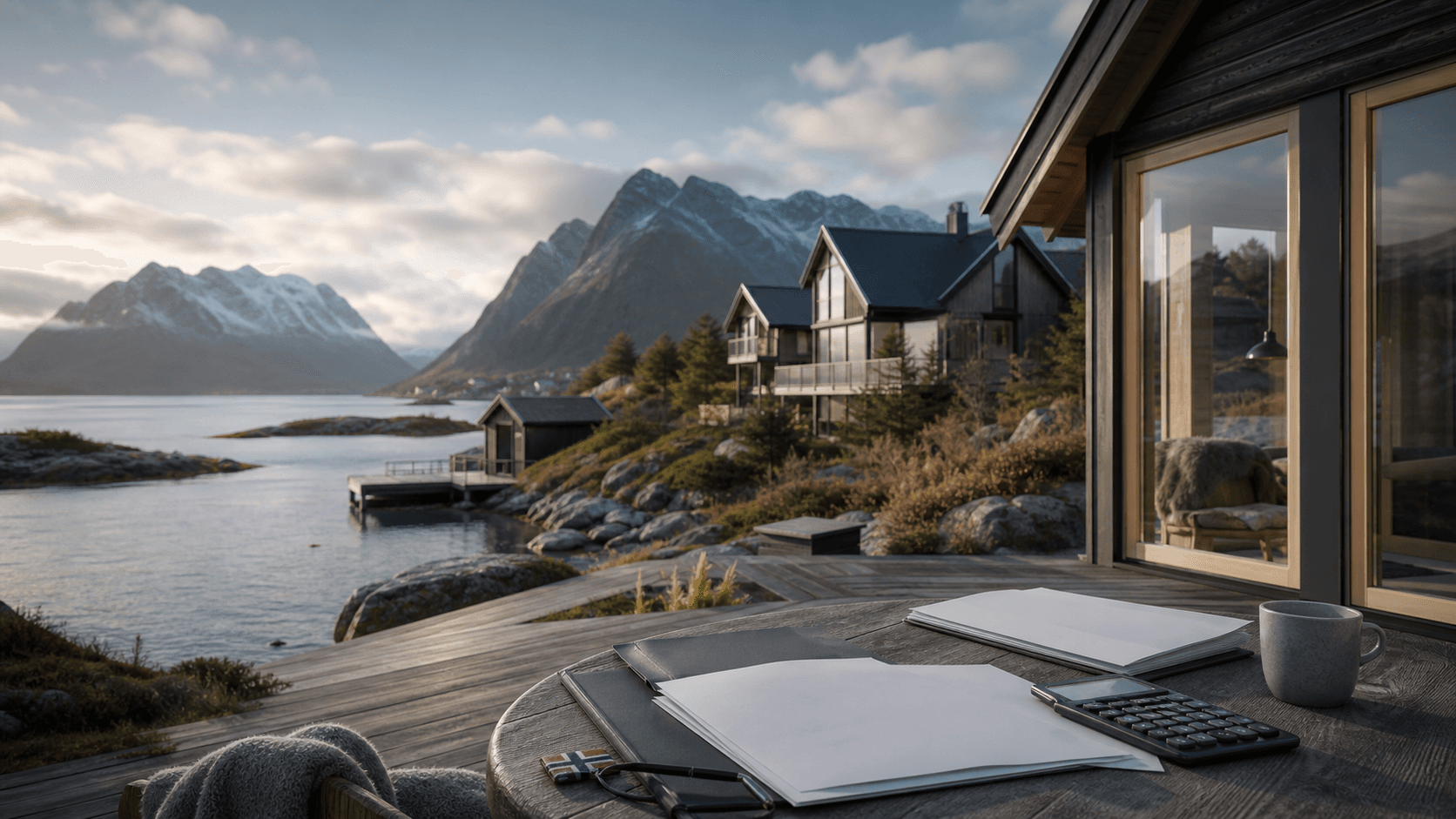
Norway draws international buyers for its fjord-side cabins, coastal retreats, and well-regulated urban property markets. The process works differently from most European countries, and the gap between expecting a familiar transaction and navigating a budrunde bidding round or calculating dokumentavgift correctly can be significant. This guide covers everything a foreign buyer needs to know: the legal framework, taxes, financing realities, the purchase process step by step, and specific due diligence for cabins and coastal properties.
All figures and rules here are sourced from primary Norwegian government sources (Kartverket, Skatteetaten, UDI, Regjeringen.no, SSB, and Eiendom Norge) and should be treated as general guidance. Consult a qualified Norwegian lawyer and tax adviser before committing to a purchase.
Can foreigners buy property in Norway?
The short answer is yes, with important caveats. There is no broad prohibition on foreign nationals purchasing residential property in Norway. Non-residents and foreign citizens can acquire apartments, houses, and holiday cabins on the open market under the same conditions as Norwegian citizens.
The exceptions relate to specific property categories. Agricultural land and certain rural plots are subject to the Norwegian Concession Act (Konsesjonsloven), which requires the buyer to obtain a concession (konsesjon) from the municipality before the purchase can proceed. The Landbruksdirektoratet (Norwegian Agricultural Agency) administers the national framework, but municipal authorities make individual decisions. Concession requirements can include conditions such as residence obligations, meaning the buyer must live on the property. For a foreign buyer purchasing a rural plot or farm, verifying whether konsesjon applies is not optional; it must be confirmed before bidding.
Ownership structures: selveier vs. borettslag
Two ownership forms dominate Norwegian listings and they carry very different legal and financial implications.
Selveier (freehold): You own the property and the underlying plot outright. Costs at transfer include the full document fee (described below). Due diligence is straightforward relative to the cooperative model.
Borettslag (housing cooperative): You purchase shares or an andel (unit entitlement) in the cooperative that owns the building. You do not hold title to the real estate directly. This means the document fee (dokumentavgift) does not apply on borettslag transfers, which reduces upfront cost. However, every borettslag unit carries a proportional share of the cooperative's collective debt, called fellesgjeld. You need to add that figure to the purchase price to understand the true economic cost of the property. Monthly common costs (felleskostnader) cover maintenance, shared debt servicing, and building insurance. These can range from a few hundred to well over a thousand euros per month depending on the building and the size of its outstanding debt.
The D-number requirement
Foreign buyers who are not registered as Norwegian residents need a D-number, a temporary national identification number issued by Norwegian authorities. According to UDI (the Norwegian Directorate of Immigration), the D-number is used in formal identification contexts, including financial transactions and property registration. In practice, most Norwegian banks will require a D-number before opening an account or processing a mortgage, and the deed registration with Kartverket requires one. Applying early is important because processing can take several weeks, and delays at this stage can slow down an entire transaction.
Taxes and ongoing ownership costs
Document fee (dokumentavgift)
According to Skatteetaten (The Norwegian Tax Administration), the document fee for transferring property ownership is 2.5% of the property's sale or market value at the time of registration. This must be paid when registering the document that transfers title. Kartverket confirms: "The fee for registering a deed is NOK 545. The stamp duty of 2.5 per cent of the property's market value is also charged."
Two points are critical for budgeting. First, the fee is levied on market value, not necessarily the agreed purchase price. If the agreed price is below assessed market value, the higher figure determines the tax base. Second, the fee applies to selveier properties but not to borettslag transactions, because those involve a share transfer rather than a deed registration.
For a property selling at NOK 3,500,000 (approximately EUR 300,000), the document fee alone is NOK 87,500. Add the Kartverket registration fee of NOK 545, and the total transfer tax and registration cost exceeds NOK 88,000.
Property tax (eiendomsskatt)
Norway does not have a uniform national property tax. Eiendomsskatt is a municipal tax that each municipality decides whether to impose and at what rate. Some municipalities charge no property tax at all; others apply rates that can add several thousand kroner annually per property. Buyers should confirm with the selling agent or the relevant municipality whether eiendomsskatt currently applies to the property and at what rate. Municipal rates and rules change, so verify this directly before committing.
Capital gains on resale
Skatteetaten's guidance on "tax when you sell a residential property or other property" is clear: any profit from selling Norwegian property is generally taxable. Exemptions exist but depend on how the property was used. For a primary residence, a common exemption applies if the seller owned and lived in the property for a qualifying period. Holiday homes and investment properties generally do not qualify for the same exemptions. Non-residents are subject to Norwegian taxation on gains from Norwegian real estate regardless of where they reside. Before purchasing with the intention of reselling, confirm your specific tax position with a Norwegian tax adviser and review Skatteetaten's published guidance directly.
Rental income tax
If you let the property, Skatteetaten's guidance on "tax when you rent out houses and properties" applies. Non-residents must report rental income from Norwegian property to Norwegian tax authorities, and deductible expenses can offset taxable profit. The rules differ between short-term holiday rental and long-term residential letting, so professional advice is recommended before establishing a rental arrangement.
Financing and mortgages for non-residents
Norwegian banks can and do lend to foreign nationals, but the underwriting process is stricter than for resident borrowers. Lenders require documented proof of income (typically payslips and tax returns from the buyer's country of residence), proof of the source of funds for the deposit, credit history or equivalent documentation, and a D-number alongside a Norwegian bank account.
The Norwegian lending regulation, amended as of December 2024 by the Ministry of Finance (Regjeringen.no), increased the maximum loan-to-value ratio for residential mortgages from 85% to 90%, while retaining a debt-to-income limit of 500%. In practice, non-resident buyers often find that individual banks apply more conservative internal policies and may require a larger deposit than the regulatory minimum. A 30-40% down payment is a realistic starting assumption for non-resident applicants, though individual circumstances vary.
The most important practical step is obtaining a written financing pre-approval (finansieringsbevis) before participating in a budrunde. Bids in Norway are legally binding once accepted. Bidding without confirmed financing is a significant legal and financial risk.
The Norwegian property purchase process, step by step
1. Pre-search preparation (4-8 weeks before bidding)
- Apply for a D-number through the relevant Norwegian authority
- Establish contact with a Norwegian bank and begin mortgage pre-approval
- Engage a Norwegian real estate lawyer (advokat), particularly if you are unfamiliar with Norwegian property law
- Set a total budget that incorporates purchase price, 2.5% document fee, legal fees, bank fees, and any renovation allowance
2. Finding listings and reading the sales documents
Most Norwegian properties are listed on Finn.no, and international buyers can also search platforms such as Homestra, which offers Norwegian property listings alongside broader European inventory, with search tools tailored to international buyers.
Every listed property in Norway comes with a salgsoppgave (sales brochure), a legally required disclosure document that includes the property's title information, shared debt (for borettslag), zoning details, energy rating, and any known defects. Always read this document in full before attending a viewing. Properties also typically include a tilstandsrapport (technical condition report), an independent assessment of the building's physical condition, graded by severity. Pay particular attention to moisture risk ratings, roof condition, and heating system assessments, especially for older cabins or coastal properties.
3. Viewing and bidding (budrunde)
The Norwegian bidding process is distinctive. After an open house viewing, interested buyers submit written bids through a regulated process called the budrunde. Bids are time-stamped and each bid must include a deadline by which the seller must respond. Bids and counteroffers are legally binding upon acceptance. The process typically runs within a single business day, with bids escalating in rounds.
Bidding without a valid finansieringsbevis exposes you to liability if you win the bid but cannot complete. Inform your Norwegian lawyer before participating so they can review bid terms.
4. From accepted bid to settlement
Once a bid is accepted, the parties sign a purchase agreement (kjøpekontrakt). Settlement typically follows 4-8 weeks later. At settlement, funds are transferred and the deed is registered with Kartverket. The document fee and registration fee are paid at this stage. The full process from pre-approval to registration typically takes 2-4 months for a straightforward transaction, though delays involving D-number processing or foreign document translations can extend this.
Transaction cost summary
The following applies to a selveier (freehold) transaction at an assumed purchase price of NOK 3,500,000:
| Cost item | Approximate amount |
|---|---|
| Document fee (dokumentavgift at 2.5%) | NOK 87,500 |
| Kartverket deed registration fee (tinglysingsgebyr) | NOK 545 |
| Legal/advokat fees | NOK 15,000, 30,000 (est.) |
| Bank mortgage establishment fee | Varies by lender |
| Property survey/valuation | NOK 5,000, 15,000 (est.) |
| Total estimated transaction costs | approx. NOK 108,000, 133,000 |
For borettslag, the dokumentavgift does not apply, but confirm the fellesgjeld and felleskostnader figures, which represent ongoing financial obligations that materially affect affordability.
Beyond closing, budget for property insurance, any applicable eiendomsskatt, utility costs (which in Norway include electricity for heating, which is a significant expense in winter), and regular maintenance. For holiday cabins, winterization costs and periodic access road maintenance can be material.
Permits, zoning, and building considerations
Buying an existing home and modifying it, or buying a plot to build on, involves the Norwegian planning permission system (plan- og bygningsloven). Renovation work above certain thresholds requires a building permit (byggetillatelse) from the municipality. New builds require full planning approval and compliance with the current technical requirements under TEK17 (the Norwegian building regulations).
For rural plots, verify zoning status early. Agricultural land classified as LNF (Landbruk, Natur og Friluftsliv) is typically not available for residential development without special dispensation. If you are considering a rural property with the intention of building, confirm with the municipality whether the plot is zoned for construction before proceeding.
Konsesjon, where required, must be applied for before transferring ownership. The Landbruksdirektoratet administers the national rules, and the process can take several months. Building a timeline that accounts for this approval is essential if rural or agricultural land is involved.
Coastal and shoreline property considerations
Norway's coastline is subject to the plan- og bygningsloven 100-meter coastal zone rule, which generally prohibits construction within 100 meters of the shoreline without municipal dispensation. This applies to new buildings, major renovations, and permanent structures, including boathouses and piers. When buying a coastal property that includes or is adjacent to a boathouse (naust) or dock, verify:
- Whether existing structures have documented planning permission
- Whether the boathouse or pier is registered and can be insured
- Whether water access rights are tied to the property deed or are subject to separate agreements
- Whether the property is accessible year-round or only seasonally by road
Insuring a property in a remote coastal or island location can be more complex than insuring an urban apartment. Request insurance quotes before proceeding with a purchase.
Due diligence checklist for Norwegian properties
The tilstandsrapport is the starting point, not the endpoint, of technical due diligence. Below is a structured checklist adapted to Norwegian property types.
For all properties:
- Confirm TG ratings (condition grades) in the tilstandsrapport for roof, moisture/dampness, drainage, and foundation
- Verify the heating system type and condition (heat pumps, district heating, wood-burning stoves, electric baseboards)
- Check for any outstanding municipality orders or enforcement notices
- Confirm property boundaries match the register entry at Kartverket
- Review the energy certificate (energiattest)
For borettslag:
- Confirm the total fellesgjeld (shared debt) and calculate the effective total acquisition cost
- Review the last 3 years of cooperative meeting minutes (sameiemøte/generalforsamling) for planned major works, disputes, or unexpected cost items
- Confirm current felleskostnader (monthly common costs) and any announced increases
- Verify whether the cooperative has an adequate reserve fund
For cabins and rural properties:
- Confirm water source: municipal supply, borehole (brønn), or surface water collection
- Verify septic/wastewater system compliance with current municipal environmental standards. Non-compliant systems require costly upgrades
- Confirm power supply: on-grid, or off-grid requiring generator/solar
- Assess winterization: are water pipes, drainage, and heating protected for sub-zero temperatures?
- Check road access: is the access road private or maintained by the municipality? What are the shared road maintenance obligations and costs?
- For mountain cabins, verify whether the property is accessible year-round or only in specific seasons
For coastal and waterfront properties:
- Confirm permits for all waterside structures (boathouse, pier, dock)
- Verify shoreline easements and any shared access rights
- Check flood risk and any municipal coastal zone restrictions
- Assess condition of any boat-access infrastructure if road access is limited
Browsing cabins for sale in Norway on Homestra provides a useful reference for understanding listing formats, salgsoppgave availability, and typical price ranges across different regions before you begin formal negotiations.
Norwegian property market: pricing and trends
Norway's residential market is tracked by Statistics Norway (SSB) through the price index for existing dwellings, which measures transaction prices of homes sold on the open market. In its December 2025 market forecast (Prognose for boligmarkedet 2026), Eiendom Norge projected 6% nominal housing price growth for 2026, reflecting continued demand in the major urban markets.
Price variation across Norway is substantial. Oslo and its surrounding municipalities command the highest prices per square meter, with urban apartments frequently transacting well above NOK 60,000–80,000 per sqm in sought-after districts. Bergen, Stavanger, and Trondheim are significantly more affordable than Oslo for comparable apartments. Holiday cabins range from under NOK 500,000 for remote, basic properties to well above NOK 10 million for premium fjord-side or mountain locations with modern facilities.
To build a realistic budget, use Finn.no's sold-price filter to pull recent comparable transactions in your target municipality. Eiendom Norge's quarterly price statistics and SSB's index both provide regional context. Do not rely on asking prices alone; the budrunde process often pushes final sale prices meaningfully above the listed ask, particularly in competitive urban markets.
For international buyers who want to compare Norway against other European markets, Homestra's resources on buying property abroad offer practical context on cross-border cost structures and process differences.
Practical checklist: who does what, and what to prepare
Your role as the buyer:
- Apply for D-number well in advance of bidding
- Secure a finansieringsbevis (mortgage pre-approval) in writing
- Read the salgsoppgave and tilstandsrapport for every property you bid on
- Confirm konsesjon requirements if the property involves agricultural or rural land
- Have sufficient funds in a Norwegian bank account by settlement date
Your Norwegian real estate lawyer (advokat):
- Review purchase agreement terms and bid conditions
- Conduct title search and verify encumbrances through Kartverket
- Handle deed registration post-settlement
- Advise on tax obligations specific to your situation
Your lender:
- Provide finansieringsbevis and confirm mortgage terms
- Transfer settlement funds to escrow or directly per Norwegian convention
Kartverket:
- Registers the transfer and records the tinglysingsgebyr and dokumentavgift
- Issues confirmation of the registered deed (grunnboksutskrift)
Skatteetaten:
- Issues D-number (in coordination with UDI and relevant registrars)
- Handles capital gains assessment on sale
- Governs rental income tax reporting for non-residents
Document checklist for non-residents:
- Valid passport (notarized copy may be required by lender)
- Proof of income: 2-3 years of tax returns or equivalent from country of residence
- Proof of source of funds for deposit
- Bank statements covering recent months
- D-number confirmation
- Mortgage pre-approval letter
- Translations of foreign documents where required by the bank or notary
For those beginning their search, Homestra's platform provides access to over 200,000 European properties, with Norwegian listings across urban apartments, fjord-side homes, and mountain cabins. The Norway property resources on Homestra's blog are a useful starting point for comparing regions, understanding listing documentation, and planning your purchase timeline before you attend your first viewing.
Share