Blog published in Buying property abroad
Share
Cost of a house in Norway in US dollars: 2025 guide
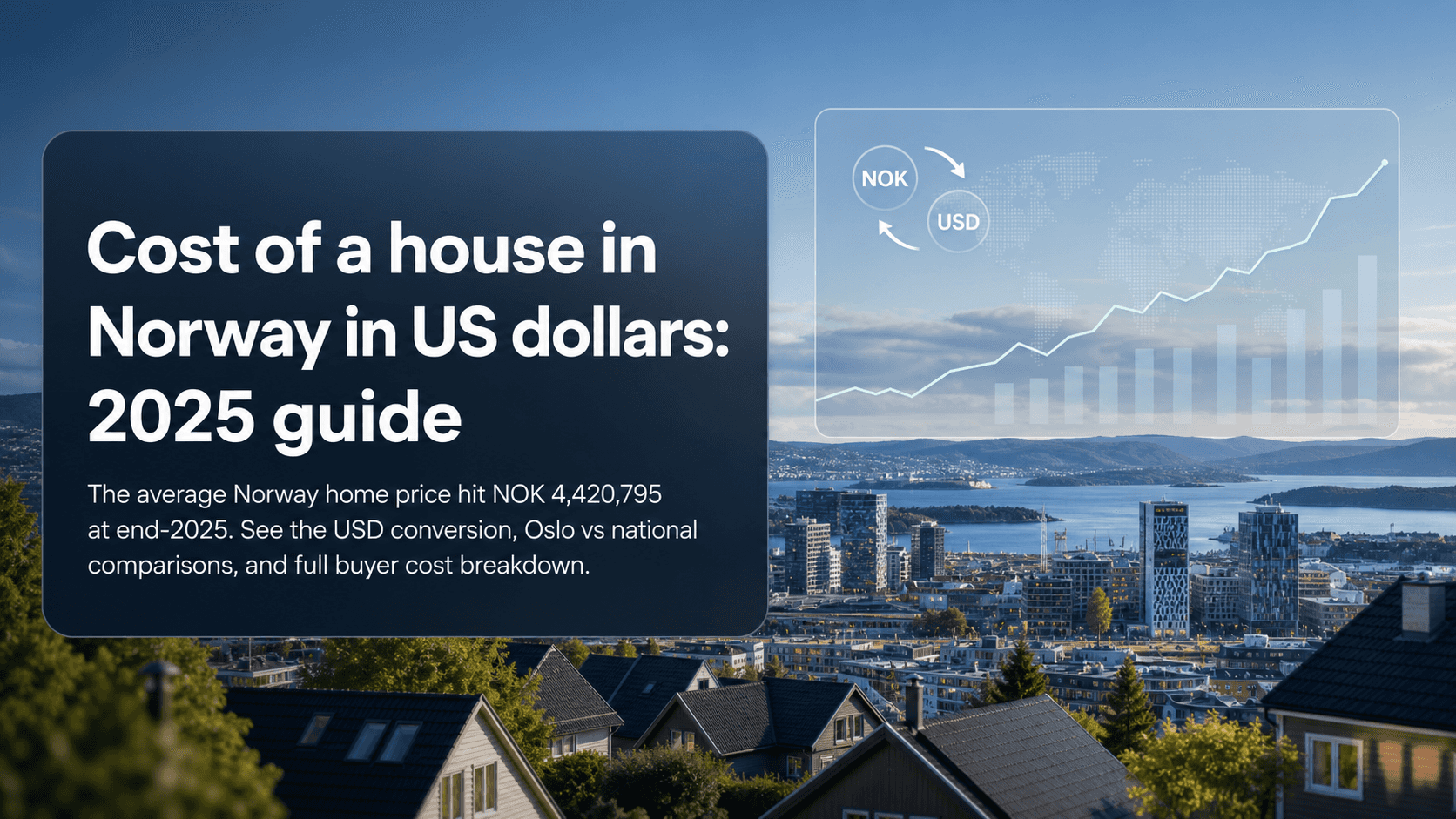
A 2025 guide to the cost of a house in Norway in US dollars, including the national average, NOK to USD conversion, Oslo vs regional prices, price per square meter, and buyer costs.
For international buyers, the first question about any market is usually the simplest: what does a house actually cost here, in dollars? Norway is a consistently high-demand European market, but getting a reliable USD figure requires more than a quick Google search. Exchange rates shift, national averages mask enormous regional variation, and the headline transaction price is only the starting point for a real budget. This guide walks through the official numbers, the conversion math, and the extra costs every buyer needs to account for.
Quick answer: the average Norway home price in USD
According to Eiendom Norge, the industry association that publishes Norway's most widely cited residential price data, the average home price in Norway at the end of December 2025 was NOK 4,420,795. Home prices rose 5% across 2025.
To convert to USD, Norges Bank (Norway's central bank) publishes daily mid-market "middle rates" (the midpoint between interbank buying and selling rates at a given time). At a representative mid-market rate of approximately NOK 10.80 per USD, that national average works out to roughly $409,300 USD.
| Benchmark | NOK | USD (approx.) |
|---|---|---|
| National average (Dec 2025) | 4,420,795 | ~$409,300 |
| Oslo average (est. range) | 6,000,000-7,000,000+ | ~$556,000-$648,000+ |
| Lower-cost regions (est.) | 2,500,000-3,500,000 | ~$231,000-$324,000 |
The USD figure is always approximate. Because Norges Bank's USD/NOK rate changes every business day, a $10,000+ swing in the USD equivalent from one month to the next is entirely normal even if Norwegian home prices don't move at all.
Market price vs. what you'll actually pay
The Eiendom Norge average is a transaction price: the amount recorded at the point of sale for a completed deal. It's not the seller's asking price, and it's certainly not your all-in cost as a buyer.
For international buyers, "cost of a house" can mean several different things:
- The market transaction price (what the data reports)
- Your purchase price after negotiation (could be above or below average)
- Your total out-of-pocket cost, including taxes, fees, and financing charges
- Your budgeted amount in USD, which includes an FX conversion layer on top of everything else
All four numbers are different. The NOK-to-USD conversion only addresses the first.
Norway-wide benchmark: what the data actually says
Eiendom Norge's national figure covers all registered dwelling transactions across Norway, a mix of apartments (leiligheter), terraced houses (rekkehus), semi-detached houses (tomannsboliger), and detached houses (eneboliger). Apartments tend to pull the average down; larger detached homes in or near cities pull it up.
The 5% annual increase in 2025 continued a trend driven partly by limited supply in urban areas and high wage growth relative to most European peers. Statistics Norway (SSB) also tracks dwelling price indices and confirms broadly similar trends through its own series, which is useful for buyers who want to cross-reference Eiendom Norge's figures.
How to convert NOK to USD using Norges Bank rates
Norges Bank publishes its official middle rates on its exchange rates page. The conversion is straightforward:
USD equivalent = NOK amount / NOK per USD rate
Using the December 2025 national average:
- NOK 4,420,795 / 10.80 = $409,333 USD
If the rate moves to NOK 11.20 per USD (a scenario consistent with historical NOK weakness):
- NOK 4,420,795 / 11.20 = $394,714 USD
That's a $14,600 difference on the same property, driven entirely by exchange rate movement. For budgeting, always use the Norges Bank rate on the day you're running your numbers, and factor in a currency buffer of at least 5-10% when setting your maximum purchase price in USD.
Oslo vs. the rest of Norway
The national average flatters what buyers will find in Oslo. The capital consistently runs 40-60% above the national average on a per-unit basis, with prime neighborhoods like Frogner and Majorstuen recording average apartment prices well above NOK 80,000 per square meter.
At a national average of around NOK 4.4 million (~$409,000), you'd be looking at a small apartment in outer Oslo or a comfortable house in cities like Stavanger, Trondheim, or Bergen. In the rural inland regions of eastern Norway or the far north, comparable money buys considerably more space.
Buyers exploring houses for sale in Oslo should treat the national average as a floor in that market, not a midpoint.
Price per square meter: a more useful comparison
Because the national average mixes small city apartments with large rural homes, the price per square meter (NOK/m2) is often a better planning tool.
As a rough benchmark, Oslo apartments trade at NOK 70,000-90,000/m2 in established areas. Outside major cities, residential property commonly falls in the NOK 20,000-40,000/m2 range. Using a mid-range estimate of NOK 45,000/m2 for a 90 m2 house outside Oslo:
- 45,000 x 90 = NOK 4,050,000 (approximately $375,000 USD at a 10.80 rate)
Detached houses generally cost less per square meter than Oslo apartments, but more per transaction because of the larger floor area. Apartments for sale in Norway span the full range from compact coastal flats under $150,000 to large Oslo penthouses well over $1 million.
Why Norway home prices (and their USD equivalent) move
Two layers of change affect the USD cost of a Norwegian property:
Norwegian home price drivers:
- Norges Bank's policy interest rate, which directly affects mortgage rates for the majority of Norwegian buyers who use floating-rate loans
- Supply constraints: Oslo and other cities have had limited new construction relative to population growth
- Wage growth: Norway's oil-linked economy has supported strong income growth, which sustains purchasing power
- Internal migration toward cities, especially among younger demographics
USD conversion layer:
- NOK is a commodity-linked currency with meaningful volatility against the USD
- A 10% shift in the USD/NOK rate is not unusual over 12-18 months
- USD buyers effectively hold a currency position from the moment they start budgeting to the moment they complete a transaction
For buyers looking at houses for sale in Norway, this dual-layer volatility is one reason to move through the purchase process efficiently once a target property is identified.
What you must budget beyond the headline price
The transaction price is not the total cost. Norway-specific purchase costs add roughly 3-5% to the headline price for most buyers. Here's what to account for:
- Document duty (dokumentavgift): 2.5% of the property's assessed value for freehold (selveier) properties. This is the single largest transaction cost.
- Stamp duty/registration fees: A small fixed fee for registering the title transfer in the Land Registry (Kartverket), typically around NOK 585.
- Mortgage registration fee: If you're financing, registering a mortgage adds a further small fixed fee.
- Real estate agent fees (meglerprovision): In Norway, the seller normally pays the agent, but it's worth confirming in any negotiation.
- Legal/conveyancing costs: Many buyers use a lawyer or a buyer's agent to review contracts, particularly if purchasing from abroad. Budget NOK 10,000-30,000 for professional advisory services.
- Home inspection (tilstandsrapport): Sellers are required to provide a condition report, but buyers may also want an independent inspection, especially for older properties.
- Mortgage arrangement and valuation fees: Norwegian lenders typically charge a valuation fee (takst) and possibly an origination fee.
For a NOK 4,420,795 property, dokumentavgift alone adds approximately NOK 110,000 (~$10,200) on top of the purchase price.
The totals above are estimates. Always confirm current rates and fees with a qualified Norwegian real estate lawyer or lender before committing to a purchase.
Platforms like Homestra, which aggregates over 200,000 European listings including properties across Norway, can help international buyers explore Norwegian properties by type and budget before entering detailed due diligence.
FAQ
Is the converted USD price the real amount I'll pay? No. The USD figure you see from converting NOK 4,420,795 is the transaction price in a different currency. Your actual cost will be higher once you add dokumentavgift (2.5% of value), registration fees, advisory costs, and any financing charges.
What exchange rate should I use for budgeting? Use Norges Bank's published middle rate for the current date, then add a 5-10% buffer to account for rate movement between now and your transaction closing date. Never lock in a budget using a rate from months ago without checking.
How much higher is Oslo than the national average? Oslo averages are consistently 40-60% above the national figure on a per-unit basis. A national average of ~NOK 4.4 million corresponds to perhaps NOK 6-7 million (or more) for a comparable property in Oslo, depending on neighborhood and dwelling type.
Do detached houses cost more than apartments in Norway? Detached houses (eneboliger) typically have higher absolute prices than apartments because of greater floor area, but the cost-per-square-meter can actually be lower outside city centers. In Oslo, high-demand apartment locations can match or exceed detached-house price-per-m2 figures.
Where can I find the latest Norway average home price and exchange rate? Eiendom Norge (eiendomnorge.no) publishes monthly price statistics. Norges Bank (norges-bank.no) publishes daily middle rates. For browsing Norwegian properties actively listed for sale, Homestra's Norway property listings show current asking prices in both NOK and EUR, giving you a real-time market sense alongside the statistical averages.
Want to understand what your budget looks like in a specific Norwegian city or region? Homestra also covers houses for sale in Bergen and other regional markets where prices sit noticeably below Oslo levels. Before buying, also take time to review the key questions covered in what to consider before buying property abroad.
Share