Blog published in Buying property abroad
Share
Homestra features for international home buyers: a 2026 guide
Discover every Homestra feature built for international buyers, property search, curated collections, country guides, and step-by-step non-resident buying workflows.

Buying property in another country is genuinely complex. You're navigating unfamiliar legal systems, currencies, tax codes, and local customs, often without a network on the ground. Homestra exists specifically to reduce that friction for expats, second-home investors, and international buyers shopping across Europe's diverse real estate markets.
This guide does three things: it maps every platform feature Homestra offers buyers, walks you through the cross-border buying journey those features support, and introduces the country-specific "how to buy as a non-resident" guide series that turns discovery into a completed purchase. It is not legal advice. For jurisdiction-specific legal requirements, consult a qualified local professional alongside the relevant country guide.
The short version of how to use Homestra: search across Europe, shortlist with filters, read the country buying guide, then connect with local experts.
What Homestra offers international home buyers on the platform
Property discovery across Europe
Homestra's starting point is a Europe-wide search that covers over 200,000 properties across multiple countries. From the homepage you can enter a country, region, or property type directly and immediately get filtered results. The country navigation is structured so you can browse by destination first, useful when you're still deciding between, say, Portugal and Sweden, then narrow by property type, price range, number of rooms, and specific features.
Property types span the full spectrum of second-home demand: cabins, farmhouses, country homes, villas, bungalows, penthouses, and renovation projects. Price filters work in euros and let you set realistic budget ceilings before you've spent an hour browsing out-of-range listings.
Curated collections that accelerate shortlisting
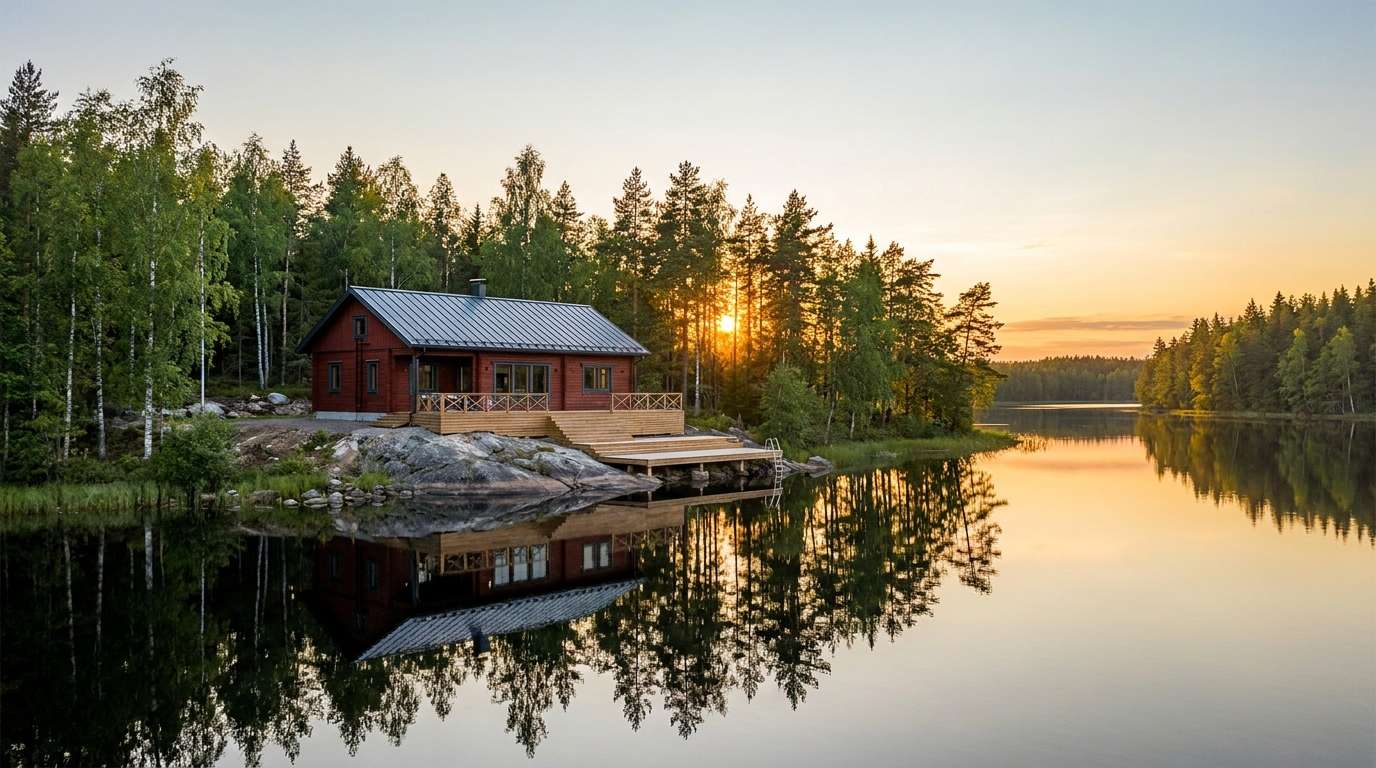
Beyond raw search, Homestra organizes inventory into themed collections: waterfront properties, cabins, farmhouses, bargain listings, and country spotlight sections. These collections aren't marketing decoration, they solve a real problem for international buyers who don't know a market well enough to know what to search for. Starting with a curated "lakefront cabins in Scandinavia" collection and then drilling into filters is often faster than building a filter set from scratch in an unfamiliar country.
Property detail pages built for international context
Each listing on Homestra carries narrative property descriptions written with international buyers in mind. They place properties in local and regional context, which matters when you don't have the geographic intuition a local buyer would have. Images, location context, and direct links to the original listing source give you the information needed to decide whether a shortlist property is worth pursuing further.
Buyer education: the blog and resource hub
Homestra's buying property abroad resource hub is the educational layer that sits on top of the search experience. The blog publishes country-specific buying guides, process explainers, and practical advice for non-residents. These aren't generic articles, they include the specific legal terms, deposit percentages, tax rates, and inspection priorities that vary by country. If you're using Homestra search to discover properties, the blog is where you turn those discoveries into informed decisions.
For a full overview of available guides and resources, the Homestra blog is the central index.
How Homestra supports the cross-border buying journey
Cross-border purchases follow four distinct jobs. Here's how the platform covers each one.
Step 1: Find the right country and property type
Start at country level. Use the homepage country navigation or the blog's country-specific content to get a feel for what markets look like, what property types are available, and what ballpark prices are. Homestra's 200,000+ listing inventory means you can do genuine comparative browsing: check what €100,000 buys you in rural Sweden vs. rural Portugal before committing to a country.
Once a market clicks, move to the property-type filter. A rural fritidshus in Sweden, a quinta in Portugal, and a farmhouse in Brittany are all different buying experiences. Getting the property type right early saves you from shortlisting properties that are legally or practically wrong for your needs.
Step 2: Shortlist intelligently with filters and collections
Use Homestra's filters to tighten your shortlist to a manageable number before you spend time on any single property. Price range, number of rooms, specific amenities like balconies or air conditioning, and property condition (ready to move in vs. renovation project) all translate into filters you can stack. Save your search to revisit it. The curated collections are worth checking alongside filtered results, they sometimes surface inventory that a keyword search misses.
Step 3: Validate feasibility with country buying guides
Once you have a shortlist, read the relevant country guide before contacting any agent. The guide answers the questions that determine whether a purchase is actually feasible for a non-resident: Can foreigners buy freely? What's the typical legal process? What inspections are required? How long does the transaction take? What deposit is expected?
This step prevents the common mistake of falling in love with a property and only discovering legal or financial blockers after you've invested time and emotion.
Step 4: Plan the money before you make an offer
Transaction costs for international buyers regularly exceed expectations. The country guide is the right tool for budgeting: it specifies acquisition taxes, registration fees, notary costs, and the typical deposit percentage. For buyers considering financing rather than a cash purchase, the guide outlines what mortgage access looks like for non-residents in that country and what documentation to prepare.
Country-specific "how to buy as a non-resident" guides
This is the practical layer that turns Homestra's discovery experience into a completed purchase. Each country guide in the series covers:
- Foreign ownership rules (who can buy, any restrictions)
- The legal buying sequence, including country-specific process steps and terminology
- Typical deposit amount and timing
- Inspection requirements and what they cover
- Transaction taxes, registration fees, and legal costs
- Financing options for non-residents
- Capital gains and rental income tax treatment
- Recommended local partners (lawyers, notaries, inspectors)
These guides link directly from Homestra's country search results, so the path from browsing listings to understanding the purchase process is a single click.
What the Sweden guide covers (a concrete example)
Homestra published its rural Sweden buying guide in February 2026 specifically for international buyers interested in a fritidshus (Swedish vacation home). It's a good benchmark for what the country series delivers.
The guide walks through the Swedish buying sequence in full: the besiktning (property inspection), the köpekontrakt (purchase contract), the 10% deposit due at signing, and lagfart (title registration with the Swedish land registry). Sweden imposes a 1.5% stamp duty on the purchase price plus an 825 SEK registration fee. For non-residents who later sell, capital gains are taxed at 22%. Buyers who rent out the property use the SINK flat-tax scheme for rental income.
On the inspection side, the guide specifically flags rural priorities: private wells, septic systems, heating infrastructure, and winterization requirements. These are the items most likely to be undisclosed problems in remote Swedish properties, and they're exactly what a besiktning needs to cover thoroughly.
The Sweden guide is a model for the series. Every country guide aims for the same level of specificity: named legal steps, actual tax rates, and real cost figures rather than vague ranges.
For buyers currently researching Portugal, Homestra's Portugal buying guide follows the same structure for the Portuguese market. You can also browse houses for sale in Portugal directly alongside reading the guide.
The step-by-step buying process across most European markets
While each country has its own terminology and sequence, most European second-home purchases follow a similar structure. Use this as a framework; the country guide will give you the exact documents and local process terms.
- Property search and shortlisting, Use Homestra's filters and collections. Save your shortlist.
- Initial due diligence, Review the country guide. Check foreign ownership rules and confirm the property type is eligible.
- Professional inspection, Commission a qualified local inspector before any contract is signed. For rural properties, cover the structure, utilities (well, septic), and heating system.
- Preliminary contract, A binding preliminary agreement (the terms vary by country: compromis de vente in France, köpekontrakt in Sweden, promessa de compra e venda in Portugal). Typically accompanied by a deposit of 5-15% of the purchase price.
- Financing confirmation, If you're not paying cash, have your mortgage pre-approval or financing documentation in order before this stage.
- Notary closing, In most European jurisdictions, a notary (or equivalent official) handles the transfer. Bring all required identity and financial documentation; your country guide specifies the list.
- Registration, The transfer is registered with the national land registry. In Sweden, this is lagfart; in France, it's the bureau des hypothèques. This step legally completes your ownership.
At each stage, consult the specific country guide for the precise documents, deadlines, and costs that apply in your target market. Some steps differ significantly: Spain requires a NIE number before any contract is signed; Portugal involves the Finanças (tax authority) in the registration chain.
Financing and mortgage options for non-residents
Non-resident mortgage availability varies significantly by country, lender, and your nationality. Homestra's country guides cover the mortgage landscape for each market: which lenders commonly work with foreign buyers, what loan-to-value ratios to expect (often lower for non-residents than residents), and what income documentation is typically required.
As a general planning baseline: most European lenders expect non-residents to provide at least 30-40% as a deposit, compared to 10-20% for residents. Documentation usually includes proof of income from your home country, tax returns for the past two years, bank statements, and a credit reference. Requirements differ enough between countries that the country guide is the right source for specifics.
One practical point: decide early whether you're financing or paying cash. If you're financing, start the pre-approval process before shortlisting properties. Processing times for non-resident mortgages are longer, and sellers in competitive markets won't wait.
Taxes, fees, and ongoing costs
Budget for four cost categories beyond the headline purchase price:
- Acquisition tax: Varies by country and sometimes by property type. Sweden charges 1.5% stamp duty. Portugal has IMT (Imposto Municipal sobre Transmissões) at tiered rates. France charges droits de mutation of around 5-6% for existing properties.
- Registration and legal fees: Fixed fees plus notary/lawyer costs. Sweden's land registry charges 825 SEK. Notary fees in France typically run 0.8-1% of the transaction value, plus fixed disbursements.
- Inspection and due diligence costs: Typically €300-800 for a standard residential inspection, more for rural properties with private utilities.
- Ongoing ownership costs: Annual property taxes, maintenance, building insurance, utility standing charges, and (if applicable) community fees for shared-facility properties.
For sellers: capital gains treatment for non-residents is a critical planning point. In Sweden, non-resident sellers pay 22% on capital gains. The relevant rate in your target country will be in the country guide. Plan for it before you buy.
Practical tips for international buyers
Inspections for rural and remote properties
Don't skip the inspection, and don't treat it as a formality. For rural second homes, the type of property Homestra buyers most commonly target, the inspection needs to go beyond the structure. In Sweden, the Homestra guide specifically flags wells, septic systems, and heating systems as priorities. A property that needs a new well or septic replacement will cost you €10,000-30,000 on top of the purchase price. Get written inspection documentation in a language you can read; if the original is in the local language, commission a certified translation.
Local legal support
Every European country requires or strongly benefits from a local lawyer or notary at closing. In some countries (Ireland, UK, parts of Spain) a solicitor is standard practice. In others (France, Sweden) the notary is the transaction's neutral officer. Either way, an independent legal advisor reviewing the title search, planning status, and contract terms on your behalf is worth the fee. The country guide for your target market will specify whether local legal representation is a legal requirement or a strong recommendation.
Seasonality and winterization
For vacation homes in northern and central Europe, winterization is a practical ownership requirement, not an optional upgrade. Properties in Sweden, Norway, Finland, and the Alpine regions of France, Germany, and Austria need insulated plumbing, adequate heating systems, and proper roof drainage for snow loads. If you're buying a property you'll only use in summer, confirm the property has been properly winterized for the months it sits empty. The Homestra Sweden guide flags this explicitly as a rural inspection priority.
Local contacts and recommended services
Homestra's role is discovery and education: finding the property and giving you the knowledge to pursue it. The legal execution, contract review, title search, notary coordination, registration, requires licensed local professionals.
Each country guide in the Homestra series includes guidance on the type of local partners you need at each stage: independent lawyers, notaries, certified building inspectors, and (where relevant) currency transfer specialists for large cross-border transactions. These aren't referral lists with commercial relationships; they're descriptions of the professional categories you need to engage and what to look for when selecting them.
The workflow is: use Homestra to discover and shortlist, use the country guide to understand the process and costs, then engage local professionals to execute the transaction.
FAQ
Can foreigners buy property anywhere in Europe? In most EU countries, yes, EU citizens have the same property rights as nationals, and non-EU buyers face few restrictions in most markets. Some countries have specific rules for agricultural land or properties in border zones. The country guide for your target market covers the specific rules that apply to your nationality.
Do I need local legal representation? In some countries it's legally required; in others it's technically optional but practically essential. In either case, using a local lawyer or notary who reviews the title, the contract, and the planning status before you commit is standard practice for any competent international buyer.
How do I prepare for due diligence? Start by reading the country guide so you know which documents to request from the seller's agent. For rural properties, commission an independent building inspection. Confirm the property's planning permissions and any restrictions on use (particularly relevant for properties near coastlines or in protected areas).
Where do I start on Homestra? Go to homestra.com and use the country navigation or property-type search to define your market. Once you have a shortlist, navigate to the buying property abroad guides and read the guide for your target country before making contact with any seller or agent. If you already know you want a rural or country property, the country homes for sale in Europe category is a good starting filter.
Have questions about the buying process before you're ready to shortlist? Read what to consider before buying property abroad for a pre-search checklist of the key decisions and risks to assess first.
Share