Blog published in Buying property abroad
Share
Buying property abroad as a French resident: a complete guide
Guide complet pour les acheteurs français : aspects juridiques, fiscaux et financement. Comparez les coûts dans 5 pays européens.

Buying property abroad as a French resident is entirely possible, and for many people it's a genuinely rewarding decision. A vacation home in southern Spain, a rural farmhouse in Tuscany, a pied-à-terre in Lisbon: these are realistic goals, not just aspirations. But the path from interest to signed deed involves a set of legal, financial, and tax considerations that don't work the same way they do in France.
This guide walks through every stage of that path: what you're legally permitted to do, what the purchase will cost beyond the listed price, how financing typically works, what happens to your French tax obligations once you own something abroad, and how the actual legal process unfolds in a foreign jurisdiction. Where country-specific figures are relevant, they appear clearly. Where rules vary, that's stated honestly.
A few terms appear throughout this article that are worth defining upfront:
- Résident fiscal (French tax resident): a person whose "domicile fiscal" is in France, as determined by official criteria published on impots.gouv.fr. This status determines whether France can tax your worldwide income.
- Revenu foncier: rental income from real property, reported on your French income tax return if you are a French tax resident receiving it.
- Plus-value immobilière: the capital gain realized on the sale of real estate.
- Résidence secondaire: a property that is not your principal residence. Tax treatment in France, and abroad, often turns on this distinction.
Can a French person buy property abroad?
Yes, in the vast majority of cases. French citizens and residents face no general prohibition on purchasing property in foreign countries. That said, the destination country controls its own rules, and those rules vary considerably.
Within the European Union, the free movement of capital means French buyers generally face no ownership restrictions when buying in Spain, Portugal, Italy, or other member states. Outside the EU, the picture becomes more complex. Switzerland, for example, historically restricts foreign residential property purchases under the Lex Koller legislation. Countries outside Europe may impose their own permit requirements, foreign ownership caps, or limitations on land type. Checking those rules before spending time on a property search is not optional; it's the starting point.
One distinction that consistently surprises buyers: owning property in a country does not automatically grant you the right to live there. Purchasing a house in Spain does not give you residency rights in Spain. Purchasing an apartment in Portugal does not make you a Portuguese tax resident. Residency and visa status are governed by immigration law, which operates entirely separately from property law.
What property ownership typically does NOT provide:
- Automatic residency or right to remain beyond the visa-free period
- Citizenship or nationality
- Tax resident status in the destination country (though extended physical presence can trigger that separately)
- Freedom from French tax obligations on rental income or capital gains
What buying abroad actually costs (beyond the purchase price)
One of the biggest planning mistakes French buyers make is budgeting only for the listed price. Acquisition costs on top of that price can range from 5% to 15% or more, depending on the country.
A useful way to organize the cost structure is by category:
Transfer taxes and registration fees: Often the largest additional cost. In France, the equivalent is the "droits d'enregistrement," which run approximately 5.8% for existing properties. Spain applies the Impuesto sobre Transmisiones Patrimoniales (ITP), which varies by region but typically falls between 6% and 10%. Italy applies an imposta di registro on resale properties, generally 9% of the cadastral value (though this can be significantly less than market value). Portugal applies the Imposto Municipal sobre as Transmissões Onerosas de Imóveis (IMT), with rates that depend on property value and buyer status.
Notary/conveyancing/legal fees: Most civil-law countries (Spain, Italy, Portugal) require a notary for title transfer. Notary fees are typically regulated and calculated on the property value, usually between 0.2% and 1.5%. In common-law countries like the UK, a solicitor handles conveyancing, with costs varying by property price and complexity.
Agency fees: Unlike France, where agency fees are often included in the listed price or split, several countries charge buyer-side agency fees separately. Confirm explicitly who pays the agent.
Property surveys and inspections: A technical inspection is often optional in law but strongly advisable in practice. In Sweden, for instance, Homestra's buyer guide describes the besiktning (property survey) as a foundational due diligence step tied to the buyer's legal duty to investigate (undersökningsplikt). The same logic applies in Spain, Portugal, and Italy, even where no equivalent legal duty exists.
VAT: New-build properties in many countries attract VAT rather than transfer tax. Rates and thresholds differ by country and property type.
Before signing anything, ask the local professional these questions:
- Who holds the title and is it clear of encumbrances?
- Who pays the agency fee?
- How is the deposit structured, and under what conditions is it forfeited?
- What form does the pre-contract take, and what conditions can you include?
Financing as a French buyer: what's realistic
There are three realistic financing routes for French buyers purchasing abroad: a mortgage from a local lender in the destination country, a loan from a French bank, or a cash purchase.
Local mortgages in the destination country are often the most straightforward route. Spanish, Portuguese, and Italian banks regularly lend to non-resident buyers, though the loan-to-value ratio for non-residents is typically lower than for locals (60-70% is common in Spain, for example). You'll need local documentation, often including proof of income, French tax returns, bank statements, and sometimes a local bank account.
French banks can, in principle, lend for foreign property purchases, but they generally require the guarantee to be France-based (a French property or French-held assets as collateral). This varies by institution and the risk profile of the transaction. Some buyers use equity from an existing French property as leverage.
For buyers considering mortgages in non-euro currencies (UK pound, Swedish krona, Swiss franc), currency risk deserves serious attention. A mortgage denominated in a foreign currency while your income is in euros means your effective debt load shifts with exchange rates. Before committing, stress-testing the mortgage payment at a meaningful exchange rate movement (10-15%) is prudent.
Documents typically required by lenders, regardless of country:
- Valid passport and French national identity card
- Last two to three years of French tax returns (avis d'imposition)
- Three to six months of bank statements
- Proof of income (pay slips or business accounts)
- Details of existing French loans or mortgages
- Proof of funds for the deposit
Residency, visa, and French tax residency: the part people miss
This section addresses the most commonly misunderstood aspect of buying property abroad.
Residency status (immigration) and tax residency (fiscal domicile) are two separate legal concepts governed by two separate sets of rules.
Your French tax residency is determined by the criteria published by the French tax authority at impots.gouv.fr (page last updated January 2026). French domestic law considers you a "résident fiscal de France" if at least one of the following applies: France is the location of your foyer (the place where your family or household is habitually established), France is your séjour principal (your main place of physical presence during the year), your main professional activity is carried out in France, or France is the center of your economic interests.
When a tax treaty between France and another country comes into play (which happens when you have ties to both countries), tie-breaker rules apply in a specific order: first, permanent home; then centre of vital interests; then habitual abode; then nationality.
Why this matters for property abroad: if you remain a French tax resident, France can tax your worldwide income. That includes rental income earned from a foreign property and, potentially, the capital gain when you sell it.
France has concluded double taxation treaties with most countries where its residents commonly buy property, including Spain, Portugal, Italy, and the UK. These treaties generally prevent you from being fully taxed twice on the same income, but they do not eliminate your French filing obligations. The mechanism (exemption method vs. credit method) depends on the specific treaty.
If you own foreign property and are a French tax resident, that property may also be relevant for IFI (Impôt sur la Fortune Immobilière) purposes if your total real estate net worth exceeds the applicable threshold. The IFI applies to worldwide real estate assets for French tax residents, subject to treaty provisions.
The legal buying process, step by step
The specific steps differ by country, but the broad sequence is consistent across most markets:
-
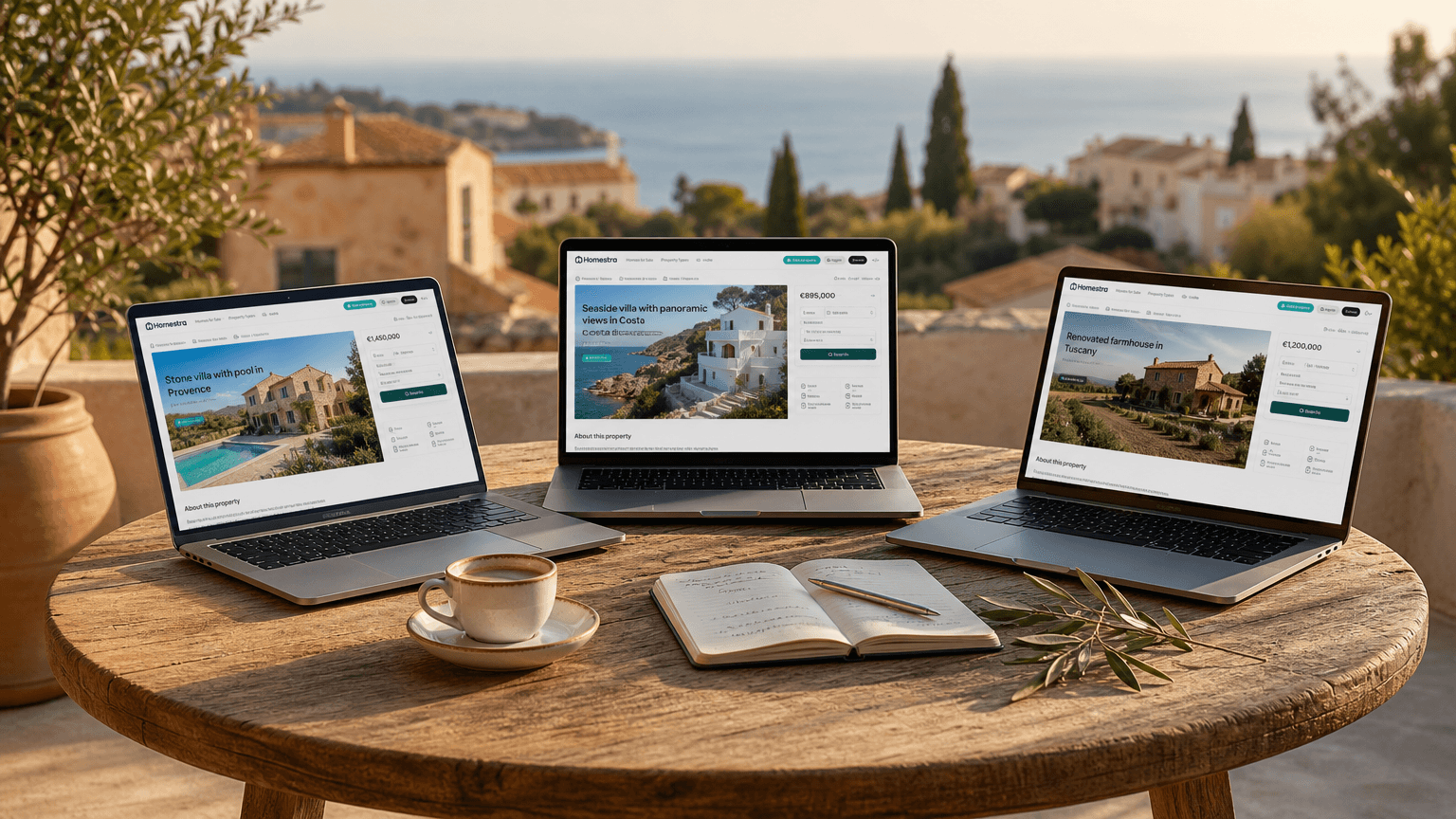
Property search: Identify your target market, engage a local agent, and shortlist properties. Platforms like Homestra, with over 200,000 properties across Europe, allow French buyers to compare options across Spain, Portugal, Italy, and beyond from a single search interface.
-
Make an offer: Offers are often informal at first but can become binding quickly depending on local custom. Get the process clear before submitting.
-
Pre-contract/preliminary agreement: In Spain, this is often a "contrato de arras" (with a deposit, typically 10%). In Portugal, the "Contrato de Promessa de Compra e Venda" (CPCV) serves the same function. In Italy, the "compromesso" or "contratto preliminare" locks both parties in. In Sweden, a "köpekontrakt" is signed with roughly a 10% deposit. These documents are legally binding in most jurisdictions.
-
Due diligence period: Have a lawyer verify the title, check for encumbrances, verify building permits, confirm boundaries, and review any HOA rules or servitudes. Do not skip this step. Title problems identified after completion can be very costly.
-
Deposit/escrow: The deposit is typically held in escrow or by the notary. Understand under what conditions you forfeit it and what happens if the seller pulls out.
-
Final deed signing: The notary or solicitor finalizes the transfer. In civil-law countries, both parties sign before the notary. The balance of funds is transferred.
-
Registration: Title is registered with the relevant land registry. In Sweden, for instance, the lagfart (title registration) carries a 1.5% stamp duty on the higher of purchase price or assessed value, plus a fixed administrative fee of 825 SEK (as documented in Homestra's Sweden buying guide, updated January 2026). Registration timelines vary from days to several weeks depending on the country.
Documents to prepare as a French buyer:
- Valid passport (and national ID where accepted)
- Marriage certificate or divorce decree if co-buying or title status affects family law
- Recent proof of funds or mortgage offer letter
- Proof of address in France
- Certified translations of key documents where required by local law
- NIE (Spain), NIF (Portugal), or equivalent fiscal identification number for the destination country
Common friction points to anticipate: opening a local bank account (often required and time-consuming), obtaining a foreign tax identification number, getting documents officially translated and apostilled, and coordinating wire transfers across jurisdictions. Start these steps early, before you find the property you want to buy.
Avoid these costly mistakes
On due diligence: Always obtain an independent title search through a local lawyer, not just through the selling agent. Verify that any extension or renovation the seller carried out has the required building permits. Check for servitudes (rights of way, shared access rights) registered on the title. In rural properties, confirm the status of water supply, septic systems, and road access.
On contracts: Understand exactly which document is binding and from what moment. In France, the compromis de vente gives buyers a 10-day cooling-off period; most foreign jurisdictions offer no such protection once the pre-contract is signed. Conditions precedent (finance condition, inspection condition) must be explicitly drafted. Don't assume they're implied.
On French tax reporting after purchase: If you rent the property, you'll generally need to declare that rental income in France on your annual tax return using Formulaire 2047 (the dedicated form for foreign-source income). The applicable double taxation treaty determines whether French tax is reduced by a credit or exemption for tax already paid abroad. Consult a tax professional familiar with both jurisdictions; a French accountant without cross-border experience may miss treaty nuances, and vice versa.
On the sale: If you sell a foreign property while you are a French tax resident, you may need to declare the capital gain (plus-value immobilière) in France, as confirmed by guidance on impots.gouv.fr. The treaty with the destination country determines how that gain is ultimately taxed, but the French filing obligation is separate from whether France ends up collecting tax.
Quick comparison: top destinations for French buyers
| Country | Ownership restrictions | Typical extra costs (on top of price) | Key local step | Common pitfall |
|---|---|---|---|---|
| Spain | None for EU/French buyers | 8-12% (ITP 6-10% + notary + registry) | NIE number + contrato de arras | Assuming seller's agent protects your interests |
| Portugal | None for French buyers | 6-9% (IMT + stamp duty + notary) | NIF number + CPCV pre-contract | Ignoring rural land classification rules |
| Italy | None for French buyers | 9-12% (imposta di registro + notary) | Codice fiscale + compromesso | Underestimating cadastral value gap |
| UK | None, but no notary system | 2-7% (Stamp Duty Land Tax varies) | Solicitor conveyancing + searches | Leasehold vs. freehold confusion |
| Sweden | None | 1.5-3% (lagfart 1.5% + agency fees) | Besiktning inspection + köpekontrakt | Undersökningsplikt: buyer bears inspection risk |
Homestra publishes detailed country-specific buying guides for international purchasers, including a full guide to buying property in Sweden that covers local transaction stages, inspection obligations, fee structures, and non-resident tax treatment. Comparable guides for Spain, Portugal, Italy, and the UK provide the same level of operational detail for buyers working from France.
Frequently asked questions
Can I buy property abroad while I'm a French resident but plan to live abroad part of the year?
Yes. French residency and property ownership in another country are independent. You can own a property in Spain, rent it out for part of the year, and remain a French tax resident. What changes is your French declaration obligations: foreign rental income must be reported to the French tax authority, and the property's value may affect your IFI position if your total net real estate assets exceed the relevant threshold.
Do I need a French notary or a French lawyer to buy abroad?
No, though it's not prohibited to consult one. The transaction is governed by the law of the country where the property is located. You'll need a local notary (in civil-law countries) or a local solicitor (in the UK and Ireland). A bilingual French-speaking local lawyer is often the most practical choice. A French-qualified avocat specializing in cross-border transactions can help with the French tax reporting side.
How do I declare rental income from a foreign property in France?
If you're a French tax resident, foreign rental income is reportable on your French annual income tax return. The standard mechanism is Formulaire 2047, used to declare income from foreign sources. The specific treatment (whether you receive an exemption or a tax credit for tax paid abroad) depends on the bilateral tax treaty between France and the country where the property is located. Official guidance is available at impots.gouv.fr under the international-particuliers section.
If I sell a property abroad, do I need to file anything in France?
Potentially yes. According to guidance published on impots.gouv.fr, a French tax resident who sells a foreign property may need to declare the capital gain in France. Whether France ultimately collects tax on that gain depends on the applicable double taxation convention. The obligation to declare and the obligation to pay are separate questions; the filing obligation may exist even when the treaty allocates the taxing right primarily to the other country. Always verify with a tax professional before selling.
Does buying a property give me residency rights or a visa?
Generally, no. Property ownership does not confer the right to reside in a country beyond the period permitted to you as a visitor or under your existing visa status. Some countries have offered specific "golden visa" or investor visa programs linked to real estate investment, but those are separate legal schemes with their own thresholds, requirements, and processing timelines. As of 2024, Portugal has ended the residential property route under its ARI (golden visa) program, though other investment routes remain. Spain's golden visa program has also faced changes. Always verify current rules directly with the relevant consulate or an immigration lawyer before assuming a property purchase qualifies you for residency.
Is the IFI (Impôt sur la Fortune Immobilière) applicable to my foreign property?
If you are a French tax resident, the IFI applies to your worldwide real estate net assets above the applicable threshold. Foreign properties are included, subject to any relief provided by double taxation treaties. Non-French tax residents are generally only liable for IFI on properties located in France. Consult an advisor and check current rules on impots.gouv.fr, as thresholds and rates are subject to change.
Share