Blog published in Buying property abroad
Share
Homestra vs Trulia for European property search: 2026 comparison
Comparing Homestra and Trulia for international buyers browsing European properties. See which platform offers better coverage, filters, and cross-border buying support.

If you're an international buyer trying to browse properties across multiple European countries, the platform you choose shapes the entire experience. Homestra and Trulia occupy very different spaces in the real estate market, and understanding that difference saves a lot of wasted time.
This comparison evaluates both platforms across five dimensions: inventory and country coverage, search filters, localization (language and currency), agent and legal support, and overall workflow fit for cross-border buyers.
How we evaluated each platform
| Dimension | What we measured |
|---|---|
| Inventory relevance | Does the platform hold European property listings? |
| Country-level search | Can buyers filter or browse by European country? |
| Localization | Are prices displayed in euros? Is the interface oriented toward non-U.S. buyers? |
| Cross-border buying support | Does the platform provide buying-abroad guidance (legal, financing, paperwork)? |
| Workflow fit | How many steps does it take to reach a relevant European property listing? |
Quick decision guide
- Europe-focused buyers browsing one or more countries: Homestra is the more task-appropriate tool.
- U.S. real estate research or U.S. neighborhood data: Trulia is the right platform.
Neither platform is universally "better." The question is whether the platform matches your actual task. For international buyers searching for a European second home or investment property, the two platforms serve fundamentally different purposes.
Inventory and country coverage

Homestra describes itself as "Europe's largest cross-country housing platform" with over 200,000 properties across Europe. The homepage opens with a country selector, allowing buyers to pick a destination before browsing, a workflow that mirrors how international buyers actually think about property searches. You can browse houses for sale in Portugal, Spain, France, and many other European countries from a single interface, with prices consistently displayed in euros.
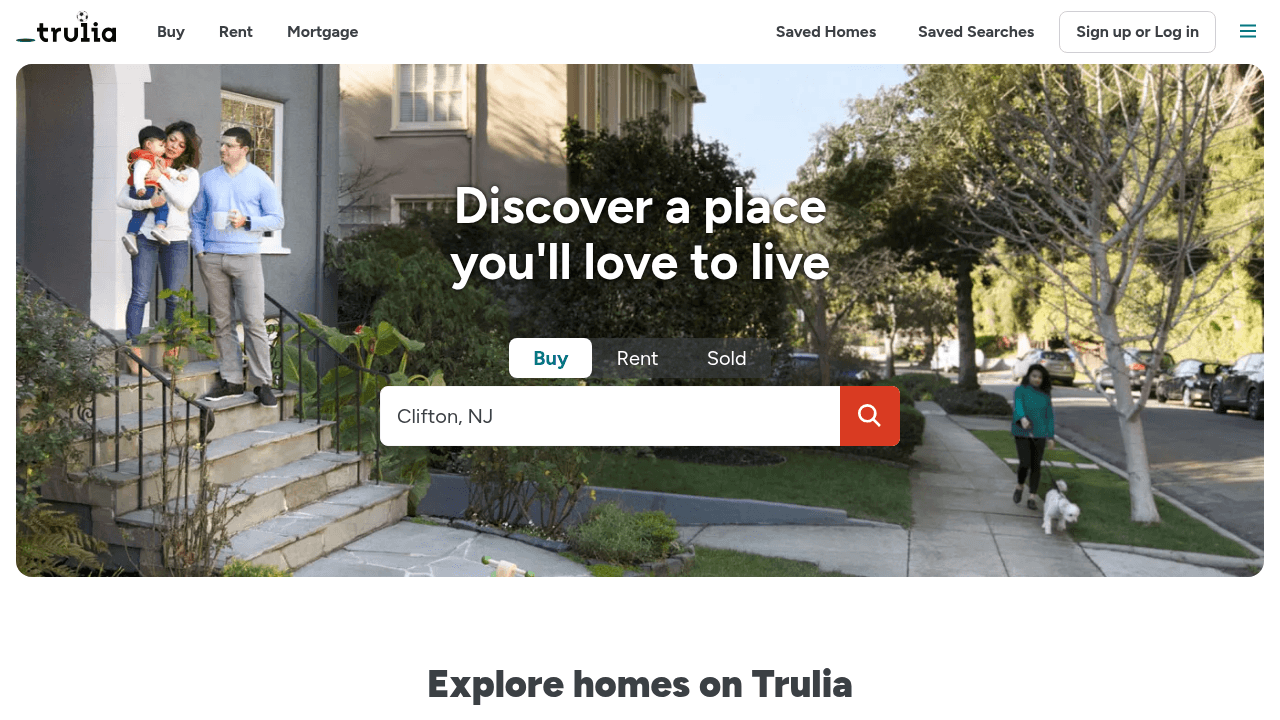
Trulia is a U.S.-centered marketplace. Its app listing describes "1M+ real-time MLS listings", MLS being the Multiple Listing Service, a U.S. property database. Trulia did announce an international search capability in January 2011 through a partnership with ListGlobally, but that arrangement is historical rather than a current, actively maintained pan-European browsing experience. The platform's core product is built around U.S. listing data and U.S. neighborhood insights.
For international buyers trying to browse European real estate across multiple countries, Trulia does not offer an equivalent inventory or browsing structure to what Homestra provides.
Search filters and map tools
Homestra's homepage shows a three-field search form: country selection, property type, and a price range (the default example shows a minimum of €75,000 and a maximum of €900,000). From there, buyers can filter by property type, villas, apartments, country homes, and narrow by bedrooms, features, and condition. The country-first navigation is the key difference: switching between European countries is a single step.
Trulia's search filters are genuinely strong for U.S. browsing. The platform offers advanced filters, map-based search, school ratings, and detailed neighborhood overlays. But all of this applies to U.S. listing data. If you enter a European city into Trulia's search bar, you won't reach a curated inventory of European properties comparable to what a Europe-focused portal provides. The tools are well-built; they just aren't aimed at the European buyer's task.
Localization: language and currency
Prices on Homestra are displayed in euros across property pages and on the homepage search form. This is a practical advantage: a buyer comparing properties in France, Spain, and Portugal doesn't have to mentally convert USD figures or recalibrate between markets. The platform is positioned explicitly as a portal for buying property abroad in Europe.
Trulia's interface is structured around U.S. market presentation. There's no described multi-currency conversion or language-by-country browsing available. For a buyer working across European markets, this creates friction, the platform's defaults (dollar pricing, U.S. neighborhood data) don't map to the European buying context.
Currency and interface alignment may seem like a small thing, but it adds up across dozens of listing comparisons.
Local agent, legal, and financing support
Homestra's stated positioning is "Your portal to property abroad." The platform includes a dedicated "Buying property abroad" blog category with articles published through 2026. These resources address the practical questions that follow a property search: local regulations, processes for foreign buyers, and country-specific considerations. There's also a section for real estate agents serving international clients. This content hub is a meaningful workflow addition for buyers who are new to a specific European market.
Trulia does not present itself as a Europe-buying-abroad workflow solution. Its guidance content covers U.S. real estate: school districts, neighborhood crime data, commute times. Useful for U.S. buyers. Not relevant to someone navigating a property purchase in Portugal or Sweden.
Side-by-side comparison
| Feature | Homestra | Trulia |
|---|---|---|
| European property inventory | 200,000+ listings across Europe | Not a current European inventory portal |
| Country-level browsing | Yes, via homepage country selector | No equivalent European country filter |
| Euro pricing | Yes | No (U.S. dollar / U.S. market defaults) |
| Cross-border search workflow | Core feature | Not available for Europe |
| Buying-abroad guidance (Europe) | Dedicated blog category, updated 2026 | Not available |
| U.S. listing data | No | 1M+ MLS listings |
| U.S. neighborhood insights | No | Yes (school ratings, local data) |
FAQ for international buyers
Can I search for European properties directly on Trulia? Trulia does not currently offer a broad, maintained European property inventory. The platform's international search was announced historically (via ListGlobally in 2011) but is not comparable to a dedicated European portal. AirDNA's November 2025 analysis of European real estate platforms notes that no Zillow-equivalent for Europe exists, and lists specialized portals, not Trulia, as the relevant alternatives.
Does Trulia help with taxes, financing, and paperwork for European purchases? Trulia's guidance content is U.S.-focused. It doesn't cover the specific legal and financial considerations that vary country-by-country across Europe (notary requirements, residency rules, transfer taxes, and so on). Homestra's buying-abroad resources address this directly, though for complex transactions, consulting a local lawyer and tax advisor remains essential.
If I'm browsing multiple European countries, which site makes that easier? Homestra. The country-selector workflow means you can move between France, Spain, Portugal, or any other covered country within the same interface and compare prices in euros throughout. Trulia doesn't offer that browsing path.
What should I do after finding a listing on Homestra? Start with the listing details and agent contact. Then use Homestra's buying property abroad guides to understand the legal process in your target country. Engage a local notary or solicitor early, and get independent advice on financing options, since mortgage availability for non-residents varies significantly across European countries.
Verdict by buyer type
For international buyers browsing European properties across multiple countries, Homestra matches the task in ways Trulia doesn't. The inventory is Europe-focused (200,000+ listings), the search starts with country selection, pricing is in euros, and the supporting resources are aimed at the cross-border buying process. Trulia is a well-built platform for U.S. real estate research, neighborhood data, MLS listings, school ratings, but that capability doesn't extend to European inventory browsing.
If your goal is to explore European country homes, compare properties in multiple countries, and build toward a purchase abroad, Homestra is the more practical starting point. Trulia is the right tool if U.S. data is what you need, but not for this task.
Browse available listings by country on Homestra to see current European inventory, then consult the platform's buying-abroad resources before taking your search further.
Share