Blog published in Buying property abroad
Share
Cheapest European countries to buy a second home in 2026
Discover the 10 cheapest European countries to buy a second home in 2026. Ranked by median price per m², with transaction costs, legal tips, and listings.

If you're searching for the cheapest European country to buy a second home right now, the short answer is Bulgaria, where rural and coastal properties regularly list below €500 per m² and total acquisition costs remain among the lowest on the continent. But that single figure only tells part of the story.
"Cheapest" in a property context has at least three dimensions: the asking price itself, the transaction taxes and legal fees added on top, and the ongoing cost of ownership once the keys are in your hand. A country with a rock-bottom listing price but a 10% transfer tax and opaque notary fees can end up costing more than a mid-range market with minimal stamp duty. The EU-wide picture is also shifting: according to Eurostat's July 2026 release, house prices across the EU rose by 5.1% in Q1 2026 compared with Q1 2025, and rents moved up 3.0% over the same period. That momentum is uneven, so timing and country selection matter.
This guide ranks the 10 cheapest European countries for second-home buyers as of mid-2026, explains exactly how the ranking was built, breaks down the real cost of buying in each, and shows you how to find active listings using Homestra's cross-country search.
How this ranking was built
Transparent methodology matters. Most "cheapest countries" lists online cite price-per-m² figures with no explanation of where the data came from, what property types were included, or when prices were captured. This ranking uses a different approach.
Primary data source: Listing prices drawn from the Homestra platform, which covers over 200,000 properties across Europe, filtered to a capture window of Q2 2026 (April–June 2026). Prices are asking/listing prices at time of capture, not completed transaction prices.
Property type filter: Detached houses, cottages, country homes, small villas, and apartments under 300 m² of living area. Ultra-luxury outliers (top 5% by price per m² per country) were excluded to prevent skew.
Currency: All prices expressed in EUR. For countries outside the eurozone (Bulgaria, Hungary, Poland, Czech Republic, Sweden), the ECB reference rate as of June 30, 2026 was applied.
Output metric: Median listing price per m² (€/m²) and median total listing price (€) per country, derived from at least 50 qualifying listings per country.
Trend context: Eurostat House Price Index data (Q4 2025 release) was used to indicate the direction of recent price change. Knight Frank's Global House Price Index Q3 2025 report, which showed a weighted average annual increase of 2.4% across 55 markets, provides a broader benchmark.
Limitations: Listing prices overstate achievable transaction prices in some markets by 5–15%. Local micro-markets (coastal vs. inland, capital city vs. deep rural) diverge sharply from national medians. These figures are a starting point for comparison, not a guarantee of what you will pay.
Top 10 cheapest European countries to buy a second home (mid-2026)
| Rank | Country | Median listing price (€) | Median price/m² (€) | Price trend (Eurostat, Q4 2025) | Best second-home use case |
|---|---|---|---|---|---|
| 1 | Bulgaria | ~35,000 | ~380 | Rising (moderate) | Beach, mountains, countryside |
| 2 | Romania | ~45,000 | ~490 | Rising (moderate) | Countryside, mountains |
| 3 | Hungary | ~60,000 | ~620 | Rising strongly (+21.2% y/y Q4 2025) | Lake (Balaton), countryside |
| 4 | Poland | ~65,000 | ~680 | Rising | Lake districts, mountains |
| 5 | Greece | ~70,000 | ~730 | Rising | Beach, islands |
| 6 | Portugal | ~90,000 | ~900 | Rising | Beach, countryside, Atlantic coast |
| 7 | Italy | ~80,000 | ~820 | Stable to rising | Rural (Abruzzo, Le Marche, Calabria), lake |
| 8 | Spain | ~95,000 | ~980 | Rising | Beach, inland villages |
| 9 | France | ~75,000 | ~760 | Stable | Rural (Creuse, Mayenne, Limousin) |
| 10 | Sweden | ~85,000 | ~850 | Stable | Lakes, forests, archipelago |
Note: France and Sweden rank slightly above Italy in median price per m² in coastal/accessible areas but drop significantly in deep rural zones; the figures above reflect median rural/non-urban listings only. Hungary's price growth rate (21.2% in Q4 2025, per Eurostat as reported by Euronews in April 2026) is an important caveat: the country is cheap today but appreciating quickly.
All figures are median asking prices for qualifying listings as of Q2 2026. They are not averages, they are not transaction prices, and they exclude the purchase costs described below.
Country profiles
Bulgaria: lowest entry price in Europe
Bulgaria consistently produces the lowest median price per m² on Homestra, particularly for rural farmhouses and inland cottages. Black Sea coastal apartments add a beach dimension, while the Rhodope and Balkan mountain ranges attract buyers who want walking and ski access. Transaction costs are low relative to Western Europe: transfer tax is typically around 2–3% of the declared value, notary fees are modest (roughly 0.1–0.5%), and local property taxes are minimal. Foreign EU citizens can own property freely; non-EU citizens can own buildings but historically faced restrictions on land ownership (though EU accession rules have largely liberalised this).
For active listings, browse country homes for sale in Bulgaria on Homestra, where rural properties under €40,000 appear regularly.
Romania: value with scenic diversity
Romania's Transylvania region, the Carpathian foothills, and the Danube Delta give buyers a wide range of landscapes. Median asking prices for rural houses remain under €500/m². Transfer tax is generally 3% of the declared value for properties held less than 3 years by the seller; notary fees range from 0.5–1% of the transaction value. Non-EU buyers face no categorical bar to ownership but should engage a Romanian notary and a local legal adviser before committing.
Hungary: cheap now, but watch the growth rate
Hungary recorded the highest annual house-price increase in Europe in Q4 2025: 21.2%, according to Eurostat data reported by Euronews in April 2026. Lake Balaton remains the primary second-home destination, but rural villages in the Great Plain still list well below €700/m². Transfer tax is 4% of the market value. Legal costs add roughly 1–1.5%. Buyers should act with an awareness that prices are compressing the "cheap" window meaningfully.
Poland: lake districts and mountain retreats
The Mazury lake district and the Tatra foothills in southern Poland attract significant domestic and international second-home demand. Urban prices in Warsaw and Krakow are high, but rural listings remain competitive. Transfer tax (PCC) is 2% of the declared value for the secondary market. Notary fees are capped by regulation and typically range from 0.5–1% of the transaction value.
Greece: beach access at mid-range prices
Greece combines Mediterranean climate, island variety, and comparatively accessible rural prices outside the Cyclades and Attica. Northern Greece (Eastern Macedonia, Thrace, Epirus) and the Peloponnese interior offer some of the lowest prices per m² among Mediterranean countries. Transfer tax is 3.09% of the "objective" (assessed) value, which is often lower than the asking price. Legal fees and notary costs add roughly 2–3%. Homestra lists properties such as a 3-bedroom house in Keramoti at €98,000 and village homes starting from €60,000 in the Peloponnese.
France: the rural countryside case
France does not rank among the cheapest in absolute terms nationally, but its deep rural zones (Creuse, Mayenne, parts of Limousin and Normandy) produce median prices below €800/m² and total listing prices well under €100,000 for habitable stone houses. France is consistently one of the most affordable places in Europe for a vacation home when buyers target these inland regions. Transfer tax (droits de mutation) is approximately 5.8% of the purchase price. Notary fees are regulated and add roughly 1–2%. Total acquisition costs of 7–9% on top of the asking price are typical. Example listings from Homestra include a 5-bedroom Normandy farmhouse at €160,000 and a 4-bedroom countryside home in Mayenne at €90,000.
Italy: the cheap-property corridor
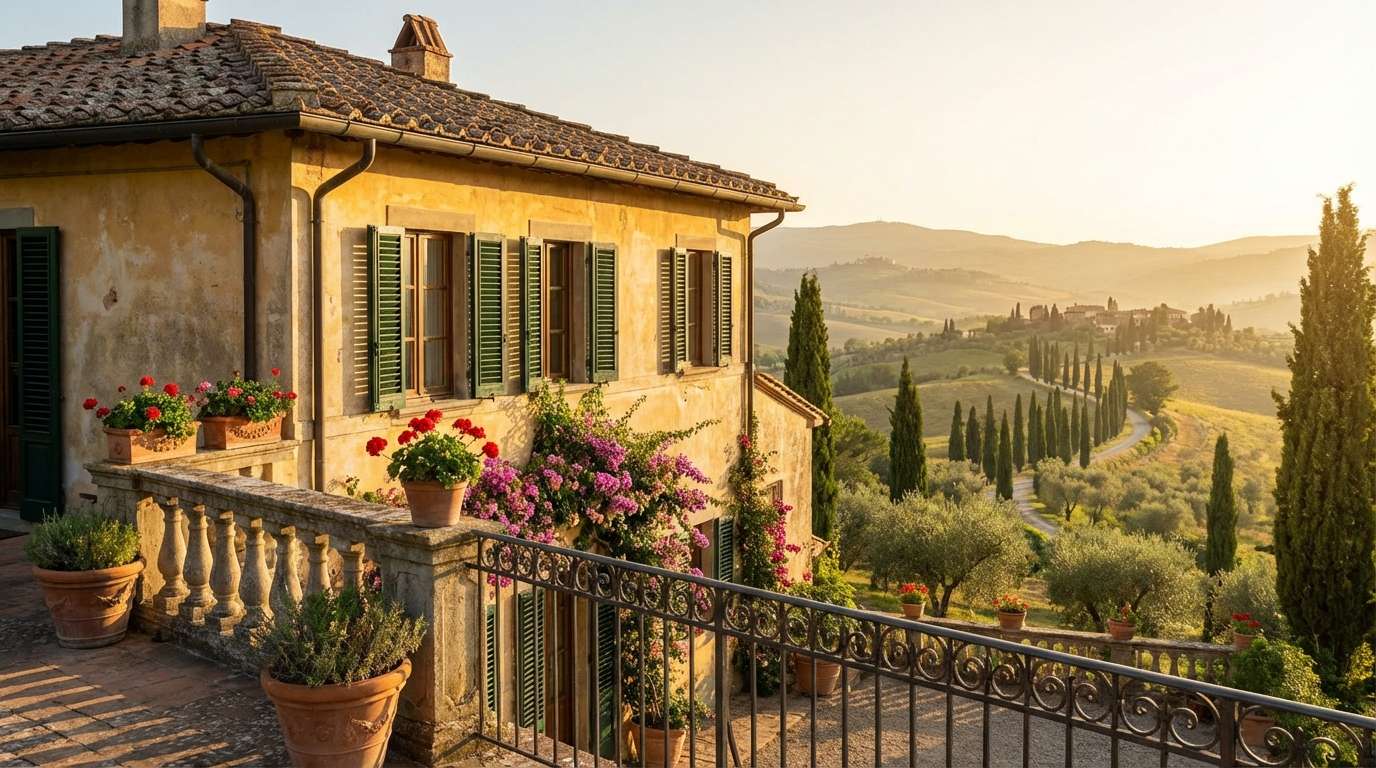
Southern Italy, Abruzzo, Le Marche, and Calabria offer the most competitive prices. Italy's famous €1 house schemes in depopulated villages attract attention, but the more practical option is a habitable rural property in Abruzzo or Molise in the €80,000–€150,000 range. Registration tax is 9% of the assessed cadastral value for second homes (reduced to 2% for a primary residence). Notary fees add 1–2%. The total transaction cost burden is higher than in Bulgaria or Romania, often reaching 12–15% of the purchase price for second homes.
Portugal: still value in the interior
Lisbon and the Algarve are well outside the "cheap" category now, but central and northern Portugal (Beira Alta, Alentejo, Fundão, Sabugal) retain genuine value. The guide to buying property in Portugal covers the legal framework for foreign buyers in detail. IMT (transfer tax) ranges from 0–8% depending on the declared value and intended use (second homes attract higher rates than primary residences). Stamp duty adds 0.8%. Notary and registration costs total roughly 1–2%. Homestra lists properties in the Beira Alta region starting from approximately €60,000 for rural renovation projects.
Spain: inland villages vs. coast premium
The coastal premium in Spain (Costa Blanca, Costa del Sol, Balearics) is pronounced. Inland Castile, Extremadura, and rural Aragon, however, offer detached houses at prices well below the national median. Transfer tax (ITP) on second-hand properties is set at the regional level and typically ranges from 6–10% of the purchase price. Notary and registration costs add approximately 1–2.5%. Total transaction costs of 10–13% are common.
Sweden: low acquisition costs, high listing prices outside deep rural
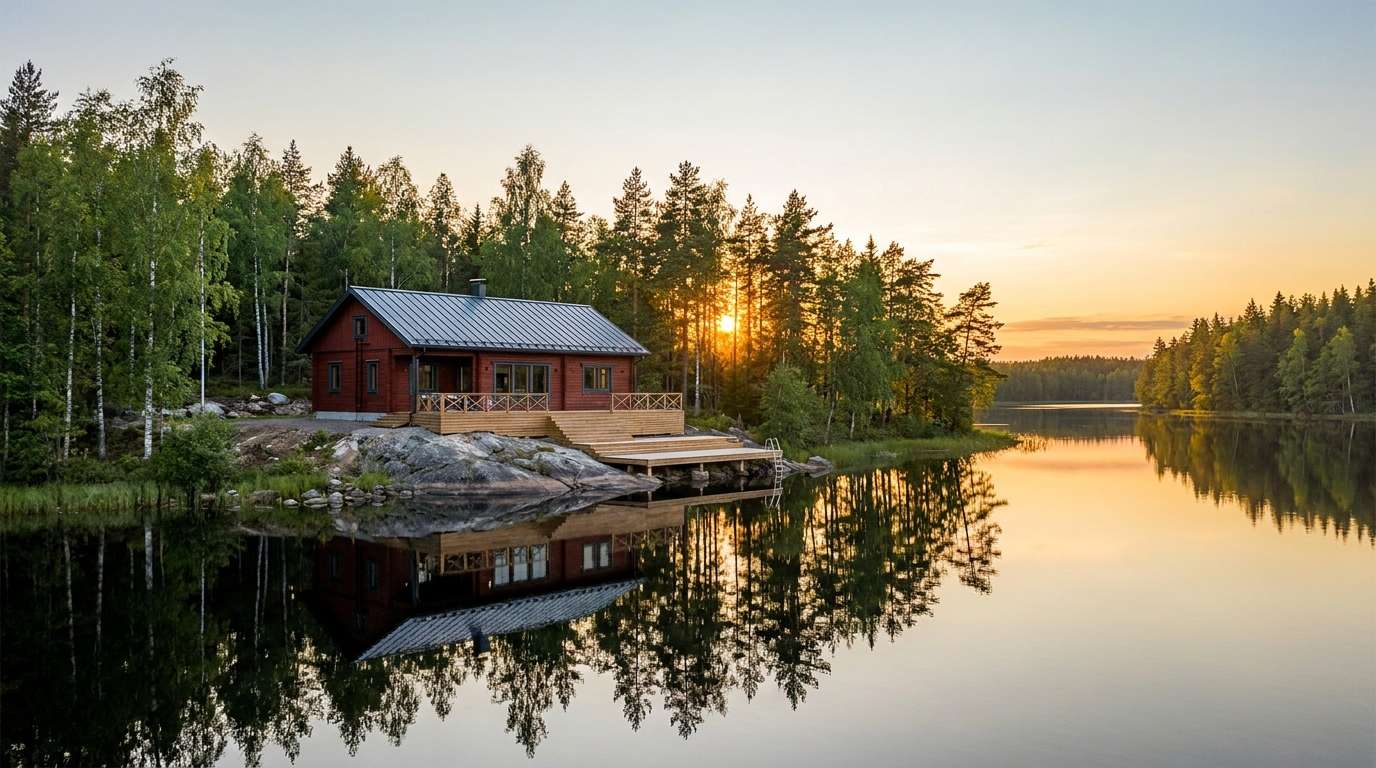
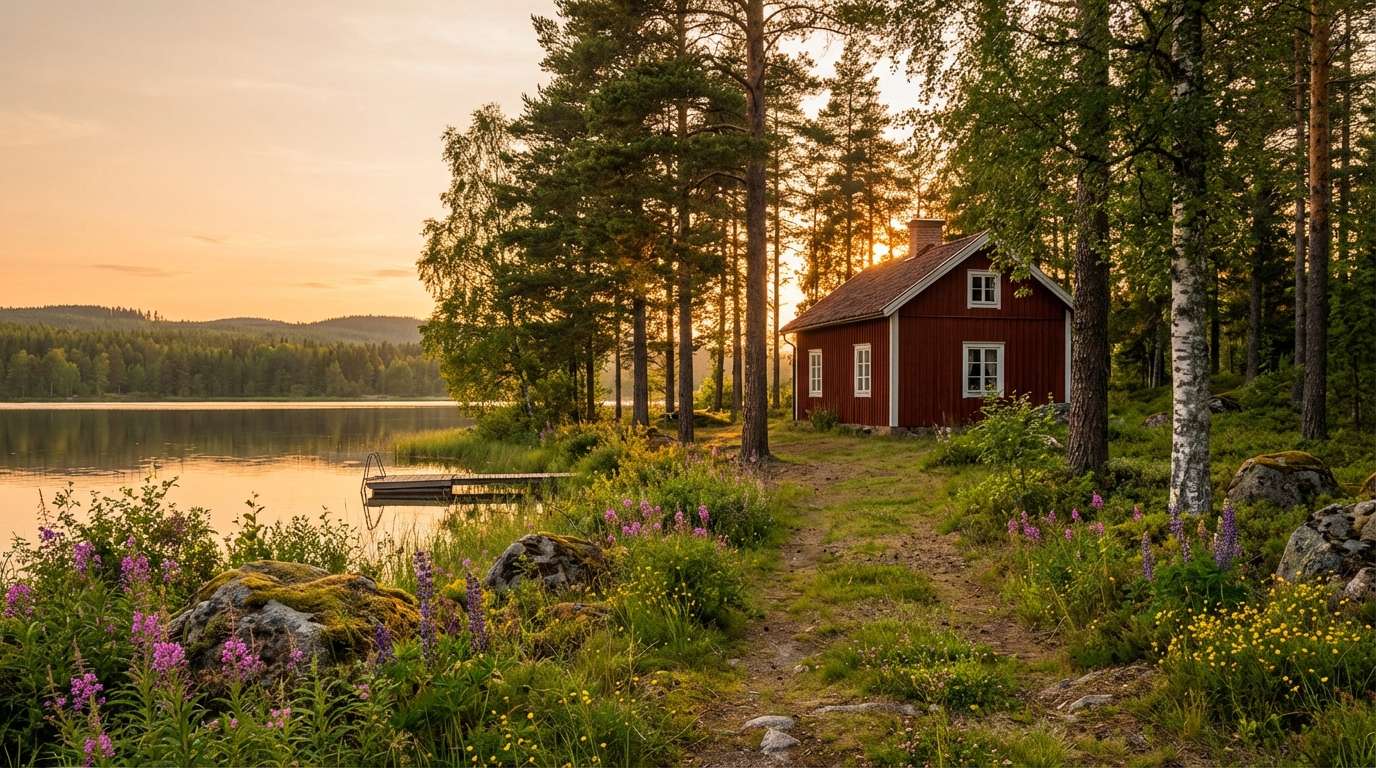
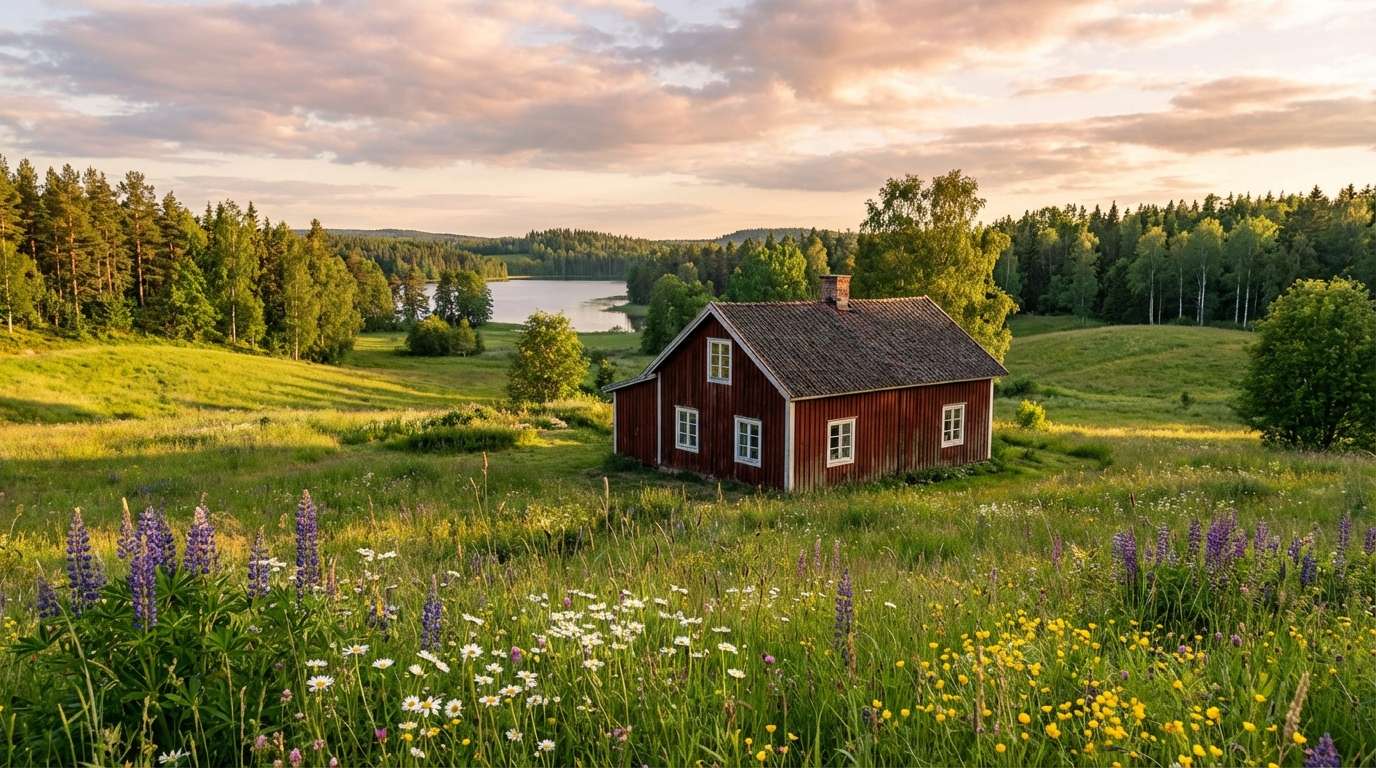
Sweden is the outlier on this list. Its median prices in accessible areas are not especially low, but its transaction cost structure is one of the lightest in Europe. As documented in Homestra's rural vacation home purchase guide, Sweden imposes no restrictions on foreign ownership: any buyer, regardless of nationality, can purchase residential property, land, and vacation homes without special permits. The acquisition process follows a clear framework: property inspection (besiktning), purchase agreement (köpekontrakt), a deposit of approximately 10% at signing, and title registration (lagfart) with stamp duty of 1.5% of the purchase price (or assessed value, whichever is higher) plus a fixed fee of 825 SEK. Total transaction costs are often under 3%, which is exceptionally low by European standards. Deeply rural properties, particularly in Dalarna, Värmland, and Västernorrland, list from around €25,000. A cozy vacation home near Boren Lake is listed at €47,000, and a lakeside country home with sauna in Skebobruk lists at €69,500.
Additional costs: what buyers consistently underestimate
The purchase price is only the starting point. International buyers frequently underestimate acquisition costs, and those costs vary substantially by country.
| Country | Transfer/purchase tax | Notary + legal fees | Land registry | Recurring annual tax | Agent commission |
|---|---|---|---|---|---|
| Bulgaria | 2–3% | 0.3–0.8% | Low fixed fee | Very low | 3–6% |
| Romania | 3% | 0.5–1% | Low fixed fee | Low | 3–5% |
| Hungary | 4% | 1–1.5% | ~0.3% | Low | 3–5% |
| Poland | 2% (PCC) | 0.5–1% | Low | Low | 2–3% |
| Greece | ~3.09% | 1.5–2.5% | ~0.5% | ENFIA (moderate) | 2–3% |
| France | ~5.8% | 1–2% | Included in notary | Taxe foncière | 5–8% |
| Italy | 9% (cadastral value) | 1–2% | ~0.3% | IMU (second homes) | 3–4% |
| Portugal | 0–8% (IMT) + 0.8% stamp | 1–2% | ~0.5% | IMI (moderate) | 3–5% |
| Spain | 6–10% (ITP) | 1–2.5% | ~0.5% | IBI (low–moderate) | 3–5% |
| Sweden | 1.5% (lagfart stamp duty) | Minimal | 825 SEK fixed | Property fee (capped) | 1.5–3% |
A few points demand attention:
Non-resident tax status. Buying abroad as a non-resident creates tax obligations that ownership alone does not. Countries including France, Spain, Italy, and Portugal levy annual taxes on non-resident property owners or require income tax declarations even if the property is not rented. Confirm your tax position with a local tax adviser before exchange of contracts.
Ongoing costs. Insurance, utilities (particularly heating in northern or mountain locations), maintenance, and communal charges (where applicable) need to be budgeted annually. A property costing €40,000 to buy may cost €2,000–€4,000 per year to maintain, insure, and tax.
Rural-specific due diligence. For rural properties, the inspection checklist should include: condition of the water supply (mains connection vs. private well), sewage system (mains sewer vs. septic tank and its permit status), heating system (age, fuel type, winterization suitability), roof and structural condition, access road status (private vs. public, year-round usability), and planning/zoning status. This applies across all 10 countries. In Sweden, the formal besiktning (structural survey) is a standard pre-contract step; in France, mandatory diagnostic reports (DPE energy certificate, asbestos, lead, etc.) must be provided by the seller; in other markets the onus is more squarely on the buyer.
For a broader overview of what to anticipate before committing funds abroad, Homestra's guide on what to consider before buying property abroad covers budget adjustments, FX risks, and hidden fees in practical terms.
How to use Homestra to find the cheapest listings
Homestra's search is designed specifically for international buyers comparing markets across countries. Here is a practical workflow for second-home searches:
- Select country from the main search or the country landing pages (e.g., houses for sale in Bulgaria, properties in Portugal).
- Set property type. For rural second homes, select "Country home", "House", or "Farmhouse". For coastal or village properties, include "Apartment" or "Villa" as relevant.
- Set your budget range. Use the min/max price filters to bracket a realistic range. For budget buyers in Bulgaria, filtering under €100,000 surfaces a large set of relevant options.
- Sort by price per m² (where available) to identify the best-value properties within your filtered results, rather than just the cheapest in absolute terms.
- Filter by newest listings first to catch fresh inventory before it is picked up by other buyers.
- Use keyword search for location specifics: terms like "lake", "sea view", "mountain", or "village" narrow results to your preferred landscape type.
- Check year-round access. For rural and mountain properties, confirm in the listing description or by direct inquiry whether the road access is maintained in winter. For properties in Sweden, Norway, or mountain areas of France and Spain, winterization costs (insulation, heating system capacity) should be factored into the first-year budget.
For buyers working across multiple countries simultaneously, Homestra's cross-country search allows direct comparison without switching between national portals, a significant time saving when evaluating five or six markets at once.
Which country is cheapest right now, and what should you do next
By median listing price per m², Bulgaria remains the cheapest European country to buy a second home in mid-2026, followed by Romania and, at a slight remove, Hungary. France's deep rural zones and Sweden's remote lake districts offer competitive absolute prices for buyers who are comfortable with renovation potential and seasonal access trade-offs, and both benefit from well-structured, low-cost acquisition processes.
Two cautions apply to any decision made today. First, the EU house-price environment is inflationary: the 5.1% EU-wide increase in Q1 2026 (Eurostat) and Hungary's exceptional 21.2% annual rise in Q4 2025 indicate that the cheapest markets are not static. Knight Frank's Global House Price Index reported a 2.4% weighted average annual increase across 55 markets in Q3 2025, a global context that suggests supply constraints are not unique to Europe. Second, transaction and running costs in markets like Italy and Spain can add 12–15% on top of the asking price, which narrows the gap with higher-priced but lower-friction markets like Sweden.
The right answer depends on your priorities: lowest absolute entry price (Bulgaria), best beach access under €100,000 (Greece or Bulgaria), best value rural house with minimal acquisition tax (Sweden or Poland), or proven rental demand and lifestyle infrastructure (Portugal or France).
Homestra refreshes its listing data continuously, with editorial ranking updates on a quarterly basis and listing examples reviewed monthly. To start your search now, use Homestra's country and property-type filters to narrow to your target market, with over 200,000 properties indexed across Europe, the range of options at every budget level is broader than any single national portal can offer.
Share