Blog published in Buying property abroad
Share
How expats can search for European homes without language skills
Find and buy a home in Europe without speaking the local language. Step-by-step guide with English portals, translation tips, and agent outreach.

Searching for a home in Europe when you don't speak the local language feels like trying to read a map in the dark. The listings look promising, the photos are gorgeous, and then you hit a wall of Portuguese, Swedish, or Greek text and have no idea whether the property has mains water or a private well, district heating or a 30-year-old oil boiler.
This guide gives you a complete, follow-along workflow. By the time you finish reading, you'll know exactly how to build a cross-country shortlist in English, translate listing details without getting burned by mistranslations, find agents who can communicate with you directly, and send a first message that actually gets a reply.
Who this is for: expats and international buyers searching for a second home, vacation property, or permanent residence anywhere in Europe. No local language skills required. You'll need a browser (ideally Chrome), an email address, and about an hour to work through the process the first time.
Difficulty: Beginner-friendly. Each step is small enough to act on right now.
Why a language barrier costs you more than just time
The surface problem is obvious: the listing description is in Dutch. But the deeper problem is what you miss when you skim past it.
A poorly translated or unread description might hide that the property runs on a private septic system rather than municipal sewage, that the heating is a wood-burning stove with no backup, or that the price shown excludes a mandatory broker commission. In Sweden, for example, buyers operate under a strict "duty to investigate" (undersökningsplikt), which means the legal responsibility to check the condition of a property falls on you, not the seller. Homestra's rural Sweden buying guide highlights specific risks that are almost impossible to spot without reading carefully: private wells, septic drainage systems (enskilt avlopp), insulation quality, and moisture or mold indicators. Miss those details in the listing and you'll only find out during a physical inspection, possibl. The same principle applies across borders — a Portuguese listing might quietly note that the property is classified as a ruin for tax purposes, or a Spanish one might mention outstanding community fees buried in a single line of fine print. These aren't edge cases; they're the kind of details that show up regularly when you're searching across multiple countries and markets you're not already familiar with.y after you've already paid for flights.
Then there's the agent communication problem. Send an email in English to an agent who works exclusively in Spanish or Finnish, and you may wait days for a reply, or get no reply at all. The listing might have gone under offer in that time.
The good news: there's a repeatable process that handles all of this. Here it is.
Step 1: Build your shortlist using an English-first platform
Start with a platform designed for cross-border search in English rather than trying to navigate local portals one country at a time.
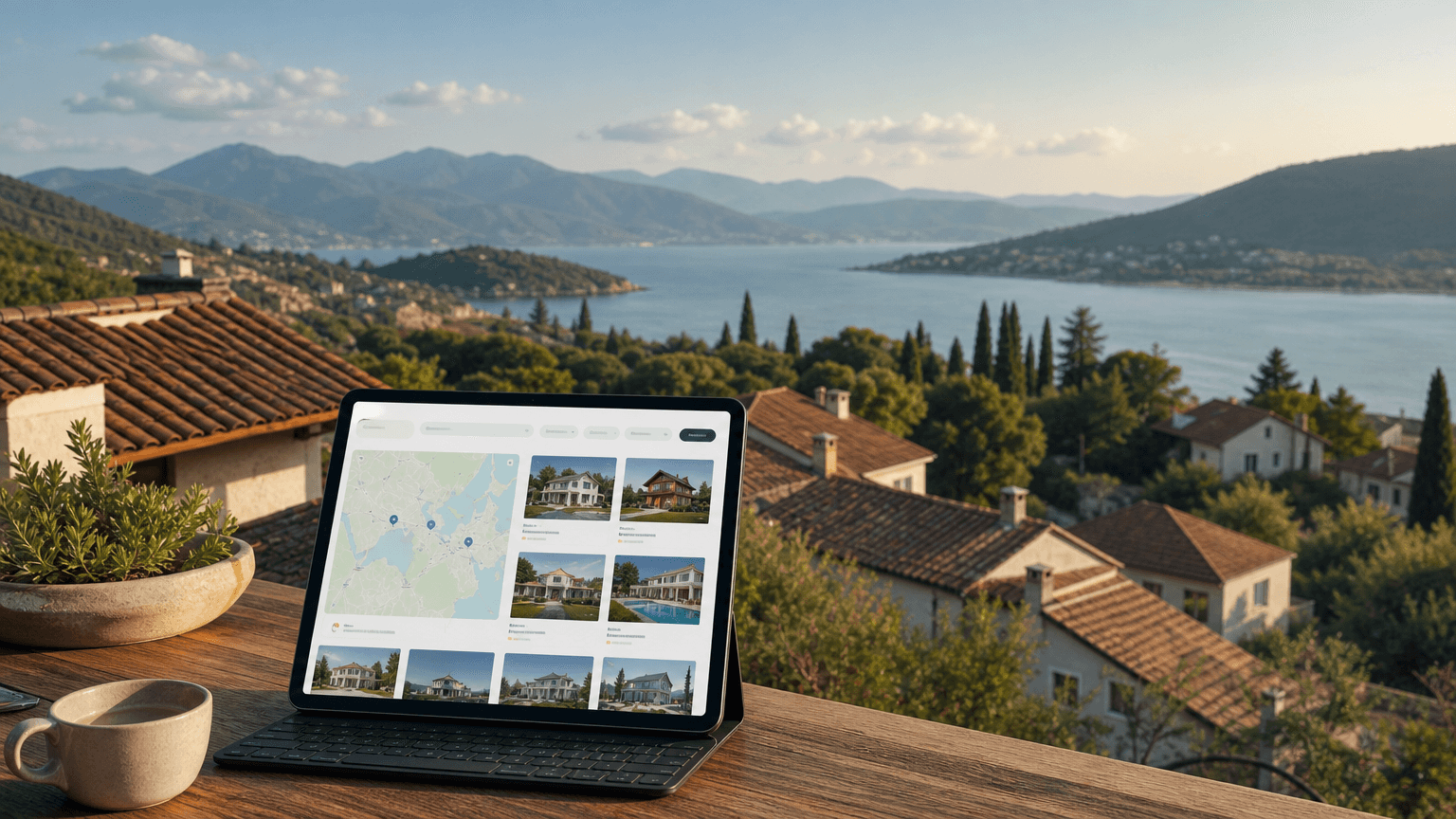
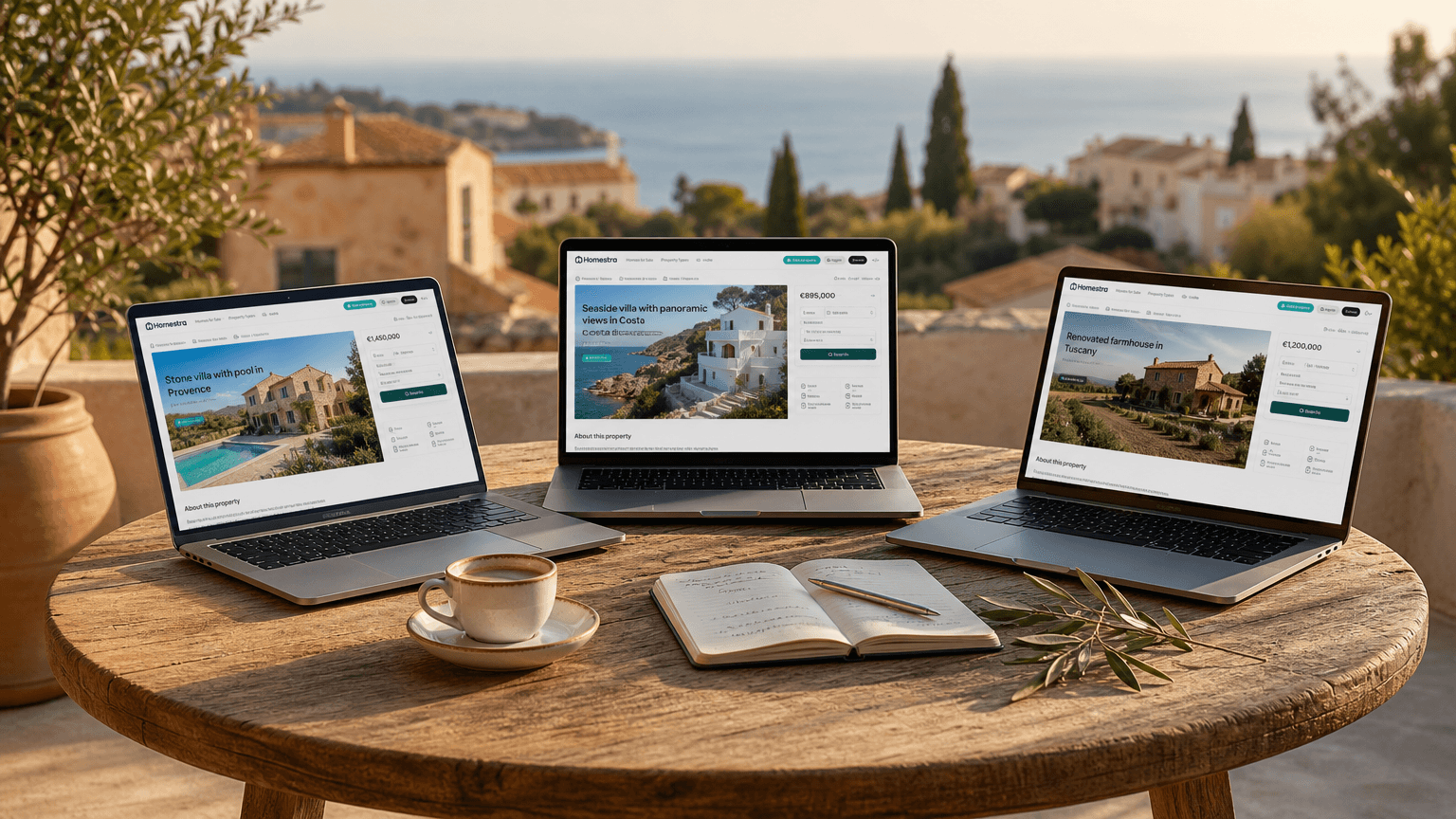
Homestra is built specifically for international buyers searching across European markets. With over 200,000 properties available, it lets you browse, filter, and compare listings across multiple countries without switching languages or portals. That's the right starting point for expats doing property search in English across Europe.
Here's how to build your initial shortlist:
- Go to homestra.com and choose whether you're buying or renting.
- Set your target countries or regions. If you're still deciding between, say, southern France, coastal Portugal, and rural Sweden, search broadly and let the results inform you. Don't narrow too early.
- Apply practical filters: budget, number of bedrooms, property type (house, apartment, rural). If winterization matters to you (it should for any northern or mountainous property), filter by heated floor area or look for listings that specify heating type.
- Open each shortlisted property and capture the essentials in a simple spreadsheet: property title, price, location, listed features, agent or agency name, and any notes about language cues in the listing contact details.
Checkpoint: You should finish this step with 5-15 properties across your target regions, all viewed in English, with agent contact details noted for each.
A few other portals serve expats doing cross-border search in Europe. Rightmove Overseas displays over 260,000 properties across more than 90 countries and caters to UK-based international buyers. Kyero focuses on Southern Europe and works with local agents in markets like Spain, Portugal, and France. HousingAnywhere is geared toward mid-to-long-term rentals across 400+ cities and suits renters more than buyers. These can supplement your search, but none of them offer the same cross-country buying focus as Homestra for second-home and international purchase scenarios.
Step 2: Translate listing details without trusting the output blindly
Once you've found properties that look right on paper (and in photos), you need to validate the written details. For listings where the agent description or neighborhood notes appear in the local language, browser translation is your first tool.
How to use Chrome's built-in translation
Google Chrome has a built-in page translation feature that works on any webpage. According to Google's Chrome help documentation, here's how to use it:
- Open Chrome and navigate to the listing page.
- Look for the Translate icon on the right side of the address bar. If it doesn't appear automatically, right-click on any blank area of the page and select "Translate to English."
- Chrome will translate the full page, including listing descriptions, fee notes, and any legal or condition disclosures.
That gets you a readable version. But don't stop there.
What to translate and what to verify
Translate everything that affects your decision: the full property description, amenities list, neighborhood and commute notes, any fee or broker commission notes, and any condition or defect disclosures. Then cross-check what you read against the photos. If the translation says "renovated kitchen" but the photos show a 1980s galley with no appliances, flag it.
Watch out for technical terms where machine translation often fails:
- Heating systems: "fjärrvärme" (Swedish district heating) vs. "värmepump" (heat pump) vs. wood pellet or oil. Chrome might just say "heating" without telling you which type.
- Water supply: whether it's mains water or a private well (brunn in Swedish, puits in French, pozo in Spanish).
- Sewage: municipal sewer connection vs. private septic tank. This matters enormously for rural properties.
- Legal descriptions: land registry references, ownership type (freehold vs. leasehold), and easements are rarely translated accurately.
- Measurements: some listings use net living area, others use gross floor area. The numbers can differ by 20% or more.
Rule of thumb: translate for understanding, but request translated documents for anything legal or financial. An inspection report, a preliminary contract, or a deed should never be acted on through machine translation alone. Ask the agent for an English version, or hire a local translator for those specific documents.
Translation checkpoint
Before moving to agent contact, run through this quick check for each property:
- Translate the full listing description
- Compare key claims against the photos
- Flag any technical terms that seem unclear or generic
- Write down your questions for the agent (utilities, heating, water source, septic, any disclosed defects)
Step 3: Find and contact an English-speaking agent
Most listing pages include the agency name and a contact form or email. Your first job is to confirm whether they can communicate in English before you invest time in scheduling anything.
How to check for multilingual support
Some agencies list their languages directly on their profile page or website (look for a "Languages spoken" section or flag icons). If you can't find that information, the first message you send is your test.
Here's a message template you can copy and adapt:
Subject: Property inquiry, [Property address or listing reference]
Hello,
I'm interested in the property listed at [address/URL]. I'm an international buyer and my primary language is English. Are you able to communicate with me in English?
If so, I'd like to confirm:
- Is this property still available?
- Is a viewing possible (in person or virtually)?
- Can you provide a summary of the key property details in English, including the heating system, water supply (mains or well), sewage connection (municipal or septic), and any known defects?
Thank you for your time. I look forward to hearing from you.
[Your name] [Your phone number or WhatsApp, if you're comfortable sharing it]
Send this message through the platform's messaging system or via email if the listing provides a direct address. Keep the message short and specific. Agents receive a lot of vague inquiries; asking precise questions about availability and utilities signals that you're a serious buyer.
When the agent doesn't respond or can't communicate in English
No response after 3-5 business days: follow up once via a different channel (phone call, WhatsApp, or the agency's main contact form). If there's still no reply, move on. A listing that's hard to reach at the inquiry stage will only get harder later.
Agent responds only in the local language: this happens, especially with smaller independent agencies. You have two options. First, try asking specifically whether a colleague in the agency speaks English. Second, consider hiring a local buyer's agent or property lawyer who acts as your English-speaking intermediary. This is worth the cost for any transaction that reaches the offer stage.
Vague or auto-translated replies: if the agent's English response reads like it went through a low-quality translator, ask to confirm specific points explicitly. Don't assume "the house has good heating" means forced-air central heating. Ask: "Can you confirm the heating type and fuel source?"
Step 4: Prepare your checklist before making contact
A little preparation before you reach out saves multiple back-and-forth emails and helps agents take you seriously.
Documents to have ready (don't send until verified)
- A copy of your passport (for ID verification, only when the agent or platform requests it through a verified channel)
- Proof of funds or a mortgage pre-approval letter from your lender
- A written statement of your timeline (e.g., "I'm looking to complete within 6 months")
Don't send sensitive documents through unverified email. Use the platform's secure messaging where possible, or wait until you're in direct contact with a verified agency.
Questions to have prepared
Go into every first contact with this list ready:
| Topic | What to ask |
|---|---|
| Availability | "Is this property still listed and available for sale/rent?" |
| Viewing | "Can I arrange an in-person or virtual viewing? What are the next steps?" |
| Utilities | "What is the heating source? Is water supply from mains or a private well? Is sewage municipal or a private septic system?" |
| Fees | "Are there any additional fees payable by the buyer, including agency commission, notary fees, or local taxes?" |
| Timeline | "What is the typical process and timeline from offer to completion in this country?" |
| Documents | "Can you provide key documents (energy certificate, inspection report, title information) in English or as official translations?" |
A word on rural properties specifically
If you're looking at rural or countryside properties, the utilities and condition questions above are not optional extras. Homestra's guidance for international buyers purchasing in rural areas makes this clear: private water systems, septic drainage, and heating setups require specific inspection attention. A property description that doesn't mention these details isn't necessarily hiding anything, but it does mean you need to ask before you visit.
Frequently asked questions
Is there a single Europe-wide property portal like Zillow in the US?
No single portal covers all of Europe the way Zillow covers the US. The European market is fragmented by country and language. Homestra comes closest for international buyers doing cross-country second-home searches in English, with over 200,000 properties and a focus on expat and international use cases. For rentals, HousingAnywhere covers mid-to-long-term stays across 400+ cities. For Southern Europe specifically, Kyero aggregates listings from local agents in markets like Spain and Portugal.
Do European property portals offer English-language search?
It varies. Some portals built for international buyers (including Homestra) are designed with English as a primary interface language. Others, like country-specific portals in France, Germany, or Scandinavia, are primarily in the local language, which is where Chrome's translation feature becomes useful.
Should I rely on machine translation for legal documents?
- Machine translation is fine for getting a general understanding of a listing description. For contracts, inspection reports, title deeds, or any document you'll be asked to sign, you need either an official translation or a bilingual property lawyer. The cost of a legal translation is small compared to the cost of misunderstanding a contract clause.
How do I know if a listing is still available?
The only reliable way is to ask the agent directly. Many portals carry stale listings that haven't been removed after sale or rental. This is true across all European markets. Always confirm availability in your first contact message before investing time in research or travel.
What if I'm comparing properties across multiple countries?
Build your shortlist in one place first (Homestra handles this well for cross-country comparison), then validate country-specific rules and costs separately for each market you're seriously considering. Buying costs, agent commission structures, and legal processes differ significantly between, say, Spain and France, or Sweden and Italy.
Your next steps
The workflow, laid out simply:
- Shortlist on Homestra, using English filters across your target countries
- Translate and validate each listing using Chrome's built-in translation, then flag technical terms to clarify
- Contact agents using the message template above, confirm English availability, and ask about utilities, availability, and viewing
- Prepare your documents and questions checklist before any serious conversation begins
- Escalate to a bilingual intermediary if direct agent communication breaks down
You don't need to speak Spanish, Swedish, or Greek to find a great property in Europe. You need a clear process, the right tools, and the patience to ask the right questions. Start with a broad search, narrow by what you learn, and confirm every detail that matters in writing before you book a flight.
Share