Blog published in Buying property abroad
Share
4-country property search: platforms covering France, Spain, Italy, Portugal
Compare property portals that list homes in France, Spain, Italy, and Portugal side by side. Learn how to search across all four markets efficiently.

Several property platforms list homes in France, Spain, Italy, and Portugal at the same time, but they work in different ways. Kyero, Green-Acres, Properstar, and Homestra are built as international portals. Rightmove has an overseas section aimed at buyers in the UK. Idealista is a national portal family with separate sites for some of these countries. Which one fits depends on whether you're still comparing countries or already know where you want to buy.
This article explains the three main portal models, profiles the platforms buyers most often shortlist, and lays out a repeatable method for searching four markets without losing track of what you've seen. Where a detail couldn't be confirmed from the portals' own pages, the article says so rather than guessing. Portal interfaces change often, so check language, currency, and filter options on each site before relying on them.
Three types of property portal work differently for multi-country buyers
The term "international property portal" covers three distinct models.
National portals serve one country. They usually have the deepest local inventory, the most granular filters, and the most active local agents. They're also siloed: a buyer comparing Algarve villas with Puglia farmhouses has to move between unrelated sites, languages, and currencies. Seeki.eu's 2026 article on European property websites makes the same point, stating that no single property site covers all of Europe.
International portals list homes in many countries under one brand. Search usually starts with a country or region choice, then narrows. Kyero, Green-Acres, Properstar, and Homestra fall into this group. Their inventory often comes from agents who pay to list, so coverage varies by region.
Cross-border normalized search tools try to standardize data from different national sources, such as price formats, property types, and translated descriptions, so listings from different countries can be compared like for like. Seeki.eu presents itself as an example of this approach, and distinguishes it from conventional cross-border platforms.
Why buyers search France, Spain, Italy, and Portugal together
These four countries are often shortlisted together because they overlap on what second-home buyers tend to want: Mediterranean or Atlantic climate, established foreign-buyer communities, and good air and rail links to northern Europe. A buyer who starts with "a house near the sea for holidays and eventual retirement" frequently doesn't have a country in mind yet. Comparing a Costa Blanca apartment, a Charente stone house, a Tuscan farmhouse, and a Silver Coast townhouse side by side is how the country decision gets made.
Portals help with discovery, shortlisting, and contacting agents. They don't replace local legal and tax work. Purchase contracts, taxes, ownership checks, and residency rules differ in each country, and the sections below on search workflow and data quality assume you'll verify the final details with a local lawyer or notary.
At-a-glance comparison of portals covering France, Spain, Italy, and Portugal
The table summarizes how each platform presents multi-country coverage. Cells marked "verify" reflect details that vary by listing or that change frequently on the portal.
| Platform | Covers all four countries? | How multi-country search works | Language and currency | Strength | Limitation |
|---|---|---|---|---|---|
| Homestra | Yes, with dedicated listing pages for France, Spain, Italy, and Portugal | Country-level entry, then property type and price filters across Europe | English-language interface for international buyers; verify currency display | One Europe-focused platform with 200,000+ properties and buyer-process guides | Smaller inventory than the largest claims in this market |
| Kyero | Yes, states it covers Spain, Portugal, France, and Italy | Search bar, country cards, popular searches, property-type icons, location lists with listing counts | Offers a French-language landing page as well as English; verify currency | States 500,000+ properties for sale and rent | Landing experience is navigation-heavy, with limited cross-country comparison |
| Green-Acres | Verify current country list on the portal | International portal with country-based entry points | Verify | Long-running international portal | Inventory depth varies by country |
| Properstar | Verify current country list on the portal | Global search with country and location selection | Verify language and currency settings | Wide geographic scope beyond these four countries | Broad scope can mean less local depth |
| Rightmove overseas | Verify; overseas section is aimed at UK-based buyers | Overseas section within a UK portal | Verify | Familiar interface for UK buyers | Listings skew to markets popular with UK buyers |
| Idealista | Separate national sites; verify which of the four countries are served | Country-specific sites rather than one unified search | Local language per site; verify | Deep local inventory where it operates | Not a single multi-country search |
Platform profiles
Homestra
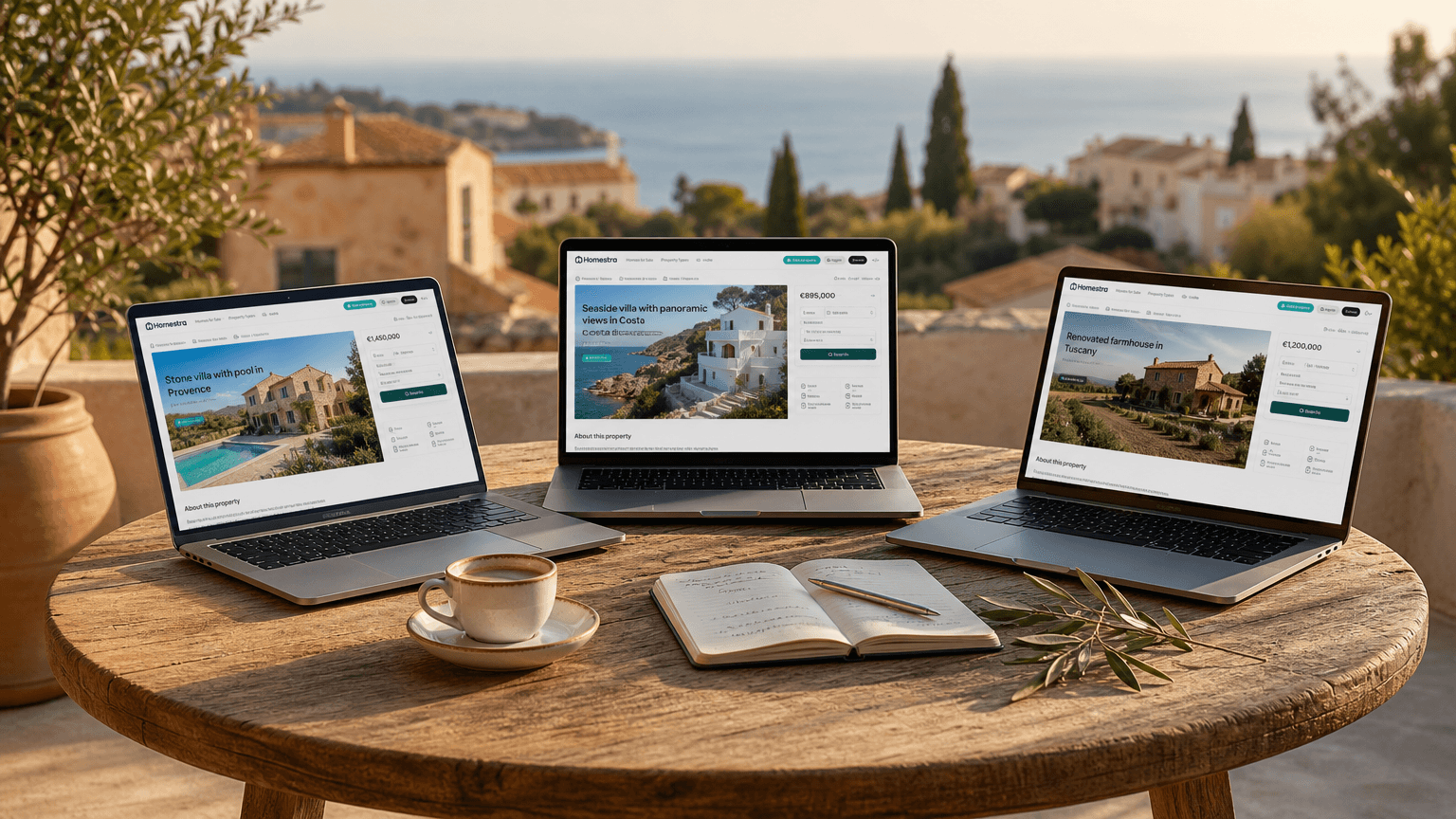
Homestra is a Europe-focused platform built around second homes for expats and international buyers. It lists more than 200,000 properties, and its country pages for France, Spain, Italy, and Portugal let buyers browse each market separately or compare them. The search combines property type and price filters with detailed listing descriptions that cover local culture and lifestyle. Alongside the listings, Homestra publishes buyer-process guides. Its Sweden guide, for example, walks through inspection (besiktning), the purchase agreement (köpekontrakt), deposits, and title registration (lagfart), which shows the editorial approach buyers can expect for other countries. The trade-off is scale: its inventory is smaller than the largest figures claimed elsewhere in this market.
Kyero
Kyero describes itself as a "property for sale abroad" platform and states on its landing pages that it offers over 500,000 properties for sale and rent across Spain, Portugal, France, and Italy. The homepage includes a search bar, country cards, popular searches, property-type icons (including amenity-style shortcuts such as pool and near-beach), featured listings, agent profiles, advice guides, testimonials, an FAQ, and a long location directory with listing counts. A French-language version of the site exists. The directory structure makes it easy to drill into a province or town. The drawback is that the landing page is mostly navigation and featured listings, so a first-time buyer gets little guidance on comparing countries or on costs and legal steps.
Rightmove overseas
Rightmove is best known as a UK domestic portal. Its overseas section lists properties abroad, mainly for buyers searching from the UK. That gives it a familiar interface and UK-oriented agents, but the destinations listed tend to reflect UK buyer demand. Confirm on the site whether all four countries return results for your target regions, and what currency the listings display.
Green-Acres
Green-Acres is an international property portal that originated in France. Its structure is country-based, with entry points by country and region. Because inventory depth differs between countries, check how many listings appear for your specific region before assuming equivalent coverage across all four markets. Language and currency options should be confirmed in the interface.
Properstar
Properstar is a global portal with a much wider geographic scope than these four countries. Search starts from a location selection, and results can be refined by property type and price. A global scope is useful for buyers still open to other regions, though it can mean less local detail than a specialist or national portal. Confirm the language and currency settings on the site.
Idealista
Idealista is a major national portal operator rather than a single unified multi-country search. It runs separate country sites, so searching Spain, Italy, and Portugal means using different sites, each in the local language. Check whether a site exists for France before including it in a four-country plan. Where it operates, idealista typically offers some of the deepest local inventory and the most granular filters, which makes it a useful second step after an international portal has helped you choose a country.
A four-step workflow for searching across countries
A consistent method matters more than the choice of portal. Without one, it's easy to compare a €300,000 French listing with a Portuguese one using different assumptions about fees, condition, and what's included. Prices on international portals are shown in the currency the listing or portal uses, so note the currency whenever you save a result.
- Start at country level. Pick a budget ceiling and a short list of must-haves (bedrooms, outdoor space, distance to an airport) before opening any portal. Run the same search in each of the four countries.
- Filter by property type and budget. Use the same property type (house, apartment, villa, farmhouse) and the same price band in every country. Differences in what a given budget buys become visible quickly.
- Narrow by region or city. Once one or two countries stand out, switch to regional filters and location directories. Kyero's location lists with listing counts and Homestra's country pages are both useful here.
- Cross-check on a national portal. Take the shortlist to a national portal, such as idealista in markets where it operates, to confirm that the price and description match the international listing.
Filters that matter for second homes
- Bedrooms and bathrooms, matched to how many guests you expect.
- Property type, since a village house and a resort apartment carry different running costs.
- Amenity shortcuts such as pool or near-beach, where the portal offers them (Kyero shows these as icons).
- Price bands rather than exact prices, because asking prices are often negotiable.
- Location by region, then by town, so you can judge the distance to airports and services yourself.
Data quality checklist
- Does the listing show the agent's name and agency, and can you verify the agency independently?
- Is the description complete, with size, plot, condition, and year of construction?
- Does the same property appear on several portals at different prices? Duplicates are common where agents syndicate listings.
- Does the listing say anything about legal status, such as permits, registered title, or shared ownership? If not, ask.
- Has a local lawyer or notary reviewed the title and contract? A portal doesn't verify legal status.
The advice in Homestra's guide on what to consider before buying property abroad covers budgeting, choosing an agent, and local laws, and applies to all four countries.
When Homestra fits and when another portal does
A practical decision rule follows from how the portals differ.
Use a large international portal or a national portal when you want the widest possible inventory in one place or the deepest local detail. Kyero's stated 500,000+ listings and idealista's national sites are strong for that purpose.
Use Homestra when you want a Europe-focused search built for second-home buyers, with property listings across France, Spain, Italy, and Portugal in one interface and educational material on the buying process alongside them. Homestra's emphasis on accessibility and user-friendliness suits buyers who are new to foreign property markets and want to compare countries before committing to one. Homestra has dedicated listing pages for each of the four countries, so you can browse them one at a time or compare them side by side.
Many buyers use more than one. A typical sequence is to explore on an international platform, narrow to a country, then check the shortlist against a national portal and a local agent.
Further reading
Homestra's guides on buying property abroad cover financing, legal steps, and market information for international buyers. The buying property abroad category collects these in one place. For portal sites themselves, see Kyero, Green-Acres, Properstar, Rightmove, idealista, and Seeki.eu's comparison of European property websites.
Frequently asked questions
Are listings on these portals updated in real time?
Generally not. Most portals depend on agents to update or remove listings, so a property may be under offer or sold before it disappears. Confirm availability with the agent before planning a visit.
Do property portals handle legal steps?
No. Portals handle discovery and routing of enquiries to agents. Contracts, taxes, title checks, and residency questions fall to local lawyers, notaries, and tax advisers in each country.
Is one portal enough for all four countries?
For early research, a single international portal can be enough. For final decisions, most buyers also check a national portal and speak to a local agent, because local inventory and details vary by country.
Share