Blog published in Buying property abroad
Share
Best sites to buy a villa in Greece or Turkey: top portals compared
Find the best portals for buying a villa in Greece or Turkey. Compare local and international sites, plus a legal checklist to verify any listing.

Most buyers who ask which sites to use for a villa in Greece or Turkey are really asking two questions. Where do the listings live, and how do I know a listing is real? The first has a short answer: a local portal in each country, an international "overseas" portal for English-language browsing, and an aggregator for comparing across borders. The second takes longer, because a polished listing page proves nothing about who owns the property, whether it was built legally, or what taxes will land on you at closing.
This article covers both. It lists the portals that matter in each country, explains how an international buyer should use each one, and sets out the legal and verification basics that apply once a villa is on your shortlist. Time-sensitive tax and fee figures change, so confirm them with a qualified local professional before you sign anything.
The best way to search is in three layers
No single site covers both countries well. A layered approach works better:
- Local portals hold the deepest inventory and the most neighborhood-level detail, but they're mostly in Greek or Turkish.
- International overseas portals surface English-friendly listings, usually from agents who work with foreign clients.
- Cross-country aggregators let you compare a Greek island villa against a Turkish coastal one without maintaining a dozen saved searches.
Use local portals to understand real asking prices in a given district. Use overseas portals to get started in your own language. Then run every shortlisted villa through the same due-diligence checklist, regardless of where you found it.
Where to find villas in Greece
Spitogatos and other local Greek portals
Spitogatos.gr is the best-known Greek property portal. It offers search for sales and rentals, plus services such as property valuation, listing submission for sellers, professional assignment, a mortgage partner promotion and a blog. As a gateway to inventory it's strong. As a source of buying guidance for foreigners it's thin: the homepage is mostly navigation, and its FAQ answers are generic rather than step-by-step.
That shapes how you should use it. Treat Spitogatos as a price-discovery tool. Search by region and property type, save the searches, and note asking prices for comparable villas so you know what's normal before you speak to an agent. Another widely used Greek portal, XE Property, works the same way. Searching both for the same area helps you spot duplicate listings from agents who post everywhere, and it gives you a more honest read on how far asking prices sit from actual market levels.
Expect to rely on browser translation. Agent descriptions are written for Greek buyers, so details foreign buyers care about, such as whether the property is within a restricted border area or whether the building permit is complete, often aren't stated at all. Missing information in a Greek listing is a question to ask, not a reason to assume.
Rightmove Overseas for Greece
Rightmove, the UK portal, runs a dedicated section titled "Properties For Sale in Greece" under Rightmove Overseas. Its value is language and presentation: listings are typically placed by agents who market to English-speaking buyers, and the interface will be familiar to anyone who has searched for property in the UK. The trade-off is inventory. Overseas portals show a curated slice of the market, and that slice skews toward properties agents expect foreigners to want. You won't see the full local market, and prices may carry a premium compared with what the same villa would list for on a Greek portal.
Where to find villas in Turkey
Turkey's property market is large and heavily online. Three portals dominate the conversation, and each suits a different purpose.
Sahibinden
Sahibinden describes itself as an online classifieds marketplace, with real estate for sale and rent as one of its categories. That classifieds DNA matters. Listings come from private owners as well as agencies, so inventory is deep, but quality varies more than on agent-only platforms. Use the villa category filter (look for "Villa" under the housing type), narrow by province and district, and sort by newest to catch fresh listings. Expect duplicate postings, and treat unusually low prices as a prompt to investigate rather than a bargain.
Hepsiemlak
Hepsiemlak offers an English interface option, which makes it the easiest of the major local portals for a first-time foreign searcher. Switch the language setting at the start, then use the map view to narrow by coastline or district. English-language settings change the interface, though, not necessarily the listing text, so you'll still meet descriptions written in Turkish. Run those through a translation tool and ask the agent to confirm key details in writing.
Emlakjet
Emlakjet presents itself as AI-supported search and market analysis, with features such as investment scoring and drone and visual tooling. For a villa buyer, the useful part is the analysis layer: scoring and market data can help you judge whether an asking price is reasonable for a district. Treat any automated score as a starting point. It can't see the condition of the roof, the status of the permit, or whether the seller actually holds the title.
Rightmove Overseas for Turkey
As with Greece, Rightmove Overseas has a dedicated "Properties For Sale in Turkey" page. It's the gentlest starting point for English speakers, and it's a reasonable place to learn which resort areas and property styles exist before moving to the local portals for the full picture.
When to use local portals and when to use overseas ones
Start on an overseas portal if you don't yet know which region you want. The English descriptions, photography standards and agent contact flow save time while you're orienting. Move to local portals once you've narrowed to a district. Local portals show more listings, more private sellers and more accurate price clustering, and the gap between what a villa is listed for on a local portal and an overseas one is itself useful information.
Using Homestra as the comparison layer
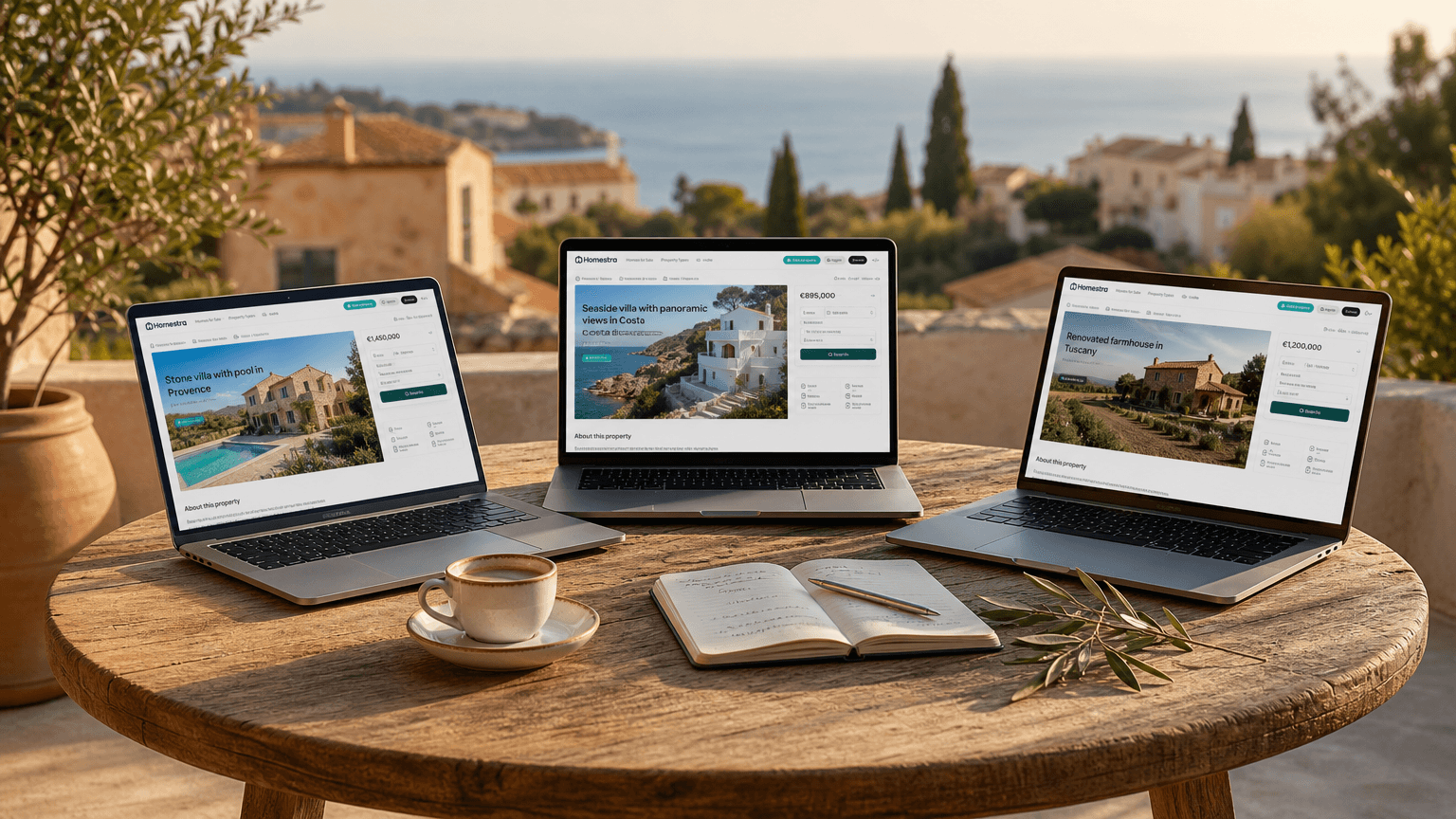
Searching four or five portals in two languages gets tiring, and it makes direct comparison harder. Homestra is a cross-country housing platform built for second-home buyers and expats, with more than 200,000 properties across Europe and browsing organized by country and property type. For a buyer undecided between Greece and Turkey, that structure is the point: you can filter by villa as the property type, set a price range, and look at options in both countries side by side, rather than reconciling two unrelated search experiences.
Use Homestra for discovery and shortlisting. Legal verification still happens locally, with professionals in the country where the villa sits. No listing platform, Homestra included, can confirm title or permits on your behalf.
What foreign buyers need to know about Turkey
Ownership limits
Foreign ownership in Türkiye is permitted under statutory limits. According to Tru Property Turkey's summary of Land Registry Law No. 2644 (Article 35), a foreign individual can own up to 30 hectares nationwide, and foreign ownership can't exceed 10% of the private land area in any given district. Purchases are prohibited in military and strategic security zones. For a typical villa plot these caps rarely bite, but the security-zone restriction can, and it's checked through the application process rather than visible on a listing.
The tapu is the proof
Ownership in Turkey is established through the title deed, called the tapu, issued by the land registry. A listing is a marketing claim. The tapu is the legal fact. According to deal-tr.com's 2026 tapu guide, the common categories include Red Tapu and Blue Tapu, along with construction-related variants such as kat mülkiyeti (condominium ownership) and kat irtifakı (construction easement). The distinction between the last two matters for villas in developments: kat irtifakı generally signals that the building isn't yet complete, while kat mülkiyeti reflects a finished, registered unit. If an advertisement describes a ready-to-move-in villa but the documentation shows an earlier-stage deed, stop and ask why.
Costs
Bilkay Legal's guidance for foreign buyers describes the Turkish title deed transfer fee as 4% in total, commonly split as 2% paid by the buyer and 2% by the seller. Other registration and transaction costs apply on top, and in practice buyers and sellers sometimes negotiate who pays what. Get a written cost breakdown from your lawyer before making an offer, and budget for the fact that some listings are priced in Turkish lira, so the cost to you will move with exchange rates and transfer fees between your bank and the Turkish one.
What foreign buyers need to know about Greece
Greece uses a different registration structure, but the due-diligence pillars are similar. According to buygreece.us's foreign-buyer guide, the process requires a Greek Tax Number (AFM) and independent due diligence in two parts: legal checks through the title chain, and technical checks through a civil engineer's certificate. The sale is then completed by notarial deed and registered with the land registry.
The AFM comes first, and it's easy to obtain without a Greek address. The notary is a state-appointed official who finalizes the deed, but the notary doesn't act as your personal advocate, which is why you need your own lawyer. Ownership is checked against Greece's cadastre (Ktimatologio) and land registry records.
Two further cautions. Transfer-tax rules can differ by buyer status, and non-EU buyers face an additional layer around border and restricted areas, which Homestra covers in its guide to buying a second home in Greece or Croatia as a non-EU buyer. Tax treatment also changes over time, so see Homestra's country-by-country property tax comparison for the structure of acquisition, annual and capital gains taxes, then confirm current figures locally before you make an offer.
A verification checklist that works in both countries
Run these checks on every villa before you pay a deposit.
- Identity match. The address, parcel or plot identifiers and the property in the photos must all refer to the same thing. Ask for the identifiers and check them yourself.
- Ownership chain. The seller named in the contract must match the registered owner. Inheritance cases and multiple co-owners need every owner's signature.
- Encumbrances. Ask your lawyer to check for mortgages, liens and court seizures at the registry.
- Construction and permit status. Confirm the building was permitted and built as permitted. Additions such as pools, extra floors and guest houses are the usual trouble spots.
- Tax and fee clearance. Unpaid property taxes and utility debts can follow the property.
- Payment discipline. Pay through traceable bank channels into accounts you've verified, and only against signed documents.
In Turkey, add one more step: compare the tapu type against what the ad claims, and ask for documents showing both ownership and build status. In Greece, add the civil engineer's technical report and the cadastre check.
Red flags that mean walk away
- The documents don't match the listing, and the explanations keep changing.
- The seller or agent suggests declaring a lower price on the deed or paying part in cash off the books.
- Ownership details stay vague, or the person you're dealing with isn't the owner and can't show a valid power of attorney.
- You're pressured to pay a deposit before a lawyer has seen anything.
- The price sits far below comparable villas on the local portals, with no clear reason.
An underdeclared price is a legal exposure for you as the buyer too, since it can affect your tax position when you later sell. Don't treat it as a favor.
The professionals to hire, and how to brief them
Hire independently. A lawyer recommended by the selling agent has a conflict of interest, however friendly. You need:
- A local lawyer to check title, encumbrances, permits, tax clearance, and the contract and payment structure.
- A civil engineer (required in practice in Greece) to confirm the building is technically compliant and matches the permits.
- A certified translator if you're working with documents you can't read.
Brief them well. Send the listing URL, any brochure materials, the parcel or plot identifiers, and whatever documents the seller has provided, translated if possible. Then ask specific questions:
- Does the seller hold clean title, and who else has a claim?
- Are there mortgages, liens or seizures registered against the property?
- Does the building match its permits, and is any part of it unauthorized?
- Are taxes and utilities paid up?
- What will the total transaction cost be, line by line, and who pays each item?
- How is the payment structured, and what happens to my deposit if the sale fails?
- Is the property in a restricted or security zone for foreign buyers?
A good lawyer will answer these in writing. If you get vague reassurance instead, find another one.
A sensible order of operations
Start broad on an overseas portal or Homestra to learn what villas cost and where. Narrow to a region, then check the local portals (Spitogatos and XE Property in Greece; Sahibinden, Hepsiemlak and Emlakjet in Turkey) for the full inventory and realistic prices. Shortlist three to five villas. Only then spend money on professionals, in the country where the property sits, and make any offer conditional on their findings.
The portals decide what you see. The lawyer and engineer decide whether you should buy it.
Share