Blog published in Buying property abroad
Share
Homestra: The easiest way to find a vacation home across Europe
See how Homestra simplifies cross-country home buying with lifestyle filters, multi-country search, and direct agent contact. Start your shortlist in hours.
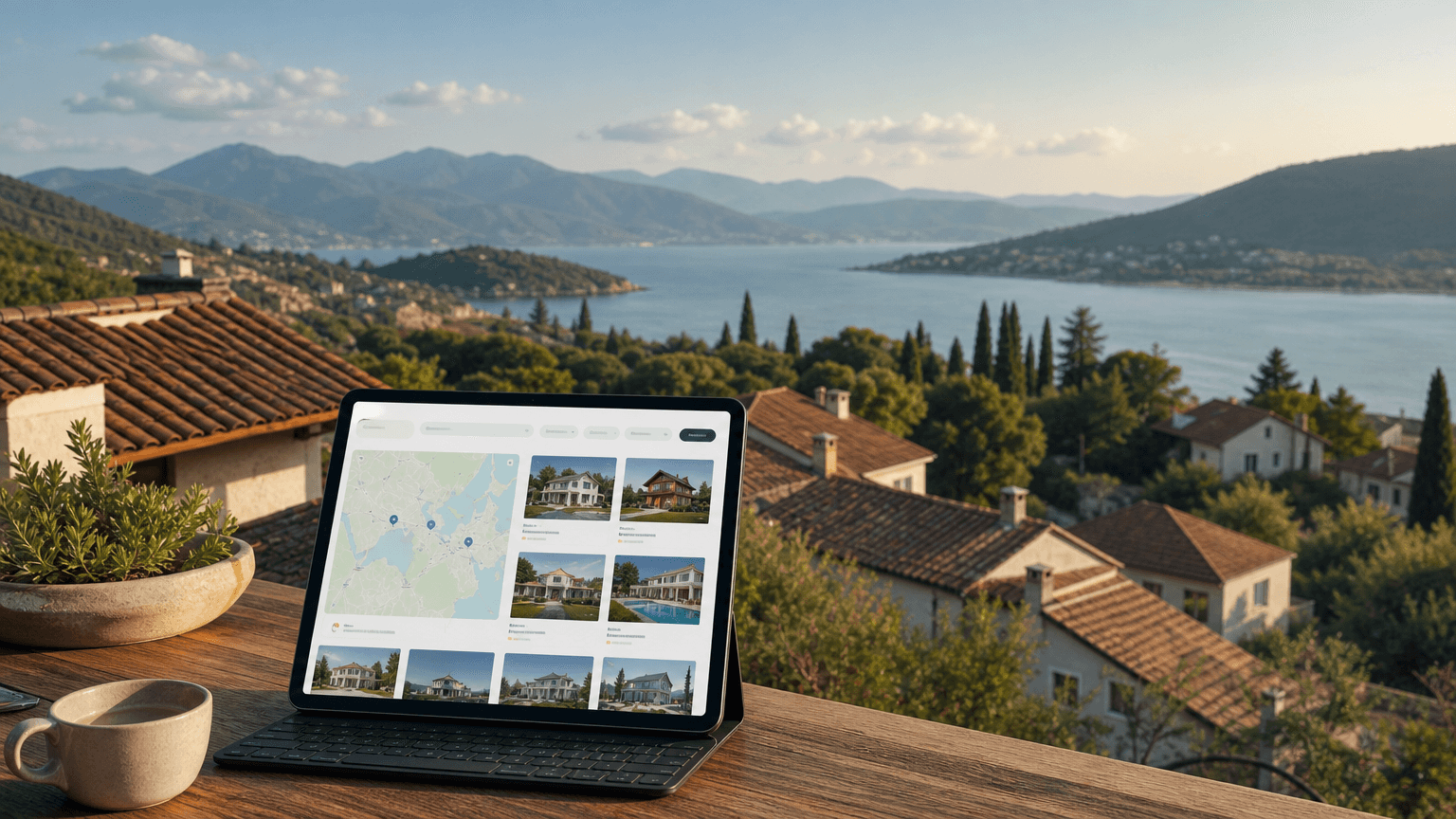
Buying a vacation home abroad usually starts with a dozen browser tabs: one portal per country, each with its own filters, terminology, and listing format. By the time you've compared a Swedish cabin with a Spanish villa, you've lost track of which tab held which property. And if you started on Airbnb or Vrbo, you've probably noticed those platforms are built for booking a week away, not for owning a place.
This guide shows you how to use Homestra to go from a vague idea ("somewhere near water, usable most of the year") to a vetted, cross-border shortlist with a plan for viewings and due diligence. It's written for expats and international buyers purchasing a second home in Europe.
Difficulty: moderate. Time: roughly 1 to 2 hours to build a first shortlist, then about 2 to 6 weeks or more to finish due diligence, depending on the country and how quickly sellers and advisors respond.
What Homestra does differently from rental sites and country portals
Start with the most common point of confusion. Homestra is not a vacation rental platform, and there's no Homestra booking engine for a week at the beach. It's a real estate platform for buying second homes and permanent residences. If your goal is a holiday stay next month, Airbnb, Vrbo, or Booking.com are the right tools. If your goal is to own a place, Homestra is built for that.
The advantages come from how the platform is organized:
| What you need | Rental platforms (Airbnb, Vrbo, Booking) | Single-country portals | Homestra |
|---|---|---|---|
| Goal | Book a stay | Buy in one country | Buy a second home across Europe |
| Coverage | Stays worldwide | One national market | Cross-country: Homestra describes itself as Europe's largest cross-country housing platform, with over 200,000 properties |
| Search focus | Dates, guests, nightly rates | Local buyers' needs | Second-home categories such as cabins, farmhouses, renovation projects, and homes with pools |
| Buyer workflow | Not applicable | Usually assumes local knowledge | Search, shortlist, then contact the listing agent or seller |
Homestra's blog sums up the aggregator idea as "one platform instead of ten country portals." That matters most when you haven't chosen a country yet. Instead of learning ten interfaces, you compare Norway, Italy, and Spain in one place, using one set of habits.
Rental sites also face a regulatory shift that affects anyone who hopes to rent out a purchased home part of the year. According to Airbnb's Help Center, the EU short-term rental regulation (Regulation (EU) 2024/1028) became applicable on 20 May 2026. Check how it and local rules apply to your target area before you count on rental income.
One caveat belongs up front. Homestra listing pages carry this disclaimer: "Homestra is a real estate platform, not an agency. We are not responsible for the accuracy, completeness, or reliability of any listing information displayed." Homestra gets you to a good shortlist faster. You still verify everything with local professionals, and this guide builds that verification into the process.
What you need before you start
Gather these before opening a search page. Skipping them is the main reason shortlists balloon into 40 properties nobody can compare.
- A target list of two to four countries or regions (a rough list is fine)
- A budget range, stated in your own currency and the local one
- A financing approach: cash, a mortgage from a local lender, or financing against property in your home country
- A time horizon: how soon you want to buy, and how many weeks a year you'll realistically use the home
- A document folder for your passport, proof of funds, and any translations you'll need later
Step 1: Write your vacation-home criteria down
A vacation home fails differently than a primary residence. A house that's perfect in July can be unreachable in February. Write down answers to these before searching:
- Lifestyle setting: beach, mountains, lakeside, or countryside?
- Season of use: summers only, ski season, or year-round?
- Access: how far from an airport are you willing to drive, and does the road stay open in winter?
- Maintenance tolerance: can you manage a garden or pool from abroad, or do you need low upkeep?
- Condition: move-in ready, or are you open to a renovation project?
Turn those answers into a one-line brief. Example: "Two to three hours from an airport, winter-ready, two bedrooms, garden, close to water or hiking trails." You'll reuse that sentence to judge every listing.
Step 2: Run a broad multi-country search
Open Homestra's Countries page and pick the markets from your target list. Browse the property type categories first. The homepage groups inventory by lifestyle, with sections such as cabins for sale in Norway, farmhouses in Sweden, renovation projects in Italy, the French countryside, homes with pools in Spain, and country homes in Denmark.
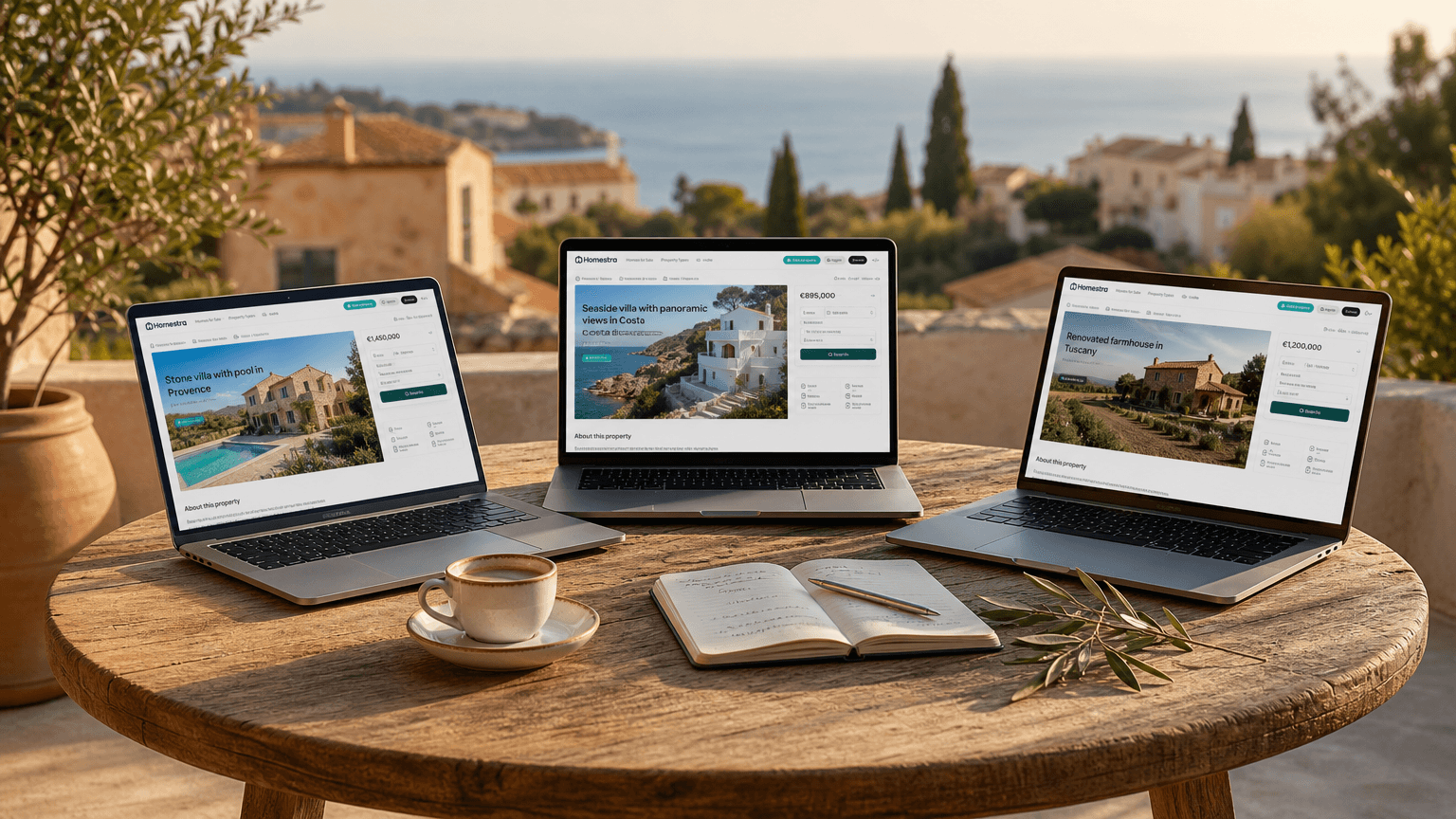
Treat those categories as prompts, not answers. If you hadn't considered a Danish country home, seeing one beside a Swedish farmhouse might change your list. For a walkthrough of running several markets side by side, Homestra's multi-country search workflow covers a Spain, France, and Italy example in detail.
Keep this first pass loose. Your aim is to learn what your budget buys in each country, not to pick a house.
Step 3: Narrow with property type and feature filters
Now apply your must-haves. On a country listing page, set the property type (cabin, chalet, farmhouse, villa) and your budget range, then add feature filters. The features that matter most for vacation use are:
- Parking, especially if the property sits on a narrow or steep road
- Garden or outdoor space
- Pool, where you want warm-weather entertaining
- Waterfront or water views
- Air conditioning, which is a real filter in southern markets
Filters show up in the page address. A search for Italian houses with air conditioning, for instance, carries a features parameter in the URL. That gives you a simple way to track your work: copy the URL of every filtered search you like into a note or spreadsheet, labeled with the country and the date. You can rerun any search later and see what's new.
A repeatable sequence keeps you disciplined:
- Broad pass per country, no feature filters.
- Add property type and budget.
- Add one must-have feature at a time, so you can see which filter eliminates the most listings.
- Open the top five to eight results per country in separate tabs and compare them against your one-line brief.
Checkpoint: search
Before continuing, confirm you can finish this sentence for each property you've kept: "This one fits because..." If you can't, drop it. A shortlist of six to ten strong candidates is more useful than thirty maybes. If you want to know how large the pool is when you start, the live inventory count explains what the 200,000+ figure covers and how to check the current total.
Step 4: Read each listing like a skeptic
Photos sell. Your job is to find what they don't show. For every shortlisted listing, go through this checklist:
- Location reality: find the property on a map. Measure the real drive from the nearest airport and the nearest grocery store.
- Condition: look for any mention of roof, heating, damp, or recent renovation. A listing that is silent on condition isn't telling you it's fine.
- Utilities: is the home connected to municipal water and sewer, or does it use a well or septic system? What heats it, and is it suited to a home left empty for weeks?
- Winter use: check road access, insulation, and whether pipes can be drained.
- Outdoor space: confirm lot size, boundaries, and who maintains shared paths or driveways.
- Missing information: list what you can't find, such as floor plans, energy certificates, or ownership details.
Photos of a sunny terrace say nothing about February. Look for exterior shots in different seasons, and zoom in on windows, rooflines, and the ground near foundations.
Write your gaps as questions. These become your outreach message.
Step 5: Contact agents and sellers remotely
Remote outreach is where expats save the most time, because a short, well-structured message screens out properties before you book a flight. Homestra connects you with the agent or seller behind each listing, so the conversation happens with the people who can actually answer.
Send one message per property, covering the same core points:
- Introduce yourself and say you're an international buyer purchasing remotely.
- Ask your gap questions: condition, heating, water source, road access in winter, annual running costs.
- Request documents: floor plans, energy certificate, recent inspection report if one exists, and details of any shared costs or restrictions.
- Ask for a video walkthrough or live video call of the property, including the utility room, roof, and access road.
- Propose two or three specific dates for a viewing and ask about inspection availability.
Specific dates get faster replies than "when are you available?" Ask whether utilities can be switched on and tested during your visit, because you can't judge a heating system in a house that's been shut down.
Translation helps. If the seller's language isn't yours, write in short sentences and keep one question per line so machine translation doesn't mangle your meaning.
Checkpoint: outreach
After the first round of replies, confirm you have:
- Answers to your must-have questions for each active property
- A viewing and inspection schedule, with dates
- A list of documents still outstanding
Rank the remaining properties. Two or three that survive this round are enough to plan a trip around.
Step 6: Complete due diligence with local professionals
This is the stage where Homestra stops and your advisors begin. The platform helps you discover and shortlist. It doesn't verify listings, represent you, or give legal or tax advice, which is why the disclaimer exists. Regardless of who represents the seller, assemble your own team: a local property lawyer or notary equivalent, a licensed inspector, and a cross-border tax advisor.
Book a professional inspection
Commission an independent inspection before you commit. Homestra's guide to buying a vacation home in rural Sweden (a fritidshus, published 02/01/2026) shows why. Swedish buyers have a "duty to investigate" (undersökningsplikt), and it can be difficult to claim compensation for defects that a thorough inspection would have found. The guide describes the Swedish inspection, the besiktning, as a core step.
Other countries have different rules, so don't assume Sweden's law applies elsewhere. The lesson travels well, though: in many markets, the buyer who skips the inspection carries the risk. Ask your local lawyer how responsibility for defects works where you're buying.
Verify title and legal status
Have your lawyer confirm:
- The seller is the registered owner
- There are no mortgages or other encumbrances on the property
- Easements, land rights, and shared-access arrangements are documented
- Permits exist for extensions, pools, or outbuildings
Which register to check and what it's called varies by country. Your lawyer will know.
Map taxes and ownership obligations
Purchase taxes, annual ownership taxes, and the taxation of rental income all vary by country and by your residency status. Don't estimate these from forum posts. Get local tax advice and, since you live elsewhere, advice on how your home country treats foreign property.
Cover operational details
Confirm utility contracts and who transfers them, winterization requirements, the condition and maintenance of the access road, service contracts for any pool or garden, and community or association fees where they apply.
Checkpoint: due diligence
You're ready to move toward a contract when you can say:
- I've reviewed the key documents with my lawyer
- The inspection is done and I understand the findings
- I know who pays the agent, notary, and any registration fees
- I've mapped my tax and ownership obligations in both countries
A realistic timeline
Treat these phases as ranges. Every country and every transaction differs.
| Phase | What happens | Typical range |
|---|---|---|
| 1. Shortlist build | Search, filter, compare on Homestra | 1 to 2 hours for a first shortlist, plus a few evenings of refining |
| 2. Remote outreach | Messages, calls, video walkthroughs | Days to a couple of weeks |
| 3. Viewing and inspection | Travel, visit, professional inspection | One trip, plus inspection scheduling |
| 4. Contract and signing | Legal review, negotiation, deposit | Varies widely by country |
| 5. Closing and registration | Final payment, transfer of ownership | Varies widely by country |
Phases 3 through 5 together commonly take 2 to 6 weeks or more. Ask your local lawyer for the realistic range in your target country rather than relying on a general figure.
How to move faster
- Prepare your document folder, with translations, before you make an offer
- Talk to a lender or confirm your cash position early
- Book the lawyer for contract review before the viewing, not after
- Line up a translator if contracts aren't in a language you read fluently
Where the money goes
Homestra doesn't publish country-by-country cost tables here, and any number would be a guess. Instead, build a budget with four categories and ask local professionals to fill in the exact amounts:
- Acquisition closing costs (taxes, notary, registration, agent fees where the buyer pays)
- Inspection and legal fees
- Travel for viewings, including a second trip if needed
- Annual ownership costs (property tax, insurance, utilities, maintenance, association fees)
Troubleshooting: where buyers get stuck
Too many results, no clear favorite. Return to your one-line brief and add a single must-have filter. If a feature doesn't change your decision, don't filter on it.
The agent doesn't reply. Resend with specific dates and one clear question. Move to the next property while you wait. Don't pause your whole search for one slow answer.
Photos look great but the details are thin. Treat missing information as a red flag until it's answered. Request the documents before you spend on travel.
Prices look low for a country. Check for a renovation need, unusual access, or restrictions on use before getting excited.
You're comparing against rental platforms. Nightly-rate sites show income potential at best, not purchase quality. Use them only to research the local rental market, and check current short-term rental rules.
Frequently asked questions
Is Homestra a vacation rental platform?
No. Homestra is for buying second homes and homes abroad, not booking holiday stays. If you're comparing it with Airbnb or Vrbo, the difference is purpose: those platforms handle stays, while Homestra handles purchases across multiple European countries.
How does Homestra compare with a national portal like idealista or Rightmove?
National portals have deep local coverage in one market. Homestra's strength is comparing across countries while you're still deciding where to buy. Homestra's own idealista comparison and Rightmove comparison explain when each makes more sense.
Can I buy as a non-resident?
Rules differ by country, and some have specific requirements for foreign buyers. Ask a local property lawyer before you make an offer.
Do I need a lawyer?
Plan on one. Even where the process is notary-led, an independent advisor who works for you can review contracts, check title, and flag problems in a language you understand.
What should I request before paying a deposit?
Ownership documents, proof the property is free of encumbrances, energy certificate, permits for any additions, inspection results, and a written breakdown of fees and recurring costs. Your lawyer can add country-specific items.
How do I handle winterization for a home I use seasonally?
Ask the seller how the house has been winterized, then confirm with your inspector. Budget for a local caretaker or property manager who can check the home when you're away.
Should I renovate now or after purchase?
Get a surveyor's or builder's estimate before you buy, so the cost is in your offer. Renovation categories on Homestra, such as renovation projects in Italy, can offer lower entry points, but they require more due diligence on permits and structure.
Your next seven days
- Day 1: write your criteria and one-line brief.
- Days 2 to 3: run a broad search in each target country, then narrow with type, budget, and one feature at a time. Save every search URL.
- Day 4: shortlist six to ten properties and write your gap questions.
- Days 5 to 6: send outreach messages, request documents and video walkthroughs, and propose viewing dates.
- Day 7: pick two or three finalists, find a local lawyer and inspector, and block out travel dates.
Homestra's job in this process is to cut the search friction: one platform covering multiple countries, second-home categories you can browse by lifestyle, and a direct route to the people selling. The verification, the inspection, and the legal and tax work stay with your local advisors. Done in that order, you arrive at your first viewing having already ruled out most of the wrong houses.
Share