Blog published in Buying property abroad
Share
7 best European vacation home platforms for expats in 2025
Compare the top portals for international buyers. Discover platforms with English support, transparent pricing, and remote buying tools to find your dream second home.

Europe has no single equivalent of Zillow or the US MLS. Property data sits in dozens of national systems, each with its own dominant portal, its own language, and its own agent conventions. A buyer in Lisbon, a buyer in Lyon, and a buyer in Lund are searching three different markets, and a vacation-home buyer living abroad often wants to compare all three.
That fragmentation creates three recurring problems for expats. Listings go stale because the same home is syndicated across several sites with different update schedules. Prices appear in a currency or format that hides the real cost. And agents in the local market may not answer in English, or may not answer quickly, in markets where good seasonal properties move fast.
The best platforms for international vacation-home buyers are therefore not one site but a short combination: one or two cross-border discovery portals, plus the dominant local portal in each country you're serious about. This article compares the main options on the criteria that matter to someone searching from abroad: country coverage, language, pricing display, how the platform makes money, what legal help is (and isn't) included, and whether remote viewing is supported. It closes with a step-by-step plan.
How we evaluated platforms for international buyers
The comparison follows a two-stage workflow that Homestra recommends in its own guidance on European portals: first, use a multi-country discovery platform to shortlist candidates across borders quickly; second, validate each property on the dominant local portal for that country. Discovery portals are good at breadth and English-language browsing. Local portals are good at freshness and depth within one market. Neither stage replaces the other.
Each platform was judged on seven criteria:
- Country coverage and whether the inventory skews toward a region or property type
- Language experience for a non-native speaker
- Whether buyers are charged, and how the platform earns revenue
- Pricing and currency transparency
- Whether the site connects you directly to agents
- Built-in tools for overseas buyers, such as buying guides and cost checklists
- What legal or transaction help is actually provided
One caveat applies to every platform below. A portal is an advertising and lead-generation channel, not a registry of record. Listings can lag what's happening on the ground, so confirm status with the agent before you book flights.
Where a platform doesn't publish a detail (a fee schedule, a virtual-viewing feature), this article says so instead of guessing.
The best vacation home platforms in Europe for international buyers, ranked
The ranking below reflects fit for an expat searching for a second home from abroad, weighted toward cross-border discovery. It isn't a statement that one platform is best for every buyer. A luxury buyer and a rural-cottage buyer should rank these differently, and the buyer-type section later in this article does exactly that.
1. Homestra
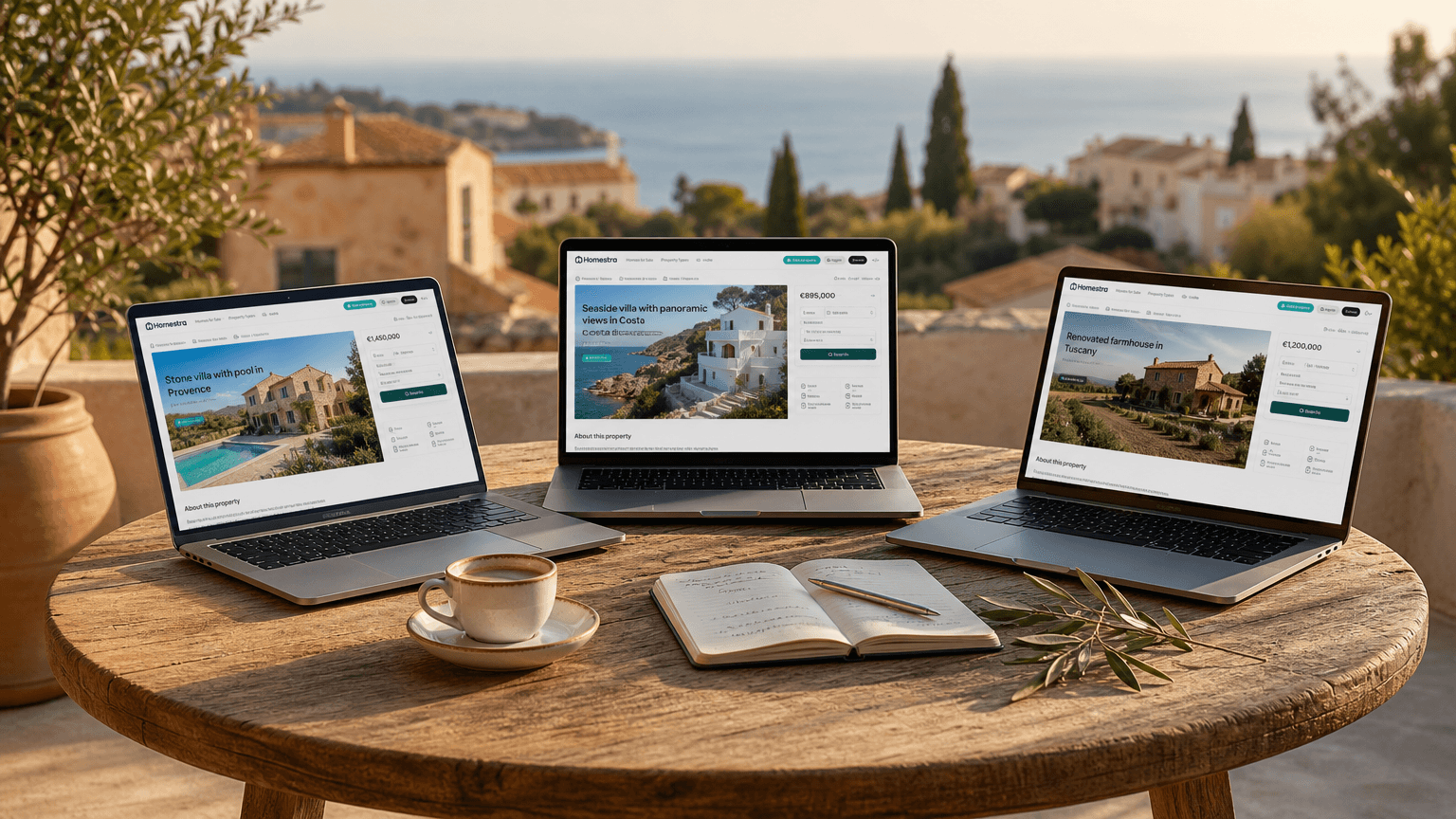
Homestra is a cross-country second-home portal built for international buyers, with an English-first interface and more than 200,000 properties across Europe. Its focus is the second-home and lifestyle market, which means search tools and listing descriptions are oriented toward location, setting, and local context rather than commuter housing. Homestra also publishes country-specific buying guides that use the local legal vocabulary buyers will meet, so you know what a term like "besiktning" means before an agent uses it.
On the supply side, Homestra's for-agents page claims reach to 5 million active international home buyers across 56 countries and more than 520 participating agents. Agent plans are published in euros: Starter Agency at €49 per month (up to 10 listings), Agency at €99 (up to 30), Pro at €249 (up to 150), and Scale at €499 (up to 500). Revenue comes from agents, not buyers.
Primary trade-off: as a discovery hub, Homestra shows you the market broadly, so you still validate each property on the local portal and with the agent. For a closer look at how listing counts compare across platforms, see the breakdown of how many European properties you can browse.
2. Green-Acres
Green-Acres is France-rooted and skews toward rural and lifestyle properties, with an international footprint of 22 countries and an English-first experience. It suits buyers hunting for a village house, farmhouse, or countryside plot rather than a city apartment. Its support pages state that browsing is free for buyers. Private sellers pay to list; public search snippets cite roughly €119 (including VAT) for a three-month listing and roughly €199 for twelve months.
Primary trade-off: the rural and lifestyle slant is a strength for second-home buyers but means thinner coverage of urban and investment stock.
3. Kyero
Kyero is an English-first portal concentrated on Southern Europe, covering Spain, Portugal, France, and Italy. For buyers who have already decided on a Mediterranean or Iberian destination, it's a natural second discovery portal alongside a multi-country one. Kyero's agent-listing model is standard for the sector, though its fee schedule isn't something this research could verify.
Primary trade-off: coverage stops at Southern Europe, so buyers considering Scandinavia, the Baltics, or Central Europe need a different tool.
4. Rightmove Overseas
Rightmove Overseas extends the UK's largest property portal to homes abroad. It's free for buyers to browse because Rightmove earns money from listing and partner fees rather than charging home shoppers. Its overseas guidance includes a "What will it cost me?" explainer covering the cost categories that surprise first-time overseas buyers. It's most comfortable for British expats and for anyone used to Rightmove's search conventions.
Primary trade-off: the audience and editorial voice are UK-centric, and its partner model means some services are routed through referral partners whose fees you should read carefully.
5. Properstar
Properstar is an international aggregator that describes itself as completely free to use for homebuyers and renters, with revenue from agent and developer subscriptions. It's useful as a breadth check when you want to see whether a market has stock your first portal missed.
Primary trade-off: aggregators can surface the same property through multiple agents, so duplicate listings and varying prices for the same home need cross-checking.
6. LuxuryEstate.com
LuxuryEstate.com is a luxury-focused, multi-country portal. If your budget sits at the high end, it narrows the field faster than a general portal. Buyers weighing luxury inventory across several platforms can read a JamesEdition vs Homestra comparison with three buyer case studies and a due-diligence checklist.
Primary trade-off: it's narrower by design. Buyers shopping a modest-budget cottage will find little here.
7. Tranio
Tranio is a different model: a broker-style service aimed at investment-led buyers rather than a self-service portal. It coordinates with local lawyers, notaries, and tax advisors in the destination country, while still requiring buyers to hire independent legal counsel for formal transaction execution. That's a useful reminder that even the most service-heavy option doesn't remove the need for your own lawyer.
Primary trade-off: a curated, service-led model suits investors who want hand-holding. Buyers who prefer to browse independently will find a portal faster.
For a related overview of national portals, Homestra's guide to the best European property portals profiles Rightmove, idealista, ImmobilienScout24, SeLoger, and others in more depth.
Feature-by-feature comparison: language, currency, fees, and remote buying
Two tables cover the dimensions that matter most. Where a platform doesn't publish a detail, the cell says so.
Coverage, language, and buyer cost
| Platform | Country coverage | Language experience | Cost to buyers | How the platform earns |
|---|---|---|---|---|
| Homestra | Multi-country Europe, 200,000+ properties | English-first | Free to browse | Agent subscriptions (€49 to €499 per month published) |
| Green-Acres | 22 countries, France-rooted | English-first | Free to browse | Listing fees (about €119 for 3 months, about €199 for 12 months, incl. VAT, per public snippets) |
| Kyero | Spain, Portugal, France, Italy | English-first | Not publicly disclosed as a charge; standard portal model | Agent listings (fee schedule not publicly disclosed) |
| Rightmove Overseas | Multi-country, UK-oriented | English | Free to browse | Listing and partner fees |
| Properstar | International aggregator | Multilingual | Free to use | Agent and developer subscriptions |
| LuxuryEstate.com | Luxury, multi-country | Not verified in this research | Not publicly disclosed | Not publicly disclosed |
| Tranio | Selected investment markets | English | Service-based (not a free portal) | Brokerage and service model |
Currency, legal support, and remote viewing
| Platform | Currency and pricing display | Legal/transaction help | Virtual viewing and remote purchase |
|---|---|---|---|
| Homestra | Listings priced by the agent; confirm currency with the agent | Country buying guides; transaction handled by local professionals | Arranged with the listing agent |
| Green-Acres | Listing prices as set by sellers and agents | Guides; no legal execution | Arranged with the seller or agent |
| Kyero | Agent-set pricing | Guides; no legal execution | Arranged with the agent |
| Rightmove Overseas | Cost explainer and partner referrals | Partner referrals; advisory fees apply | Arranged with the agent |
| Properstar | Agent-set pricing | Not a legal service | Arranged with the agent |
| LuxuryEstate.com | Agent-set pricing | Not a legal service | Arranged with the agent |
| Tranio | Service-quoted | Coordinates local lawyers, notaries, tax advisors; you hire independent counsel | Service-led; details not publicly disclosed |
Three principles hold across the table:
- Portals are usually free for buyers. Agents, developers, and private sellers pay to advertise, which is why the browsing experience costs you nothing.
- Local costs are yours. Agent commissions (where the buyer pays them), transfer taxes, notary fees, and registration charges vary by country and aren't covered by any portal.
- A local lawyer and, where customary, an independent inspector are not optional. No portal executes the transaction for you.
On virtual viewings, none of the platforms above publicly describes a standardized remote-purchase product. Video tours and remote signing happen through the individual agent, notary, and lawyer, and practices differ by country. Ask for a live video walkthrough early and treat a reluctant agent as information.
Which platform fits which buyer type
The right combination depends on what you're buying.
Second-home lifestyle buyers
Start with Homestra for multi-country discovery, then add Green-Acres if you're drawn to rural properties or Kyero if your shortlist is entirely Iberian, French, or Italian. Buyers weighing several Mediterranean countries at once will find the four-country search guide for France, Spain, Italy, and Portugal useful for structuring the search.
Investor-led buyers
Rental yield and resale liquidity matter more than views. Pair a broad discovery portal with Tranio's service-led model if you want coordination support, or Properstar for breadth. Either way, verify rental regulations locally. Short-term letting rules differ sharply between cities and regions.
Retirees and low-maintenance buyers
Look for newer builds, apartments in managed buildings, and towns with healthcare and transport. Rightmove Overseas and Homestra both suit this group, since their guides explain the cost and process categories first-time buyers underestimate.
Searching from abroad with no local language
English-first platforms matter most at stage one. Homestra, Green-Acres, and Kyero all lead with English. For the messaging stage, which is where language barriers actually cost money, Homestra's guide to searching for European homes without local language skills covers translation tools and agent outreach.
Local validation portals by country
After discovery, check each shortlisted property on the dominant national portal:
- Spain, Portugal, and Italy: idealista (also strong in Italy and Portugal), with Immobiliare.it as the main Italian validator
- France: SeLoger and Le Bon Coin
- Germany: ImmobilienScout24
- United Kingdom: Rightmove
- Sweden: Hemnet
- Norway: Finn.no
If the same listing appears at a different price, or has disappeared, that's your signal to call the agent before going further. Buyers focused on Portugal can pair this with the guide to buying property in Portugal, which covers the legal framework and process for foreigners.
A five-step plan for using Homestra as an international buyer
Step 1: Fix your criteria. Decide region, budget ceiling (including purchase costs, not just the asking price), property type, and how you'll use the home. A house you'll visit four weekends a year has different needs from one you'll rent out in summer.
Step 2: Run discovery across countries. Use Homestra to browse multiple markets in one place and compare what your budget buys in Portugal against Italy or Sweden. Narrow by property type and price, and read the local-context descriptions, since they often reveal what a listing's headline doesn't.
Step 3: Shortlist five to ten properties and contact agents. Ask for the current asking price, whether the property is still available, the legal status of the title, annual running costs, and any planning or usage restrictions. Request photos and a live video call. Agent responsiveness at this stage predicts how the transaction will go.
Step 4: Validate on the local portal and run due diligence. Cross-check each listing on the national portal named above. Then follow the country's own process. Sweden is a clear example. Homestra's rural Sweden guide describes a pre-purchase structural inspection called besiktning, a purchase contract (köpekontrakt) that typically involves a deposit of around 10%, and title registration called lagfart, which carries stamp duty and a fixed registration fee. The sequence of inspection, contract, then registration is specific to Sweden. Spain, France, and Italy each have their own order of steps and their own professionals, such as notaries, who play a larger role in some systems than in others.
Step 5: Hire local professionals and finalize. Engage an independent lawyer in the country of purchase, an inspector where customary, and a tax advisor if the property will be rented or you'll be taxed in two countries. Don't rely on listing text or the agent's summary of the title. Have your own lawyer check ownership, encumbrances, and permits.
Frequently asked questions
Are these platforms free for buyers?
Browsing is free on Homestra, Green-Acres, Rightmove Overseas, and Properstar, and that's the standard portal model across Europe. Agents, developers, and private sellers pay, whether through subscriptions (Homestra's published agent plans run from €49 to €499 per month) or per-listing fees. Free browsing doesn't mean a free purchase: agent commissions, taxes, notary and registration fees, and legal costs still apply.
How many portals should I use?
One or two discovery portals plus one local validator per target country is enough. More than that mostly produces duplicate listings and conflicting prices without surfacing new properties.
Do portals handle legal or tax work?
No. Portals list properties and connect you with agents. Even service-led providers such as Tranio coordinate with local lawyers and notaries while requiring buyers to retain independent legal counsel for formal execution. Treat any portal content on taxes and legal steps as orientation, not advice.
How do I avoid stale listings?
Confirm availability and the current asking price directly with the agent before you travel or pay for anything. Check the same property on the local portal, compare dates and prices, and ask for current documentation. If the agent can't confirm a property's status quickly, move on.
Can I buy a vacation home entirely remotely?
It's often possible, but not through the portal. Remote purchases rely on video viewings arranged with the agent and on a lawyer or notary in the destination country, sometimes acting under power of attorney. Rules and practice differ by country, so ask your lawyer what's possible before you commit.
Next steps
- Write down your budget, preferred regions, and how you'll use the property.
- Shortlist five to ten homes across two or three countries on a discovery portal.
- Ask each agent for current status, price, title information, and a video tour.
- Cross-check every candidate on the dominant local portal.
- Hire a local lawyer before you sign anything or pay a deposit.
Start searching on Homestra to compare second homes across Spain, Portugal, France, Italy, Sweden, Norway, and beyond, then validate your shortlist locally.
Share