Blog published in Buying property abroad
Share
Best vacation home websites in Europe: 9 platforms compared
Compare 9 platforms for short-term rentals, long stays, or buying a second home. Get a workflow to pick the right site for your European trip or purchase.

The best website to find a vacation home in Europe depends on what you mean by "find." A traveler booking a villa in Puglia for two weeks needs a rental marketplace with clear cancellation terms. Someone planning to own a stone house in Portugal needs a property portal and a legal process they can follow from another country. Those are different jobs, and no single site does both well.
This guide treats "vacation home" as three separate use cases: a short-term rental (a few nights to a few weeks), a long-stay rental (a month or more), and a second-home purchase. It compares nine platforms across those jobs: Airbnb, Vrbo, Booking.com, Holidu, HomeToGo, Idealista, Rightmove Overseas, Kyero, and Homestra. Fees, protections, and legal requirements vary by listing and by country, so treat the comparisons below as a starting framework and confirm terms on each checkout or inquiry page.
How the platforms were evaluated
The criteria differ depending on whether you're renting or buying, so the rubric is split in two.
For rentals, the questions are:
- Inventory coverage across the countries you're considering
- Filters that work for travelers who don't know the area (entire home, bedrooms, amenities, dates)
- Listing quality signals such as photo depth, review volume, and host or property verification
- Transaction model: whether you book and pay on the platform, or get redirected to another provider
- Fee transparency: whether the total price is visible before checkout
- Cancellation terms and the guest protections attached to them
- Support availability and language coverage
For purchases, the questions are:
- Listing coverage by country and region
- Whether listings come from regulated local agents
- Availability of country-specific buying guidance (process, taxes, documentation)
- Support for non-residents, such as help with local ID numbers, inspections, and legal representation
- Search tools that let you compare regions, not just single listings
Platform features change often. Where this article describes a platform's model, it reflects publicly stated positioning, and you should verify specifics on the platform's own help or policy pages before paying a deposit.
Top platforms at a glance
| Platform | Best for | Primary transaction type |
|---|---|---|
| Airbnb | Browsing entire homes and unique stays with visible reviews | Short-term rental booking |
| Vrbo | Entire-home stays for families and groups | Short-term rental booking |
| Booking.com | Mixing apartments and villas with hotels in one search | Short-term rental booking |
| Holidu | Comparing prices for the same property across sources | Metasearch / redirect |
| HomeToGo | Wide comparison across providers, including longer stays | Metasearch, with some onsite booking |
| Idealista | Spanish property searches | Property purchase portal |
| Rightmove Overseas | Buyers starting from the UK portal ecosystem | Property purchase portal (routes to local agents) |
| Kyero | Southern Europe purchases, especially Spain | Property purchase portal (routes to local agents) |
| Homestra | Cross-country second-home searches for international buyers | Property purchase portal with country-specific guidance |
Rental platforms: what each one does
Everything in this section applies to renting. Rental protections are consumer-booking protections, not real-estate legal protections, and they don't carry over to a purchase.
Airbnb
Airbnb's homepage works as a discovery interface: destination carousels, property cards, and a large internal-link section called "Inspiration for future getaways." It also states its pricing approach plainly, with messaging that shows one price for the trip with all fees included. That matters because fee presentation is one of the most common sources of frustration when comparing rental sites.
Strengths are inventory depth, strong photo and review signals, and ratings or badges on listings. The weaker side is editorial: the site gives you listings, not comparative guidance about cancellation trade-offs or how it differs from other platforms.
Before you pay, check the cancellation policy attached to the specific listing, the cleaning and service fees in the final total, and whether the host is a private individual or a professional manager. Rules on registration and short-term rental licensing differ by city and country, so look for a license or registration number in the listing where local law requires one.
Vrbo
Vrbo positions itself around entire homes and vacation rentals. Its homepage emphasizes trust signals, including "VrboCare" guarantee messaging and 24/7 customer support, alongside promotional and membership pricing. For travelers who want a whole property and no shared spaces, that positioning is a clean fit.
Like Airbnb, the homepage is visual and carousel-driven, with little in-page guidance. The practical difference between the two for entire-home searches is mostly in focus: Vrbo's catalog is built around whole-property rentals, while Airbnb's mixes entire homes with private rooms and other stay types, so you'll want to apply the "entire place" filter there.
Before you pay, read what the guarantee actually covers, confirm the total price including fees, and check the cancellation window against your flight and travel-insurance terms.
Booking.com
Booking.com is best known for hotels, but it lists apartments and villas alongside them. That's useful if you're undecided between a hotel and a rental, or splitting a trip between cities and a countryside stay.
Cancellation terms on Booking.com vary by property and by rate. Two listings in the same town can have free cancellation until a week before arrival or be fully non-refundable. Read the specific rate conditions before booking rather than assuming the platform applies one standard. The same applies to payment timing: some rates charge at booking, others at the property.
Holidu
Holidu is a metasearch service for vacation rentals. It aggregates listings from many sources and shows prices side by side. It also offers host tools through Bookiply. For a guest, the practical point is that the booking path can differ by listing: you may complete the reservation in Holidu's flow or be passed to a partner site.
The contract relationship matters here. When a booking is completed with a partner, that partner's terms for cancellation, payment, and complaints generally apply. Check the partner name on the checkout page before you enter payment details.
HomeToGo
HomeToGo works as a mediation and metasearch platform. Depending on the inventory, a booking can happen on HomeToGo itself or on a connected provider's site. It also supports longer-stay searches, which makes it useful for people comparing month-long options.
As with Holidu, the benefit is breadth: one search shows the same villa or apartment across several providers, and price differences between them can be material. The trade-off is that terms and protections aren't uniform across providers, so read the conditions on the final booking page.
Rental checklist
Whichever site you use, these steps reduce surprises:
- Compare the final price after cleaning fees, service fees, and local tourist taxes, not the nightly rate.
- Read the cancellation policy for the exact listing and note the deadline in your calendar.
- Confirm who you're contracting with (the platform, a property manager, or a private host).
- Keep all communication and payment on the platform's own system.
- For stays of a month or more, confirm utilities, internet speed, and whether the property is licensed for longer lets.
Buying platforms: what each one does
This section applies to purchasing a second home. Buying involves a notary or lawyer, local taxes, and registration. None of those are provided by a listing site, so a portal's job is limited to helping you find properties and reach the right agent.
Idealista
Idealista is one of the major property marketplaces in Spain, and it has published advice articles aimed at overseas buyers. For a Spanish search it's often the first stop because of the volume of listings. Homestra's own guides on Spanish portals, including its comparison of Idealista alternatives for buying property in Spain, note that serious buyers typically cross-check several portals, since listings and pricing vary between them.
Before you inquire, confirm the agent is a registered local professional, compare the asking price against similar listings, and ask for the property's registry details.
Rightmove Overseas
Rightmove Overseas is the international arm of the UK's best-known property portal. It lists properties abroad and routes buyers to local sales channels, with guides on purchasing overseas. It's a familiar starting point for UK-based buyers, since the interface and brand are the same as the domestic site.
Because it hands you off to agents, the due-diligence responsibility sits with you. Ask each agent about fees, who represents whom in the transaction, and what the process looks like in that country.
Kyero
Kyero connects international buyers with local estate agents, mainly in Southern Europe, including Spain and Portugal, and publishes buying advice alongside listings. It's a common choice for sun-belt second-home searches.
Before you contact an agent through any portal like this, verify their licensing in the country concerned, and never transfer reservation money before you've seen the contract terms and had them reviewed by an independent lawyer.
Homestra
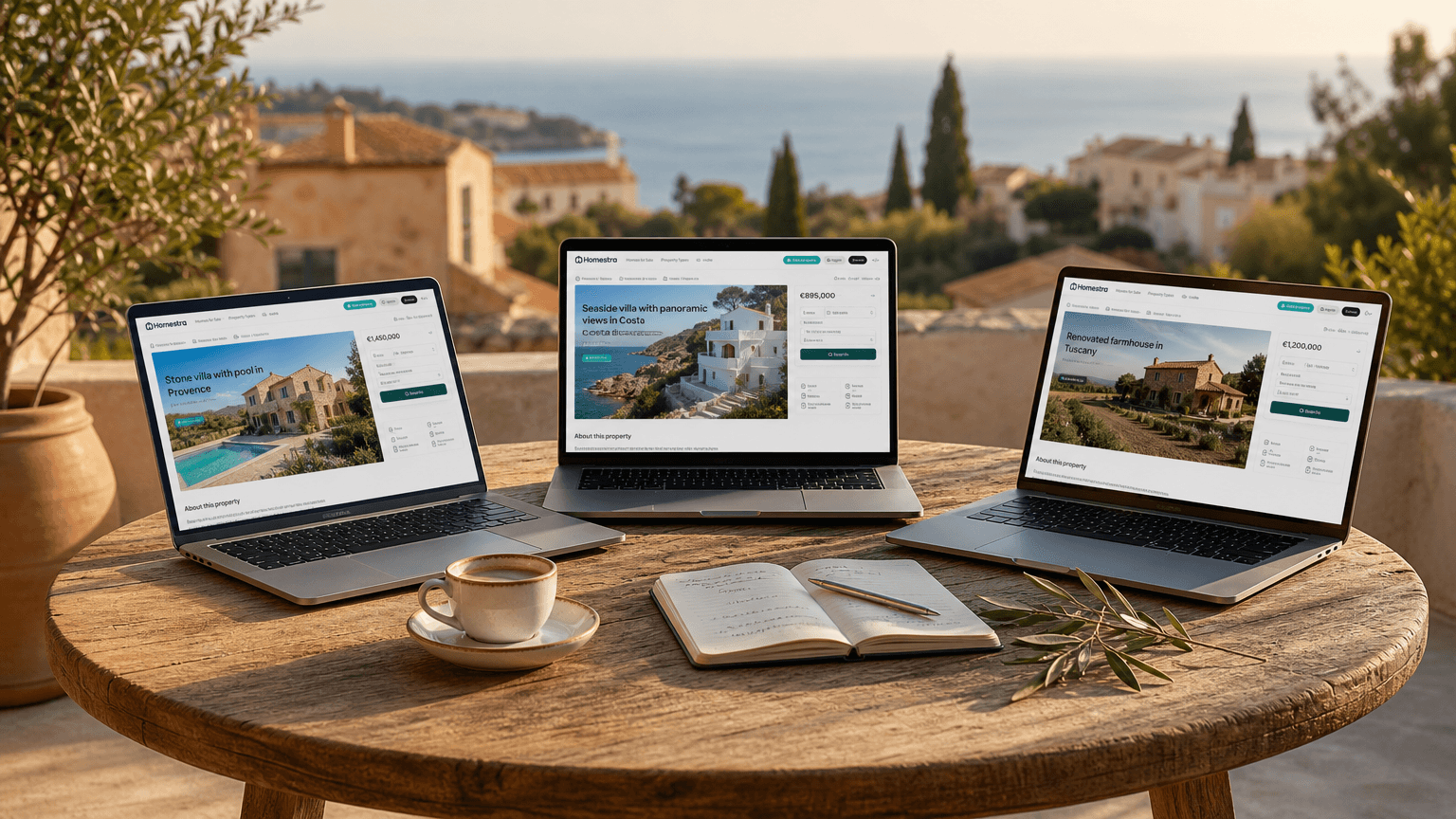
Homestra is a cross-country platform built for expats and international buyers purchasing second homes in Europe. It lists more than 200,000 properties across multiple countries, with search tools for property type and price range and listings that describe local lifestyle and market context. Where single-country portals go deep on one market, Homestra's focus is comparing across borders, and its guides to buying property abroad cover process, financing, and legal basics country by country.
The country guides are where the platform separates itself from listing-only portals. Its guide to buying a fritidshus in rural Sweden is a good example of the level of detail:
- Sweden places no restrictions on foreign ownership.
- A Swedish coordination number (samordningsnummer) can simplify property registration, utilities, banking, and taxes, with a typical processing time of 4 to 8 weeks.
- Non-residents are taxed at 22% on capital gains (profit), with deductions for improvements and purchase costs.
- A survey by a besiktningsman (inspector) is a standard part of the process, and for rural homes the guide stresses checking heating and insulation, particularly when viewing in winter.
Homestra covers other markets too, including guides to buying property in Portugal and the case for France as an affordable vacation-home market. For buyers still deciding between countries, its financial model guide walks through comparing cashflow, return, and break-even occupancy for two properties in different regions.
One limit worth stating: Homestra is a purchase platform, so it isn't the place to book a week at a villa. Use a rental site for that.
Best platform by use case
Each use case below lists three to five platforms, not a ranking of all nine.
Short-term rental of an entire home (family beach week, multiple bedrooms): Vrbo, Airbnb, Booking.com, HomeToGo. Vrbo's catalog centers on whole properties; Airbnb has the broadest mix of stay types; Booking.com helps if you want to compare against hotels.
Long stays of a month or more: HomeToGo, Airbnb, Booking.com. Look for availability windows, monthly pricing, and confirmation that the property permits longer stays.
Comparing prices and finding deals: Holidu, HomeToGo, Booking.com. Metasearch shows the same property across sources, but the cheapest headline price isn't always the cheapest total. Compare after fees, and weigh refundable against non-refundable rates.
Buying a second home in Spain or Portugal: Idealista, Kyero, Rightmove Overseas, Homestra. Use more than one portal, since inventory overlaps only partly.
Buying a second home across several countries: Homestra, Rightmove Overseas. If you haven't picked a country, a cross-country search and country-by-country process guides are more useful than a single-market portal.
Renter protection is not buyer protection
A rental guarantee, a free-cancellation window, and 24/7 support are consumer-booking features. They cover a trip. A property purchase is governed by national property law, a notary or conveyancing process, and tax rules. No portal listing replaces independent legal advice, and a "verified" badge on a rental platform says nothing about title to a house you're buying.
Tips for expats and international buyers
Before booking a rental
- Screenshot the listing, cancellation terms, and total price at the time of booking.
- Check whether tourist tax is collected at checkout or on arrival.
- For long stays, confirm the rental type under local law. Some countries treat stays over a set period as residential tenancies with different rules.
- Look at recent reviews, not only the overall score.
Before making an offer on a property
- Verify the seller and the agent. Confirm the agent's registration in that country and that the person selling is the registered owner.
- Hire your own lawyer. Choose someone independent of the agent, ideally with experience acting for foreign buyers.
- Commission an inspection. In Sweden that means a besiktningsman; most countries have an equivalent. Time it around conditions that expose problems, such as winter for heating and insulation.
- Check utilities, land, and structure. Confirm water, sewage, access rights, and boundaries, especially for rural properties.
- Get your local tax or ID number early. Sweden's coordination number takes 4 to 8 weeks, so starting late can stall the purchase.
- Budget for taxes and closing costs. These differ by country, and non-resident tax treatment can differ from the resident one, as with Sweden's 22% capital gains rate for non-residents.
- Understand registration. Know when ownership is legally transferred and recorded.
Sweden is one example, but the sequence applies broadly: verify, get independent advice, inspect, handle local registration, and cost the full transaction before committing.
Frequently asked questions
What's the difference between Airbnb and Vrbo for entire homes?
Both offer entire-home rentals. Vrbo's catalog is organized around whole properties and promotes its VrboCare guarantee and 24/7 support. Airbnb lists a wider range of stay types, including private rooms, so filter for entire places. Privacy is the same in practice when you book an entire home on either site, but check each listing for shared spaces such as a pool or garden used by other units.
Is Booking.com safer than other rental sites?
Safety depends on the property and the rate you choose. Booking.com's cancellation conditions vary by listing, with some rates fully refundable and others non-refundable. Read the terms for the exact rate.
How do Holidu and HomeToGo work?
Both are metasearch-style platforms that gather listings from multiple providers. Depending on the listing, you either book within the platform or get redirected to a partner. Whoever completes the booking is typically your contracting party, so check their cancellation and payment terms.
What should I check for long stays?
Confirm the availability window, whether the price drops for monthly stays, who pays utilities, and whether local rules affect rentals over a certain length.
How should I budget for fees and taxes when buying?
Add the purchase price, notary and legal fees, registration costs, transfer taxes, and any inspection costs, then include ongoing property tax and potential capital gains tax. Rates differ by country. For example, Homestra's Sweden guide notes 22% capital gains tax for non-residents, but that figure is Sweden-specific.
Can foreigners buy property in Europe?
It depends on the country. Sweden, for instance, has no restrictions on foreign ownership. Other countries impose conditions in certain areas or for certain property types, so check national and regional rules before making an offer.
How do I choose between renting and buying?
Four factors usually decide it:
- Length of intended use: frequent, repeated stays in one region favor buying; occasional trips in changing destinations favor renting.
- Financing readiness: buying involves a deposit, closing costs, and possibly foreign-currency exposure.
- Risk tolerance: property values, maintenance, and local taxes carry ongoing risk that a rental doesn't.
- Time horizon: ownership costs tend to be spread over years, so a short horizon rarely favors purchase.
Renting in your target region for a few seasons before buying is a low-commitment way to test an area.
A 10-minute workflow to pick the right site
- Decide the job. Short stay, long stay, or purchase. This determines everything else.
- Set region and dates, or region and budget. A country or region narrows the platform list quickly.
- Shortlist three to five properties. For rentals, use one marketplace and one metasearch tool. For purchases, use a country portal plus a cross-country platform.
- Check the details that cost money. For rentals: total price, cancellation deadline, contracting party. For purchases: seller verification, taxes, inspection plan.
- Act. Book, or contact the agent and arrange independent legal advice before any offer.
For rentals, a marketplace such as Vrbo or Airbnb paired with a metasearch tool such as HomeToGo or Holidu covers most needs. For purchases, a country-specific portal like Idealista or Kyero is useful once you've chosen a market, while Homestra is built for the earlier stage of comparing countries and following the process for each one. Start with the transaction type, then pick the platform that fits the region, and keep the terms for that specific listing in front of you before any money moves.
Share