Blog published in Buying property abroad
Share
Homestra vs other property platforms: a database comparison
Compare Homestra's 200,000+ European listings across 20 countries with local portals like Rightmove and idealista. Learn which platform fits your search stage.

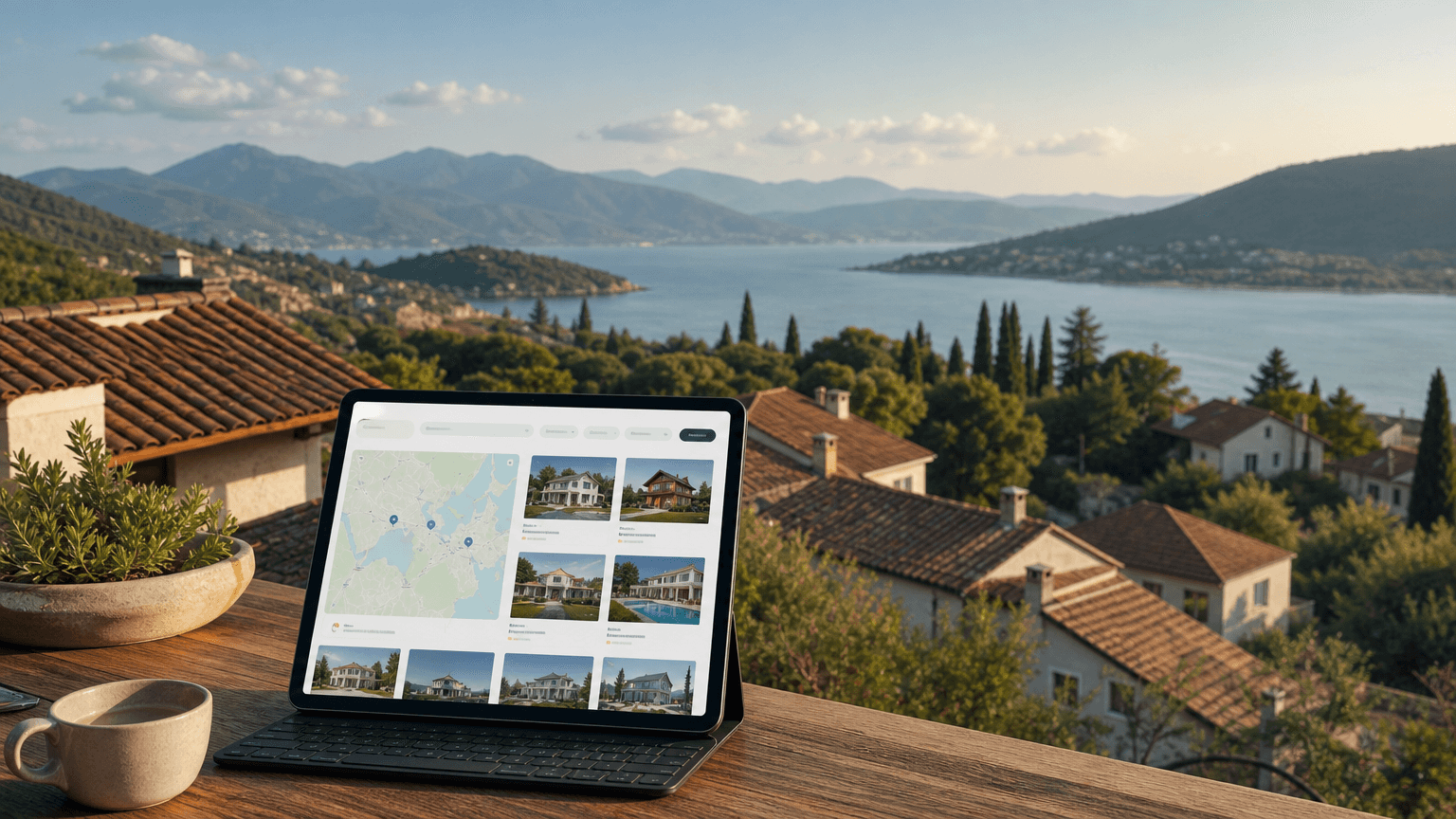
Buying a second home in Europe rarely starts in one country. A buyer in Chicago or Toronto might be weighing a farmhouse in Portugal, a coastal apartment in Spain, and a stone cottage in Sweden at the same time. Local portals like Rightmove, idealista, SeLoger, Immobiliare.it, and ImmoScout24 are built for people who already know which country they want. Homestra is built for the stage before that.
That difference shapes how the databases compare. A "property database" on a portal isn't an MLS equivalent in most European countries. It's an aggregated set of listings, supplied by agents and feeds, organized to match how people search. So the useful questions aren't only "how many listings?" but also "which countries, which kinds of homes, and what can I do with them in a first session?"
Homestra's database: 200,000+ properties across 20 countries
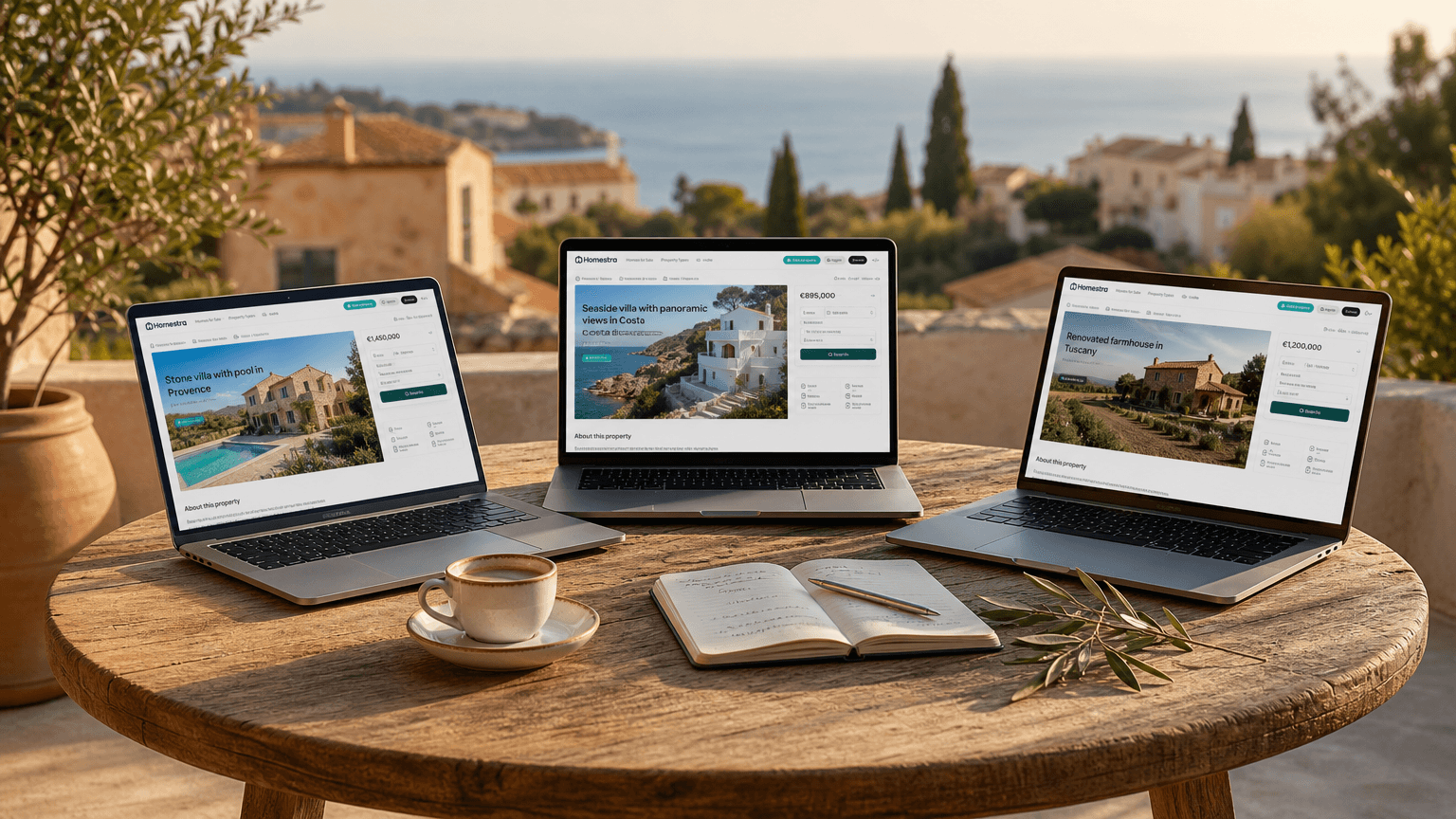
Homestra states that it lists over 200,000 properties, and its country directory presents coverage across 20 European countries, each with its own live property count. Those counts change as listings are added and removed, so check the figure on the Over 200,000 properties on Homestra page and the country directory for the current number and "as of" date.
The collection is organized around second homes: vacation properties, retirement homes, renovation projects, beach locations, and bargain finds. Descriptions lean on local culture and lifestyle, and the platform is presented in English for expats and international buyers. That's a curated, cross-border view rather than a single national marketplace.
How the scale compares with local and US portals
Local portals are enormous inside their home markets, but coverage stops at the border. Here's how the coverage models differ.
| Platform | Market boundary | Primary orientation |
|---|---|---|
| Homestra | 20 European countries | Second homes for international buyers |
| Rightmove | United Kingdom | UK search, valuations, moving tools |
| idealista | Spain (links to Italy, Portugal) | Spain-first search plus valuation and mortgage services |
| SeLoger | France | French search, estimation, buyer guides |
| Immobiliare.it | Italy | City and province search, mortgage tools |
| ImmoScout24 | Germany | Large German catalog, valuation and financing tiles |
Most of these portals don't publish a single, stable active-inventory figure on their homepages, and mixed sale and rental inventory makes raw counts hard to compare. Verify any number on the portal itself before relying on it.
US portals do publish counts, which makes them a useful reference for scale, though they aren't European alternatives. Realtor.com reported 1,126,252 active listings for July 2026 and 1,140,035 for August 2026. Zillow Research showed roughly 1.4 million active listings as of September 2026. Redfin reported 1,510,784 homes for sale in the US in September 2026.
Those figures are for one country. Homestra's 200,000+ is smaller in raw terms, and it spans 20 countries with a narrower purpose. Comparing the two directly is like comparing a national census to a travel shortlist. Both are valid, and they answer different questions.
Where bigger inventory helps and where it doesn't
Large local portals win on depth. If you've already chosen Valencia, idealista's density of Spanish listings, local filters, and service tools will likely surface more homes in that market than any cross-border platform. The same holds for Rightmove in the UK or ImmoScout24 in Germany.
Cross-border buyers face a different problem. Switching between five sites means five interfaces, five languages, five sets of filters, and five ways of describing a property. A homepage on a local portal is built to capture leads, run valuations, and promote calculators. That's good for residents. It's less useful when you're still deciding between Portugal and Italy.
Homestra's advantage is the shortlist stage: one place to compare countries, price ranges, and property types, with descriptions written for someone unfamiliar with the area. For a closer look at single-country matchups, see Homestra vs Rightmove and idealista vs Homestra.
Features that matter for international buyers
Three differences stand out in practice:
- Country-first navigation. Homestra lets you start from a country directory with live counts, then narrow by property type and price range.
- Lifestyle context. Listings carry descriptions that explain the setting and local culture, not only room counts.
- Process education. Homestra's guides cover how foreign purchases actually work. Its rural Sweden guide, for example, walks through bidding, the inspection (besiktning), the purchase agreement (köpekontrakt), a deposit of roughly 10%, and title registration (lagfart) with 1.5% stamp duty and an 825 SEK registration fee.
On data freshness, be realistic. Portals generally update through agent feeds and uploads, and none of the platforms discussed here publishes a verifiable update cadence on its homepage. Treat any listing as a lead to confirm, not a guarantee of availability.
What agents should compare
Agents should compare three things: pricing model (subscription or lead-based), the tools available, and how visible a listing is to its target buyer. Exact fees vary by portal and market, so confirm them directly with each platform.
The qualitative case is clearer. An agent in Portugal or Sweden who sells to foreign buyers reaches an audience on Homestra that is already looking across borders. A local portal reaches residents and domestic investors. Many agents use both.
A workflow that uses each platform for what it does best
How to measure whether a platform helps you? Track a few simple numbers: how many countries you considered in the first session, how large your shortlist became, and how many listings reached verification.
- Start on Homestra. Browse by country and property type, and build a shortlist across two or three countries.
- Narrow the countries. Use price, lifestyle fit, and process complexity to cut the list.
- Verify on the local portal. Cross-check the chosen region on Rightmove, idealista, SeLoger, Immobiliare.it, or ImmoScout24 for comparable prices and wider local stock.
- Validate the basics anywhere. Confirm ownership status, commission an inspection, and understand the legal and tax steps, whichever portal you used.
Homestra also publishes broader comparisons, including European real estate: how many properties can you browse? and a 4-country property search guide for buyers weighing France, Spain, Italy, and Portugal together.
Choosing the right platform at each stage
Use Homestra when the question is "where in Europe?" Its 200,000+ properties across 20 countries are organized for exactly that decision, and the English-language, second-home focus removes friction for expats. Use local portals when the question is "which house in this town?" Their depth is hard to match inside one market.
The strongest searches use both, in that order. Start wide, narrow fast, then verify locally. Whichever platform you use, treat every number, including the ones in this article, as a snapshot, and confirm the current figure and date on the source page before you decide.
Share