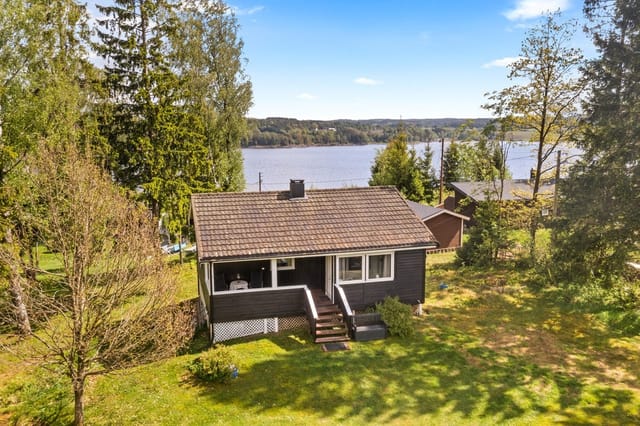
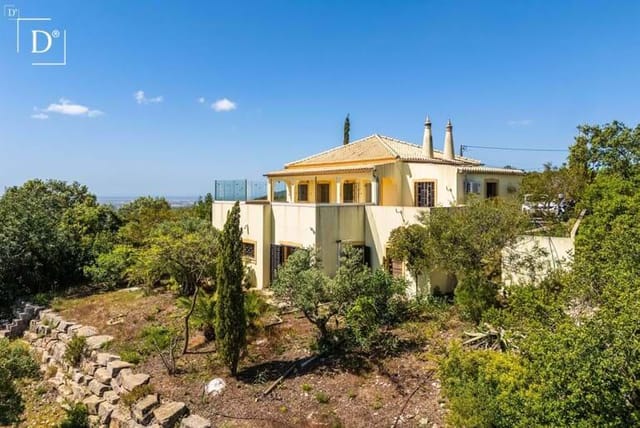
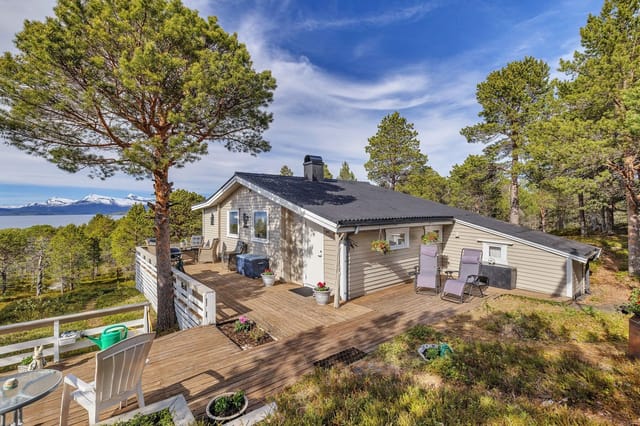
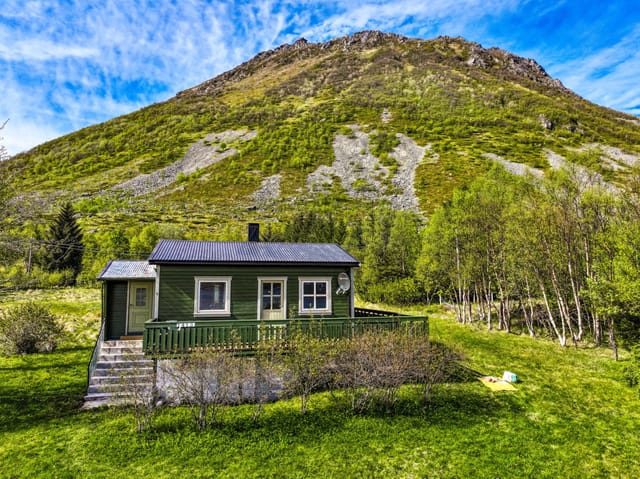
Houses For Sale In Europe With A Garden (page 9)

Houses for sale in europe - homestra offers the largest amount of european real estate with over 200,000+ properties, find any type of property within your budget from villas to country homes. buy or rent your perfect home in europe. (page 9)

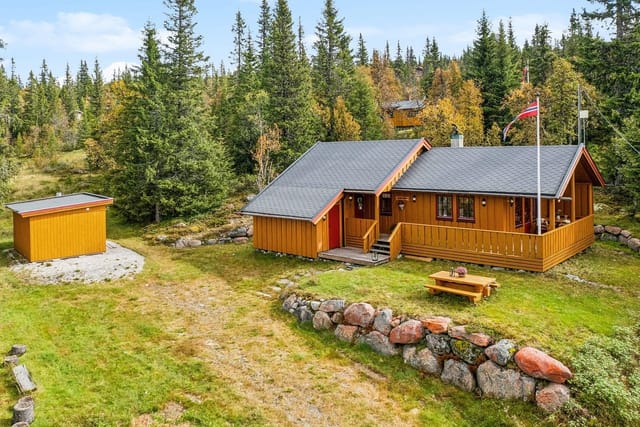
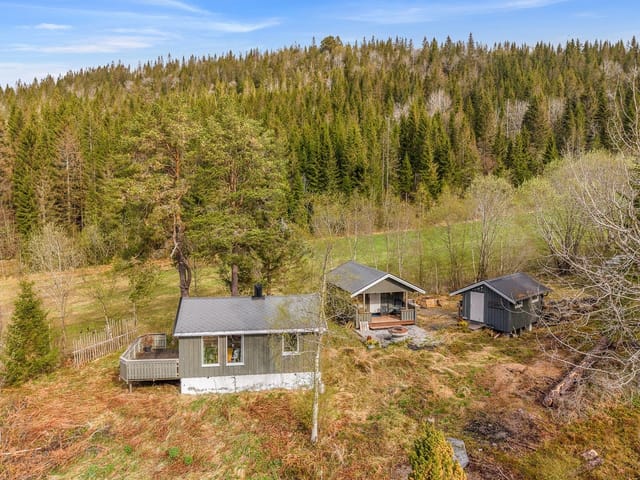
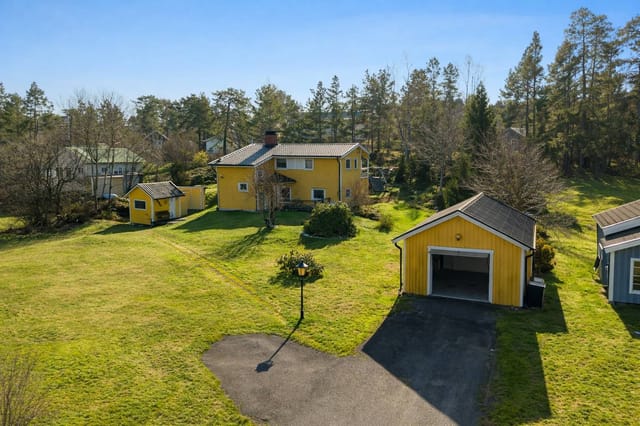
Step out onto the terrace at Kjossetervegen 19 on a July morning, coffee in hand, and the silence hits you first. Not the uncomfortable urban kind — the deep, living quiet of the Norwegian mountains, broken only by wind through birch trees and the occasional call of a fieldfare somewhere up the slope. The sun is already high. It's been up since four. This is what summer in Svingvoll actually feels like, and once you've had it, ordinary holidays start to feel like a poor substitute. This three-bedroom chalet sits at the end of a cul-de-sac on Kjossetervegen, a detail that matters more than it sounds. No through traffic. No walkers shortcutting past your windows. The road ends at your gate, and beyond that, nearly five acres of owned land rolls out in every direction. For Norway — where freehold plots of this size close to recreational areas are increasingly hard to find — that's a genuine rarity. The cabin itself dates to 1946, with the bones to prove it. But it's been extended and updated intelligently over the decades, and what you actually get is something that works well rather than something that merely looks good in photographs. Single-storey layout, which matters when you're arriving after a long drive in February with ski gear and small children or aging parents in tow. Bright interior surfaces, 81 square metres used efficiently, and a living room that pulls the outside in through large windows framing the mountain ridgeline opposite. In the evenings, when the light goes amber and the valley below catches it, that view from the sitting room is worth the price of entry on its own. The fireplace is the social anchor of winter stays. Get it going by mid-afternoon, and by dinner the whole cabin holds heat that no r ... click here to read more

Picture 1

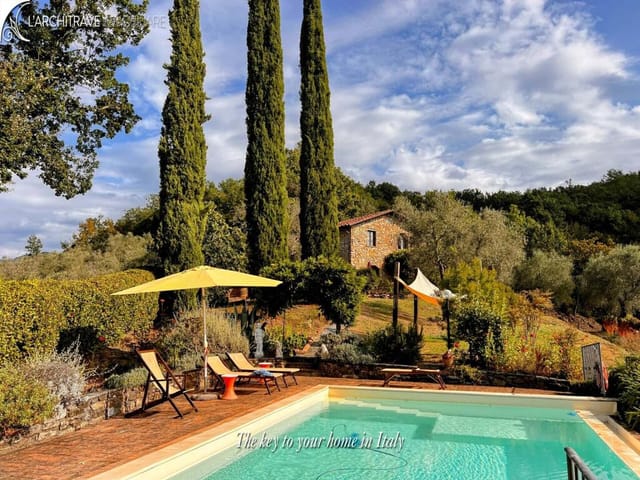
On a clear morning, you push open the shutters of the upstairs bedroom and the Apuan Alps are just there — close enough that you can trace the ridgelines with your finger, white-tipped in winter, darkly forested through July and August. The smell drifting up from the kitchen is coffee, and somewhere below the terrace an olive grove is already warm in the early sun. This is your Tuesday. Imagine your Saturday. Sitting at the end of a quiet lane outside Aulla in the Lunigiana corner of Tuscany, this two-bedroom, four-bathroom stone villa sits on four hectares of land — olives, fruit trees, vines — and feels genuinely removed from the world while remaining surprisingly easy to reach. It's the kind of property that gets into your head the first time you visit and doesn't leave. The house itself has the bones that matter. Thick stone walls keep rooms cool well into the afternoon heat of August. A wisteria-covered portico frames the entrance, and inside, the living room pivots around an impressive stone fireplace that earns its keep from November through March. The kitchen-dining room has marble surfaces and a marble sink — not an affectation, just the way kitchens were built here, and still the best material for rolling pasta dough. There's a utility space tucked out of sight with a washing machine, a ground-floor WC, and a separate ground-floor room — flooded with light on three sides — that opens directly onto the garden and has its own ensuite shower. Upstairs, two double bedrooms each have their own ensuite facilities: one with a bath, one with a shower, both with air conditioning for the peak summer weeks. The first bedroom steps out onto a large terrace where those mountain views hit you full in the face. Every room i ... click here to read more

Picture 1

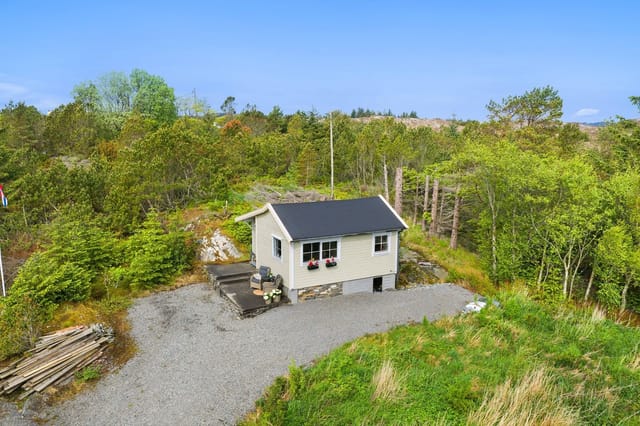
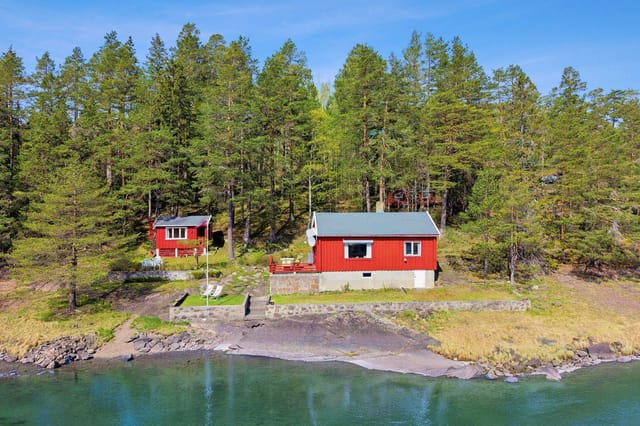
Picture yourself sitting on a small timber terrace at seven in the evening, a cup of coffee going cold in your hand because you keep getting distracted by the light. That particular Norwegian summer light — low and golden and doing something extraordinary to the water stretching out below Breivikvegen. This is Rong. And once you've had an evening like that here, the question stops being whether to buy, and starts being how soon you can make it happen. Rong sits on Radøy island in the Vestland region, roughly 45 minutes northwest of Bergen along the E39 and then across the Osterøy bridge network. It's close enough to Norway's second city to feel connected, far enough removed to feel genuinely apart from it. You arrive and the pace shifts. The road narrows. The spruce trees get taller. The fjord appears between houses without warning. That's the rhythm up here. This 1957-built cabin at Breivikvegen 228 sits on a gentle rise above its plot, looking out toward the sea. Thirty-two square metres inside — compact, but the Norwegians have always understood that a hytte is not about square footage. It's about the view from the window in the morning, the smell of a wood-burning stove on a cold October weekend, the way silence sounds different here than it does anywhere else. The living room, at just over ten square metres, holds a sofa corner and dining space around that wood stove. Pine floors, panel walls painted in pale muted tones. It feels genuinely old in the best sense — not tired, just honest about what it is. The kitchen has good work surfaces and is not yet connected to water or drainage, which is one of the main renovation items a new owner will tackle. The cabin runs off the public water supply via an outdoor tap, a ... click here to read more

EiendomsMegler 1 v/Merete Seim presents Breivikvegen 228. (Photo: Mats Lie)

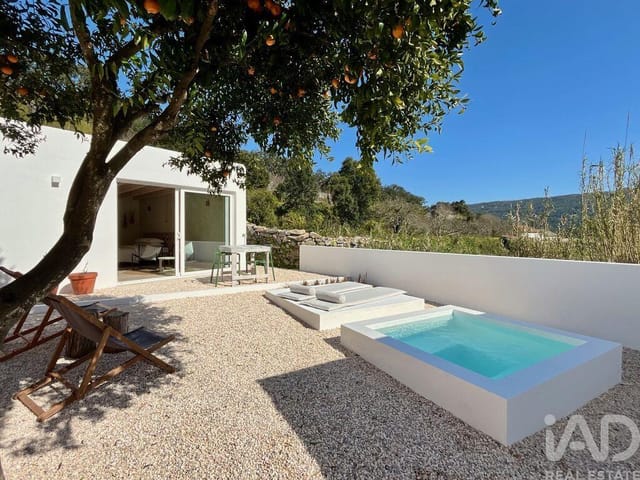
Stand on the upper terrace just after sunrise and watch the mist lift off the Serra de Monchique, the valley below turning from grey-green to gold as the light catches the olive groves. Church bells drift up from the town square five minutes down the cobbled hill. The smell of medronho — the local arbutus berry spirit that Monchique has been distilling for centuries — still hangs faintly in the cool morning air from last night's bar. This is your Saturday morning. And it's not a fantasy. This fully renovated two-bedroom house sits on a 1,080 square metre terraced plot right at the edge of Monchique's historic centre, delivering unobstructed valley panoramas that most people only see on postcards. At 599,000 euros, it's a rare intersection of contemporary architecture, serious eco credentials, and a location that places you equally between mountain wilderness and some of the Algarve's most celebrated coastline. The main residence was designed around one core idea: let the landscape in. The living room ceiling climbs to six metres, and large glass walls mean the valley view is essentially a living painting that changes by the hour. On grey winter afternoons, clouds roll through the valley below you — you're actually above them. By midsummer, the light turns amber by seven in the evening and the temperature on the covered terrace is exactly where you want it. The kitchen doesn't make you choose between beauty and function: custom American walnut cabinetry, full Bosch appliances, and enough counter space to actually cook — which matters here, because Monchique's market produces the kind of medronho-cured sausages, Serra cheese, and wild mushrooms that make cooking feel worth the effort. Large sliding doors open from the l ... click here to read more

Picture 1

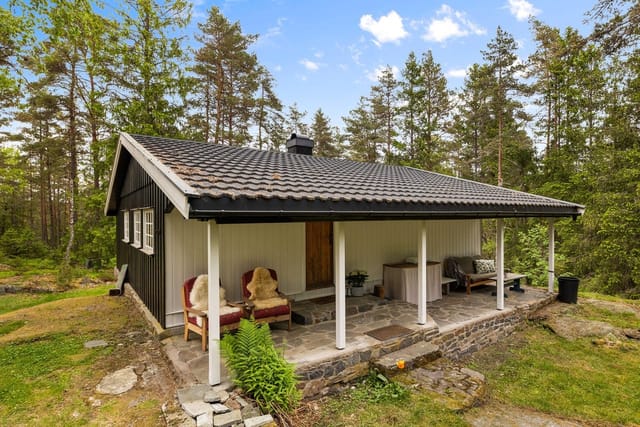
Some mornings you wake up before anyone else, pull on a sweater, and step out onto the slate terrace while the forest is still half-asleep. The birch trees hold the light differently at that hour — pale gold filtering through the canopy, a woodpecker working somewhere close. You put the kettle on in the renovated kitchen and stand at the window watching a roe deer pick its way across the exposed bedrock at the edge of the plot. This is Skirød 13. It's 56 square meters, and it contains about a thousand square kilometers of breathing room. Built in 1970 and kept in genuinely good shape, this one-bedroom forest cabin sits on a 1,310 square meter leased plot in Sperrebotn, a quiet corner of Østfold county that most international buyers haven't discovered yet. That's partly why it matters. Vansjø — Norway's largest lake entirely within a single municipality — is a short walk away, and with your included share in the Skirød Common Dock Association, you have a rotating mooring spot right on the water. Pull a kayak out in June. Drop a fishing line in August. In October, when the maples go rust-red and the lake turns silver, the whole scene becomes something that's genuinely hard to leave. The cabin's interior layout is modest but well-considered. High vaulted ceilings open the main living space up so it never feels cramped, and the open-plan connection between the kitchen and sitting room means that whoever's cooking isn't cut off from the conversation. The central masonry fireplace does double duty as a room divider and a heat source, and the wood-burning stove in the living area means you're never cold — not even on a Norwegian January evening when the temperature drops hard and fast. Both sources of warmth add something bey ... click here to read more

Welcome to Skirød 13 - A cozy forest cabin in scenic surroundings within walking distance to idyllic Vansjø.

Sit on the veranda with a cup of black coffee just after seven in the morning. The Glomma slides past without a sound, wide and unhurried, catching the early light in ways that make you put down your phone and just look. That's the daily reality at this two-bedroom chalet on Liverudtangen 15 — a proper Norwegian cabin with its feet in nature and its head screwed on practically. Skiptvet is the kind of place people from Oslo discover and then tell nobody about. Tucked into Østfold county roughly an hour south of the capital along the E6, this quiet municipality sits on the banks of Norway's longest river. The Glomma here is broad and calm, ideal for leisure paddling by kayak or canoe, casting a line for perch and pike in the morning mist, or simply watching the water traffic drift past while you do absolutely nothing. Summer weekends have a specific rhythm — the smell of grilling meat drifting between cabins, kids jumping off the dock into dark river water, and the kind of long Nordic evenings where it doesn't get properly dark until well past ten o'clock. The chalet itself was built in 1964, which in Norwegian cabin terms means good bones and a no-nonsense layout. At 58 square metres it's compact but genuinely liveable — two comfortable bedrooms that each sleep a couple, a combined kitchen and dining area large enough to seat four or five around the table, and a bright main living room where the windows do the heavy lifting. The views from those windows are the point. You see the river constantly, from nearly every angle, framed by mature birch and pine that turn amber and gold each September in a way that stops returning visitors mid-sentence. The exterior received a fresh stain treatment in 2024, so the classic dark ... click here to read more

Welcome to Liverudtangen 15

Stand on the sun terrace on a clear January morning and you can see all the way to the Atlantic. Not a glimpse—a full blue stripe of sea sitting low on the horizon, framed by rolling hills stitched with carob and olive trees. This is São Brás de Alportel, the Algarve's quiet, unhurried interior, and from this elevated plot four kilometres south of the town centre, that view is yours every single day. The villa sits on 1,401 square metres of gently sloping land, far enough from the coast road to feel genuinely private but close enough to the beach that you won't need to plan around it. Twenty minutes to Meia Praia or Garrão. Fifteen to the Thursday market in Loulé where farmers sell figs still warm from the tree. Five minutes to the padaria on Rua Dr. João Dias where they pull trays of fresh broa from the oven before 8am. This is not a holiday-brochure version of the Algarve. It's the real one. At 252 square metres across two floors, the house is generously sized—a fact that becomes obvious the moment you step into the ground-floor living and dining room. It's big enough to host a long family lunch without anyone feeling crowded, anchored by a wood burner that earns its keep on crisp February evenings when the serra cools sharply and the valley below fills with a thin morning mist. The kitchen runs off to one side, fully equipped with a pantry that solves the eternal problem of too many tins of Portuguese tinned fish and not enough cupboard space. A third bedroom on this floor does current service as a home office—practical if you plan to split time between here and elsewhere, or ideal as a guest suite for the friends who will, inevitably, want to visit once word gets out. The patio doors off the living area are the ce ... click here to read more

Picture 1

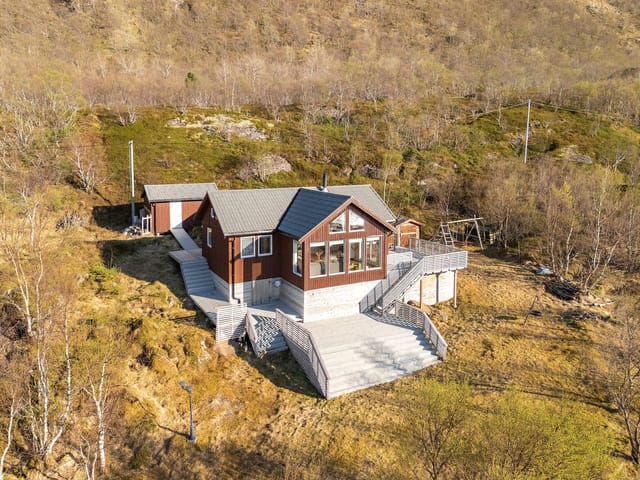
Step outside on a July morning, coffee in hand, and the Ofotfjord is just sitting there below you — steel-blue and enormous, framed by mountains that still carry last winter's snow on their upper shoulders. The pine trees around the cabin are dead quiet except for the wind moving through them. That's the view from the terrace at Sildvikhøgda-E6 110. No neighbors visible. No noise from the road. Just the fjord, the forest, and the kind of silence that actually resets something in you. This is a genuine Norwegian hytte — the kind Norwegians have been fiercely protecting in their families for generations. Built in 1968 on a solid timber frame, this two-bedroom chalet in Skjomen sits elevated on the ridge known as Sildvikhøgda, wrapped on three sides by mature Scots pines that act as both windbreak and privacy screen. The cabin has been kept in good condition throughout the years, with meaningful updates done where it counted: the electrical system was fully renewed in 2018, the toilet room renovated the same year, the south-facing exterior cladding replaced as recently as 2025, and a steel-plate roof that doesn't ask much of you at all. This is not a project property. You can arrive, open the windows, and get on with the business of actually being here. Inside, the 66 square metres feel well-considered rather than cramped. Stained timber paneling runs across the walls and ceiling in the living area — warm in winter when the wood-burning stove is going, and pleasantly cool and dim during the long Nordic summers when you'd rather be outside anyway. The stove sits against a brick chimney that anchors the room, and the large windows on the fjord-facing side pull the view right in. You can be sitting on the sofa and still see ... click here to read more

Welcome to Sildvikhøgda-E6 110! Photo: Kalle Punsvik

Step out onto the balcony at Haverringen on a July morning and the light does something you won't forget. The sun hasn't set in weeks. The fjord below catches the reflection of mountains so sharp they look painted. A lone eider duck cuts across the water. It's 6am and it feels like noon. This is Bøstad, Lofoten — and this cabin sits right in the middle of it all. The property at Haverringen 1413 sits on roughly 25,284 square meters of private land — that's over six acres of gently sloping hillside, open lawn, and wild grass running toward the coast. For context, most Norwegian holiday cabins come with a plot you could cross in thirty seconds. This one takes a while to walk. The terrain rolls down toward the water, framing a view of the Vestfjorden that changes by the hour depending on cloud cover, season, and time of day. No neighbors pressing in. No noise except whatever the wind and birds decide to make. The cabin itself dates to 1950 and has been maintained in good condition, carrying all the hallmarks of classic Norwegian fritidsbolig design — wooden paneling, a wood-burning stove in the living area, and windows positioned to drag as much of the outside in as possible. At 46 square meters, it's compact without feeling cramped. The open plan between the kitchen and living room keeps things sociable. Pine cabinets, a wooden countertop, a dining spot by the window — practical, warm, honest. The kind of space where you actually cook rather than order in, where someone always ends up sitting on the counter talking while the coffee brews. The single bedroom gets the morning light. There's room for a double bed, and direct access to the surrounding land makes it easy to step outside before you're properly awake, which in ... click here to read more

Welcome to Haverringen 1413 - presented by Thomas K. Johansen / Advanti & Partners. Photo: Arctic Vision.

You wake up to silence. Real silence — no traffic, no neighbours too close, just the dry warmth of an Algarve morning pushing through the shutters and the faint smell of wild rosemary rising off the hillside below. This is what São Brás de Alportel feels like before the rest of the world gets going, and from this four-bedroom country house on its outskirts, you get that feeling every single day. São Brás de Alportel sits in the Barrocal, the limestone inland strip between the Algarve coast and the Serra do Caldeirão mountains — and it's one of the least discovered corners of southern Portugal. That's not a flaw. It's the whole point. The town itself is compact and deeply local: a main square where old men argue over espressos at Café Garrett in the morning, a weekly market on Saturdays where you'll find the season's best blood oranges and medronho brandy from the hills, and the Museu do Traje — a folk costume museum tucked into a former cork baron's mansion — that quietly explains how this region made its money for two centuries. The streets smell like charcoal smoke in winter and jasmine in summer, and almost nobody speaks at you in English unless you start it. The house sits roughly ten minutes outside town on a generous 1,016 square metre plot, with unobstructed views across the rooftops of São Brás and out to the layered ridges of the Caldeirão range beyond. On clear days — and there are a lot of those, given the Algarve logs around 300 days of sunshine annually — the view runs so far east it almost reaches Spain. The plot itself gives you room: space for a swimming pool at the back, a proper kitchen garden if you want one, and a garage that could double as a workshop or storage for bikes and gear. At 140 square m ... click here to read more

Picture 1

Step out onto the terrace at Gafsetveien 123 on a July morning and you'll understand immediately why Norwegians have been coming to this corner of Trøndelag for generations. The air smells of pine resin and cut grass. Somewhere below the hill, the Trondheimsfjord catches the early light. A woodpecker is doing its thing in the birch stand at the edge of the plot. It's 6am and you have nowhere to be. This 1-bedroom cabin sits on a 1,463-square-meter plot just outside the small community of Stadsbygd, with the sea 1.4 kilometers away and the bustle of Rissa center a short drive down the road. At 29 square meters for the main cabin plus a 16-square-meter annex with its own covered terrace, this isn't a grand estate — it's something better: a proper Norwegian fritidsbolig, the kind of place where a long weekend feels like a full reset. The cabin was built in 1976 and has the bones you'd expect from that era — solid, practical, honest. The living room, roughly 17 square meters, pulls in natural light from three directions, which matters a lot this far north. In midsummer, that means golden evening light streaming in until nearly 11pm. In late September, it means amber afternoon warmth that makes the wood stove across the room look even more inviting. That stove is going to become one of your favorite things about this place, almost certainly by your second visit. The kitchen is functional and real — no pretense here. A pump system currently supplies water to the kitchen tap, and the owner has noted that a permanent water line runs directly behind the cabin, meaning a full connection is a practical future upgrade rather than a distant fantasy. A septic tank is already in place, with drainage laid toward the annex. This isn't ... click here to read more

Welcome to Gafsetveien 123! (Photo: Harald Wanvik, Interior Photo)

At half past ten on a midsummer evening, the sun is still high above the Lofoten skyline, burning copper across the water. You're sitting on the west-facing terrace at Kjerringøyveien 542 with a cup of coffee and nowhere to be. The fjord is right there — close enough that you can hear the faint slap of waves and, if the wind is right, the cry of Arctic terns returning to the shoreline across the road. This is Kjerringøy. Not a resort, not a holiday park — a real peninsula on the Nordland coast, where the light in summer defies logic and the silence in winter feels almost sacred. Built in 2008 and kept in genuinely good condition, this three-bedroom chalet sits on a 1,011-square-metre plot that the owners have owned outright — no leasehold complications, no shared title headaches. For international buyers used to navigating fractional ownership or ground rent clauses, that's worth pausing on. The land is yours. All 1,011 square metres of it, with multiple beach access points literally across the road. The cabin itself runs to 70 square metres of well-organised interior. Step through the front door and a sliding-wardrobe entrance hall takes the chaos of outdoor living — hiking boots, waterproof trousers, fishing gear — and makes it disappear before you reach the main living space. The open-plan kitchen and living room is where the 2008 build quality really shows. Large windows face west and pull in the last light of the evening, framing the fjord and the mountain ridgeline beyond like a painting that changes every hour. There's a wood-burning stove in the corner, the kind that becomes the gravitational centre of the room on November evenings when the temperature drops and the Aurora Borealis starts making appearances abo ... click here to read more

Welcome to Kjerringøyveien 542. Photo: Leel v/Benjamin

The smell hits you first — salt air and pine, drifting through an open window on a July morning while the harbor down the hill is already busy with fishing boats heading out toward the Kosterfjord. That's what mornings look like from Hovslagargatan 3. Coffee on the terrace, the conservatory catching the early light, and absolutely nothing demanding your attention until you're ready. Grebbestad sits on Sweden's Bohuslän coast, a stretch of coastline that West Coast Swedes guard like a family secret. The town has a real working harbor — lobster and oysters pulled straight from those cold, clean waters — and yet it never turns into the kind of place that forgets itself for the sake of summer crowds. The main street runs to the water's edge. There are maybe four or five restaurants worth returning to, a bakery that opens early enough to catch the sunrise crowd, and kayak rentals at the dock if you feel like paddling out to the skerries before lunch. In late August, the Smögen and Grebbestad area fills with Swedish families doing what Swedes do best: slow evenings, open boats, crayfish parties on granite rocks by the sea. November brings a different kind of quiet. Fog and moody skies. The kind of weather that makes you glad you've got a hot tub. This property at Hovslagargatan 3 sits at the end of a residential street — far enough from the summer foot traffic to feel private, close enough to the harbor that you're never hunting for parking. It's a substantial house. 115 square metres of main living space, good condition throughout, and a basement apartment that effectively gives you a second home within the property. That last part matters more than people initially expect. The main floor opens wide. Living room and kitche ... click here to read more

Exterior view of the house and garden

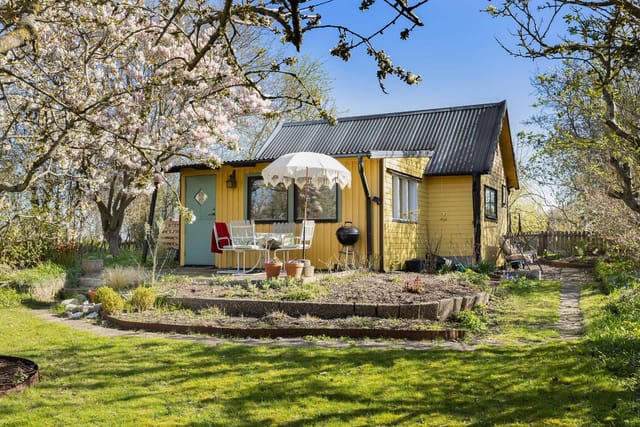
Saturday morning, and the cherry tree outside is dropping its last white blossoms onto the patio table. You've got coffee on, the kitchen window is cracked open, and the only thing on the agenda is deciding whether to cycle down toward the Öresund coast or spend the afternoon in the hammock. This is Björkgången 22 — a compact, well-kept cottage in Kölnans Fritidsby, one of Malmö's most quietly coveted leisure village districts, and a property that earns its price tag through sheer livability rather than size. Forty square meters sounds modest until you're inside. The main room is flooded with light from several windows, and a door opens straight onto the garden so that the line between inside and outside essentially disappears on warm days. Summers in southern Sweden last longer than most visitors expect — July evenings here don't go dark until past ten, and that extra space between the living room and the patio effectively doubles what you're working with. The kitchen sits just off the main room, a garden-framed window turning even mundane meal prep into something more pleasant. A washing machine is tucked in discreetly, which matters more than it sounds when you're planning weeks here rather than weekends. The bedroom is at the quieter end of the cottage. No street noise, no early traffic — just birds in the morning and the occasional rustling from the mature trees that ring the back of the 375-square-meter lot. That lot is the real story here. A pear tree, an apple tree, a cherry tree, and a magnolia that puts on an extraordinary show every April. The rear of the garden is genuinely secluded: dense summer growth means you could host a lunch back there and your neighbors wouldn't know. A hammock is already strung bet ... click here to read more

Front view of the cottage and garden

Step out onto the back terrace on a Friday evening in July. The light on Värmdö doesn't fade so much as it lingers — that long, amber Scandinavian glow that makes everything feel unhurried. You can hear the water. The sea is 350 meters away, close enough that a morning swim before coffee is a completely reasonable life choice. That's not a weekend treat here. That's Tuesday. Evlinge is one of those corners of Värmdö that locals tend to keep quiet about. The island sits just east of Stockholm, connected by road through the leafy arc of the archipelago — about 35 to 40 minutes from the capital, depending on where you're headed. It doesn't have the same postcard fame as Sandhamn or Vaxholm, and that's precisely why it works. No tour buses on Betesvägen. Just a quiet residential street, generous plots, and the kind of birch-and-pine silence that Stockholm residents pay considerable sums to access on weekends. This house, built in 1970 and kept in good condition over the decades, sits on a 2,596 square meter plot. That number deserves a moment. Nearly 2,600 square meters means actual land — room for a kitchen garden, a hammock between the trees, a snowman in February that the kids can build without running out of space. The footprint of the house itself is 70 square meters of living area spread across two floors, which keeps maintenance manageable without feeling cramped. Two wood-burning stoves. That detail matters more than any spec sheet can convey. On a November afternoon when the temperature drops and the first snow settles on the garden, both stoves earn their place — one on each floor, each one pulling the room inward and making it feel smaller in the best possible way. The upper-floor stove sits in the main living ... click here to read more

Exterior view of the house and garden

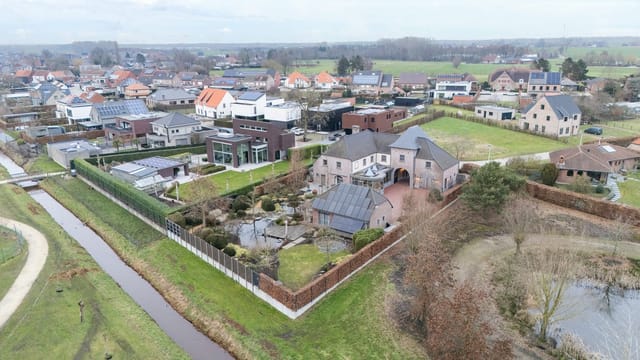
Saturday morning in Loenhout moves at its own pace. The bakery on the village square opens early, and by nine o'clock the smell of fresh bread drifts down Sint Annastraat. You walk back through the gate of number 52 with a paper bag still warm in your hands, into a southwest-facing garden already catching the first strong light of the day. The pond catches it too. This is what life feels like here — unhurried, grounded, genuinely good. Built in 2007 on a plot of nearly 2,000 square meters, this four-bedroom villa in the heart of Loenhout is one of those rare properties where scale and soul arrive together. At 562 square meters of interior space, it has room for a large family, long-staying guests, a home office, a wine cellar, a cinema room — and still doesn't feel like it's showing off. The architecture is confident without being cold. Stone staircases, high-quality finishes throughout, and a layout that flows from room to room with the kind of logic that only becomes obvious after you've lived somewhere for a while. Step through the entrance hall and the proportions immediately do their work. The living area is generous and genuinely light-filled — the adjoining veranda runs along the garden-facing side of the house, its oversized windows pulling in afternoon sun from the southwest all year round. In summer, the doors open wide and the boundary between inside and garden dissolves completely. In winter, you're watching frost on the pond from a warm room with underfloor heating underfoot. Both versions are equally good. The kitchen is built around a Boretti gas stove, and if you know, you know. These Italian-made ranges are the kind of thing serious home cooks seek out specifically. The kitchen functions as a proper g ... click here to read more

Front view of Sint Annastraat 52

Wake up to the sound of water lapping against the shore and nothing else. No traffic. No alarms. Just the low call of a great northern diver drifting across Tyrifjorden at 6am while the morning light turns the fjord surface into hammered copper. That's a Tuesday at Tangenveien 50. This 1959 timber chalet sits directly on the water's edge at Kroksund, one of the narrowest and most dramatic pinch-points along Tyrifjorden — a lake so large it creates its own weather, so clear in summer you can see three meters down from a rowboat. The plot stretches across 1,199 square meters of leased land, giving the property a generous natural buffer from the rest of the world. The terrace — 20 square meters of sun-drenched outdoor living — faces the fjord dead-on. Sit there long enough with a coffee and you'll start rethinking your entire relationship with city life. At 43 square meters, the main cabin is compact the way a well-designed sailboat is compact: every centimeter works. The living room runs on natural light thanks to large windows aligned directly with the water view — in the late afternoon, the sun drops over the Krokskogen ridge behind you and the light on the fjord turns amber, then pink, then gone. The kitchen keeps things simple and functional: smooth-fronted cabinetry, a solid wood worktop, a stainless steel sink, and an externally vented hood — the kind of practical detail that matters when you're cooking fresh perch you pulled out of the fjord two hours earlier. A wood stove anchors the living space, and on September evenings when the air sharpens and the birch trees along the shore start turning yellow, you'll be very glad it's there. Three bedrooms across the main cabin, an annex, and a playhouse. That last sente ... click here to read more

Front view of the property

The first thing you notice on a summer morning at this Hankø cabin is the light. It comes off the Hankøsundet strait in long, low shafts and pours through the large living room windows before you've even had your coffee. Somewhere out there, a wooden sailboat is making its way toward open water. The ferry horn sounds in the distance. You're not in a hurry. Nobody on Hankø ever is. This three-bedroom cabin sits on a generous, flat plot on one of the Oslofjord's most coveted car-free islands, a short ferry hop from Gressvik in Fredrikstad municipality. The private jetty juts out over the water at the bottom of the garden — your direct line to the fjord for swimming, kayaking, fishing, or simply dangling your feet off the edge with a cold beer on a July afternoon. There's also the option to purchase a 3-meter boat berth in the Vadbukta marina nearby, which opens up day-trip sailing to the outer archipelago islands like Kjøkøy and Kråkerøy. The cabin spans 90 square metres across a well-considered layout that feels larger than it sounds. The living room anchors the interior with a wood-burning stove at one end — genuinely useful in May or September when the evenings cool fast — and panoramic windows framing the strait at the other. It's the kind of room you don't want to leave. The open connection to the kitchen and dining area means whoever's cooking doesn't miss the conversation or the view, and the kitchen itself has modern appliances, real counter space, and storage that actually works. The dining table fits the whole family, plus guests. Three bedrooms offer proper sleeping arrangements for a full household. The master opens directly onto the terrace, so you get the birdsong and the sea breeze before you've properly ... click here to read more

Picture 1

Early morning on Vesterøy, the smell of salt air comes through the window before you've even opened your eyes. By the time coffee's ready, you're sitting on the south-facing terrace watching the light shift across Hvaler Archipelago — the kind of slow, wordless morning that city life has been stealing from you for years. Vikerveien 191 sits right at the boundary of Ytre Hvaler National Park, one of Norway's most fiercely protected stretches of coastline, on the island of Asmaløy. This is not a cabin you stumble upon. You turn off just before the Hvaler Tunnel, follow the road through open, wind-carved terrain where juniper scrub hugs the rock faces, and then it appears — a well-kept 1965 chalet on 6,180 square metres of sunny, south-tilting land, with views that stretch out over the sea in a way that makes you reset your sense of scale. At 60 square metres, this is a cabin that's been lived in properly. Not over-renovated into something soulless, not left to quietly deteriorate — genuinely cared for over the past fifteen years in ways that matter. A drilled well with pump means fresh water independence. New windows keep out the coastal chill. The electrical system has been fully upgraded. The fireplace in the living room does real work from September through April, when the archipelago empties of summer crowds and you get the place almost entirely to yourself. Two bedrooms, one bathroom with shower and toilet, a functional kitchen, and a hallway that doesn't feel cramped — the layout is compact but sensibly arranged. Natural light fills the interior throughout the day, partly because of the orientation, partly because the windows are well-positioned for both the morning sun on the eastern side and the long Norwegian s ... click here to read more

Photo: Eivind Lauritzen

The first thing you notice on a July morning here is the light. Not the pale, apologetic kind—the full, wide-open West Coast Swedish kind that bounces off the water somewhere beyond the treeline and fills every room before you've made your coffee. By eight o'clock, the kayakers are already out on the inlet below Hamnebuktsvägen. By nine, you can smell someone grilling on the rocks down near the water. This is life on Hamburgö, and this 162-square-meter country home at the end of a quiet lane puts you right at the center of it. Built in 2006 on a 3,689-square-meter plot, this is a house that was designed with intention. The classic Scandinavian exterior—clean lines, quality cladding, pitched roofline—doesn't feel dated because it was never chasing a trend. Inside, the open-plan kitchen and living area runs across the main floor with the easy confidence of a well-thought-out space. Large windows frame the garden and the sky beyond. Sunlight moves through the rooms differently at each hour of the day, and you start noticing that within the first week. The kitchen is proper. Generous worktops, modern appliances, the kind of layout where two people can actually cook together without negotiating territory. A sunny terrace steps off the living area—wide enough for a proper outdoor table, a gas grill, and still room to stretch out in a chair after dinner while the midsummer sky refuses to go dark until nearly midnight. Three bedrooms in the main house handle the family comfortably. Two bathrooms mean no queues before a day at the beach. But the real conversation-starter is the guest house. Separate, self-contained, with its own bathroom and kitchen, it changes the whole dynamic of having visitors. Friends stay for a week and ... click here to read more

Front view of the house and garden

Six o'clock on a July morning and the light here is already gold. You push open the kitchen window and catch the faint salt-and-pine smell drifting up from the water at Räfsnäs, just five minutes down the track on foot. The coffee is on. Somewhere across the garden, a wood pigeon is doing what wood pigeons do. This is Bokenäs — and if you've never spent a summer on this stretch of the Bohuslän coast, you're in for a genuine revelation. Hjalmars väg 5 sits on a southwest-facing plot in the Eriksberg neighborhood, a quietly sought-after pocket of Uddevalla municipality where most houses go dark from September to May and come magnificently alive in June. The property dates from the 1930s and carries that era's unhurried sensibility: proper rooms with real proportions, large windows that pull the garden indoors, and the kind of robust timber construction that has laughed off nine decades of Swedish winters without drama. Three bedrooms, two living rooms, one bathroom — 76 square meters of main house that feels bigger than the number suggests, partly because of those windows and partly because the layout was designed for actual living, not a floor-plan brochure. The garden is the heart of everything. Southwest aspect means sun from late morning until the evenings go rose-pink around ten o'clock in high summer. There's room for a long table under the trees, a hammock, a patch for growing tomatoes that never quite ripen but you keep trying anyway, and enough grass for children to run themselves properly tired. The guest cottage — a simple, functional annex on the same plot — handles the overflow when friends arrive, which they will, repeatedly, once word gets out you have this place. The share in the local community associat ... click here to read more

Front view of the house and garden

The boat engine cuts off. Suddenly it's just the sound of water lapping against the hull, a pair of oystercatchers calling from somewhere along the shoreline, and the faint creak of the old wooden pier as you step ashore. That's your pier. That's your lake. And that's the moment most owners say they knew this was the one. Sitting directly on the water's edge of Regnarvatnet at 327 metres above sea level, this 62-square-metre chalet is the kind of place that genuinely does not come up often. Forty-six metres of private shoreline. Solar power. Water drawn directly from the lake wall. No road noise, no neighbours in sight, just the Norwegian wilderness doing what it does — putting on a quiet, relentless show from sunrise to well past nine in the evening during July. The cabin itself dates to the 1950s, expanded in the 1990s and renovated steadily since. It shows. Whitewashed timber surfaces, large windows replaced in 2016 that frame wide views across the water, and an open-plan kitchen and living area that feels genuinely social rather than cramped. On summer mornings, the light comes through those windows at an angle that turns the wooden floors amber. You'll stop noticing the kitchen is running on gas after about day two — it works, it's efficient, and it suits the rhythm of a place like this perfectly. Two ground-floor bedrooms cover the basics: a proper master room and a second bedroom with a family bunk setup, ideal for kids or extra guests. The loft above adds two further rooms with built-in beds — low ceilings, yes, but the kind of cosy that children absolutely love and adults secretly do too. In total, this chalet sleeps a full family group without anyone feeling squeezed. The bathroom setup is honest: a storage ... click here to read more

Welcome to Regnarvatnet 42 - Photo by Robin Malm.

Step outside on a February morning and the only sound is the scrape of your own skis clipping into their bindings. The groomed cross-country trail is literally 150 meters from the front door—you can see it from the terrace—and the air at 900 meters above sea level has that particular sharpness that makes coffee taste better and lungs feel cleaner. This is Åsgrende 52 in Nes Østmark, a solar-powered three-bedroom chalet sitting on a sunny hilltop above the lakes of Langevatn and Buvatn, and it is one of those rare Norwegian mountain properties that actually works as well in July as it does in January. Built in 1970 and kept in good condition over the decades, the cabin has 55 square metres of indoor space that feel surprisingly generous thanks to a vaulted living room ceiling that opens everything up. Pine paneling runs along the walls—the real thing, worn smooth and honey-colored from years of wood stove heat—and the cast iron stove itself sits at the heart of the room like a small monument to every cold evening well spent. Large windows pull the landscape inside: open hillside, distant ridgeline, and on clear days a slice of the lake catching the afternoon sun. This orientation isn't an accident. The plot faces south and the cabin collects light for long hours, which matters enormously in the Norwegian highlands where a sunny hilltop position can extend your usable outdoor season by weeks on either end. The kitchen is functional in that straightforward cabin way—solid wood cabinetry, a gas stove, enough counter space to actually cook a proper meal rather than just boil water for instant noodles. The dining area fits the family comfortably. Three bedrooms sleep seven in total, so there's room for kids, grandparents, or ... click here to read more

Charming cabin in scenic surroundings.

Picture waking up on a frost-sharp October morning, the tiled stove already ticking with warmth, steam rising from a mug of coffee as you look out through the glazed conservatory at the still water of the Ljungan River catching the first pale Scandinavian light. The horses are already at the fence. This is not a weekend fantasy — it is a Tuesday in Nedansjö, and it can be yours. Hemgraven 128 sits in the Ljungan valley about 25 minutes west of Sundsvall, in a corner of central Sweden that most international buyers haven't discovered yet — which is precisely why it matters. The property is large, genuinely versatile, and soaked in the kind of regional history that no developer can manufacture. It started life as the steward's house on the estate built by industrialist Bünsow in the late 19th century, the same man who financed the railway between Sundsvall and Torpshammar, established an ironworks and a pulp mill at Hemgraven, and essentially built an entire self-sustaining community from scratch, complete with shops, workers' housing, and even a toy factory. The area was enclosed — outsiders had to ask permission to enter. Today that same sense of a world unto itself is what makes the property so compelling. At 146 square metres, the main house gives you five rooms and a kitchen arranged with the practical logic that Swedish country homes developed over generations. Two classic tiled stoves — kakelugnar, if you want the Swedish word — anchor the principal rooms. They work. They radiate a dry, even heat that a radiator simply cannot replicate, and they look the way old things should look: solid, slightly imposing, quietly beautiful. The geothermal heat pump handles the bulk of winter heating with minimal running costs, s ... click here to read more

Front view of the main house and grounds

The first thing you notice, stepping out onto the west-facing terrace on a Saturday morning, is the silence. Not the unsettling kind — the rich, full kind that only comes when you're 706 meters above sea level, surrounded by pine forest so dense it absorbs sound like wool. Then a woodpecker starts up somewhere in the trees. Coffee in hand, you look out over rolling mountain terrain and that small pond — dug back in the early 1980s, now perfectly settled into the landscape like it was always there. This is Blefjell. And this cabin estate on Buenveien is about as honest an expression of Norwegian mountain life as you'll find. The property dates to 1968, and it carries that age well. The main cabin is built in traditional Norwegian log construction, complete with a turf roof that goes copper-green in summer and holds snow like a postcard in February. Exposed timber runs through the interior — walls, ceiling, the thick frame around the windows. The living room has both a wood-burning stove and an open fireplace, and on a cold October evening with the larch trees turning gold outside, you'll use both. The kitchen is practical without pretending to be a design showroom, which is exactly right for a place where the priority is getting out the door and onto the trail. The layout across the three structures totals 102 square meters of indoor living space. The main cabin covers 55 sqm and holds an entrance hall, kitchen, living room, two bedrooms, and a utility room. The separate annex adds another 27 sqm — its own entrance, a combined living area and kitchen, a bedroom, and a small terrace — making it genuinely useful for families with teenagers, visiting in-laws, or guests who appreciate their own front door. The outbuilding i ... click here to read more

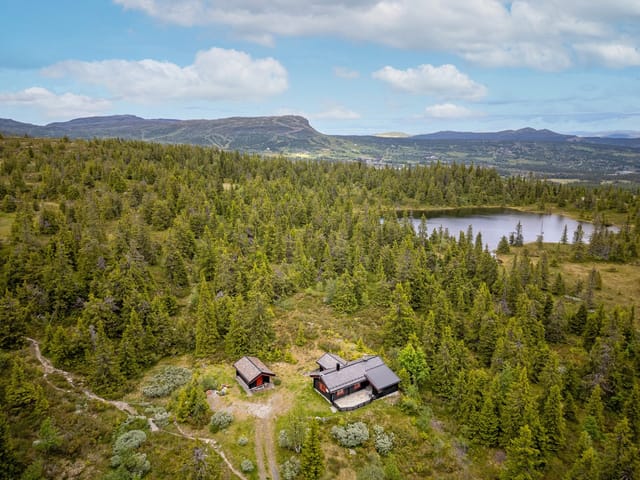
Welcome to Buenveien 2451!

You wake up before anyone else in the house. The sun is already high — it's July, and this far north of the Arctic Circle, it barely dips below the horizon. You pull on a fleece, step outside onto the lot, and walk the forty-odd meters down to the edge of Lake Kusträsket. The water is glass. A pike rolls near the reeds. You have nowhere to be. That's the reality of owning a place at Kusträsk 34. This 60-square-meter timber holiday home sits on a generous 2,190 square meter plot in the Boden municipality of Norrbotten County, built in 2007 from solid log construction that keeps the interior cool in summer and retainable-warm through the brutally cold Swedish winters. Two bedrooms, one bathroom, a separate hygiene cottage with a traditional sauna, and fiber-optic broadband that runs fast enough to handle a video call or a Netflix evening when the weather turns. It's the kind of property that covers every real need without overcomplicating anything. The open-plan living and dining area is the social core of the cabin. Wide windows face the forest and the lake — not a curated view through a narrow frame, but a proper wide look at the spruce canopy and the water beyond. The natural pine interior does something good to the light in here; everything takes on a warm amber tone by late afternoon. Cook, eat, play cards at the table, watch the weather roll in across the lake. The kitchen is set up for proper cooking, not just reheating — and after a morning out on the water pulling in perch, that matters. Local anglers smoke their catch over alder wood, a tradition worth learning quickly. The sauna is the detail that separates a Swedish cabin from every other rural property in Europe. This one sits in its own separate structure ... click here to read more

Exterior view of the timber holiday home

Step outside on a still October morning and the surface of Loch Rannoch is flat as glass, reflecting the Munros on the far shore in colours that shift from bruised purple to gold as the sun clears the ridge. The only sounds are the creak of Scots pines behind the house and the soft knock of your boat against the slipway thirty-five metres away. That slipway is yours. So is the beach, the loch frontage, the stone bothy, the motor cruiser, and 1.37 acres of some of the most quietly extraordinary land in Scotland. Blackwood Lodge sits on the south shore of Loch Rannoch, tucked between the ancient Black Wood of Rannoch — one of the last large remnants of the original Caledonian pine forest that once covered the Highlands — and the loch itself. The house was built in 1974 as the residence for the Blackwood forester, which tells you something about how it sits in the landscape: practically, purposefully, with the kind of relationship to the land that most weekend retreats can only gesture at. It has been thoughtfully updated since, but the original intent — a proper country house that serves people who actually use the outdoors — is still written into every corner of the place. Single-storey living makes this a property that works for everyone, from young families to older buyers who want easy access without compromise. The open-plan living and dining area runs across the front of the house behind full-height glazing, and the view from that glass is the first thing every visitor stops to stare at: uninterrupted loch and hill, the water changing colour with the weather, red squirrels occasionally crossing the garden. The wood-burning stove anchors the living room. Come back from a November walk up Schiehallion — a satisfying ... click here to read more

Blackwood Lodge

Stand on the wooden deck at six in the morning, coffee in hand, and watch a sea eagle glide low over the water while the inlet below your plot sits completely still. No traffic noise. No neighbours in your sightline. Just the occasional creak of a boat at the shared dock and the smell of Swedish summer — sun-warmed pine, salt air, wild strawberries growing somewhere in the grass behind you. This is Vaden 125, sitting at the very tip of Söderön island in Östhammar Municipality, and mornings here genuinely feel like the world kept a secret just for you. The house was built in 1992 and has been in the same family's hands ever since — the kind of place that accumulates decades of careful attention rather than neglect. You can feel it in the condition of the property: maintained properly, updated where it mattered, left alone where it didn't need changing. The main house runs to 135 square metres of living space across nine rooms, seven of which are bedrooms. Five of those bedrooms face the water. Waking up to an ever-shifting view of the Swedish archipelago isn't something you get used to quickly, which is rather the point. The open-plan kitchen and living room is the gravitational centre of the house. Large windows run the length of the water-facing wall, and the light that comes through them changes completely with the seasons — the pale gold of late-summer evenings, the hard winter brightness bouncing off snow-covered rocks, the flat grey of an October storm that somehow makes the inside feel even warmer. The wraparound timber deck connects to this space directly, and in July it becomes an outdoor dining room, a sunbathing terrace, a stage for long evenings that drift past midnight. The guesthouse — the original buildi ... click here to read more
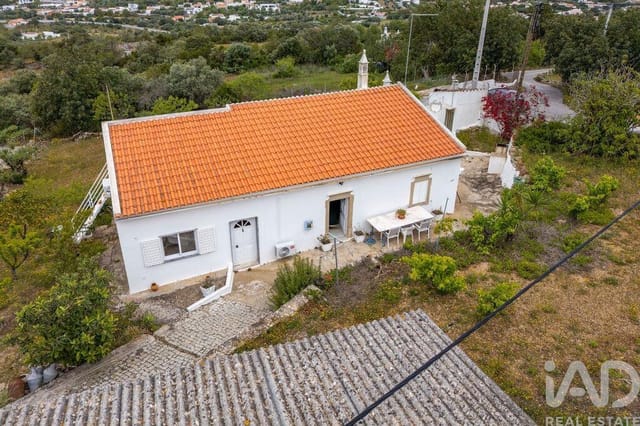
Main house with sea view

The first thing you notice on a summer morning here is the silence — then, slowly, the birdsong fills it. Standing on the front deck of this 89-square-metre house in Norra Rörvik, coffee in hand, the only interruption is the occasional creak of a boat rope from the jetty at the bottom of the path. That jetty is a two-minute walk away. This is the kind of detail that changes how you spend your summers. Set on an elevated 2,010-square-metre plot at the end of a quiet cul-de-sac on Höjdviksvägen, the house sits above its neighbours just enough to offer a sweep of the surrounding landscape without sacrificing the sense of being tucked into the trees. The elevated position isn't just about views — it means genuine privacy, the sort that's hard to find anywhere near the Stockholm archipelago without spending twice as much. The interior is honest and well thought out. The open-plan living room and kitchen work together naturally — large windows pull the outside in, and on a clear day the light bounces around the room from mid-morning well into the evening. It's a space that works for a rainy October evening with board games and candles just as well as it does for a noisy midsummer dinner. The kitchen is properly equipped, not a weekend afterthought, and the dining area has room to seat a full table of guests without anyone bumping elbows. Three bedrooms cover the practical range: one genuine double room, and two smaller rooms that flex depending on who's visiting — kids, grandparents, a friend who always stays "just one night" and ends up staying three. One bathroom with a shower and a separett eco-toilet keeps things functional and low-maintenance, which matters when you're not living here full-time. And then there's the sa ... click here to read more
Exterior view of the house and garden

On a still Tuesday morning in Balen, the only sounds drifting through the kitchen window are birdsong and the faint ripple of water from the Vaart canal just beyond the garden fence. No traffic. No crowds. Just the kind of quiet that most people have to travel far to find — and here, it's simply the Tuesday morning. Driehuizen 101 sits on a wide, sun-filled plot of 1,093 square metres at the end of a dead-end street in one of Balen's most sought-after residential pockets. Built in 2022, this is not a renovation project or a "full of potential" euphemism. It's genuinely move-in ready, finished to a high standard, with an A+ energy label and 24 rooftop solar panels feeding into a home battery system that keeps the electricity bills remarkably close to zero. In an era when energy costs dominate every property conversation across Europe, that's not a footnote — it's a headline. Step inside and the ground floor opens into a living and dining area that faces the garden. Large windows pull the green of the plot right into the room; late afternoon light comes in low and golden in the summer months and on winter weekends the place still feels alive with natural brightness. The kitchen runs along one wall with quality appliances and storage that's been thought through properly — deep drawers, a full-size oven, the kind of setup where you can actually cook rather than just heat things up. Two terraces extend from the ground floor, one catching the morning sun, the other shaded by early evening. Pick your mood. Upstairs, the three bedrooms all overlook the surrounding greenery. None of them feels like a compromise. The main bathroom has a double washbasin, a walk-in shower, and finishes that lean toward considered rather than sho ... click here to read more
Front view of Driehuizen 101

Stand at the upstairs window on a clear evening and the Atlantic stretches out ahead of you, Gigha sitting low on the horizon, the dark shapes of Islay and Jura beyond it, and the sky doing something extraordinary in shades of amber and deep violet that no filter could replicate. This is what westward-facing Scotland does at dusk. And it does it every single night from Crubasdale Lodge. Crubasdale Lodge is a substantial Georgian-Victorian stone house at the northern edge of Muasdale, a quiet village on the A83 that most people drive through on their way somewhere else. That's their loss. The Kintyre Peninsula is one of those places that rewards the people who actually stop—properly stop, unpack, breathe the salt air, and stay a while. Eight bedrooms, four bathrooms, over 4.5 acres of mature grounds, a detached three-bedroom annexe, a timber cabin, a Victorian walled garden, stone outbuildings, and a private sandy beach that comes with the title deeds all the way to the high water mark. Properties like this don't appear on the market often. When they do, they tend to go quietly and quickly to people who recognize what they're looking at. The house itself was originally built as a hunting lodge, and that heritage shows in the bones of the place. Stone walls under a slate roof. An impressive staircase rising through the central hall. A marble fireplace in the drawing room beside a wood-burning stove that, on a January evening when the rain is coming in off the Atlantic and the wind is up, becomes the single most important thing in the building. The proportions are generous throughout—rooms with height and light, windows positioned to catch the views. Someone designed this with intention, and that original thinking still h ... click here to read more
Front view of Crubasdale Lodge

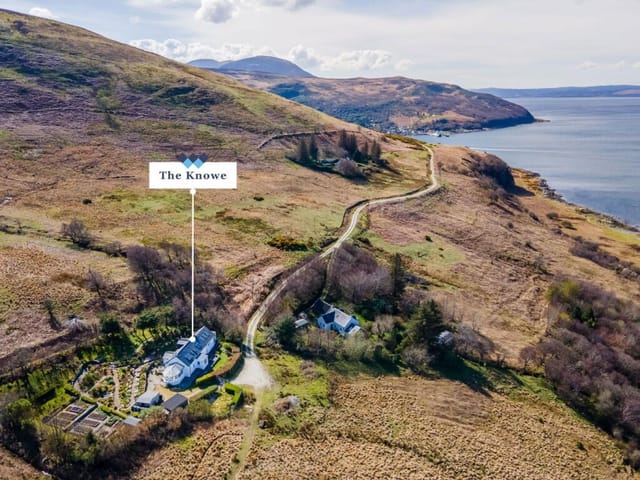
Stand in the dining kitchen on a clear October morning and you can watch the light change over the Kilbrannan Sound in real time — the water shifting from steel grey to deep cobalt as the clouds roll off the Kintyre hills. The skylights above you let in a shaft of pale Scottish sun. The log burner is going. There's coffee on. This is not a fantasy version of island life. This is just a Tuesday at The Knowe. Set at the northernmost tip of the Isle of Arran, on a narrow track shared with only a handful of neighbours, this three-quarters-of-an-acre property was once a working croft. It's been transformed over time into something genuinely rare: a three-bedroom home that delivers serious architectural quality without losing the soul of its rural setting. The conversion has been done with care — double-height ceilings in the kitchen, handsome wood-fronted cabinetry with granite work surfaces, hardwood flooring in the sitting room, and not a single gesture that feels out of place against the backdrop of open hillside and churning sea. The views deserve their own paragraph. From the sitting room, the conservatory, the garden room at the gable end, and both upstairs bedrooms, you're looking out across the Kilbrannan Sound toward Loch Fyne and the upper Firth of Clyde. The principal bedroom has a Juliet balcony, and on still evenings in late spring you'll hear seals calling from the rocks below. Golden eagles are a regular sight on the hill behind. This is not the kind of wildlife encounter you plan — it just happens, because you live here. Inside, the layout has been thought through for people who actually use a house rather than just look at it. The boot room at the entrance is exactly right for a property like this — somewh ... click here to read more
Front view of The Knowe

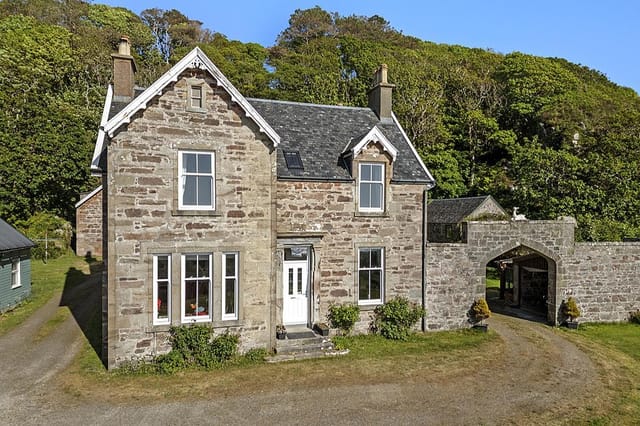
Step outside on a October morning at Arrlochaira and you'll hear the River Garry rushing through the gorge below before you even open the front door. The light at this hour — filtered through ancient birch and oak — turns the garden silver. It's the kind of quiet that people from Edinburgh and London spend years searching for, and here it's simply Tuesday. Killiecrankie sits in one of the most dramatic river valleys in highland Perthshire, sandwiched between steep wooded crags that the National Trust for Scotland has protected for decades. Pitlochry, just a few minutes' drive south along the B8019, has a proper railway station on the Highland Main Line — direct trains to Edinburgh in under two hours, Glasgow in roughly the same. That combination of genuine wilderness and actual connectivity is rarer than you'd think in Scotland, and it's a big part of why this corner of Perthshire has quietly become one of the most sought-after second home markets north of the border. Arrlochaira itself is a four-bedroom detached villa with three bathrooms, set in private garden grounds that roll out to a backdrop of mature trees. The architecture does something that a lot of modern Scottish houses don't bother attempting: it goes vertical. Vaulted ceilings in the main living areas create an almost Scandinavian sense of volume, and the floor-to-ceiling windows pull the outside in regardless of the season. On a grey February afternoon, when the hills are dusted white and the birch branches are bare, those windows frame something that honestly looks like a painting. In summer, the French doors off the living room open onto the lawn and you barely notice where the house ends and the garden begins. The living room anchors the ground floor ... click here to read more
Front view of the villa

You wake up on a Saturday morning in July, coffee in hand, and step out onto the covered veranda. The air smells of cut grass and pine. Somewhere down the lane, a neighbour is dragging a kayak toward the water. The sea is 850 metres away. You could be there in ten minutes — or you could sit right here, do absolutely nothing, and count that as a perfect morning too. That's the particular pleasure of this two-bedroom holiday home at Björnösund södra 2G in Norrtälje. It's not trying to impress you. It just quietly delivers everything that makes a Swedish summer house worth having. The property sits on a generous 2,032-square-metre plot that feels like it belongs to another era — mature fruit trees, thick hedging that keeps the outside world outside, wide lawns that are made for barefoot afternoons and long Midsummer evenings. The main house comes in at 77 square metres, which sounds modest until you're actually in it and realise the open-plan kitchen and living room have been arranged in a way that makes the space work harder than its footprint suggests. There's a dining area, a proper sofa corner, and a fireplace that becomes the gravitational centre of the room the moment October rolls in and the archipelago wind picks up. A set of doors leads straight off the living room onto the veranda — covered, so you can eat outside even when the weather is being difficult, which in this part of Sweden it occasionally is. Two bedrooms in the main house, a full bathroom with shower, and then the real surprise: a large family room that can be split into one or two additional sleeping spaces depending on how many people you've invited for the weekend. And you will invite people. That's the thing about a place like this — the layout ... click here to read more
Exterior view of the house and garden

Step outside on a February morning and the world is white and silent except for the crunch of your boots and the distant hiss of skis on groomed snow. The cross-country trails are literally 100 metres from your front door. You can smell coffee still brewing in the kitchen. This is what owning a mountain chalet in Eggedal actually feels like — and once you've had a taste of it, a standard hotel weekend never quite cuts it again. Sitting at 861 metres above sea level in the Haglebu recreational area of Numedal, this three-bedroom timber chalet at Nedre Åsseterlia 14 is the kind of property that gets passed down through families. The 80-square-metre layout is honest and unfussy — wooden-panelled walls, exposed ceiling beams, a cast-iron fireplace that does serious work on cold evenings. Nothing is trying too hard. It just works. The living room catches the mountain light in the afternoon, and the large windows frame views that shift with every season — deep pine green in July, flame-orange birch in September, and that particular blue-white silence of a Norwegian winter. The open-plan kitchen connects directly to the living space with a bar-counter setup, which means whoever's making the reindeer stew or the Saturday waffles doesn't miss the conversation. Pine cabinetry, solid wood countertops, a dishwasher — practical without being clinical. Three proper bedrooms give the place real versatility. The master fits a double bed comfortably, and the two additional rooms are set up with bunk beds — genuinely useful when you've got kids or a group of friends along for a ski weekend. Above the entrance hall, a loft accessed by a fixed ladder provides extra sleeping capacity, bringing the total to around eight people. The bathroo ... click here to read more
Welcome to Nedre Åsseterlia 14!

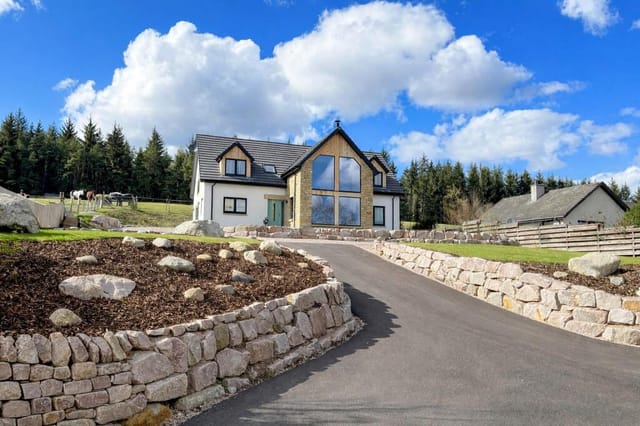
Step outside on a frost-edged October morning, coffee in hand, and there they are—the Cromdale Hills stretching wide across the horizon, catching the first pale light of a Highland dawn. This is what greets you from the south-facing terrace at Cath Ann, a newly completed architect-designed house on Skye of Curr Road in Dulnain Bridge, just minutes from Grantown-on-Spey. Built in 2025 and finished to a standard that genuinely impresses rather than merely ticks boxes, this is not a holiday property cobbled together for the rental market. It was built to live in—properly. The house sits within roughly 0.3 acres of thoughtfully landscaped grounds, framed by pink granite retaining walls cut from the nearby Alvie quarry. That detail matters. The stone doesn't feel imported or decorative—it belongs here, rooted in the same geology that defines the whole upper Spey valley. The sweeping tarmac driveway opens to a generous gravelled turning area, and the elevated plot means that even from the car, you get that first hit of open sky and rolling moorland that makes the Cairngorms feel different from anywhere else in Britain. Inside, the 182 square metres are organised around a dramatic double-height sitting room—the kind of space that makes you pause the first time you walk in. A HWAM Danish wood-burning stove anchors the room, and floor-to-ceiling glazing pulls the landscape indoors so convincingly that on grey November afternoons, when the hills disappear into low cloud, the room still feels alive. Kahrs premium oak flooring runs underfoot, and the glazed balustrade of the first-floor landing hovers above, catching light from the Velux windows that punctuate the upper level. It's an architectural move that gives the whole interi ... click here to read more
Cathann Skye Of Curr

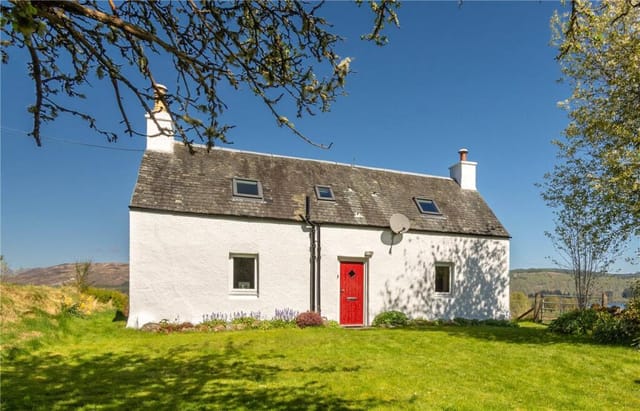
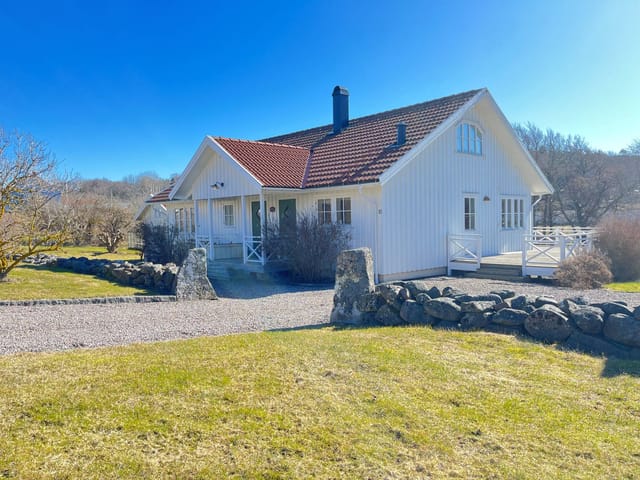
Stand at the garden room window on a still October morning and the whole of Loch Rannoch stretches out before you — pewter-grey water, ancient Scots pines crowding the far shore, a pair of red squirrels working the apple tree twenty feet away. No road noise. No neighbours in sight. Just the kind of silence that takes a few days to truly settle into, the kind most people only read about. East Camghouran is a two-bedroom stone cottage perched on the elevated southern shore of Loch Rannoch in Highland Perthshire, and it has been quietly earning its keep as a much-loved family escape and proven holiday let for nearly three decades. The whitewashed walls and slate roof are the kind of honest Scottish vernacular that looks like it grew out of the hillside, because in a sense it did — this was once a working shepherd's cottage, and the bones of the place carry that history without making a fuss about it. Step inside and the character hits you immediately. Wooden latch doors. Original period fireplaces. The sitting room opens to an adjoining garden room with floor-to-ceiling glazing that frames the loch and the hills beyond like a painting that changes every hour. On winter evenings the dining room Charnwood dual-fuel stove throws enough heat to warm the whole ground floor, and the light from the flames bouncing off whitewashed walls is something that photographs simply cannot capture properly. The modern fitted kitchen and utility room with direct garden access are practical without being characterless — someone has thought carefully about how this cottage actually gets used, not just how it looks in listing photos. Upstairs, two well-proportioned double bedrooms share a family bathroom with both a bath and a shower. The gro ... click here to read more
Front view of East Camghouran

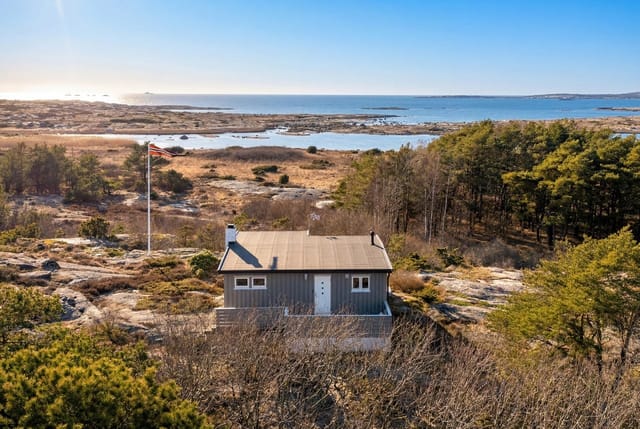
Step out of the boathouse on a July morning, coffee in hand, and the Mefjorden is already glittering. Two piers jut into calm water, a small wooden rowboat knocking gently against the dock. The sandflies haven't woken up yet. This is what you came for. Øyaveien 30 sits at the quiet end of a lane on Østerøya, one of Sandefjord's most established coastal retreats, and it delivers something increasingly rare along the Norwegian Vestfold coast: a full estate — main cabin, annex, boathouse — on a flat 2,009-square-meter plot that runs all the way down to its own sandy beach. South-facing, sun-drenched from mid-morning until the sky turns pink, the property looks out over a scattered panorama of islets and skerries that changes mood with every weather system rolling in from the fjord. The main cabin has the bones of a place that's been genuinely loved. Pine floors, painted wooden doors, traditional wooden interiors — nothing here is trying to be a Scandinavian showroom. The living room is divided into natural zones: a long dining table on one side, a deep sofa arrangement around a fireplace insert on the other. On a cool September evening with the fire lit and the windows fogged from dinner, it feels exactly right. The kitchen is properly functional — solid wood countertops, serious storage, freshly painted walls and ceiling in 2022 that give the space a lighter, more current feel without erasing its character. Access to a crawl-space hatch in the floor adds practical storage for the kind of gear that accumulates when you live a life on the water. Four bedrooms across the main cabin and annex handle a full family or a rotating cast of guests without anyone feeling squeezed. A ground-floor bedroom in the main cabin sits next ... click here to read more
Welcome to Øyaveien 30! Photo: Mille Gran

Stand at the corner window of the master bedroom on a clear October morning and you can see all the way across the Firth of Clyde to the Ayrshire coast, the water shifting between slate and silver depending on where the clouds break. That view doesn't get old. Not after a week, not after a decade. It's the kind of thing that makes you set down your coffee and just stand there for a moment longer than you planned. Helenslea is a substantial six-bedroom detached villa in Whiting Bay, built around 1926 and sitting in approximately half an acre of mature, mostly level garden on the Isle of Arran. It has the bones of a genuinely grand island house — original timber staircase, an open brick fireplace in the entrance hall, period features throughout — combined with the kind of practical updates that make it liveable year-round rather than just a summer indulgence. Three bathrooms, a second staircase serving bedrooms five and six, and a layout that can flex into a self-contained wing if you want it to. This is not a fixer-upper. The property is in good condition and, with some furnishings available by separate negotiation, could be up and running as a vacation home or holiday let almost immediately. The ground floor sets the tone. You come in through the entrance porch — red quarry tiled floor, plenty of hooks and storage for waterproofs and walking boots, which you will absolutely need — and into a wide hallway anchored by that open fireplace. To the front, the main lounge stretches across the width of the house, windows facing the gardens and the sea beyond. On grey afternoons you light the open fire and the room becomes exactly what a Scottish island living room should be. The dining room sits off the hallway, overlooking t ... click here to read more
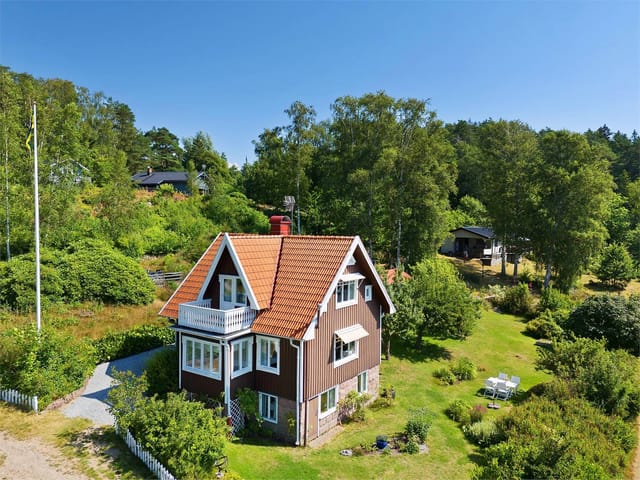
Aerial location

Step out onto the upper terrace on a Saturday morning and the Svelvikstrømmen is already alive. A kite surfer carves a long arc across the steel-blue water. A fishing boat putters south. The fjord smell — salt, pine, cold stone — drifts up through the open window above the kitchen sink, and you're standing there with coffee, wondering why you ever lived anywhere else. That's the thing about this chalet on Voldenveien 61B in Klokkarstua. It doesn't perform. It just delivers. The property sits right at the fjord's edge in the Verket district, a low-key stretch of Røyken municipality where the summer crowd knows what they've found and mostly keeps quiet about it. One bedroom, one bathroom, 74 square metres of well-considered interior space — and then roughly 90 square metres of terraces wrapped around the cabin at different levels, designed so you can chase the sun from morning to dusk without ever leaving your own plot. It's a compact footprint that lives much larger than the numbers suggest. The chalet is in good condition throughout. Walk in through the entrance hall and you immediately notice how much natural light the place holds — large windows face the fjord, and on clear days the view straight across the water to the opposite shore is the kind of thing that makes people stop mid-sentence. The open-plan living room and kitchen occupy the main floor, and the fireplace in the corner changes the whole character of the room once autumn rolls in. Birch logs crackling while rain crosses the fjord in grey curtains — that's October here, and it's genuinely worth experiencing. The kitchen is properly fitted: profiled cabinetry, stone side panels, a laminated countertop, ceramic cooktop, oven, full-size fridge, and a dishw ... click here to read more
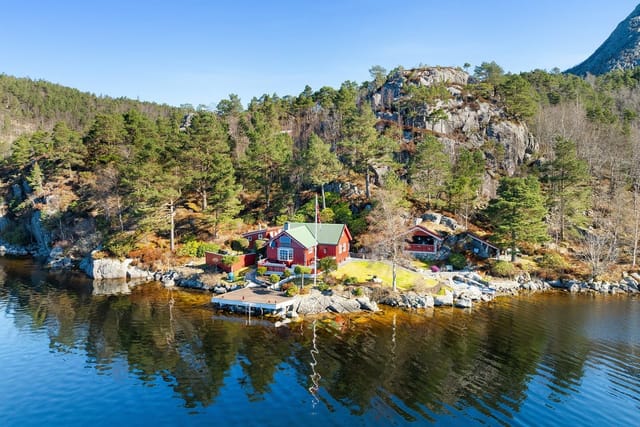
Welcome to Voldenveien 61B! Photo: Trond Flesaker. Taken in August 2025.