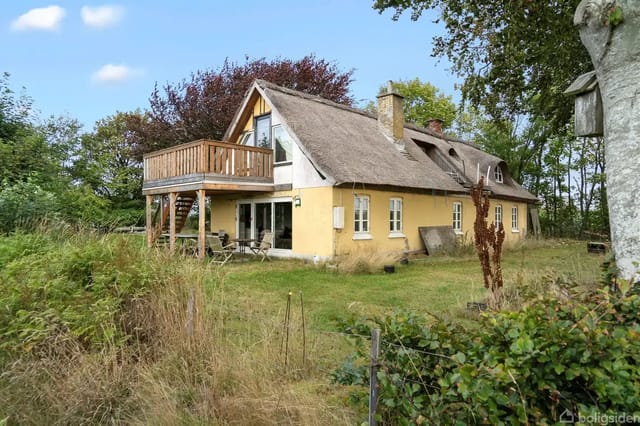
Stand in the garden at Overmark 4 on a July evening, the air carrying the faint sweetness of cut hay from the cornfield next door, and you start to understand why people fall hard for this corner of northern Jutland. The silence is almost physical. No traffic hum, no sirens—just swallows cutting arcs above the thatched roof and the occasional tractor somewhere far off on the Hannæs peninsula. This is the kind of quiet you can't fake, and it comes attached to a 138-square-metre, four-room Danish farmhouse that has just had its most important feature replaced: a full, brand-new thatched roof that will last decades and sets the tone for everything a new owner can do here.
The house dates to 1880, and you feel it the moment you walk through the door. Not in a damp, discouraging way—but in the way old Danish rural buildings carry a certain honesty in their bones. The kitchen still has its white-painted wooden cabinets, a timber countertop, and a low wooden ceiling that practically asks for copper pots and the smell of something slow-cooking. A hallway with a staircase leads you deeper into the floor plan, and what you're really looking at is a blank canvas of 138 square metres on a 1,167-square-metre plot, four flexible rooms, one bathroom, central heating, and supplementary solid-fuel stoves for those months when a Jutland gale decides to announce itself. The interior needs work—there's no softening that truth—but the bones are solid, the roof is done, and the structural conversation has already been started for you.
Outside, the lot is generous and private. Mature trees ring the garden, the grass is wide open, and the field views give you that sense of borrowed landscape that money can't really buy in most of Europe. A ut ... click here to read more