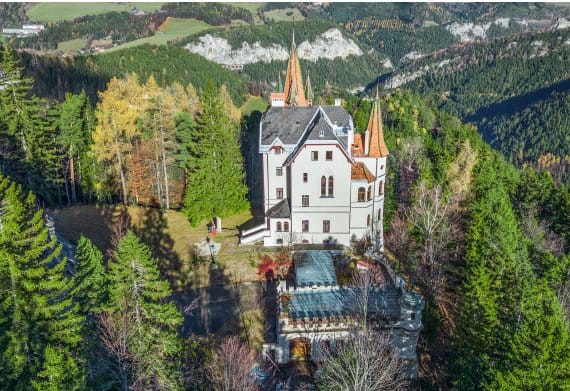
Stand at the top of the observation tower on a clear October morning and the Alps lay themselves out before you like a relief map — the Rax to the east, the Schneeberg to the north, the Hirschenkogel ridge close enough that you can almost pick out the ski runs. Below, 12 acres of forested Pinkenkogel hillside belong entirely to you. No neighbors visible. Just conifers, mountain air, and the faint sound of a train working its way up the world's first mountain railway in the valley. This is Silbererschlössl, and it is unlike anything else on the Austrian property market.
Built in 1894 for Victor Silberer — a man who was a journalist, a politician, an entrepreneur, and one of Austria's earliest champions of organized sport and tourism — the castle was never meant to blend in. While the rest of Semmering was filling up with graceful country house villas, Silberer commissioned something deliberately medieval. The eastern round tower with its four neo-Gothic bay windows pulls the eye immediately, its silhouette drawing comparisons to Neuschwanstein, though this one sits on an Austrian mountain at 985 meters elevation rather than behind a Bavarian lake. The 1896 Neo-Renaissance wrought-iron gate on the main road announces the estate before you've even turned up the private driveway.
Inside, the scale shifts from impressive to genuinely extraordinary. The marble staircase is carved from Istrian stone and finished with a wrought-iron railing — the kind of craftsmanship that simply doesn't get commissioned anymore. The vestibule and Great Hall carry stained glass windows painted by Rudolf Geyling, the Viennese artist, dating to 1893 and 1894. Natural light filters through them in the afternoon in colors that move across the ston ... click here to read more