Houses For Sale In Europe (page 4)

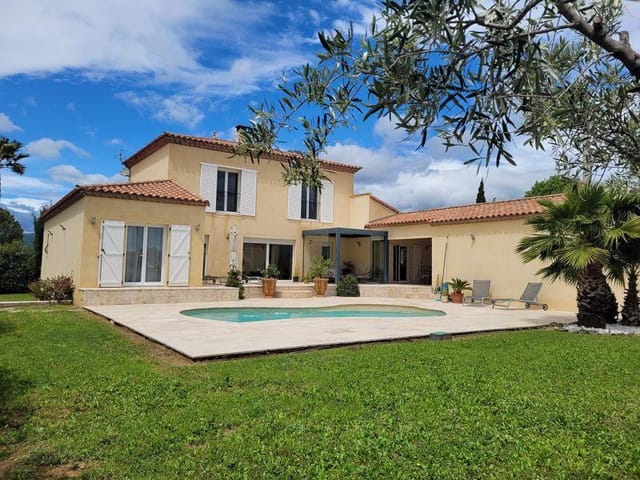
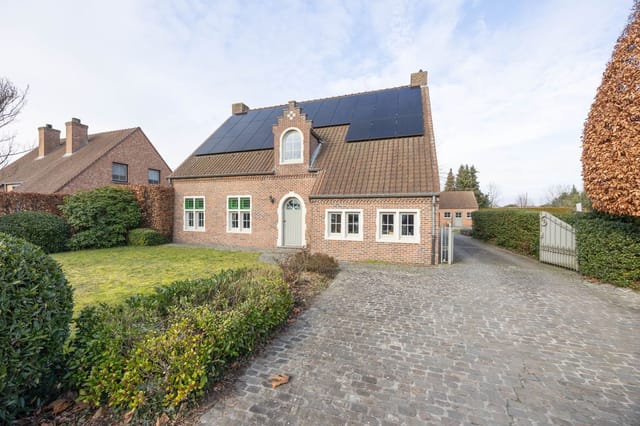
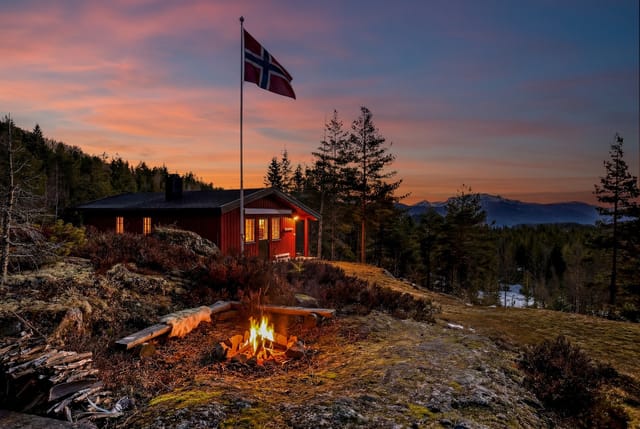
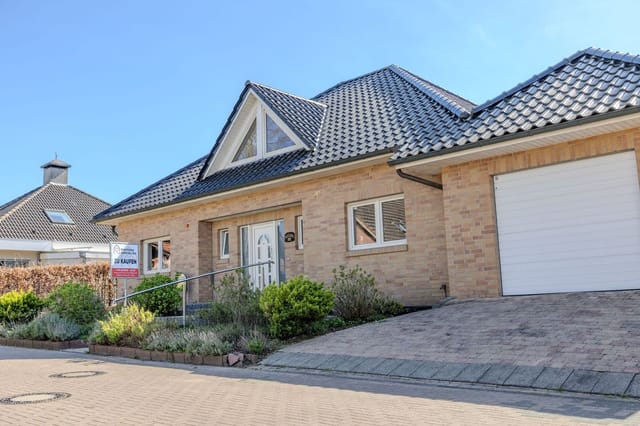
Houses for sale in europe - homestra offers the largest amount of european real estate with over 200,000+ properties, find any type of property within your budget from villas to country homes. buy or rent your perfect home in europe. (page 4)

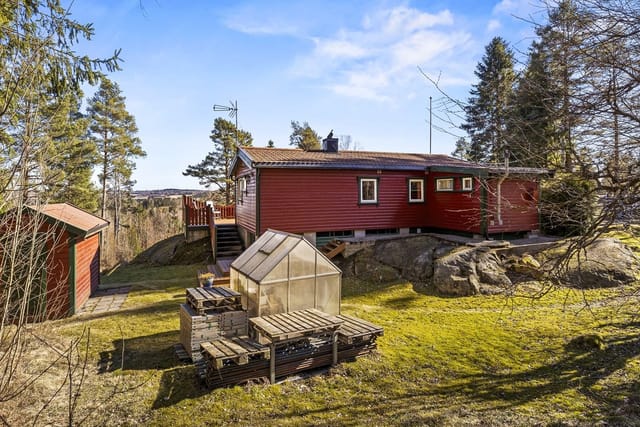
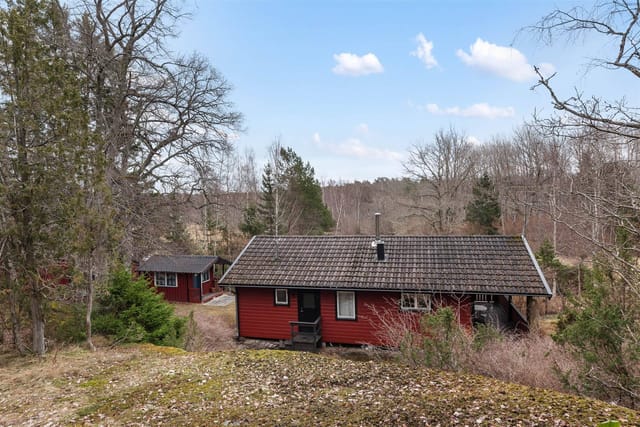
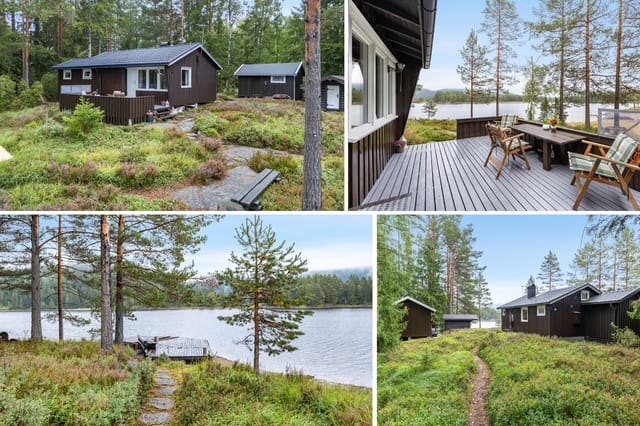
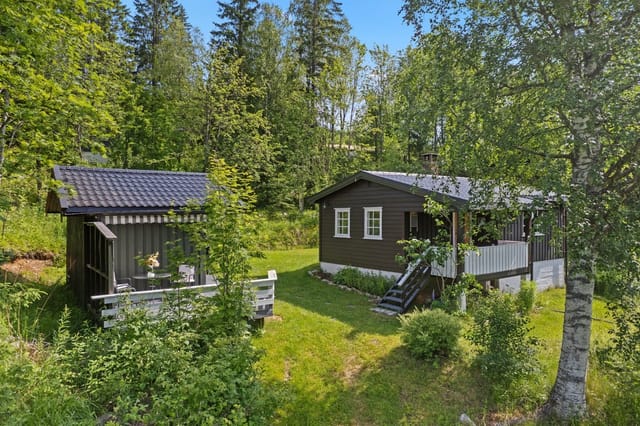
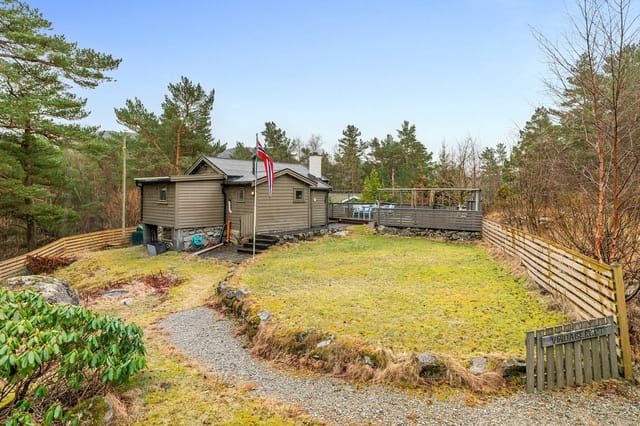
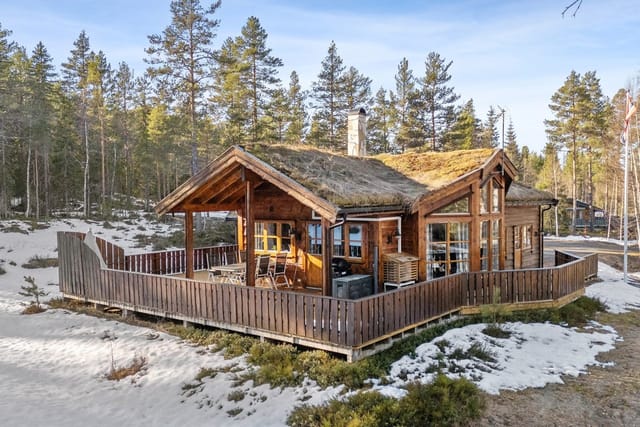
Saturday morning at Fossumskogen 34. Coffee steam curls up from a mug on the wide terrace railing, the forest is absolutely still except for a woodpecker working somewhere in the birches, and the only thing on your agenda is deciding whether to lace up your trail shoes or stay right here a little longer. That's the daily reality of owning this two-bedroom cabin in Spydeberg — and honestly, staying put wins more often than you'd expect. Built in 1970 and kept in genuinely good shape over the decades, this 64-square-metre cabin sits in the well-established Fossumskogen cabin community in Østfold county, roughly an hour's drive south of Oslo. It's the kind of place that feels immediately familiar the moment you step through the door — wood-panelled walls, solid pine floors, a cast-iron wood-burning stove glowing orange in the corner of the living room. The smell of birchwood smoke on a cold October afternoon is something you simply don't forget. The layout is straightforward and honest. The combined living room and kitchen sits at the heart of the cabin, with large windows that frame the tree line and flood the space with afternoon light. The kitchen comes fully equipped — stove, microwave, refrigerator — so you're cooking dinner on your first evening, not making trips to a big-box store. The master bedroom has built-in storage that actually solves the "where does everything go" problem, while the second bedroom runs a bunk bed setup that children treat like the best possible upgrade over their room at home. One full bathroom with a shower rounds things out, along with a practical Porta Potti arrangement that's standard for Norwegian leisure cabins and keeps operating costs low. Then there's the terrace. Sixty-seven squa ... click here to read more

Welcome to Fossumskogen 34 - presented by Nordvik Ski og Ås v/Silje Byman

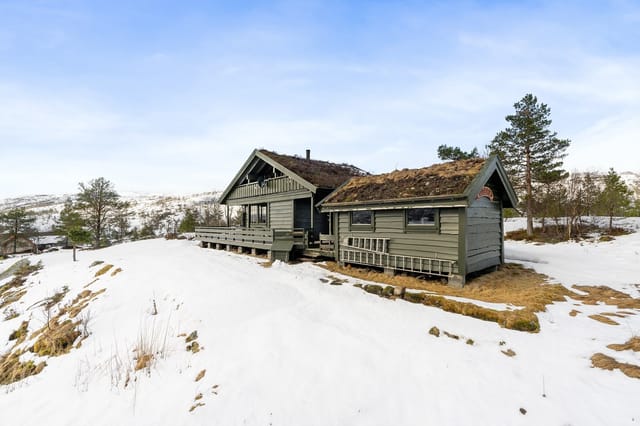
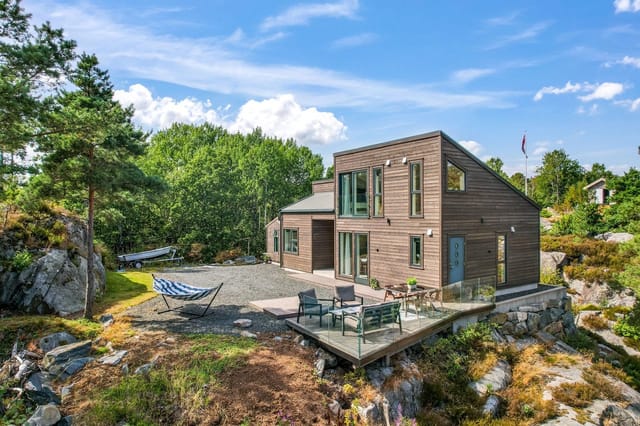
Step outside on a Saturday morning in July and the lake is already catching the early light, Mosvatnet glinting below Gullingtoppen while the air carries that particular Norwegian sharpness that no amount of city living can replicate. That's what waits at Osahaugvegen 78. Not a postcard version of Norway — the real thing. Sitting at 534 metres above sea level in the Gullingen area outside Sand, Rogaland, this four-bedroom chalet has been someone's beloved retreat since it was built in 1998. It shows in the best possible way: maintained consistently, sold fully furnished, and ready to walk into without a single weekend spent at a hardware store. For international buyers looking at vacation homes in Norway, that matters more than almost anything else. The layout is smart for a group. Downstairs, a generous living room opens straight into the kitchen — no wall between cooking and conversation, which is exactly how it should be when you're feeding eight people after a long day on the trails. Two bedrooms sit off the main floor, and the loft upstairs holds two more, giving four bedrooms total. Sixteen years ago the bathroom got a proper renovation — tiled floors, updated fixtures — and it still holds up. The wood-burning stove anchors the living room, and on a wet October afternoon when the clouds have dropped around Mosvatnet, getting that fire going and cracking open a bottle of local cider from the Ryfylke region is the kind of simple pleasure that reminds you why you bought a mountain cabin in the first place. That 52-square-metre terrace is the real heart of summer life here. It's not just a deck — it's a proper outdoor room. Big enough to run a long dining table, a pair of sun loungers, and still have space for the k ... click here to read more

EiendomsMegler1 v/ Henrik Lauvsnes presents Osahaugvegen 78. Photo: Eivind Dirdal

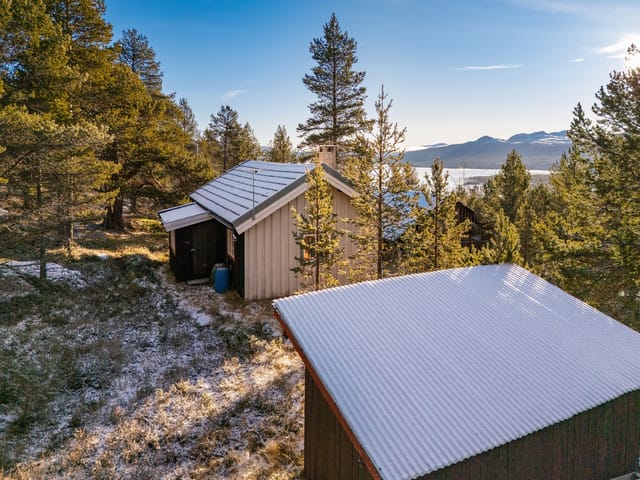
Stand on the porch at Utsikten 121 on a clear September morning and you'll understand immediately why someone named this road "The View." To the southwest, Sveinsnuten's ridge cuts a clean line against a sky that turns impossibly pink at dawn. Gjøranset stretches out below. And somewhere beyond the treeline, the animals at Langedrag Nature Park are already awake before you've made your coffee. This is Tunhovd. Not a postcard version of Norway — the real one. Quiet enough to hear the wind moving through birch trees. Wild enough that moose tracks appear in the snow outside the woodshed some mornings. And just connected enough, with mains electricity and a road you can actually drive year-round, to make it genuinely liveable rather than just pretty. The chalet itself sits on close to 8,000 square meters of gently sloping natural terrain — nearly two acres of south-facing land that soaks up sun from mid-morning until the last light fades. The plot is one of those rare ones where you can set up a lawn chair in three different spots depending on where the sun is, and none of them feel cramped. There's room for a kitchen garden, room for children to disappear into the trees for hours, and room to simply do nothing — which, in Norway, is practically a cultural institution. Inside, the cabin follows the traditional Norwegian hytte layout that has worked for generations: entrance hall to knock the mud off your boots, a separate kitchen with enough counter space for serious cooking, a living room generous enough to fit the whole family around a table, and two bedrooms that between them sleep six people comfortably. The loft — an 8 sqm hems above — adds a little extra for overflow sleeping or the kind of afternoon nap that only h ... click here to read more

Utsikten 121 presented by Mekleriet via Tobias Røang. Photo: Terje Bjørnsen.

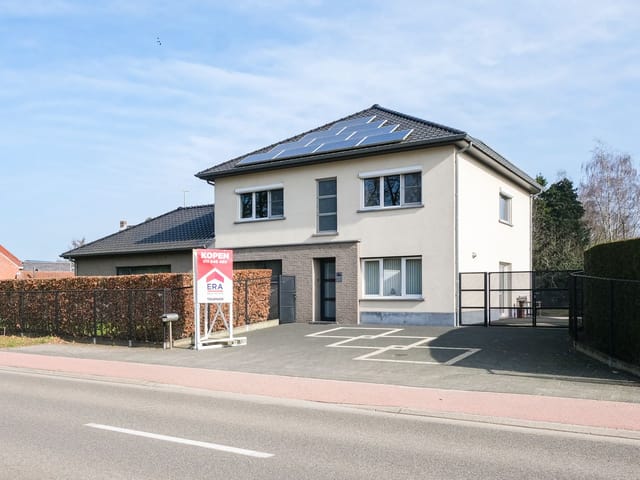
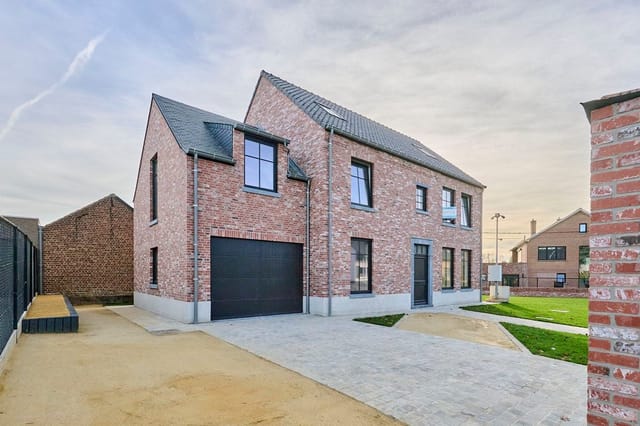
Saturday morning in Eksel starts with the smell of fresh bread drifting from the bakery two doors down on Marktplein. You open the living room's large windows, let the village sounds in — a cyclist ringing a bell, the low hum of conversation at the café terrace — and pour a coffee before anyone else in the house is awake. That quiet, unhurried rhythm is what makes this address so hard to walk away from. Marktplein 17 sits directly on Eksel's central square, which sounds like it should be noisy, but isn't. This is a Flemish village of about 4,000 people in the Limburg province, part of the broader Kempen heathland region — flat, forested, and fiercely underrated as a base for anyone seeking real Belgian countryside life rather than a postcard version of it. The house itself is a solidly built detached property, originally constructed in 1954 and put through a thorough renovation in 2010 that brought everything up to a genuinely modern standard. At 272 square meters of interior space on a 1,033-square-meter plot, it's one of the larger private homes on the square, and it shows. Inside, the scale hits you immediately. The entrance hallway is wide and welcoming — not the narrow corridor you often find in Belgian village homes of this era. It opens into a living room where a built-in gas fireplace anchors the space. On rainy November afternoons, and there will be rainy November afternoons in Limburg, that fireplace earns its place. The room gets light from generous windows that look out toward the square; you catch the weekly market stalls being set up on Friday evenings, the brass band rehearsing in the community hall across the way in spring. There's a particular pleasure in being at the center of a village's small, relia ... click here to read more

Photo 1 of Marktplein 17

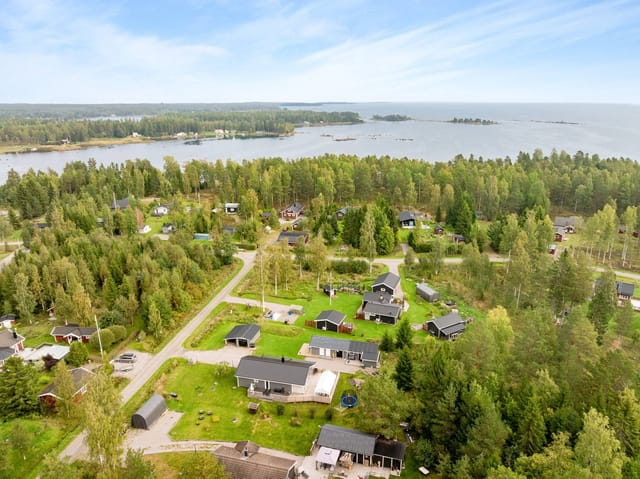
Step outside on a July morning and walk 300 meters through the trees in your bathrobe. That's how close Lake Kolmaren is. The water is clear, the dock is quiet, and you're back at the kitchen table with coffee before anyone else in the house has stirred. This is the kind of thing that happens when you own a place on Boängsvägen in Spillersboda — and it happens every single day you're here. The house sits at the end of a cul-de-sac in the Frötuna-Spillersboda area of Norrtälje municipality, roughly an hour north of Stockholm by car or SL bus. It borders a public green area on one side, which means no future neighbor crowding in. The plot runs to 2,262 square meters — a generous spread by any measure — and it moves through the property in layers: a southwest-facing terrace catching afternoon sun, flat grass wide enough for a proper game of kubb or badminton, then rocky outcrops that push up through the ground and form natural sheltered spots where you can sit with a book without anyone finding you. The apple trees are old and reliable. Currant bushes produce more than any one family can eat. In August, you'll find wild blueberries and lingonberries along the forest edge without walking more than a few minutes. Come September, the same forest throws up kantareller — chanterelles — in quantities that make you wish you'd brought a bigger basket. Lilacs bloom hard in May and fill the downstairs rooms with scent when you leave the windows open. Inside, the house is 64 square meters across three bedrooms, which is compact but genuinely well-used. The living room has a soapstone wood-burning stove — not a decorative one, a real working heat source that makes late-October weekends here entirely viable. Large windows look out ov ... click here to read more

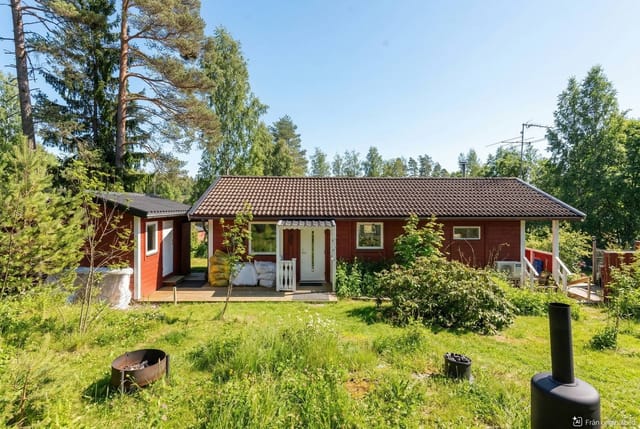
Front view of the house and garden

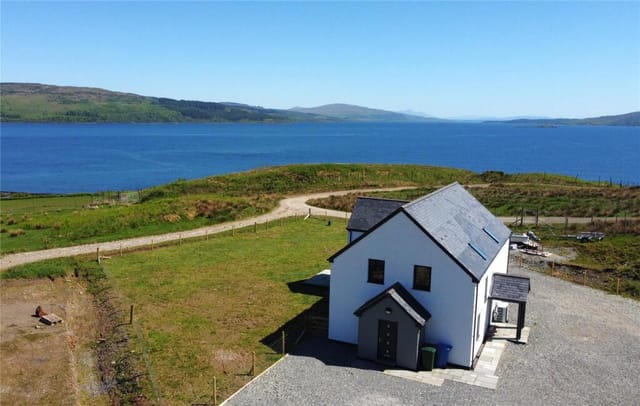
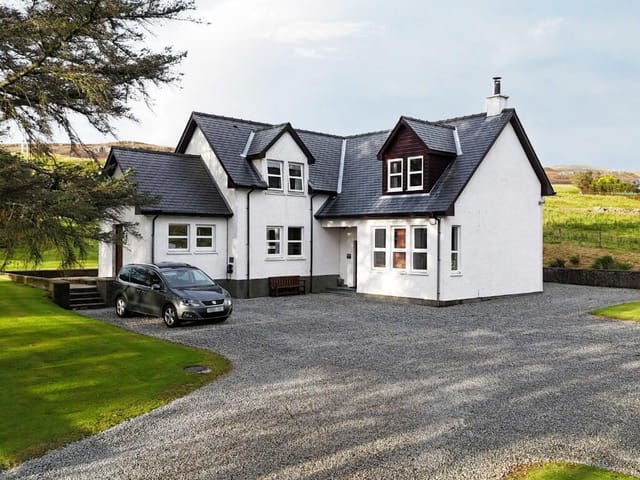
Stand at the front of this house on a clear October morning and the view does something to you. Across the Sound of Mull, the Morvern Peninsula sits grey-blue and enormous, the kind of landscape that makes you feel both very small and very lucky. A buzzard circles above the hillside behind. The kettle is already on. Kinelvadon View is a four-bedroom contemporary detached house set on roughly half an acre of elevated ground between Craignure and Tobermory, on one of Scotland's most visited and genuinely wild islands. At 177 square metres, it's substantial — big enough for the whole extended family, roomy enough that teenagers and grandparents can each find their own corner without anyone feeling crowded. The house is in good condition and ready to walk into. No renovation project. No waiting. Just Mull, immediately. The open-plan ground floor is the social engine of the place. Kitchen, lounge, and dining area all flow into one another without walls chopping up the space, and the triple-aspect windows in the lounge pull light in from three directions. On a bright June afternoon, the room practically glows. The kitchen is built around dark cabinetry against white worktops — a combination that sounds simple but reads as genuinely sharp in person. Integrated hob, extractor, dishwasher, microwave, and oven are all in place, so arriving after a long ferry journey and cooking a proper dinner is actually manageable on day one. A ground-floor room off the hallway currently works as a home office with open views to the front — easy to reconfigure as a fourth bedroom for guests. Next to it, a contemporary shower room with strong tilework finishes the ground floor neatly. A side vestibule offers a second entrance, which anyone who ... click here to read more

Front view of Kinelvadon View

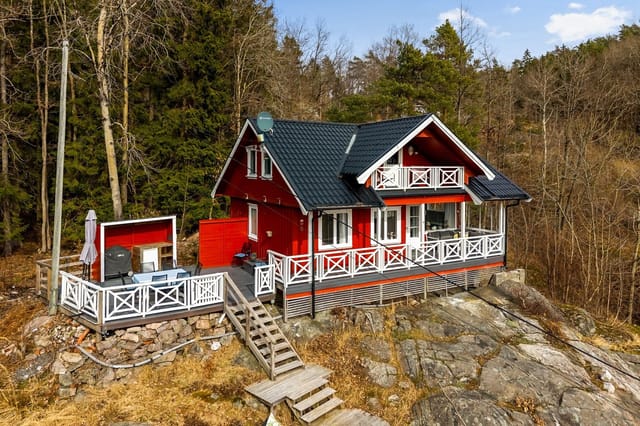
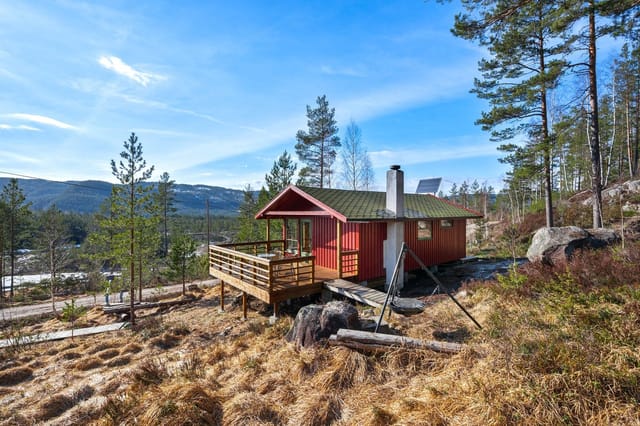
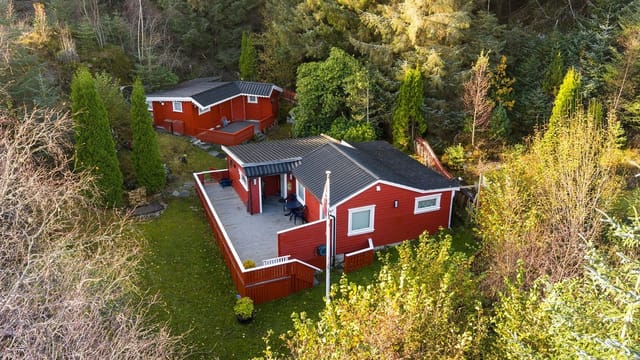
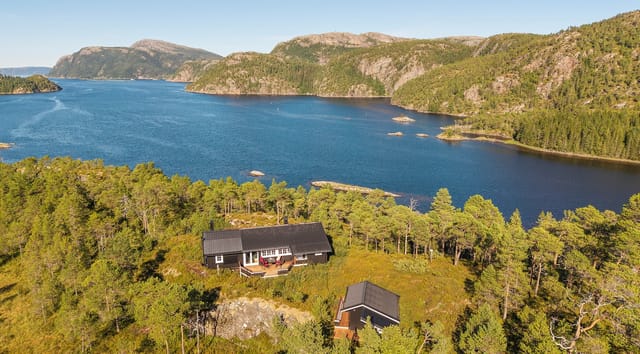
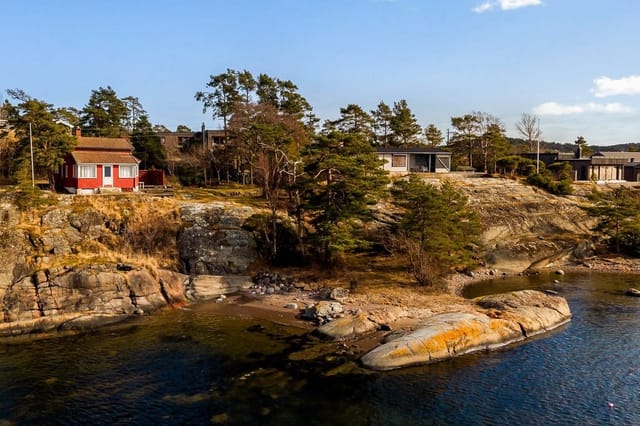
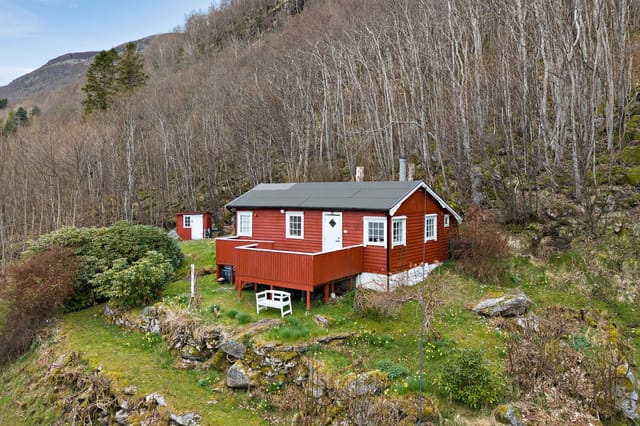
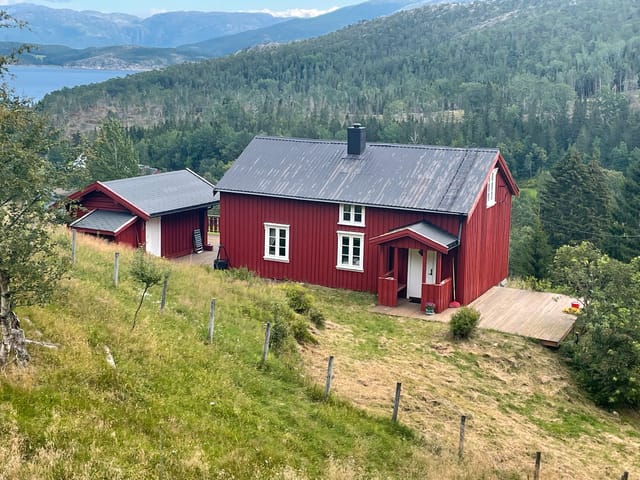
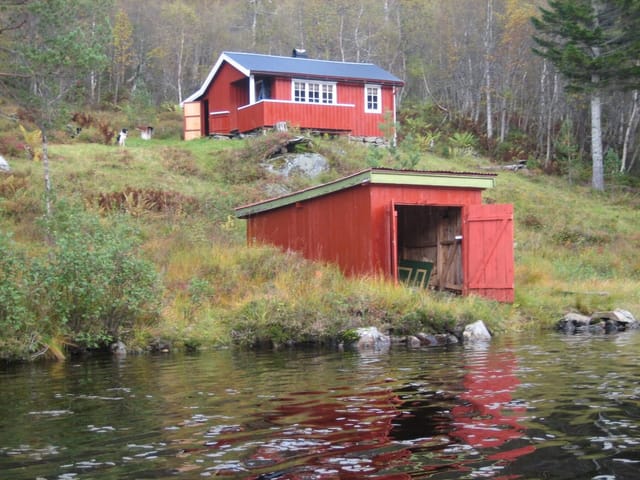
The first thing you notice, standing on the main terrace with a morning coffee in hand, is the light. Norwegian coastal light in July does something particular — it hits the water off Vågøy at an angle that turns the whole fjord silver, and you can watch it shift for twenty minutes without realizing that much time has passed. That's the kind of morning this chalet at Rønningstrandåsen 6 gives you. Regularly. Set on a gentle rise just south of Valle, this red-painted three-bedroom chalet sits alone on its own small hill, with an annex tucked just below. There's a genuine sense of remove here — no neighbors crowding the sightlines, no road noise cutting through the stillness — but the sandy beach is about a two-minute walk away and the village of Valle is close enough that a dinner run takes no planning at all. That combination is rarer than it sounds along this stretch of the Telemark coast. The chalet was built in 1965 and has been kept in good, well-maintained condition. It's not a renovation project. Walk in and it's ready for a summer season, which matters enormously when you're buying a second home and want to be swimming by the weekend of purchase, not project-managing a kitchen refit. The layout is compact and honest — 77 square meters across two floors, plus the separate annex — and every square meter pulls its weight. Downstairs, the living room is the kind of space that doesn't waste itself trying to impress. A comfortable sofa, a dining nook pressed right up against the window where you eat with the fjord view as a placemat. The kitchen opens directly onto the living area and has a back door leading out to a small secondary terrace — useful for early mornings when the main terrace is still in shade. Upstairs ... click here to read more

Secluded summer retreat. The red-painted cabin sits on a hill all by itself with an annex below.

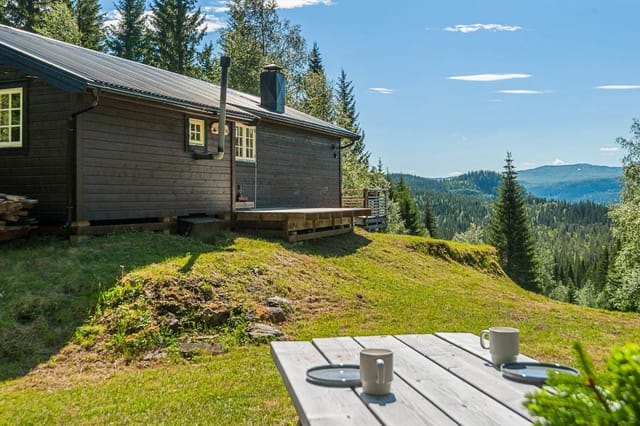
The first thing you notice on a clear morning at Kotsveien 219 is the silence — not the dead kind, but the kind that hums faintly with wind moving through spruce trees and the occasional call of a fieldfare somewhere up the ridge. Then the view hits you. A wide valley spreading out below, mountain flanks catching the early light, and nothing between you and all of it except a broad timber terrace and a cup of coffee going cold in your hand because you keep forgetting to drink it. This is Singsås. Not a name that appears on many tourist maps, and that's precisely the point. Sitting at 478 metres above sea level in the Gauldal region of Trøndelag, this three-bedroom Norwegian chalet sits on its own quiet plot along Kotsveien, a road that feels more like a suggestion than an artery. The cabin was built in 1973 — the era when Norwegian holiday architecture was all about function, orientation, and making the most of the terrain — and it shows in the best possible way. The structure faces the valley with a deliberate confidence, the kind of placement that took someone time and thought to choose. Every window is an argument for staying another week. At 59 square metres, this isn't a sprawling estate. It's a cabin in the truest Norwegian sense — a hytte — and that means the space has to earn its keep. The open-plan kitchen and living area does exactly that. Recent renovations have left the kitchen genuinely usable: gas stove, refrigerator, solar panels feeding the essentials off-grid. The fireplace anchors the living room and on an October evening when the temperature outside drops and the birch logs have been stacking up since August, that wood stove becomes the centre of gravity for everyone in the building. Three bedrooms ... click here to read more

Welcome to Kotsveien 219!

You wake up to the sound of nothing. Not silence exactly — there's the soft creak of timber warming in the morning sun, a woodpecker working somewhere deep in the spruce, and if you lie still enough, the distant trickle of water over rocks. The coffee is already on the wood stove. Through the big living room window, the forest stretches out in every direction, and the only thing you need to decide before noon is whether today is a hiking day or a fishing day. This is Risdalsveien 96. A compact, two-bedroom timber chalet set on a privately owned 858-square-metre plot in Mykland, just before the small community of Risdal in Froland municipality. Built in 1976 and kept in genuinely good condition, the cabin punches well above its 42 square metres — because so much of the life here happens outside. The veranda is where you'll spend most of your time in summer. Recently built, it adds a full 28 square metres of south-facing outdoor space directly off the living room, and in June and July the sun lingers on those planks until well past nine in the evening. Meals stretch on. Glasses are refilled. Kids disappear into the trees and come back muddy and grinning. The plot's elevation — around 222 metres above sea level — means the air has that particular freshness you can't manufacture, and on clear evenings the light turns the birch canopy gold in a way that makes you want to never look at a screen again. Inside, the open-plan living room and kitchen is genuinely practical rather than just theoretically cosy. A wood-burning stove anchors the space, and the large windows that pull in the surrounding landscape also mean you don't need artificial lighting until the evenings are quite far gone. Both bedrooms feature custom-built be ... click here to read more

Welcome to a cozy cabin on a privately owned plot in scenic surroundings with forest and hiking trails nearby

Step outside on a Saturday morning in July, coffee in hand, and watch the light hit the fjord-facing hillside from your south-facing terrace. The air carries that particular Norwegian coastal mix — salt, pine, and something you can't quite name but immediately recognize as the smell of actual quiet. This is Røyksund, a small community on the island of Karmøy in Rogaland, and this single-level chalet on Naustvikvegen 44 is exactly the kind of place people spend years looking for and decades not wanting to leave. The property sits on a generous 3,917 square metre plot — which, to put it plainly, is a lot of land for a cabin at this price point. The garden has been carefully worked over the years: shrubs that have had time to establish, flower beds that show genuine attention, and a wide lawn with enough room for a badminton net, a fire pit, and still have space left over. Rocky outcrops form a natural boundary on two sides, which means privacy without the visual heaviness of fencing. There's a charming entrance gate that marks the transition from the gravel lane outside to your own world within. The main cabin itself is 48 square metres, all on one level, which makes it genuinely easy to use. No awkward staircases, no split-level layouts that become tiresome when you're hauling groceries or moving in for the summer. The entrance porch leads into a hallway, then opens to the kitchen, the bathroom — renovated in 2015 with modern fittings — a dining area that can flex into a second sleeping space if needed, and a living room that gets warm afternoon light through the west-facing windows. It's a cabin in the truest Norwegian sense: compact, functional, not an inch wasted. What sets this property apart from most leisure cabi ... click here to read more

Welcome to the viewing of Naustvikvegen 44 presented by Real Estate Agent Christoffer Frøyland!

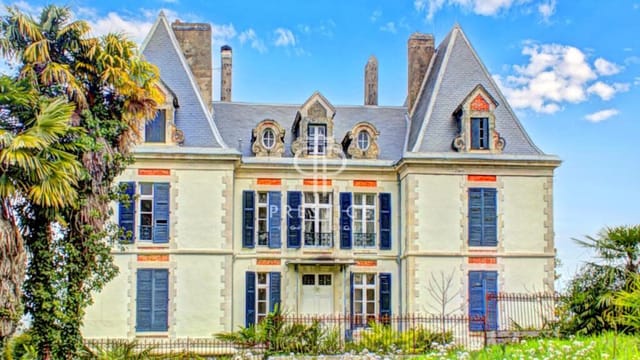
Picture this: it's a Tuesday morning in July, the kind that only happens in the Béarn. You've pushed open the tall shutters of the first-floor landing, and the garden below is already alive — bees working the lavender, the pool catching the early light, the Pyrenean foothills just visible through a soft summer haze on the horizon. Downstairs, someone has put a baguette on the kitchen table. The nearest boulangerie is five minutes away, and by now you know exactly which one to use. This is what owning a château actually feels like, and this particular one — a three-storey, 468m² stone manor built in 1898, set on 4.16 hectares of its own grounds in a tiny hilltop hamlet near Salies-de-Béarn — makes that morning feel entirely possible. The château sits at the end of a winding country lane, approached by a private drive that curves around to a small parking area in front of the house. Stone steps rise to the front door and open into an entrance hall that stops first-time visitors mid-sentence. The double staircase that dominates the hall — symmetrical, unhurried, built for making an impression — sets the tone for everything that follows. A matching pair of stone exterior steps at the rear mirror the interior staircase and lead straight down to the grounds, the 12m x 4m pool, and the tennis court beyond. The ground floor arranges itself logically around that central hall: a sitting room of 30m², a dining room of equal size with an open fireplace that earns its keep through autumn and into the Pyrenean winter, a library-study-office of 23m², and a kitchen. The spaces are generous without being cavernous, which matters more than people expect when a property like this becomes a real family base rather than a weekend curiosity ... click here to read more

Picture 1

Step outside on a Tuesday morning in early October, and the air carries that particular Swedish countryside smell — pine resin, damp grass, and horse. The paddocks at Fjuckby Solvallen 146 are already alive by seven o'clock, and from the kitchen window of the 1929 farmhouse you can watch the whole scene unfold without putting down your coffee. This is the kind of property that has a pulse. Set on just over 3.3 hectares of long, well-arranged land on the quiet outskirts of Storvreta — about 15 kilometers north of Uppsala — this is a working equestrian estate with serious bones, genuine rental income streams, and enough residential flexibility to make it work for almost any buyer's vision. Four bedrooms in the main house, two bathrooms, two additional apartments, a convertible cottage, and a nine-box stable complex. That's the bare-bones version. The reality is considerably richer. The main residence was originally built in 1929, extended in 1980, and sits at a comfortable 157 square meters. It wears its age well. The living room centers around a soapstone stove — the kind that holds heat for hours long after the fire has died down — and large windows pull in the low northern light that makes Swedish interiors feel cinematic in winter. The kitchen has solid wood cabinetry and modern appliances, and it functions the way a country kitchen should: generous counter space, room for multiple people, the sense that you could feed ten without breaking a sweat. Bedrooms are properly sized. Not the optimistic "double" measurements you sometimes see in older rural properties, but genuinely roomy spaces. The two bathrooms are well-appointed and practical, which matters when you're running a property with tenants, boarders, or exten ... click here to read more

Main house and stables

Step out onto the deck at Söderstig 3 on a July morning and the Gulf of Bothnia is barely a two-minute walk away. The air carries that particular mix of pine resin and salt water that you only get along this stretch of the Gävleborg coast. The soapstone stove inside still holds a little warmth from the evening before. This is what owning a holiday home in Axmar actually feels like — unhurried, deeply restorative, and about as far from city noise as you need it to be. Axmar sits on the Hälsingland coastline, roughly 40 kilometres north of Gävle and about a 2.5-hour drive from Stockholm. It is not the kind of place that shows up on tourist maps, and the people who live here — both year-round and seasonally — tend to like it that way. The village has developed quietly around its harbour, its community association, and the kind of neighbourly traditions that are increasingly rare. Midsommar here is the real thing: a maypole goes up near the marina, someone brings out a speaker, and the long Nordic evening stretches past midnight with no one particularly in a hurry to go anywhere. The house itself sits on a 1,520-square-metre plot on Söderstig, a quiet residential road lined with similar summer properties and year-round homes. The building has been methodically updated over recent years — new roof, new windows, a new front door and patio door, and an air-source heat pump that keeps running costs manageable in the colder months. None of these are flashy improvements, but they are exactly the kind that matter: the ones that mean you arrive in May and everything just works. Inside, the ground floor runs as an open plan from kitchen to living room, which gives the 75-square-metre main house a sense of space that the floor area ... click here to read more

Exterior view of Söderstig 3

On a still morning in Mauseidvåg, you can hear the fjord before you see it. Open the cabin door and the air hits you — cold, clean, faintly salt-tinged — and through the treeline, Sulafjorden sits there like hammered pewter, the mountains on the far shore still catching the last of the night's shadow. This is what 114,000 euros buys you in northwest Norway: a 1958 timber chalet on nearly 2,000 square meters of land, with a boathouse plot at the water's edge and views that no architect could improve upon. The chalet at Nøringsetvegen 64 is a proper Norwegian fritidsbolig — a traditional leisure cabin built for people who take their weekends seriously. It sits in Mauseidvåg, a quiet coastal community on the island of Sula in Møre og Romsdal county, roughly 25 kilometers southwest of Ålesund city center. That distance matters. Close enough that a Saturday morning trip to the Brogata fish market in Ålesund takes forty minutes by car and ferry, far enough that you won't hear a single car from the veranda. Forty square meters inside, which is exactly as much space as a Norwegian cabin should have. Two bedrooms, one bathroom, a living room with a Jøtul wood-burning fireplace, and a kitchen with a window pointed directly at the fjord. The Jøtul stove — installed in 2008 and still the heart of the room — is the kind of thing Norwegians argue about lovingly. Get it going on a grey October afternoon, pour something from a flask, and the argument for staying another week becomes very easy to make. The northern bedroom has a Velux skylight fitted in 2015, so you get the full Nordic summer experience: pale sky at midnight, the strange half-light that makes sleep feel optional and irrelevant. The kitchen runs on practical logic — dr ... click here to read more

Welcome to Nøringsetvegen 64! Photo: Diakrit Norge AS (Krisztian Szere)

Early on a Saturday morning at Polleveien 30, the smell of birch wood smoke curls up from neighboring chimneys and the forest is already full of light. You pull on boots, step off the 28-square-meter south-facing terrace, and you're on a trail within sixty seconds. By the time most of Oslo has poured its first coffee, you've already been to Pollevannet and back. That's the rhythm of life this cabin makes possible. And it's not some distant fantasy — Vinterbro sits roughly 25 kilometers south of Oslo city center, a straightforward run down the E6 that takes about 25 minutes by car or a manageable bus ride from the stop an 11-minute walk from the front door. This is a second home that actually gets used, because getting here never feels like an ordeal. The cabin itself dates to 1960, but don't let that fool you. What the original builders got right — the solid construction, the generous plot, the way the site is angled to catch southern sun — has been kept. What needed updating has been updated. The kitchen was overhauled in 2021 and 2022, the bathroom completely redone in 2024. The result is 73 square meters of interior space that feels cohesive and genuinely comfortable, not a patchwork of decades. Step inside and the living room stops you. Ceiling height reaches 2.95 meters in places, which is uncommon in a cabin this size and makes the room feel considerably bigger than the floor plan suggests. A cast iron wood-burning stove anchors one wall. On a grey October afternoon, with rain tapping the windows and that fire going, this room is where everyone will want to be. The wooden paneling and floors keep the traditional Norwegian hytte atmosphere intact — this doesn't feel like a city apartment that got transplanted to ... click here to read more

Welcome to Polleveien 30!

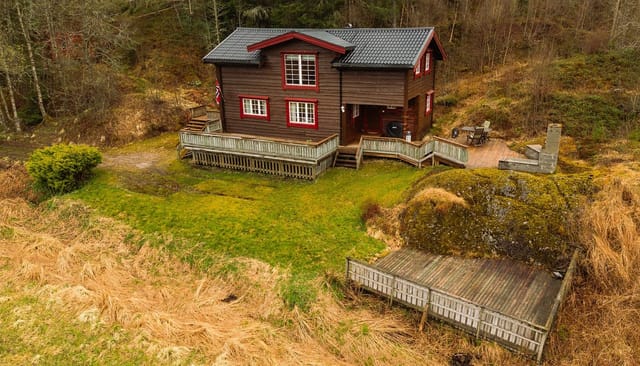
Stand at the kitchen window on a still July morning and count the layers: the grass track curving down through birch and pine, the glint of the Bindalsfjord catching the low Nordic sun, a neighbor's boat cutting a quiet V across the water. No traffic. No crowd noise. Just the creak of the old house settling and the occasional clatter of sheep on the hillside below. This is what 400 meters from the Norwegian coast actually feels like when you have 96 decares of land wrapped around you like a buffer from the rest of the world. Åkvikveien 225 is a genuine working smallholding on the Helgeland coast in Nordland, and it has been in continuous use since around 1900. That's not a selling point dressed up to sound historical — it means the bones are real. The timber has dried over generations, the walls have been reinforced, insulated, and upgraded steadily from the 1980s right through to today, and the result is a main house that feels lived in rather than staged. Three bedrooms, one bathroom, a proper kitchen with a wood-burning stove that heats the room fast on wet autumn evenings, a laundry room, a ground-floor WC, and a living room just over 21 square meters where the afternoon light comes through long enough to make you forget your book entirely. Upstairs, the two bedrooms sit under a roofline that also hides 14 square meters of unfinished attic space — raw and full of possibility. A reading loft, a kids' bunk room, a small home office with a forest view. The structure is already there. What you do with it is yours to decide. Out in the yard stands the annex, built in 2007 using stavlaft — the traditional Norwegian log technique where each round timber is hand-notched and stacked without nails. It's 12.5 square meters o ... click here to read more

House and annex seen from above

The first thing you notice on a summer morning at Rødtanglia 31 is the light. It comes off Drammensfjorden in long, shimmering bands, cuts across the living room floor, and lands on the coffee table just as the coffee finishes brewing. You step out onto the 26-square-metre terrace with your mug, and the fjord stretches out in front of you — glassy, quiet, impossibly wide. This is what Holmsbu feels like before the rest of the world wakes up. Rødtangen is one of those places that people who know Norway's coast quietly guard. It sits at the end of a peninsula on the western shore of Drammensfjorden, about an hour's drive south of Oslo along the E18 — close enough for a Friday evening escape, far enough that the city feels genuinely distant. The holiday area itself is barrier-controlled at the entrance, which keeps through-traffic out entirely. You hear birdsong here, the occasional creak of a rope on a dock, and in the evenings the low chug of a returning motorboat. That's about it. This three-bedroom chalet sits on a freehold plot of 1,395 square metres on Rødtanglia, with the plot sloping gently toward open sky and fjord views that face southwest — the magic direction for Norwegian sun chasers. The terrace catches afternoon and evening light until late, which in July means golden hour stretches well past nine o'clock. Bring the neighbours over. Nobody's in a rush. The chalet itself was built in 1969 and has been looked after with genuine care over the decades. At 59 square metres, it's an honest Norwegian hytte — designed not for show, but for living. Everything is on one level: entrance hall, kitchen, living room with a wood-burning fireplace, three bedrooms, a bathroom, and a separate toilet room. The layout is effi ... click here to read more

FREM EIENDOMSMEGLING presents Rødtanglia 31

On a clear morning in Glenhinnisdal, the Trotternish Ridge turns a deep violet before the sun crests it. You're standing at the breakfast room window with a coffee, watching the light spill down onto open croft land, and your guests haven't stirred yet. This is what ownership here actually feels like — not a business you manage from a distance, but a life you step into. Trotternish Bed and Breakfast sits on a working croft in northern Skye, eleven miles above Portree on the peninsula that most visitors only see from a tour bus window. That distance from the beaten path is precisely what makes this place work. Guests who find Glenhinnisdal are the ones who came looking for the real island — the wide silence of it, the geology that looks like another planet, the kind of Highland hospitality that doesn't come from a script. The building itself is architect-designed and substantial — 219 square metres across two storeys, built in 2007 and thoughtfully remodelled twice since. The exterior is durable roughcast render under a traditional slate roof; honest materials that suit the landscape. Inside, the standard of finish is consistently high: new carpets and beds fitted in 2023, emergency lighting installed, UPVC soffits and fascia replaced across 2023 and 2024, and an EV charging station added in 2024. The heating runs on an oil-fired wet system backed up by electric ceramic panel heaters for the shoulder months. Nothing here feels provisional. This is a property that has been properly looked after. Five letting rooms occupy the house, each with a name that reflects the island — Stag, Otter, Highland Cow, Puffin, Sheep. Every room has a modern en-suite with heated towel rails, fitted wardrobes, a silent fridge, a Nespresso ... click here to read more

Front view of Trotternish Bed and Breakfast

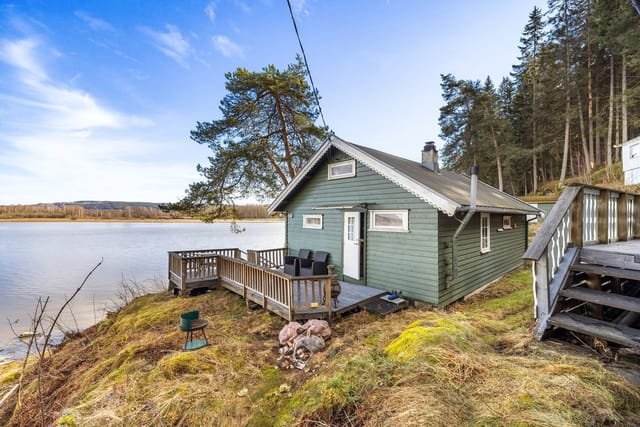
Step out onto the 30-square-meter terrace at Støtterudvegen 201 on a still Saturday morning, coffee in hand, and the only sound is water lapping against the shore of Lake Øyeren. Oslo's skyline feels like another world from here—and technically, it's only 30 kilometers away. This is what draws people to Fjerdingby. Not a manufactured resort, not a managed holiday park. A real Norwegian cabin on a real freehold plot of roughly 883 square meters, with a private stretch of shoreline and a forested backdrop that turns golden every October. Finding something like this within half an hour of a Scandinavian capital is genuinely rare, and the market around Lake Øyeren knows it. The chalet itself was built in 1953 and has aged with the kind of character that newer builds simply can't fake. Log walls. Exposed timber beams. A wood-burning stove that takes the edge off cool September evenings in about twenty minutes flat. A heat pump added in 2022 means you're not entirely dependent on firewood during shoulder-season stays, which is a practical upgrade that pays for itself quickly when you're arriving on a Friday evening in November and want warmth immediately, not in an hour. The cabin sits in good condition throughout—well maintained, thoughtfully updated, and ready to use from day one without any urgent renovation pressure. Inside, the single bedroom uses a bunk arrangement to sleep more than the room count suggests, and a practical alcove near the main living space can absorb overflow guests or serve as a cozy reading corner for kids. The living room's large windows frame the lake view so directly that you sometimes forget there's glass there at all. It's a small space used cleverly, which is very much the Norwegian cabin tra ... click here to read more

Welcome to Støtterudvegen 201! A charming cabin with its own shoreline by Lake Øyeren.

The first thing you notice on a summer morning at Älgholmen 7 is the quiet. Not the artificial quiet of soundproofing, but the real kind — wind through pine trees, a wooden hull knocking softly against the dock, maybe a cuckoo somewhere out over the meadow. You've just made the ten-minute boat crossing from Åva Marina, the engine off now, your coffee still warm in your hand. This is what it feels like to own here. Älgholmen is a small, privately held island in the outer reaches of the Haninge municipality, sitting at the edge of the Dalarö archipelago about 45 kilometres south of Stockholm. Getting here requires a short boat ride, and that small friction is exactly the point. The moment you leave the mainland dock, the week detaches itself from you. The island is shared among fourteen property-owning households, all members of Älgholmens vänner — Friends of Älgholmen — a community association that collectively maintains the shared trails, beaches, and clubhouse. It has the feel of a private enclave that somehow never tips into exclusivity or pretension. People actually talk to each other here. The property itself has a footprint that makes sense for extended family or a close group of friends. The original house anchors the plot — its former living room now serves as the master bedroom, anchored by a fireplace that gets genuinely used on cool September evenings when the archipelago light goes golden and the temperature drops fast. The kitchen is laid out for real cooking: wide surfaces, a rustic functional design, nothing fussy. From the kitchen window you catch tree-framed glimpses of open water, and on calm evenings the smell of the sea drifts through if you leave it open. The 2012 extension changed the character of ... click here to read more

Exterior view of the holiday home on Älgholmen 7

Picture this: it's midsummer in Trøndelag, and you're sitting on a 103-square-metre terrace with a coffee going cold in your hand because the view over Selnesvika keeps pulling your eyes north. The light here doesn't really set in June — it just softens into this amber haze that sits over the water for hours. That's the kind of evening this chalet was built for. Set along Selnesvegen in Bangsund, roughly 15 kilometres from the centre of Namsos, this 111-square-metre traditional Norwegian cabin has been standing since 2004 and sits on a 1,174-square-metre private plot accessed by its own driveway. No hiking gear required to reach the front door — the car goes all the way up, winter included. That detail matters more than you'd think when you're arriving in late October with a week's worth of bags and the temperature dropping. The chalet covers two floors. Downstairs, a generous living room runs the social heart of the place, with traditional cabin finishes, a sleeping alcove tucked into the wall — the kind that kids claim immediately and adults secretly want — and large windows that let the surrounding woodland push its way inside without actually letting in the cold. The kitchen carries the same honest aesthetic: lacquered pine fronts, solid worktops, enough counter space to actually cook a proper meal rather than just heat one up. The bathroom doubles as a laundry room and handles everything a full-time rotating group of guests needs. Upstairs in the loft, three bedrooms and a separate loft sitting room spread across the top floor. The sitting room is genuinely useful — it becomes a film room, a rainy-day board game corner, a teenager's escape hatch, depending on who you bring. Each bedroom is quiet and practical. No ... click here to read more

Front view of the holiday home at Selnesvegen 336

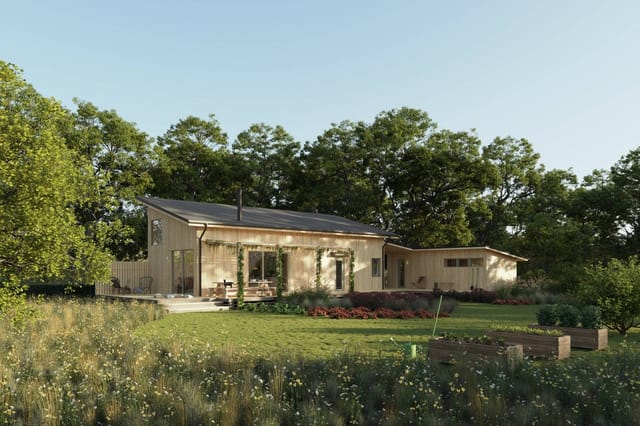
Stand on the south-facing terrace at Törnbotten 113 on a late June morning and you'll understand immediately why Öland has been pulling people across the Kalmar Strait for centuries. The meadows ahead of you stretch all the way to the treeline of Mittlandsskogen, Sweden's largest contiguous deciduous forest. Swallows cut low over the grass. The only sound is wind moving through the stone wall that borders your plot. It's 7am and you're already outside, coffee in hand, with nowhere to be. This is a genuinely rare find. An architect-designed, newly built home on a Swedish island that gets more sunshine hours than almost anywhere else in the country — and it's priced as a vacation home purchase, not a mainland city premium. The house at Törnbotten 113 sits in Färjestaden on the island of Öland, connected to the mainland city of Kalmar by the 6km Öland Bridge — one of the longest bridges in Europe and, frankly, one of the more satisfying drives you'll ever make, with the Baltic spreading out on both sides. The architect behind this home is M. Rutensköld, winner of both the Red Dot Award and the Swedish Design Award. That pedigree shows in every decision made here, from the passage between the two building volumes — a direct nod to the traditional rad byar, the row villages that define Öland's historic landscape — to the vitriol-treated wood facade that will weather gradually to a soft silver-grey, the way old Öland barns do. This isn't a house trying to look Scandinavian. It actually is. Inside, the ceilings climb to five metres at their peak. Natural light doesn't just enter the house — it moves through it, shifting from the south-facing living areas in the morning to the north and east-facing loft windows by afternoon. ... click here to read more

Exterior view of Törnbotten 113, main house and annex

Picture a Tuesday afternoon in late July. You've just walked back from the lake, towel over your shoulder, the cold fresh water of Lunddalsvatnet still on your skin. The cabin door swings open, the wood-burning stove in the kitchen still holds a little warmth from the morning, and through the large windows the afternoon sun cuts long gold lines across the pine floor. There's no traffic noise here. Just wind in the birch trees and the occasional bird you've not quite managed to identify yet. This is Hjørdisbu — a 1954 Norwegian leisure cabin sitting at roughly 265 metres above sea level on Lunddalsvegen in Hjelset, and it has a particular kind of quiet that's genuinely hard to find anymore. At 20 square metres of interior space on a freehold plot of around 660 square metres, this is not a property that tries to impress you with square footage. It earns its place through something else entirely: position, soul, and the promise of a life considerably simpler than the one you've got right now. The southwest orientation is no small thing in this part of Norway — it means the cabin catches the sun from mid-morning right through to the long Nordic evenings, and that west-facing veranda at the entrance becomes one of the best seats you'll own anywhere. Coffee at nine, wine at nine, it doesn't matter — the light does something different every hour. The interior is honest and unfussy. Pine flooring runs throughout, wooden panelling covers the walls and ceiling, and the open fireplace in the living area gives the room a focal point that no flat-screen television ever quite manages. The kitchen and living space share an open layout — compact, yes, but functional in exactly the way a weekend cabin should be. There's a loft above th ... click here to read more

Welcome to idyllic Hjørdisbu! (Photo: EFKT by Jay Maturan)

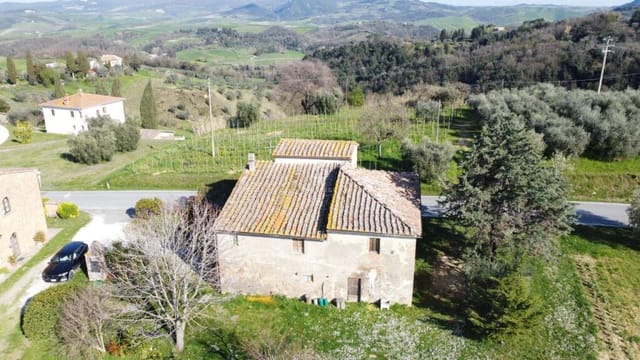
Stand at the kitchen window on a Tuesday morning and you'll understand why people come to this corner of Tuscany and never quite leave. The hills roll away toward Volterra's medieval skyline — towers, rooftops, the faint outline of the Roman amphitheater — while olive trees catch the early light on the slopes below. No traffic. No noise. Just the wind moving through the fruit trees and, if you're lucky, the distant clang of the Duomo's bells drifting up from town. This is a proper Tuscan stone farmhouse. Four bedrooms, 315 square meters spread across two floors, original cross-vaulted ceilings in the former stable, thick stone walls that keep the rooms cool well into August, and wooden beams that have been darkened by decades of use. There's even an old dovecote tucked into the attic — one of those details that stops first-time visitors mid-sentence. It doesn't need to serve any function. It's just wonderful that it's still there. The ground floor tells the story of how this place was lived in for generations: a large garage, two cellar rooms with stone floors, and that former stable with its vaulted ceilings and original mangers still in place. Upstairs, reached by an internal staircase, you'll find the four bedrooms, a generous bathroom, a kitchen, and a living room with the kind of proportions you simply don't find in new builds. The property needs a thorough renovation — it's priced to reflect that honestly — which means the next owner has the freedom to shape it exactly as they want, rather than inheriting someone else's half-finished vision. The location is smarter than it first appears. Sitting directly along the road that connects Volterra to the Volterrana provincial road, the farmhouse has strong visibility ... click here to read more

Picture 1

Step out onto the terrace with a cup of coffee and the only sound you hear is water. Not traffic, not neighbours, not anything urban — just the soft lap of Sørfjorden against the rocks below the jetty, and maybe a wood pigeon somewhere back in the birch trees. That's the morning routine at Nesstranda 16, and it never gets old. Sitting right on the shore of Lake Vegår in the quiet municipality of Vegårshei, this two-bedroom Norwegian chalet has been part of the Nesstranda cabin community since 1972. It's well maintained, immediately liveable, and comes with something increasingly rare in this corner of Aust-Agder: a privately owned plot of nearly 2,000 square metres with direct water access and a working jetty. You tie up a rowboat here. You fish from here at dusk. On warm July evenings — and they do get warm in this part of inland Norway — you jump straight off the end into clear lake water. The cabin itself is compact and honest. Fifty-five square metres inside, laid out sensibly: a living room anchored by a wood-burning fireplace, a kitchen with room to actually cook after a day out on the water, two bedrooms that sleep the family or a couple of close friends, and a bathroom that does the job. There's an additional 16 square metres of external storage, useful for kayak paddles, fishing gear, cross-country skis, and all the paraphernalia that comes with four-season outdoor living. Big windows face the fjord, so the light moves through the space all day. In the afternoons, the sun swings around and floods the terrace — a proper south-facing suntrap that the plot seems to have been designed for. The fireplace matters more than it might sound. Vegårshei sits inland, away from the coast's moderating influence, which mean ... click here to read more

Picture 1

Stand on the terrace at nine in the evening in July and the sun still hasn't gone down. The fjord below you — Nufsfjorden stretching west toward Nærøysund — catches the light in long copper ribbons. A boat cuts a white line across the water somewhere in the distance. The wood stove inside is cold because you don't need it yet. You pour a coffee and sit down and realize you haven't checked your phone in four hours. That's Ølhammarvegen 485. This 1994-built cabin sits at the high end of a small, unhurried community on Elvalandet, a peninsula that juts into the fjord system south of Namsos in Trøndelag. It was extended in 2007 and has been looked after with real care since — not the performative kind where everything's been repainted to sell, but the practical kind where things work. The boathouse went up in 2022. Solar panels were added the same year. A new gas water heater replaced the old one. Small, deliberate investments over time, which is exactly how Norwegians tend to treat a cabin they actually use. The approach itself sets the mood. You park on the west side of the road — there's a dedicated spot — and walk a roughly 150-metre footpath up to the property. It sounds minor, but that short walk does something. By the time you reach the door, you've already left most of your daily life behind. The cabin sits well clear of its neighbours, with enough distance between plots that you rarely hear anyone else. Privacy here isn't a marketing word. It's just the physical layout of the place. Inside, 78 square metres of living space is organized around an open plan that keeps things light. Two bedrooms handle a family or a couple with guests easily. There are two separate living areas — one that tends toward relaxed eveni ... click here to read more

Holiday home at Ølhammarvegen 485 presented for sale! (Photo Martin Hågensen)

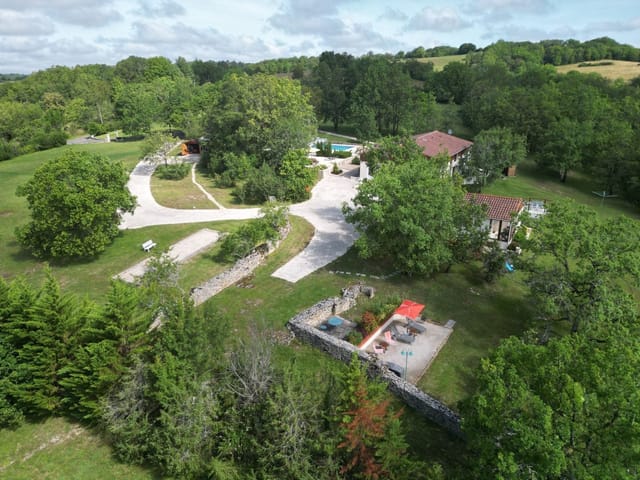
Step outside the kitchen door on a September morning and the view hits you before the coffee does. Rolling causse plateau, oak woodland dissolving into mist, and not a single rooftop visible in any direction. This is Sénaillac-Lauzès — a quiet corner of the Lot department that most people drive through on the way somewhere else, which is precisely why it's worth stopping. The villa at 630 Route de la Tuilerie sits on 10 full hectares of mixed land — meadow, mature woodland, and manicured garden — at the end of a private lane about 35 kilometres north of Cahors. Four bedrooms, two bathrooms, a separate furnished guest house, a 10 x 5.5 metre pool, a barn, outbuildings, and panoramic views that on a clear day seem to reach the next département. At €379,500, it's the kind of property that makes buyers from Paris, London, or Amsterdam do a double take and then immediately book a viewing. The main house runs to 210 square metres across two floors. Ground level is where daily life happens. The living room has underfloor heating fed by a heat pump installed in 2023 and a wood-burning stove added the same year — so the room is genuinely warm, not just theoretically warm. There's a real difference between a house with a stove for atmosphere and a house with a stove that actually works. This is the latter. The kitchen clocks in at 30 square metres, which means two people can cook at the same time without negotiating territory. It's fully fitted: five-burner gas hob, oven, microwave, dishwasher, built-in fridge, water softener, and air conditioning for the height of summer. The terrace opens directly off the kitchen — eat outside from April through October without a second thought. Three bedrooms sit on the ground floor, measuri ... click here to read more

Front view of the house and grounds

The first thing you notice on a summer morning at Lysgardslia 17 is the silence. Not dead silence — the kind with texture. Wind moving through the birch trees behind the plot, a woodpecker somewhere up the hill, and the distant glitter of Hurdal Lake visible through the tree line. You pour coffee and step out onto the south-facing terrace before anyone else in the cabin is awake. That right there is what this place is for. Set in the quiet forest hamlet of Erikstellet, about 6 kilometres north of Hurdal village, this compact two-bedroom cabin sits on a generous 1,135-square-metre plot where the garden simply dissolves into the surrounding spruce forest. The building dates to 1970 and has been kept in good condition over the decades — solid, honest, and full of personality. It's not a renovation project. It's a cabin that works, with room to add your own mark over time. Inside, the main living area is anchored by a wood-burning stove and an open fireplace — the kind of combination that makes January evenings feel like a reward rather than something to endure. An air-to-air heat pump handles the shoulder seasons, so the cabin stays comfortable from early March right through to late autumn. Large windows on the south-facing wall pull in light generously all day, and the open connection between the kitchen and living room means meals naturally become communal events, whether it's a family of four or a group of friends back from a day on skis. The kitchen is worth pausing on. The cabinet fronts are hand-painted with troll motifs — a detail straight out of Norwegian folk tradition — and while the laminate worktop and stainless steel sink are entirely functional, it's those painted doors that give the room its soul. There's ... click here to read more
Peaceful and scenic surroundings with excellent sunlight.

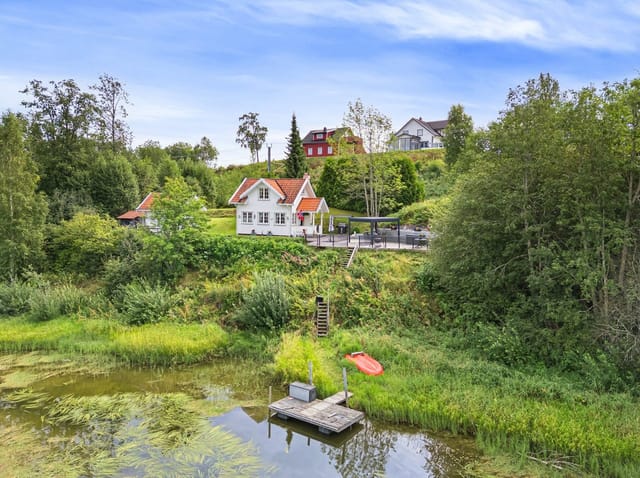
The first thing you notice on a summer morning at Svendsrudveien 80 is the light. It comes in low across the Glomma River, catches the dew on the grass, and floods the 95-square-metre wooden terrace in a warm, amber wash before most of Norway has even thought about breakfast. You pour your coffee, step outside, and the only sounds are birdsong and the distant whisper of the river moving south. This is what you came for. Fetsund sits at a point where the Glomma — Norway's longest river — fans out into a wide, slow stretch that locals have been fishing, swimming, and paddling since long before anyone thought to build a road through here. The chalet at Svendsrudveien 80 catches all of that riverside energy from a plot of 798 square metres that feels quietly private, ringed by mature hedging and plantings that have been tended over many years. It's a proper Norwegian hytte in character, white-painted facade, classic red roof, the kind of place you'd sketch on a postcard — but it's also genuinely functional, well-maintained, and ready for a new chapter. Inside, the main cabin runs to 64 square metres of thoughtfully arranged living space. The ground floor keeps things open and social: the living room and kitchen flow together naturally, both finished in light timber panel walls and solid wood floors that give the interior that distinctive warm hum you get in Scandinavian cabins where every material has been chosen to hold heat and light in equal measure. The wood-burning stove is the centrepiece of the living room, the kind of cast-iron fixture that earns its place on a February evening when snow is coming down outside and the whole cabin smells faintly of birch. Direct access from the living room to the terrace means summe ... click here to read more
Front view of the cabin presented by Notar Romerike

Step off the gravel path on a Saturday morning in July and you can already hear it — the soft lap of Nordavatnet against the reeds, maybe a cuckoo calling from the spruce ridge above Vier. The kettle goes on. The sun has been up since four. This is what you bought the place for. Sitting on a generously sized, south-facing plot along Vierveien in Hommersåk, this 1942 cabin has quietly held its ground for more than eighty years. It's not trying to impress anyone. The wooden walls have darkened to that deep amber that only comes with age, the terrace boards creak in a satisfying way underfoot, and the fireplace in the living room still does exactly what fireplaces are supposed to do on an October evening when the birches have gone gold and the temperature has dropped to single figures. Good condition throughout — solid, dry, genuinely loved. At 49 square metres the main cabin is compact, but the layout is cleverly proportioned. The hallway doubles as proper storage — hooks, space for muddy boots, room to hang wet waterproofs after a day on the trails. Cabins that skip a real hallway always regret it. This one didn't. The living room opens into the kitchen, and large windows on the south-facing wall pull in light from mid-morning through to early evening. On clear days you catch glimpses of the treeline and the shimmer of Nordavatnet beyond the garden. The fireplace anchors the room — wood-burning, practical, the kind of thing you find yourself sitting in front of far longer than you planned. The kitchen has profiled wooden fronts and a laminate worktop that's seen a lot of summer dinners and handled all of them. There's room to cook properly, not just heat things up. The bedroom fits a double bed with space to spare and ... click here to read more
Picture 1

Step out onto the terrace on a July morning and the air already smells of sun-warmed rock and salt. The Norwegian coast does this thing in summer where the light arrives absurdly early and the water between the skerries turns a shade of pale blue you don't quite believe until you're standing in front of it. This chalet, built in 2020 and sitting just 200 metres from the shoreline at Søndeled, puts you right in the middle of all of it. Built to a high standard and finished with real care, the home spans 83 square metres across two levels, with five bedrooms and two full bathrooms. That might sound compact on paper, but the layout is smart. The open-plan kitchen and living area on the ground floor is the social engine of the house — stone countertops, integrated induction hob, refrigerator drawers, dishwasher — and the large windows pull in so much light that you rarely feel enclosed. On grey autumn days, which do come, the room glows. On clear summer evenings, you watch the last of the sun move across the treeline from the sofa without getting up. The five bedrooms are split between the ground floor and a mezzanine level. Up top, there's also a loft lounge — the kind of space that kids immediately claim as their own but that adults quietly appreciate too. A reading chair, a low lamp, the sound of everyone below: it works. Both bathrooms are properly done, with underfloor heating in the tiled floors, wall-mounted fittings, and one with a full bathtub. A second bathroom has washing machine provisions, which matters more than you'd think when you're coming back from a week of hiking and kayaking with muddy gear and wet swimwear. Outside, a 30-square-metre terrace wraps around the property with enough room for a proper out ... click here to read more
Welcome to SSS-veien 1633!

Step inside on a quiet Tuesday morning in Vliermaalroot and the first thing you notice is the light. Southwest-facing windows pull the sun deep into the living room from mid-morning until the last gold slips behind the Haspengouw farmland in the evening. Old Beerse brick on the facade, blue stone detailing at the threshold, solid oak underfoot — this is a house built the way Flemish craftsmen used to build them, except the boiler room holds a heat pump and 8 kWp of solar panels are quietly generating more electricity than a family of five will ever use. This is what makes this 310-square-meter pastorijwoning in Kortessem so compelling as a Belgian second home or vacation property: it carries the visual weight and presence of a classic Flemish manor house while running on near-zero energy, with an E-peil score under 20. That kind of combination is genuinely rare in this price bracket. The house sits on Bornstraat 17a in the hamlet of Vliermaalroot, which is technically part of the wider Kortessem municipality — but locals will tell you it feels like a village unto itself. Slow. Green. The kind of place where the school is 500 meters away on foot and the pharmacy is the same distance in the other direction. There are no traffic lights. There is, however, a cycling route that loops out through the fruit orchards of Haspengouw — one of Belgium's most productive agricultural regions, famous for its apple and pear blossoms in April, when the whole landscape turns white and the roadside farm stalls start selling freshly pressed juice. Six bedrooms across three floors gives the property a flexibility that's hard to find in new-build stock. The ground floor sets the tone: a wide entrance hall opens to a versatile room that wor ... click here to read more
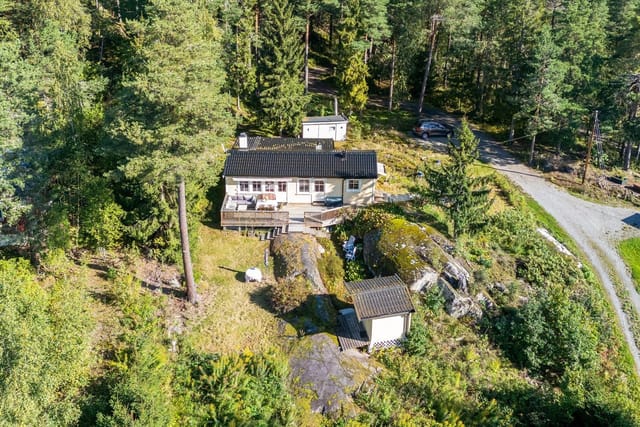
Photo 1 of Bornstraat 17a

The sun doesn't set here so much as it melts. Stand on the rocky outcrop at Tangenodden 17 on a July evening and watch the light turn the Sandefjord fjord into hammered copper while the last kayakers of the day drift past your private shoreline. That's roughly forty metres of it — actual sandy beach, flanked by smooth polished rocks worn down by centuries of tides. You won't find this combination easily anywhere along the Vestfold coast, let alone attached to a freehold plot of over 1,100 square metres. This is a 1928 cabin — a proper one, with the kind of bones that builders stopped using when they started building faster and cheaper. Four bedrooms spread across two floors, one bathroom, a kitchen and living room that face directly west toward the fjord. The orientation isn't incidental. Every afternoon, light pours through the windows with the conviction of something that has nothing to obstruct it. No neighbouring rooflines. No dense tree cover blocking the horizon. Just open water and sky going all the way to Korsvika and beyond. Sandefjord itself is a city that rewards people who actually slow down in it. Former whaling capital of Norway, yes, but today it's better known among Norwegians for its waterfront promenade, the Haugar Vestfold Art Museum, and the kind of seafood you eat at a harbour-side table with a cold Ringnes in hand. The twice-weekly market at Torget square sells smoked salmon, local honey, and early-season strawberries that taste nothing like the supermarket variety. It's a fifteen-minute drive from Tangenodden — enough distance to feel like you've properly escaped, close enough that you're never stranded. The neighbourhood of Vesterøya is what happens when a peninsula decides to keep things civil ... click here to read more
Welcome to Tangenodden 17! Photo by Karl Filip Kronstad

On a clear morning in Laurens, you open the bedroom shutters—electric, silent—and the air that comes in smells like sun-warmed garrigue and something faintly floral from the vines on the hillside. The village below is just waking up. A motorbike passes the café. That's about as busy as it gets. This is life in the Hérault heartland, and if you've been looking for a second home that delivers genuine southern French countryside without the tourist-trap prices of Provence, this four-bedroom villa might be the answer you didn't know you were this close to finding. Built in 2010 on the edge of Laurens—a compact stone village in the Faugères wine appellation—the property sits on a generous plot with uninterrupted views across the vines and rolling hills that define this stretch of Languedoc-Roussillon. It's not ancient, and that matters. The bones are solid, the design is contemporary bastide: clean lines, generous proportions, Mediterranean palette, none of the maintenance headaches that come with centuries-old stone. In good condition throughout, it's the kind of place you can unlock on a Friday evening in July and be swimming before dark. Inside, the ground floor is organized around a large lounge and dining room with an open fireplace—the kind you'll actually use from October through April, when the Hérault evenings cool fast and the smell of woodsmoke drifts through the valley. The fitted kitchen comes equipped with the full complement: oven, induction hob, extractor, integrated dishwasher, even a built-in fryer for when you've come back from the Béziers market with a bag of local potatoes and some merguez. French doors open directly onto a wide terrace. Marble and travertine finishes throughout give the interiors a pol ... click here to read more
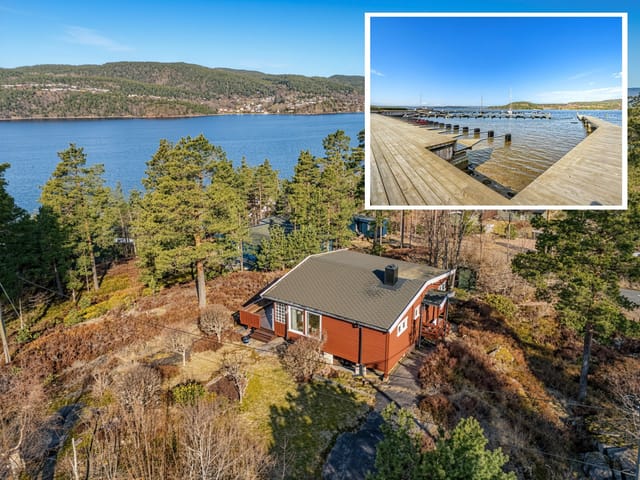
Photo 1

On a warm June evening in Hamont-Achel, you slide open the doors from the extension into the garden, the pool deck already rolled back, kids splashing in the heated water while the poolhouse gas stove keeps the evening chill at bay. The smell of pine drifts in from the Bosstraat treeline. The solar panels have been quietly charging everything all day — the car, the heat pump, the house — and your energy bill is, for the third month in a row, essentially nothing. This is not a fantasy. This is Tuesday at Bosstraat 62. Belgium's Limburg province doesn't get the international press that the Ardennes or Brussels do, but locals know exactly what they have. Hamont-Achel sits right at the northern tip of Belgian Limburg, pressed against the Dutch border near Valkenswaard and a short drive from Eindhoven. The landscape here is flat, forested heathland — the Kempen region — criss-crossed by hundreds of kilometres of dedicated cycling paths that weave through nature reserves like the Averbode Abbey woods and the Hoge Kempen National Park. On weekends, the Bosstraat neighbourhood is quiet enough to hear woodpeckers. On weekday mornings, you're on the E314 motorway within fifteen minutes, which puts Hasselt in forty and Brussels in ninety. The town itself punches well above its size. The Achel Trappist Brewery, one of the last authentic Trappist producers in the world, is just a few kilometres down the road — you can pick up their distinctive amber ales directly at the source. The Saturday market on the Marktplein fills up with local cheese, fresh-cut flowers, and Limburg vlaai (the regional custard tart that every Belgian will insist is better here than anywhere else). There are solid neighbourhood restaurants doing Belgian class ... click here to read more
Front view of Bosstraat 62

Step outside on a Saturday morning in early October, coffee in hand, and look out over the Telemark Canal as the mist lifts off the water. The birches are turning gold. The only sounds are wind through the pines and, faintly, the bell from the old church down in the valley. This is what mornings feel like at Tveitgrendvegen 356. Kviteseid sits in the heart of Telemark, one of Norway's most historically layered and visually dramatic regions—and yet it remains genuinely off the radar for most international buyers. That's exactly why this property is worth paying attention to. Set at 427 meters above sea level along the Tveitgrend hillside, the chalet commands sweeping views over the Telemark Canal and the surrounding mountain ridges. Not the kind of view you glimpse between rooftops. The kind that fills an entire wall of windows. The property itself is a solid 73-square-meter cabin built in 1983 and kept in consistently good condition over the decades. What makes it more than a typical Norwegian hytte is the combination of thoughtful upgrades, a generous land holding, and a secondary structure that adds real flexibility. Two separate freehold plots together cover just over 3,000 square meters—room enough for children to disappear into the trees, for a proper bonfire circle with log benches, and for a lawn that actually feels like a lawn rather than a postage stamp. The cabin's living room is where you'll spend most of your time. Large windows frame the canal view from the sofa, and the open-plan design means whoever is cooking isn't cut off from the conversation. A wood-burning stove installed in 2017 takes the edge off cool evenings—and evenings in Telemark can get cool even in July, which is part of the appeal. App-co ... click here to read more
PrivatMegleren presents Tveitgrendvegen 356! Photo: Tor Helge Thorsen

Stand at the kitchen window on a Saturday morning and watch the light roll in across the south-facing garden while the coffee brews. The village of Elten is still quiet — a dog walker passes on De Dweel, the air carries a faint green smell from the Eltenberg forest just up the hill. This is the kind of calm that people spend years searching for, and it exists here just a few minutes' drive from the Dutch border. Built in 2006 and set on a peaceful residential street in this small German-Dutch border village, this 140-square-metre semi-bungalow is the kind of property that reveals itself slowly. From the outside, it reads as a tidy, well-kept family home. Step inside, and you start doing the mental arithmetic — ground-floor bedrooms, a fully finished basement with its own bar setup, a double garage, a deep south-facing garden — and you realise there's considerably more going on here than the facade suggests. The ground floor does what the best house plans do: it gets out of your way. The living room faces the garden through generous windows, pulling daylight deep into the space throughout the afternoon and evening. An open fireplace anchors the room — not decorative, genuinely useful on grey Rhine-valley winters when the temperature drops and you want a reason to stay in. The semi-open kitchen connects directly to the living area, fitted with a cooking island and built-in appliances that have been used and maintained, not just photographed. Two bedrooms sit off the ground floor alongside a full bathroom with bathtub, separate shower, and vanity — which means this house functions as a genuine single-storey home if that's how you want to live it. Upstairs, the arrangement shifts gear. A third bedroom sits here along with ... click here to read more
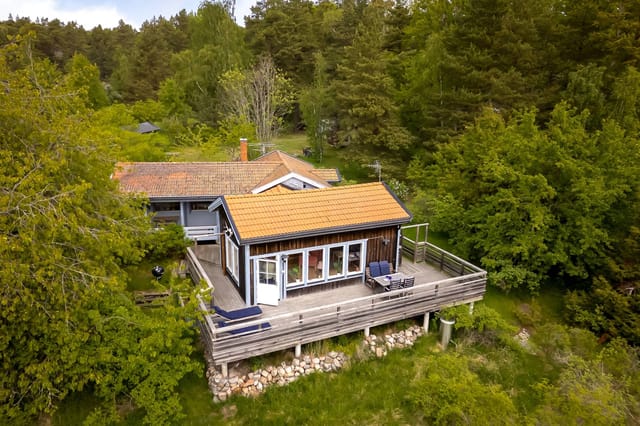
Photo 1 of De Dweel 23

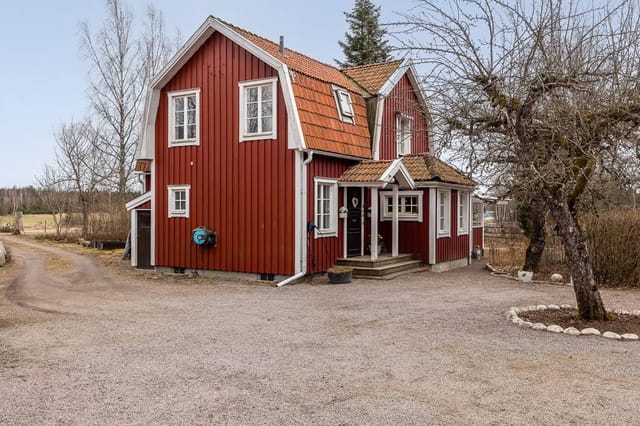
Step outside on a July morning, coffee in hand, and the air already smells like warm pine and cut grass. The Enviken community pool is a five-minute walk away, someone is dragging a kayak toward Vaxtunasjön down the road, and the Baltic is close enough that you can be on the water before the day heats up properly. This is Galoppbacken 4 — a solid, move-in ready holiday home in Bergshamra that gives you all of that, plus a 1,425-square-metre garden, a guest cottage, and a hot tub on the patio for when the sun finally goes down. Bergshamra sits in the heart of Norrtälje municipality, the great coastal retreat for Stockholmers who want archipelago access without giving up convenience. That matters for buyers thinking about rental income or resale: demand for holiday homes within 90 minutes of Stockholm has stayed remarkably firm, and this corner of Roslagen — the name locals use for the string of coastal parishes north of the capital — is especially popular because it combines genuine waterfront access with year-round infrastructure. The SL bus to Norrtälje town runs from a stop you can walk to in minutes, and from Norrtälje it's a direct ride into Stockholm. Practical, and that's the point. The house itself was built in 1978 and covers 58 square metres — compact, but thought through. The living room anchors the ground floor, and in winter the fireplace does exactly what a fireplace should do: it makes you want to stay inside with a book. There's also an air-source heat pump installed, so heating costs are reasonable even through January and February when Norrtälje can drop well below zero for weeks at a stretch. A covered terrace opens directly off the living room, and that covered part is key — Swedish summers are brill ... click here to read more
Exterior view of the house and garden

Step off the terrace on a September morning and the air hits you — cold, pine-sharp, and absolutely still. The fairways of Sorknes Golf Course are turning gold at the edges, mist sitting low in the valley, and you've got the whole day ahead of you with nothing on the agenda but a round of golf and whatever comes after. This is life at Bjørsland 44, and it has a way of recalibrating your sense of what matters. Built in 2002 and kept in genuinely good condition throughout, this 129-square-metre chalet on a 1,622-square-metre freehold plot is the kind of property that works in every season. Not just summer. Not just winter. Every single season has something to offer here, and the cabin is set up to take full advantage of all of them. The living room is the anchor of the whole place. A fireplace holds centre stage, and on a January evening after a long day on the cross-country trails, it earns its keep. Large windows pull in the light and look out over the terrace — all 99 square metres of it — which wraps around the south-facing side of the property and collects sun from mid-morning well into the evening. In summer, that terrace becomes an outdoor living room in its own right. Dinners out there stretch late, the sky over Østerdalen staying pale long after midnight. Three bedrooms sleep family and guests comfortably. The layout is practical without feeling clinical — a proper hallway with real storage, a functional kitchen with modern appliances, a separate toilet room, and a bathroom fitted with underfloor heating that you will genuinely appreciate when you come in from the slopes in February. The private sauna is not a luxury afterthought; it is, frankly, essential to the Norwegian cabin experience and here it delivers ... click here to read more
Picture 1

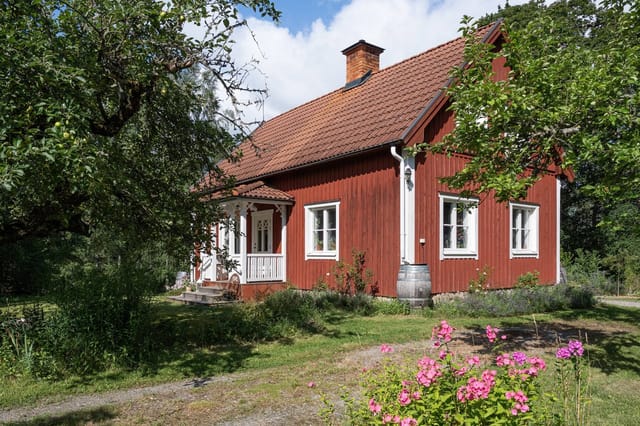
Picture this: a Saturday morning in late June, pale Nordic light filtering through hand-printed wallpaper at six a.m., the smell of birch smoke drifting up from the kitchen's wood-burning stove, and absolute silence outside — except for the soft shuffle of ducks settling onto the garden pond. That's what mornings feel like at this 18th-century country house in Stjärnhov, just outside Gnesta in Södermanland. It's a rare thing, a property that actually delivers on the rural Sweden fantasy rather than just hinting at it. The house sits on 4,299 square meters of mature garden in Herrökna Sofielund, a quiet hamlet surrounded by forest and farmland roughly 80 kilometers southwest of Stockholm. From the capital you're looking at just over an hour by car, or a train to Gnesta station followed by a short drive. For buyers based in Stockholm who want a proper country escape without the half-day journey, this area — locally called Sörmland — is something of an open secret. The land rolls gently here, dotted with red-painted timber houses, small lakes, and riding trails through spruce forest. No dramatic mountains, no coastal circus. Just unhurried Swedish countryside at its most honest. The garden alone makes this place worth serious attention. Whoever planted it thought long and hard: established fruit trees, raised vegetable beds, herb patches near the kitchen door, climbing roses over the wooden fence, and a pond with enough depth to attract frogs in spring and ice-skaters' shadows in February. Gravel paths loop between beds of peonies, hollyhocks, and what appears to be a small cutting garden for the house. It's the kind of garden that has its own rhythm through the seasons — you're not maintaining it so much as participating ... click here to read more
Front view of Herrökna Sofielund 1