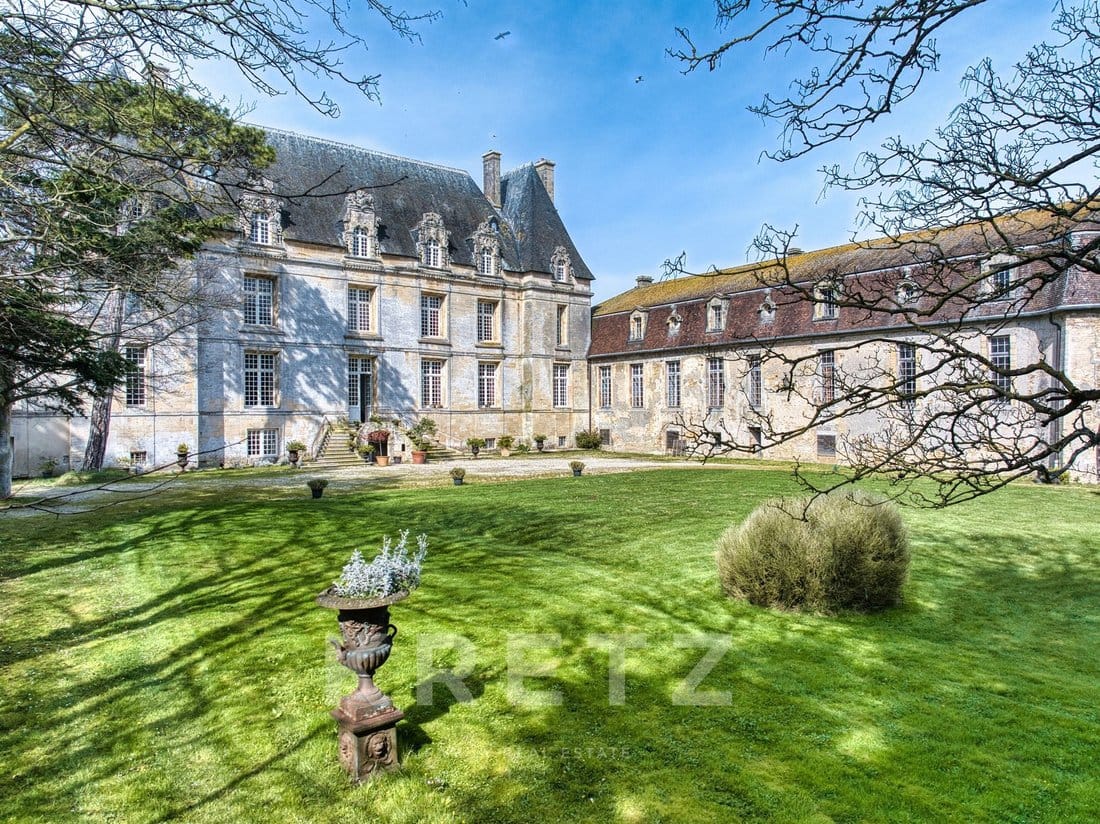
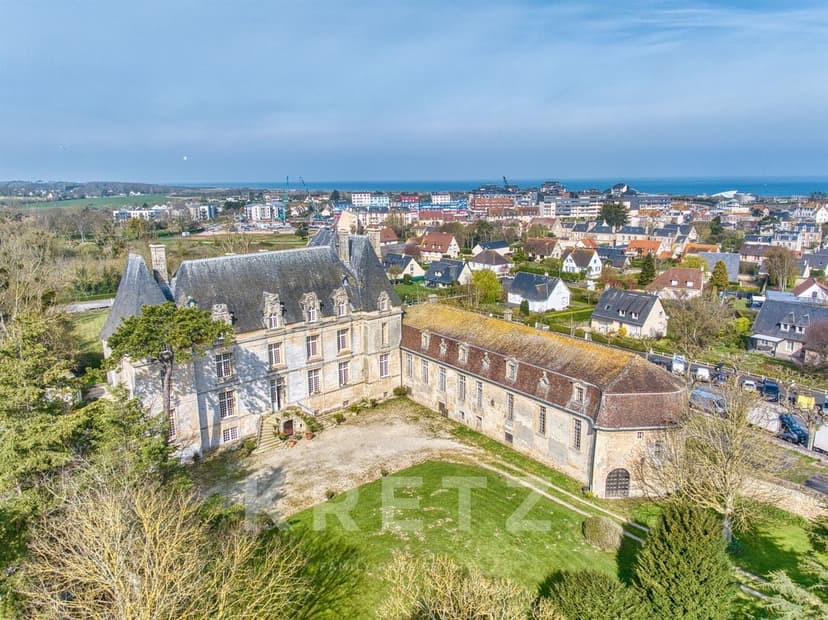
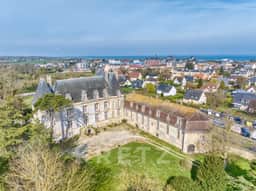
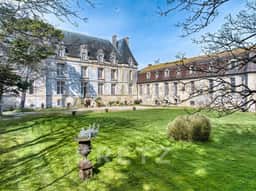
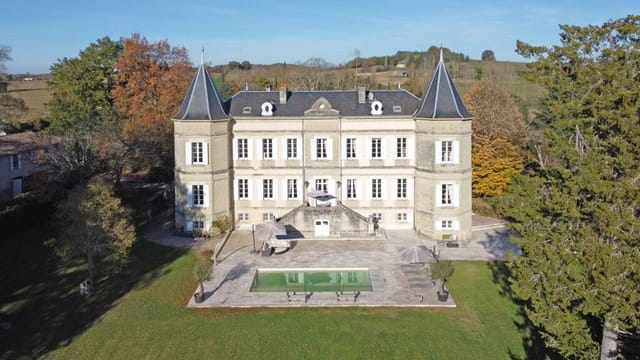
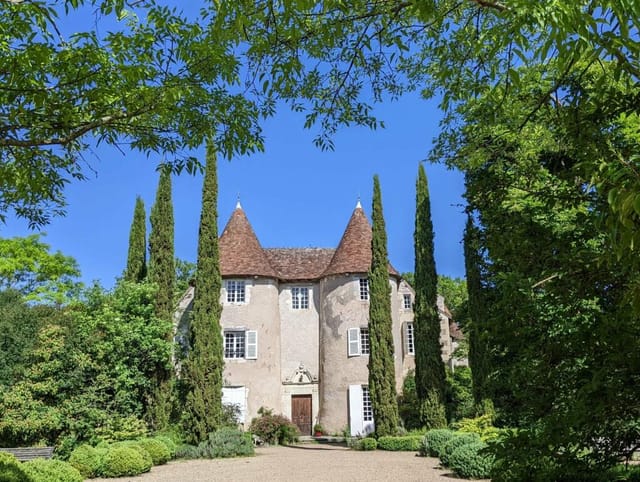
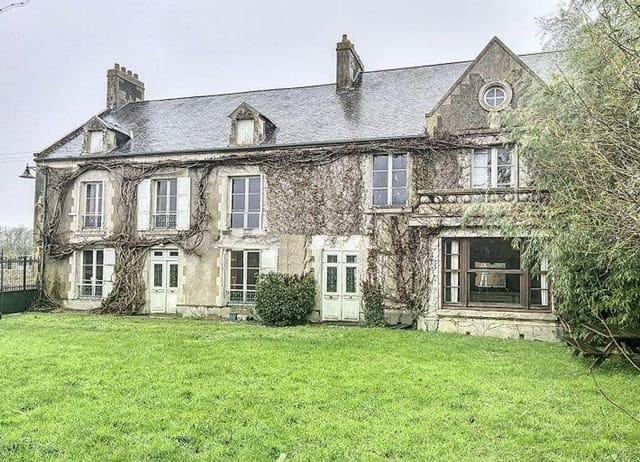
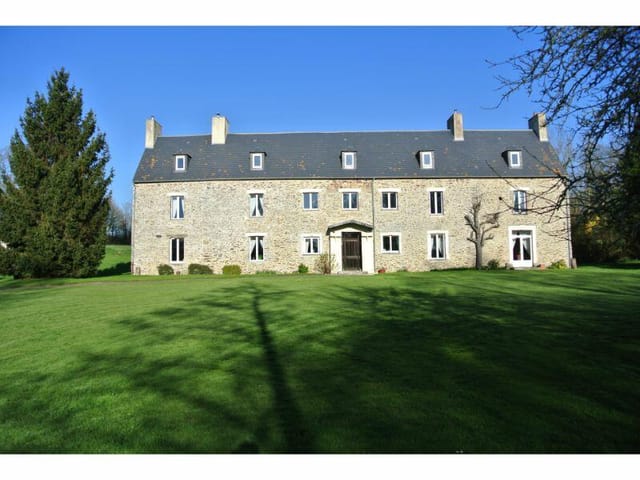
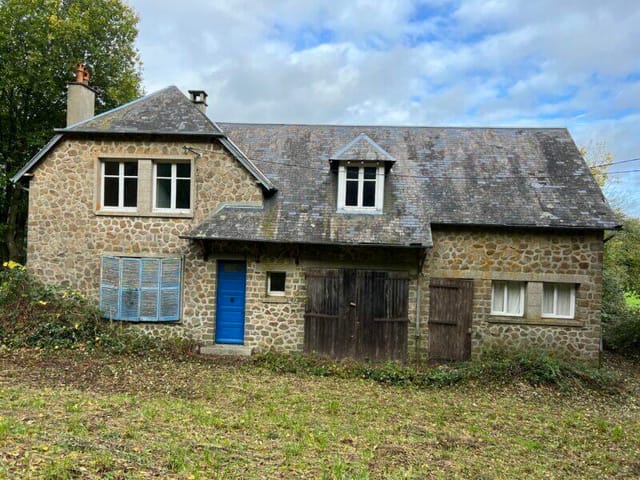
Stand on the terrace of this château on a June morning and you'll understand immediately why this address carries weight unlike any other in France. The salt air comes in off the Channel, the horizon is wide and flat and grey-blue, and less than 400 meters away, Juno Beach stretches in both directions—the same sand where Canadian soldiers waded ashore on June 6, 1944. This isn't a property with a view. It's a property with a conscience. And yet, it's also a genuine home: warm, livable, full of morning light, and surrounded by 1.16 hectares of walled park that make the outside world feel very far away.
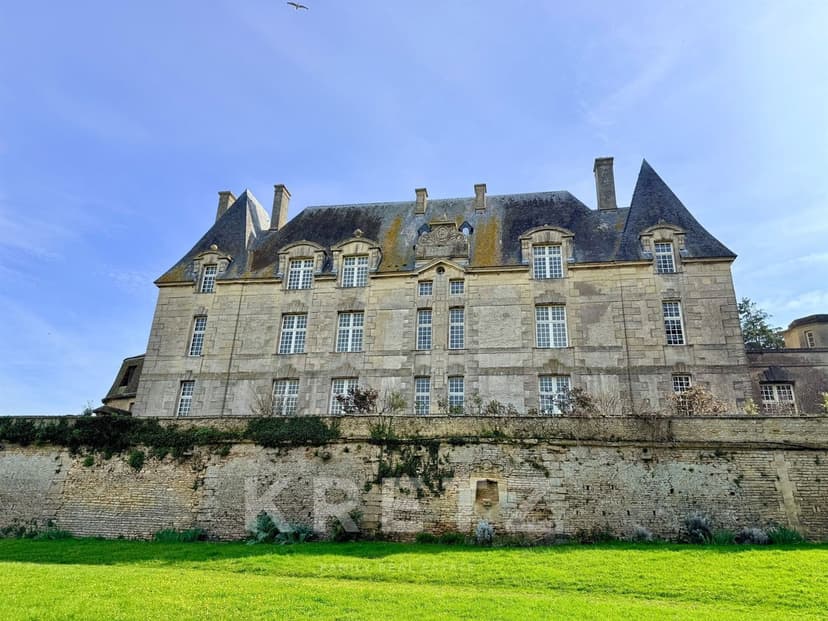
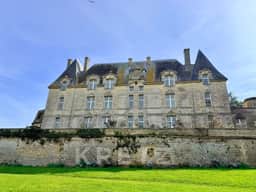
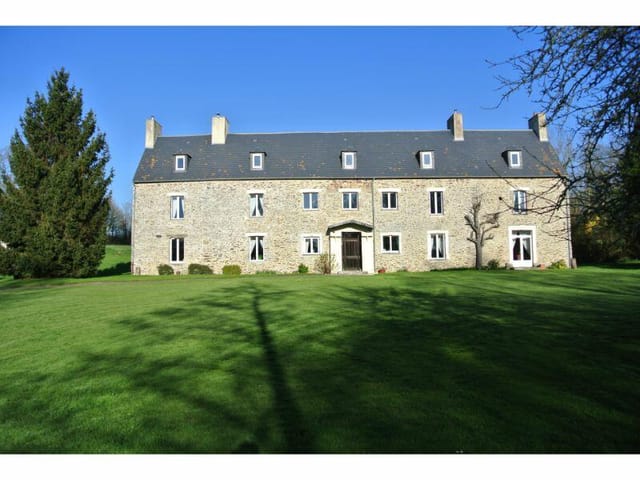
The château sits at 6 Rue du Maréchal Montgomery in Bernières-sur-Mer, a name that says everything about where you are. The street was renamed in honor of the British field marshal who commanded Allied ground forces on D-Day. The building itself predates that moment by roughly three centuries—it's a 17th-century structure, classified as a Historic Monument, the last standing remnant of a once-fortified site that occupied this natural promontory above the Côte de Nacre. Post-war restoration brought it back from significant damage, and subsequent work has been careful and respectful, preserving the Louis XIV bones while making 528 square meters of interior space genuinely comfortable.
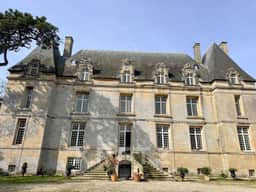
The approach sets the tone. You enter through wrought-iron gates, cross the yew-lined lawns, and climb the horseshoe staircase—that unmistakable double-curved stone entry that was the signature flourish of grand French country architecture in the 1700s. Inside, the proportions are generous without being oppressive. The entrance hall opens to a kitchen with utility room, and beyond that, a dining room of around 60 square meters anchored by a grand fireplace. On a December night, with a Norman cider warming on the stove and rain tapping the tall windows, that fireplace earns its keep. Two reception salons flank the central spaces—both well-lit, both sized for actual gatherings, not just the idea of them.
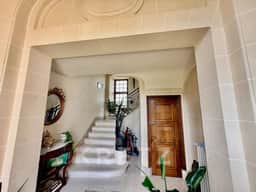
The stone staircase to the upper floors is the kind of architectural detail that photographs can't quite capture. It has a particular solidity, a worn warmth in the stone, that only centuries of footfall produce. Ten bedrooms and six bathrooms spread across the upper levels, enough to host extended family or a rotation of guests without anyone feeling cramped. The period details throughout—parquet floors, carved mouldings, finely worked woodwork—were recreated during restoration rather than faked, which makes a meaningful difference. You feel the intention behind them. Drop down to the garden level and the vaulted cellars open up: the former kitchen is down here, and an original stone well that connects the building physically to its medieval origins.
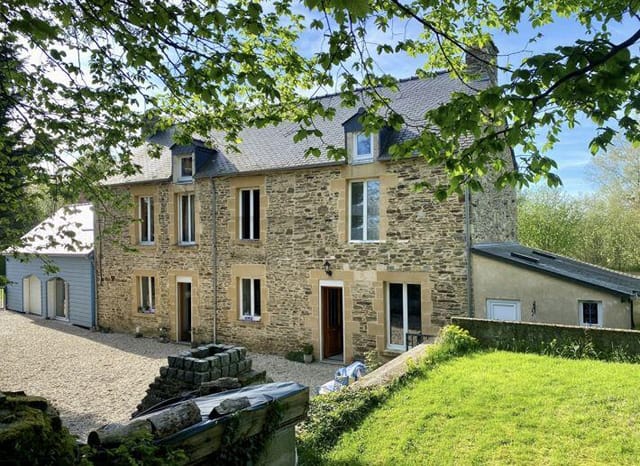
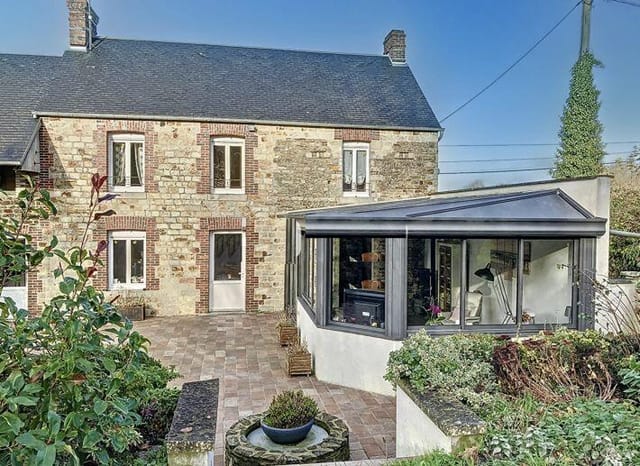
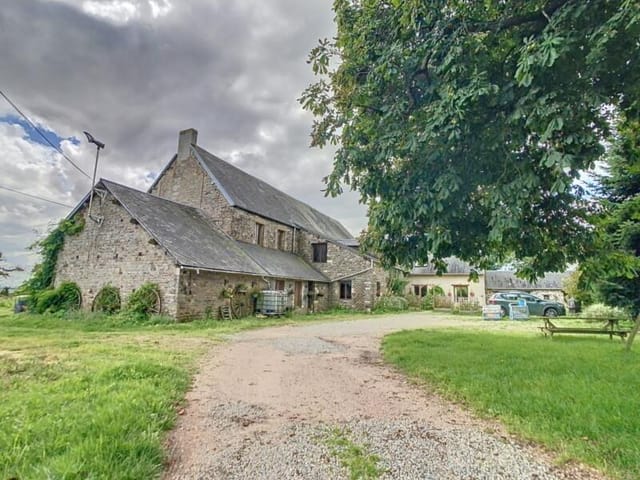
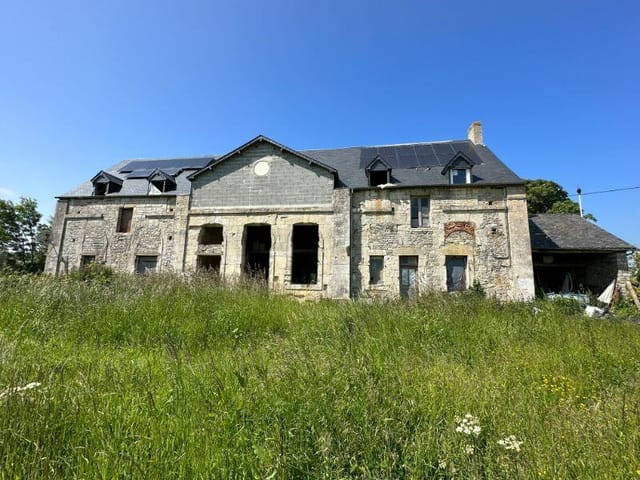
The outbuilding changes the conversation about what this property could become. It spans approximately 390 square meters with its own independent access—a structure in sound condition that hasn't yet been decided. Guest suites, a dedicated event venue, a gîte operation, artist studios: the bones are there for any of these directions. Some interior work would be needed depending on the use, but the structural situation is solid. For international buyers thinking about income generation or multi-generational use, this second building is genuinely transformative.
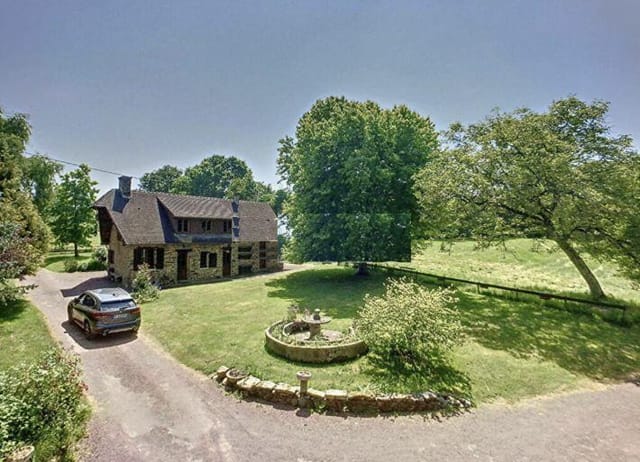
The park deserves its own mention. Fully enclosed behind high stone walls, 1.16 hectares of mature trees, maintained lawns, a vegetable garden, a small orchard, a double garage, and a sea-facing terrace. Privacy inside these walls is near-absolute. You won't hear the road. On clear evenings, the terrace catches the last light off the water, and the Channel goes gold before it goes dark.
Beyond the gates, the Côte de Nacre—the Mother of Pearl Coast—runs east toward Ouistreham and west toward Arromanches. The D-Day sites are your neighbors in every direction: the Juno Beach Centre is a short walk, the Canadian War Cemetery at Bény-sur-Mer is just inland, and Sword Beach, Gold Beach, and Omaha are all within a 45-minute drive. The region draws visitors from Canada, the United States, the UK, and across Europe every summer, particularly around the June anniversary commemorations, which become deeply moving community events rather than tourist spectacles.
Caen is 20 minutes south—a proper city with a University, a remarkable Mémorial de Caen peace museum, the Abbaye aux Hommes, and a food market on Sunday mornings at Place Saint-Sauveur that's worth setting an alarm for. Calvados, andouille de Vire, Camembert from the farms just inland at Camembert village itself, moules marinières from the coast—Normandy feeds people seriously, and Caen is where you go when you want a table at a restaurant that takes its cooking as seriously as Paris does. The ferry port at Ouistreham runs Brittany Ferries routes directly to Portsmouth, making this property accessible from the UK without touching an airport. Paris is roughly 2.5 hours by car via the A13.
For the international buyer, the Historic Monument classification brings both responsibility and advantage. Owners of classified buildings in France benefit from significant tax deductions on restoration and maintenance costs—a legal framework worth discussing with a notaire who specializes in heritage properties. The classification also ensures the building can never be altered in ways that would diminish its architectural integrity, which protects the investment from the kind of unsympathetic renovation that can erode a property's character over time. As a second home or vacation property, this château has exceptional rental potential during the heavy D-Day anniversary season and summer months, when demand for distinctive accommodation in this part of Normandy consistently outstrips supply.
Key features at a glance:
- 17th-century château classified as a Historic Monument, fully restored
- 528 sq m of living space with 10 bedrooms and 6 bathrooms
- Iconic Louis XIV horseshoe entry staircase
- 60 sq m dining room with original grand fireplace
- Period details throughout: parquet floors, carved mouldings, sculpted dormers
- Vaulted garden-level cellars with historic well
- 390 sq m outbuilding with independent access and significant conversion potential
- 1.16-hectare fully walled and gated park
- Sea-facing terrace, vegetable garden, small orchard, double garage
- Walking distance to Juno Beach and the Juno Beach Centre
- Minutes from the Canadian War Cemetery at Bény-sur-Mer
- 20 minutes to Caen, 2.5 hours to Paris by car
- Brittany Ferries connection to Portsmouth via Ouistreham
- French Historic Monument tax benefits available to owners
- Strong summer and anniversary-season rental income potential
This is a rare asset in every sense—historically, architecturally, and geographically. Properties of this caliber on the D-Day coast don't reappear often, and when they do, they rarely carry the combination of scale, condition, park, and outbuilding that this one does. If you're looking for a vacation home in Normandy that also happens to matter, or a second home in France with genuine estate credentials, this château on the Côte de Nacre is worth a serious look.
Contact Homestra today to arrange a private viewing. The horseshoe staircase is waiting.