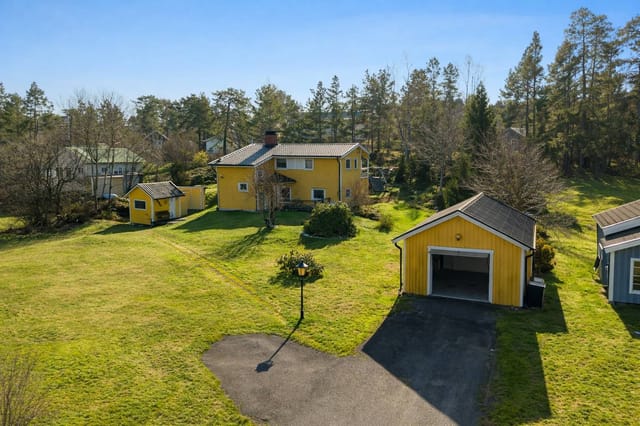
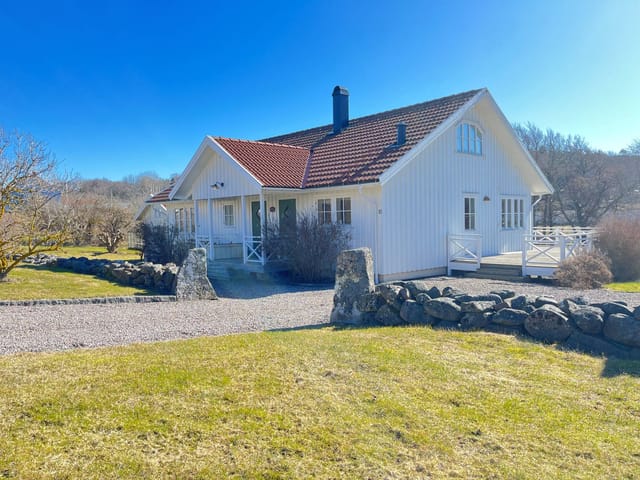
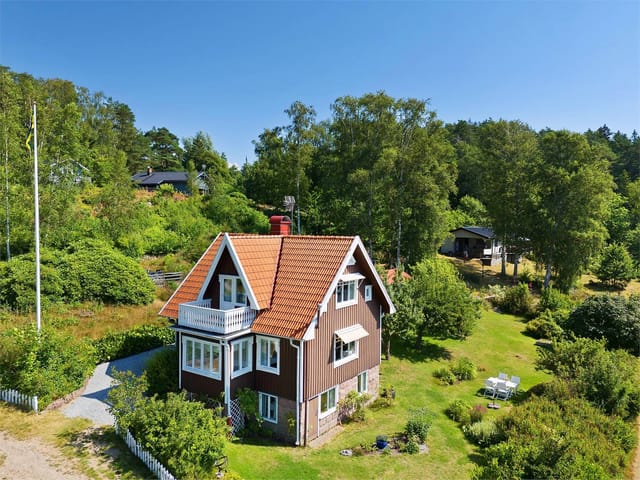
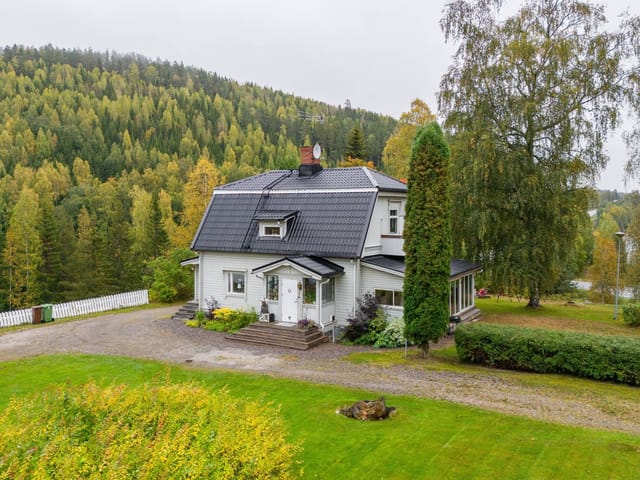
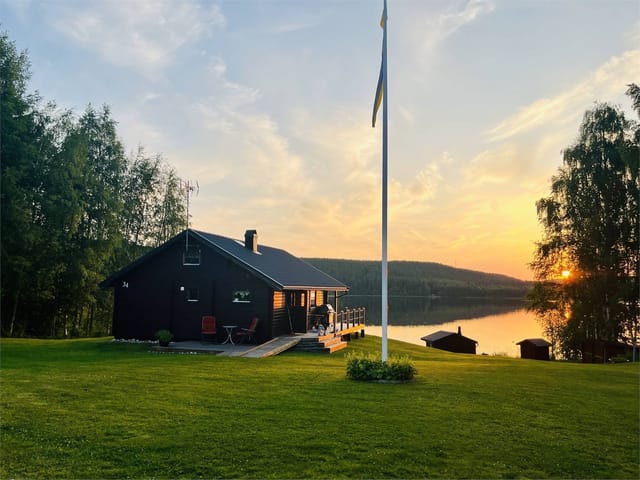
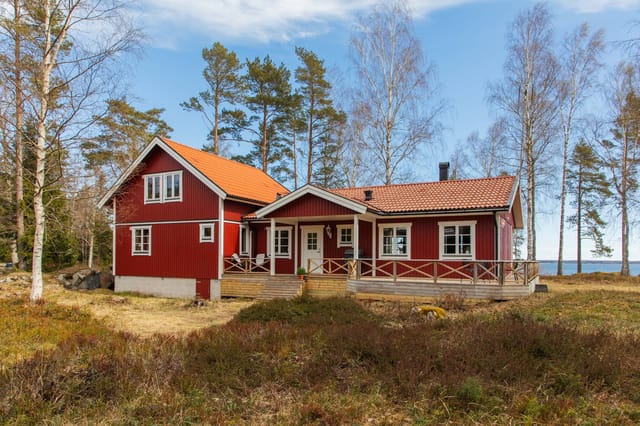
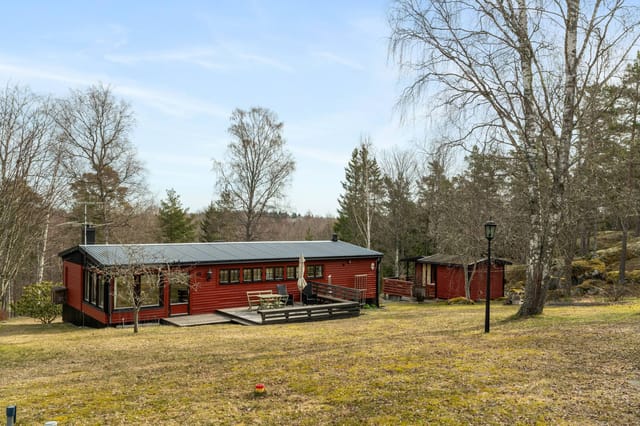
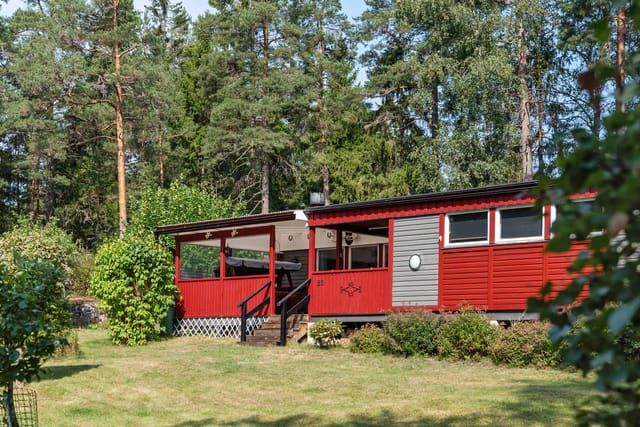
Houses For Sale In Sweden (page 3)

Houses for sale in sweden - homestra offers the largest amount of european real estate with over 200,000+ properties, find any type of property within your budget from villas to country homes. buy or rent your perfect home in europe. (page 3)

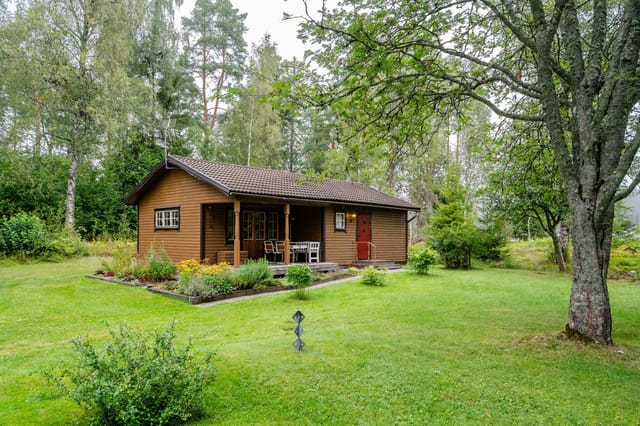
Step outside on a January evening, lid off the spa, steam rising against the dark Swedish sky, and you'll immediately understand why properties like this one at Glindran Solliden are so hard to let go of. The cold bites your cheeks while the water holds you warm, and somewhere beyond the treeline, nothing moves. Complete quiet. This is the Swedish countryside at its most honest. Built in 1952 and sitting on a 4,121-square-metre plot just outside Björkvik in Katrineholms kommun, the house has the kind of solidity you don't often find in newer builds. Thick walls, thoughtful updates, and a layout shaped by generations of practical Scandinavian living. At 122 square metres of main living space plus an additional 15 square metres of secondary area, it doesn't feel oversized or unwieldy — it feels exactly right for a family of four, or for a couple who want room to breathe. Walk in through the front door and the first thing that hits you is light. Large windows pull in the southern exposure across the main living areas, and on a clear winter afternoon the low Nordic sun throws long amber rectangles across the timber floor. The fireplace in the living room is open — a proper one, not a decorative insert — and on colder evenings it becomes the gravitational centre of the whole house. The kitchen adjoins the living space without any awkward formality. Oak cabinetry, generous worktop space, and enough storage that someone who genuinely cooks here could do so without compromise. The proportions feel generous but never cavernous. The fully glazed conservatory running off the main ground floor is genuinely one of the property's best features, and not in an abstract sense. In Sweden, shoulder-season living is everything. Mid-May w ... click here to read more
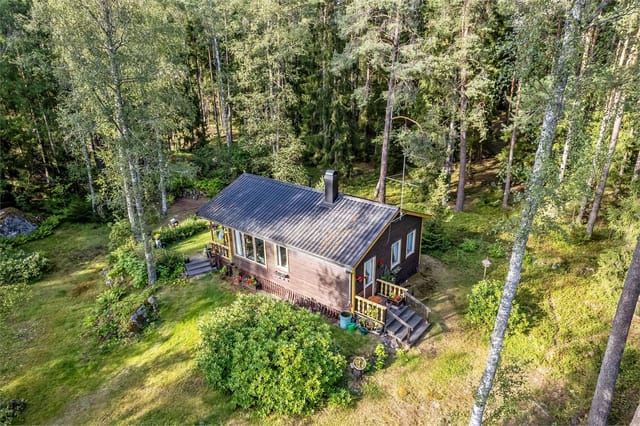
Exterior view of Glindran Solliden

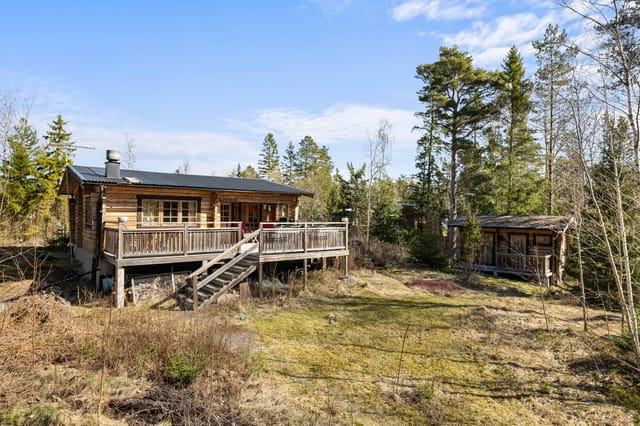
Step outside on a Tuesday morning in July, coffee in hand, and hear absolutely nothing except a wood pigeon somewhere in the birch trees overhead and the distant lap of Lake Vänern carrying across the meadow. That's 550 meters of open Swedish countryside between you and the largest lake in the Nordic countries. That's what Ulleredsbro 56 actually feels like. This is a three-building property on Kållandsö — the wooded island in Lidköping municipality that most international buyers have never heard of, which is precisely the point. It sits in Västra Götaland, a region that Swedes themselves treat as a serious destination, and it offers something increasingly rare: a genuine country retreat with multiple usable structures, a garden that's mature enough to actually give shade, and a waterside lifestyle that doesn't come with a waterside price tag. Listed at 54,900 EUR for a leasehold arrangement (standard and well-regulated in this part of Sweden), this is one of those properties where the numbers make you look twice. The three buildings are what make this place work. The centerpiece is a brand-new Attefall house — a Swedish planning category for compact structures built without a full permit — completed in 2023. Eighteen square meters, yes, but designed with the kind of floor logic that makes every centimeter count. There's a sleeping area, and a bathroom with both a combustion toilet and a proper shower. The materials are fresh, the finish is clean, and the whole thing is built for year-round use. On a cold November weekend, it holds warmth the way a well-insulated modern build should. Then there's the original blacksmith's cottage. Thirty square meters of preserved character — low ceilings, thick walls, a fireplace in ... click here to read more
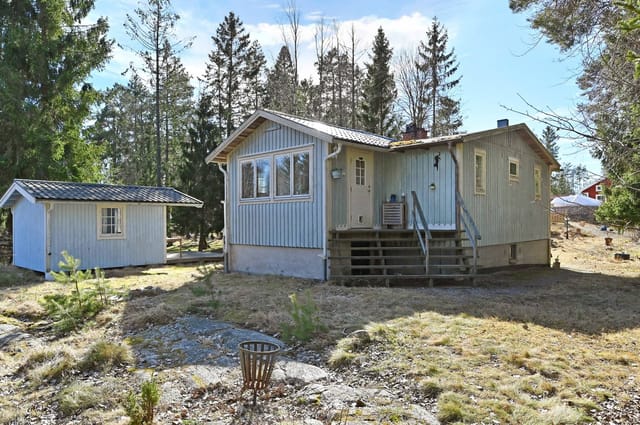
Exterior view of the main house and garden

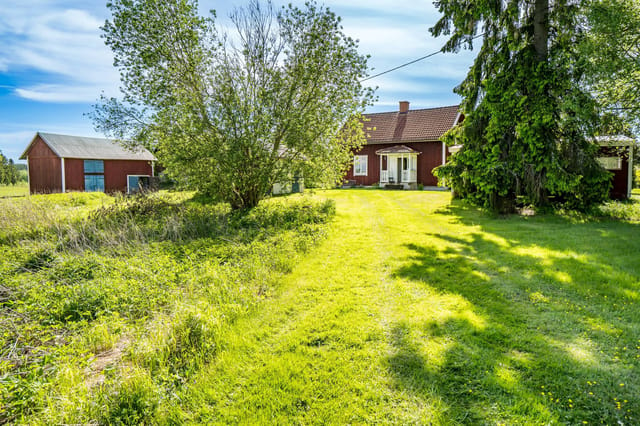
Early on a September morning, the mist sits low over the fields at Ustorp. You open the kitchen window and the smell that comes in is grass and lake water and something faintly woodsy — pine resin, maybe, or the leaves already turning on the birches at the far edge of the meadow. There's no traffic noise. Just the distant call of cranes gathering for their southward journey, and the creak of the old wooden frame as the house warms up. This is what daily life looks like at Ustorp 11, a country property on 2.4 hectares of southern Swedish land, sitting roughly a kilometer from the western shore of Lake Solgen in Eksjö Municipality. The plot is the first thing that stops you. 24,000 square meters of it — open arable fields, mature trees, lawns wide enough to get genuinely lost in. The house sits on elevated ground, which means you're looking out over the surrounding farmland rather than into it. On clear days the view extends toward the lake. In winter, when the deciduous trees drop their leaves, you can see even further. The elevation also means the rooms get good light most of the day, which matters in Småland, where winters are real and dark and you learn to chase the sun across the house. The main residence is in good condition, cared for in the understated way that Swedish country homeowners tend to look after things — quietly, consistently, without fuss. Classic rural Swedish architecture means thick walls, practical proportions, and windows that frame the outside like paintings you never get tired of. Inside, the atmosphere is warm and genuinely liveable. This isn't a renovation project held together by optimism. You could arrive on a Friday evening and simply be here. What sets this place apart from a typical Swe ... click here to read more
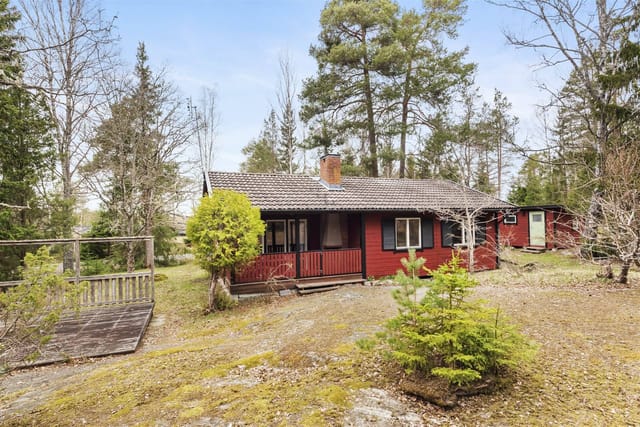
Main house and outbuildings, Ustorp 11

Stand on the balcony at Skolvägen 13 on a clear July morning and you can watch the fishing boats slide out past the harbor entrance toward Väderöarna, the scatter of islands that turns the Bohuslän horizon into something you'd think was painted. The salt air comes in off the Kosterfjord and the church bell on the hill marks eight o'clock. Coffee is already brewing in the kitchen one floor below. This is what owning a piece of the Swedish west coast actually feels like — and this house, sitting barely 350 meters from the water in the very center of Grebbestad, delivers that feeling every single day you're here. The house itself has a story worth knowing. Built in 1891 and physically relocated from Bullaren — a feat of craftsmanship in its own right — it sits on a solid granite foundation that speaks to how seriously the Swedes took their building stock in that era. The renovation that followed was so meticulous, so respectful of every original detail, that the Prince's Fund awarded it recognition for exemplary restoration work. That's not a marketing badge; it's a genuine acknowledgment from Sweden's foremost heritage institution that whoever took on this project cared deeply about getting it right. Wide original floorboards, the weight of old pine doors, the proportions of rooms that feel generous without being cavernous — these are the things you notice when you walk in. The ground floor opens into a kitchen and dining area that has real warmth to it. Not the curated warmth of a showroom, but the kind that comes from a well-considered layout and the right amount of natural light. A veranda runs off this space — the spot where, in practice, most mornings and most evenings end up happening. Comfortable chairs, the sound ... click here to read more
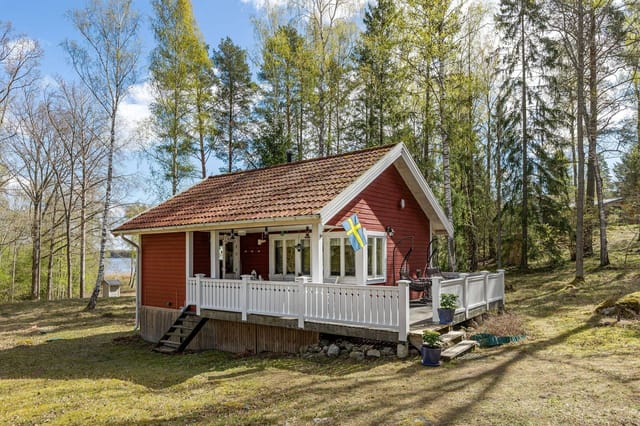
Front view of the house

The smell hits you first — cut grass warming in the late afternoon sun, woodsmoke drifting from somewhere across the fields, and the faint sweetness of the apple trees that line the far edge of the yard. Then you notice how quiet it actually is. Not the uncomfortable quiet of isolation, but the deep, settled quiet of a place that has been at peace with itself for over a hundred years. That's Fågelsta Stormbacken. A 1910 red-painted farmstead on the outer edge of Julita, Katrineholms kommun, sitting on 1.3 hectares of Swedish countryside with the kind of bones that modern houses simply can't replicate. The main house runs to 160 square metres across seven rooms, and it carries its age well. Wide wooden floors creak in exactly the right places. Original period doors still swing on their hinges. Three traditional tiled stoves — kakelugnar — stand in the sitting rooms and do what they've always done: turn a cold November evening into something you don't want to leave. The ceilings are high enough that the rooms never feel crowded even when the family descends in full. Large windows face the courtyard and the open fields beyond, pulling in light from morning through to the long Swedish summer evenings when dusk doesn't fall until nearly eleven o'clock. The kitchen is the heart of the place, as it should be. Country-style cabinetry, a serious amount of worktop space, and updated appliances sit alongside the original character of the room without any sense of awkward compromise. The dining area flows directly off it, which matters enormously when you're hosting — plates passing between rooms, conversation spilling between spaces. This is a kitchen designed for proper cooking, not just reheating. Think slow-braised elk from t ... click here to read more
Front view of Fågelsta Stormbacken country home

Stand at the kitchen window on a September morning, steam rising from your coffee cup, and watch the mist lift slowly off the Värmland fields. Fifty meters away, through a line of birch trees, is Mårbacka — the estate where Selma Lagerlöf wrote the stories that earned her the Nobel Prize in 1909. That's not a marketing line. That's just Tuesday here. Mårbacka 34, known locally as Mårbacka Där Ner, sits on roughly 18,000 square meters of Värmland countryside just outside Sunne in west-central Sweden. The main house dates in spirit to the 18th century — its proportions, its symmetry, the way the windows frame the meadows beyond — but it was fully rebuilt in 1998 after a fire, using materials and methods that honored the original architecture rather than replacing it. The result is a house that feels genuinely old without demanding constant maintenance. Solid wood floors, about four centimeters thick and running the full length of each room, have the kind of depth and warmth you simply don't find in new construction. Every room has its own fireplace or stove — some are classic Swedish kakelugnar (tiled stoves), some are open hearths, others are vedspis wood-burning stoves — and every single one has its own individual flue in the chimney. That detail alone tells you something about how this house was rebuilt: with patience, with intention, without shortcuts. The ground floor sets a particular mood. The kitchen is genuinely the center of gravity — a large cooking island, a wood stove, an induction hob, an electric AGA cooker, multiple ovens, and a wine climate cabinet. This is a kitchen designed for people who actually cook, not for photographs. After a day out on Lake Fryken — the long, narrow lake that stretches through t ... click here to read more
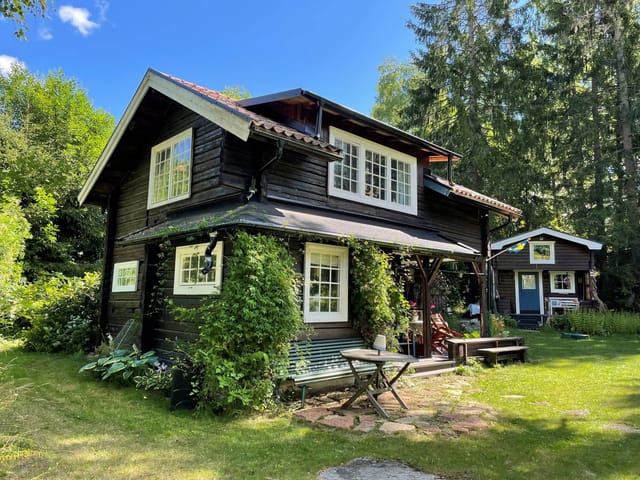
Front view of Mårbacka 34

Picture a Saturday morning in late June. The forest outside is doing that thing it does in Swedish summers — the birch leaves catching the light like scattered coins, the air carrying a faint smell of pine resin and damp earth. You step out of your little chalet at Gäddesta with a cup of coffee, walk the few steps to your raised garden beds, and check on the tomatoes. Somewhere down the path, a neighbor is whistling. This is what 15,300 SEK buys you: not a room, not a timeshare — an actual place of your own, rooted in one of Central Sweden's most quietly rewarding corners. Gäddesta Nr 118 sits within the Karlslunds stugförening, a community of 122 cottage plots spread across the Karlslund Ridge about five kilometers from Örebro's city center. The chalet itself was built in 2018, so there's none of the rot-in-the-eaves anxiety that comes with older Swedish summer cottages. It's compact — 20 square meters, open-plan, with a sleeping loft overhead that's cozy rather than cramped. Think of a well-fitted boat cabin on land. The kitchen runs on propane gas, heating comes from a gas heater that takes the edge off a cool August evening, and the whole interior was recently repainted. It's move-in ready in the truest sense of the phrase. The plot is where things get genuinely interesting. Four hundred and fifty square meters is a serious amount of ground for a property at this price point. Previous owners have made good use of it: there's an outbuilding for tools and garden equipment, raised cultivation beds already in place, and enough open space left over to set up a proper outdoor dining area under the trees. Swedes have a word — friluftsliv — for the philosophy of spending meaningful time in nature, and this garden is a work ... click here to read more
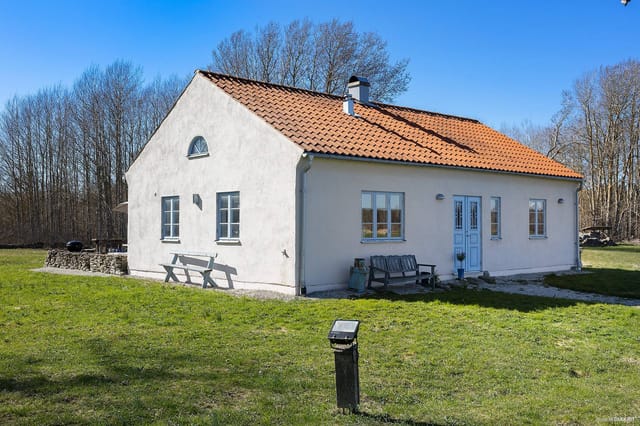
Exterior view of Gäddesta No. 118 cottage

Step outside on a July morning and the lake is already glittering through the birch trees, maybe fifty paces from your front door. By the time the coffee is ready, you can hear the water. That's the daily reality at Stensbovägen 21 — a compact, well-kept house on a generous 2,363 square metre plot in Stensbo, one of those quietly kept corners of Dalarna that locals don't rush to advertise. Built in 1991, the house is 61 square metres of sensible, unfussy living space — two bedrooms, one bathroom, four rooms total — with an extra 10 square metres of secondary space that can absorb whatever life throws at it. A boot room for muddy trails, a workbench for tinkering, a quiet reading corner. The layout is tight without feeling cramped, the kind of floor plan that actually works for two people or a small family rather than looking good on paper and frustrating you in practice. Large windows pull the garden inside, and in the long Nordic summer evenings, the light in here goes golden somewhere around nine o'clock and stays that way for a while. The plot is the real story. At 2,363 square metres, this is serious outdoor space by any standard — not a manicured suburban garden but a proper, usable piece of ground that rewards investment. Raised vegetable beds, a fire pit area, apple trees, room for a greenhouse. Or none of those things — just space and silence and the smell of grass after rain. Two outbuildings come with the property: a traditional Swedish härbre (a historic log storage building that is frankly one of the most atmospheric structures you'll find on a residential plot anywhere) and a guest cottage that gives visiting family or friends their own front door and their own privacy. That last detail matters more than p ... click here to read more
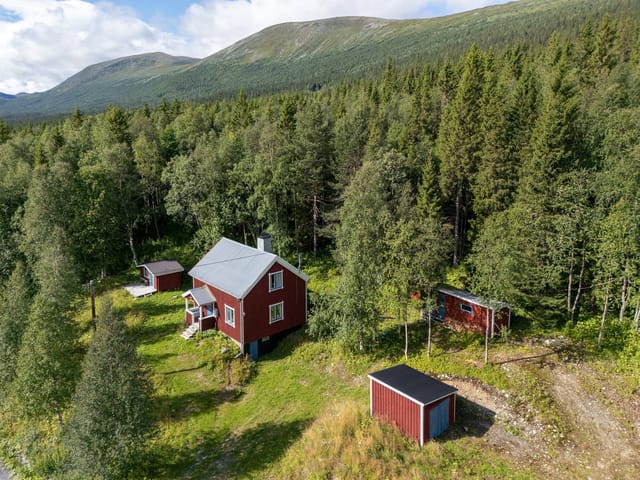
Front view of the house and garden

Step outside on a Saturday morning in July and the lake is right there — twenty seconds down the path, glittering through the birch trees, still enough to mirror the sky. That's not a selling point. That's just Tuesday at Kvarsätters sjöväg 26. This two-bedroom country home sits on a generous corner lot in the Kvarsätter community of Hallsberg Municipality, Örebro County, with Lake Tisaren less than fifty meters from the front gate. It's a proper Swedish fritidshus — built in 1979, solid and well-maintained, 100 square meters of comfortable interior space — but what makes it work as both a vacation home and a potential year-round residence is how effortlessly it fits the life you'd actually want to live here. The house itself is warm and unpretentious. The living room anchors everything: a working fireplace for the deep-winter months when the lake freezes over and the forest goes completely quiet, paired with a modern air-source heat pump that makes climate control genuinely practical in every season. Autumn evenings in particular are something here. The surrounding forest turns amber and rust in September, and with the heat pump humming quietly and a fire going, the inside of this house becomes exactly the kind of place you don't want to leave. The kitchen is full-sized and functional — real counter space, real storage, designed for people who actually cook rather than just heat things up. It flows naturally into the dining area, which matters when you've got family visiting or friends up from Stockholm for a long weekend. The bathroom is large and modern, refreshingly so for a house of this era and type. Out back, a substantial south-facing wooden deck catches sun from mid-morning through early evening. In midsumme ... click here to read more
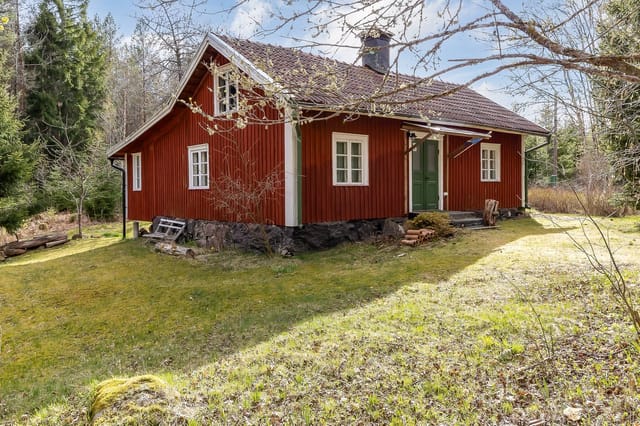
Exterior view of the house and garden

The first thing you notice on a February morning at Vallavägen 10 is the silence. Not the dead kind, but the thick, insulated quiet that only comes when snow has settled deep into the spruce forest outside your window. Then comes the smell of coffee on the stove and the faint creak of pine floorboards underfoot — the kind of sensory ritual that turns a ski holiday into something you start planning your entire calendar around. This two-bedroom mountain chalet at Hundfjället in Sälen is the kind of place that gets under your skin. At 44 square meters, it's compact in the best possible way: everything has a purpose, nothing is wasted, and the layout has a logic that only becomes obvious once you've spent a week inside it. You come back from a long day on the pistes and the covered terrace greets you before you even reach the door — a decent-sized outdoor area that works just as well for a cold beer at dusk in January as it does for morning coffee in June when the meadows around Hundfjället turn green and yellow. Built in 1976 and maintained to a genuinely solid standard, the cabin carries the unpretentious confidence of Swedish mountain architecture. The main living space — the storstuga, as it's known locally — anchors the whole interior. A masonry fireplace with an insert sits at the heart of it, and on the evenings when you light it after a full day of skiing the Tandådalen connection runs, you understand exactly why people buy these places and never sell them. The wooden floors, the warm timber ceiling, the open connection between the dining and lounge areas — it all adds up to something that feels earned rather than designed. The kitchen is practical in the right ways: stove and oven, a combined fridge-freezer, a di ... click here to read more
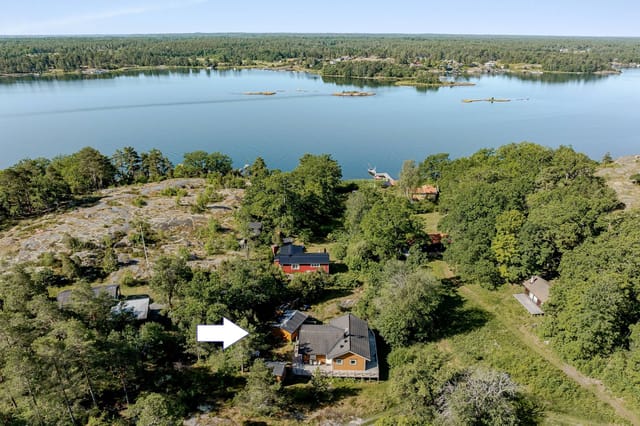
Exterior view of the mountain cabin

There's a particular kind of quiet you notice on your first morning at Ladängsstigen 4. Not silence exactly, but the soft, layered stillness of birch trees filtering the early light, the occasional splash from Lake Mälaren just down the road, and the smell of damp Swedish earth warming up in the sun. By the time you've made coffee and stepped out onto the wooden deck, you understand immediately why people who find this corner of Lybeck/Frösåker rarely want to leave. This is a proper year-round holiday home — 47 square meters of well-used, freshly finished living space sitting on a freehold plot of 2,096 square meters — in one of the most quietly sought-after pockets outside Västerås. The address is Ladängsstigen 4, and it sits in that rare sweet spot between genuine countryside and real accessibility. You're not roughing it. You're not trading convenience for scenery. You get both. Step inside and the vaulted ceiling does something unexpected to the space. For a 47-square-meter house, it feels generous, open, almost roomy. The open-plan layout puts the kitchen and living area in easy conversation with each other, which matters when you're cooking Swedish meatballs on a Friday evening while family settles in around the fireplace. That fireplace earns its keep from October through April — this is central Sweden, and the winters are real, crystalline, and honestly quite wonderful when you're watching snow settle across the garden from a warm interior. Large windows pull the outside in throughout every season, and in July, when the garden goes full green and the lake shimmers at the end of the road, you'll understand why Swedes have been making pilgrimages to places exactly like this for generations. The two bedrooms are ... click here to read more
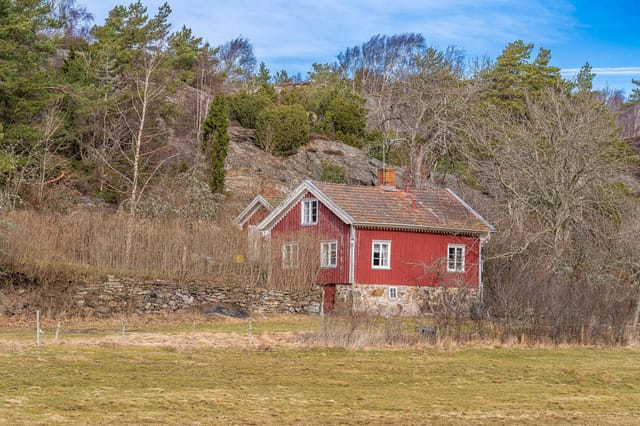
Front view of the house and garden

Step outside on a July morning and the air already carries salt from the Baltic. The rauks — those ancient limestone pillars rising from the water at Kyllaj — are catching the low sun about five hundred meters away, and the only sounds are wind through the birches and the distant clang of a mooring line at the small harbor. This is northern Gotland on a weekday, and it feels like the rest of the world doesn't exist. This 1929 whitewashed country home has belonged to one family for roughly sixty years. That kind of continuity is unusual, and you can feel it. The proportions are honest, the walls are thick, and nothing about the place feels rushed or flipped. It sits on 2,475 square meters of mature garden — big enough for a vegetable patch, a lawn worth lying on, and still room for the kids to disappear somewhere between the trees. At 69 square meters, the interior is compact but genuinely livable. The living room pulls in light from large windows that look straight onto the garden, and on a clear afternoon the brightness in that room is something else — white walls, wooden floors, and green outside every pane of glass. The kitchen keeps its rustic bones while running on modern appliances, with enough bench space to actually cook rather than just heat things up. Gotlandic lamb stew with local saffron, maybe, or fresh-caught pike-perch from one of the fishing spots along the northern coast. The bedroom is a proper quiet room — not a converted alcove — with the kind of stillness at night that urban buyers simply haven't experienced in years. What sets this property apart from most holiday homes in Sweden isn't the house itself. It's everything around it. The earth cellar keeps wine and root vegetables at a natural cool t ... click here to read more
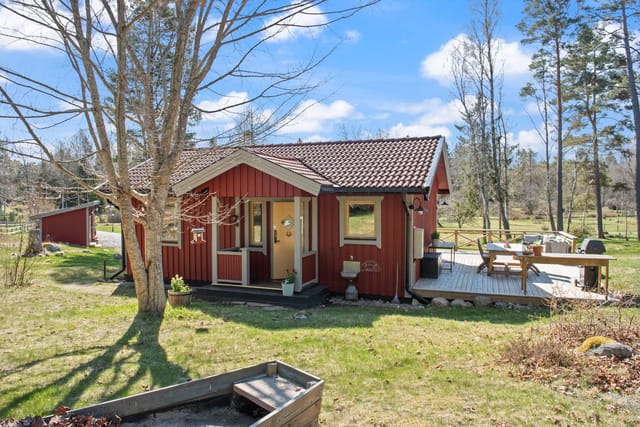
Front view of the house and garden

Stand at the kitchen window on a Tuesday morning in July, coffee in hand, and the only sounds reaching you are birdsong and the distant knock of a wooden hull against a dock. That's Matrosvägen 8. It sits at the very end of a quiet cul-de-sac, three kilometres south of Grisslehamn village, on a natural plot that feels far wilder and more private than 2,727 square metres should feel. This is a proper Swedish coastal property — year-round insulated, intelligently laid out, and set up for a lifestyle that moves between the pool, the sea, and the archipelago in easy, unhurried steps. The main house runs to 80 square metres, and it earns every one of them. The living room centres on a wood-burning stove that pulls the whole room together — on October evenings when the birch trees outside have gone amber and the temperature drops fast, this becomes the most important piece of furniture in the house. Large windows look out directly onto the garden, and in spring, when the wild cherries flower along the boundary, the view through that glass is genuinely something to stop and look at. The kitchen is generous enough to seat people around a table while something is cooking — a proper sociable kitchen, not a galley you have to take turns standing in. The bedroom is calm and well-proportioned, and the tiled bathroom with shower and WC is clean, modern, and functional. Nothing overcomplicated. The whole house is designed to be easy. What makes this property genuinely unusual for the area is the garden setup. In the middle of the plot sits a large insulated swimming pool with a retractable roof. In practice, this means you're swimming in May and still swimming in September, which in the Stockholm archipelago is not something to take ... click here to read more
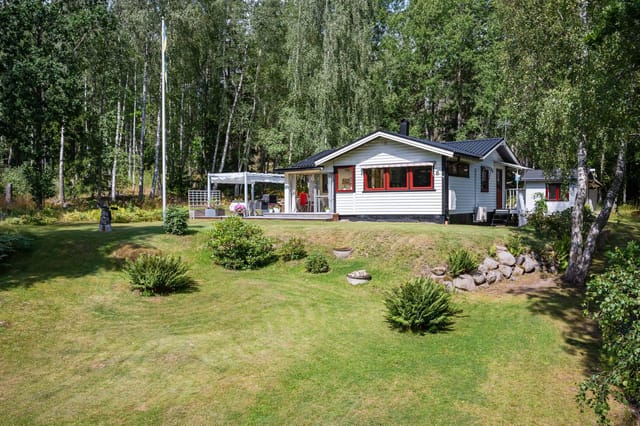
Main house and garden view

Picture a Tuesday morning in late July. You've left the house on Gata 29 with a thermos of coffee, walked the five minutes down to Grönemad harbor, and you're untying your boat before most of the village has woken up. The Bohuslän archipelago stretches out in front of you — smooth granite skerries, dark green islands, the kind of light that northern Sweden does in summer that you simply cannot photograph well enough to explain to people who haven't seen it. That's the morning this property makes possible. Grebbestad sits on the western coast of Sweden, tucked into the Tanums municipality on the Bohuslän coast about 130 kilometers north of Gothenburg. It's one of those small Swedish coastal towns — population hovering around 1,500 — that somehow punches well above its weight in the summer. The harbor fills with sailboats from Norway and Denmark. The seafood shacks along the promenade sell some of the freshest oysters and langoustines you'll find anywhere in Scandinavia; the Grebbestad oyster in particular has a mild, mineral flavor that local restaurants have been building menus around for decades. During the Grebbestad Oyster Festival in October, the whole town turns into something between a food market and a street party, and it draws visitors from across Sweden and Norway every year. This is a house that has been sitting quietly on its 1,301-square-meter plot since 1964, and it still has the original bones of that era — the kitchen with its period detailing, the compact layout that was designed for real living rather than Instagram staging, the deep basement running the full length of the ground floor. It's been inspected by Fukt & Byggkonsult and the sale includes insurance against hidden defects, so you're not walk ... click here to read more
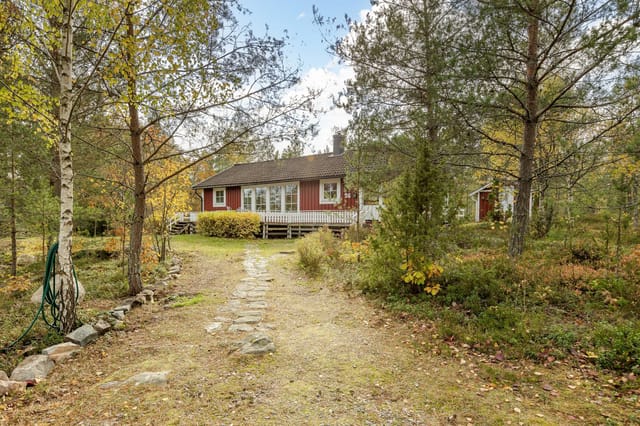
Front view of the house and garden

There's a particular kind of quiet that settles over Lundsbäck on a Saturday morning in June. The kind where you hear bees before you see them, where the smell of someone else's tomato plants drifts over the low hedge, and where your only real decision is whether to take your coffee in the conservatory or carry it out to the garden table while the dew is still burning off. That's the rhythm this 39-square-meter cottage runs on — and once you've tasted it, the city starts to feel very far away indeed. Tucked inside the Lundsbäck Koloniförening allotment community in Helsingborg's Vasatorp district, this one-bedroom summer house is a genuinely well-thought-out small space. At 39 sqm, every square meter is earning its keep. The glass-fronted conservatory greets you as you arrive and immediately does double duty — it's the first room you walk into and the last one you want to leave. On rainy Swedish afternoons (and there will be a few), it's where you'll eat dinner listening to drops on the glass. On sunny evenings, the doors fold back and it becomes an open-air dining room with a roof, which is exactly as useful as it sounds. Inside, the layout flows naturally from the conservatory into a furnished TV room, then into a well-proportioned bedroom that handles a double bed and actual storage without feeling cramped. The kitchen has more counter space than you'd expect and a proper spot for a dining table — so cooking here doesn't mean exiling yourself from conversation. A toilet sits neatly between the bedroom and kitchen. It's compact, yes, but the design has been done with enough intelligence that compact doesn't feel tight. The garden is genuinely the heart of this property. The plot is sunny from morning through evening ... click here to read more
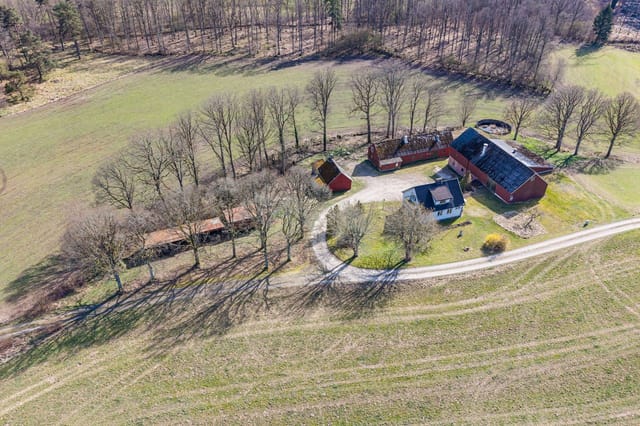
Exterior view of the cottage and garden

The first thing you notice when you step onto the boathouse terrace is the silence. Not the absence of sound—more like a different kind of sound entirely. Lake Vättern stretches out in front of you, Sweden's second-largest lake, and on a still morning the water is so clear you can see several meters down to the pale sandy bottom. A pair of oystercatchers call from somewhere along the shoreline. The birch trees behind the house are just catching the early light. You haven't checked your phone yet. You probably won't for a while. This is a vacation home and second property opportunity that doesn't come around often. The house at Norra Bäckebo Sjungarns 1 sits on the western shore of Lake Vättern, outside the small municipality of Habo in Västra Götaland County, and the setting is about as private as private gets in Sweden. Your nearest neighbor is a few hundred meters away through the trees. The plot is 1,100 square meters of genuine lakefront, and the water is yours to use directly—swim from the dock, moor your boat in the boathouse, or just sit and watch the weather move across the lake in the afternoons. The house itself was built in 1874 and still carries the bones of that era. Thick walls. Low ceilings in the original rooms. A kitchen with the kind of character that newer builds never quite achieve no matter how hard they try. At 50 square meters the footprint is compact, two rooms and that distinctive kitchen, but the additional 20 square meters of auxiliary space gives you practical breathing room for storage or a workshop. This is not a property you buy because you need square footage. You buy it because you want a base for a different kind of life, and the boathouse terrace at dusk in July earns its keep a thous ... click here to read more
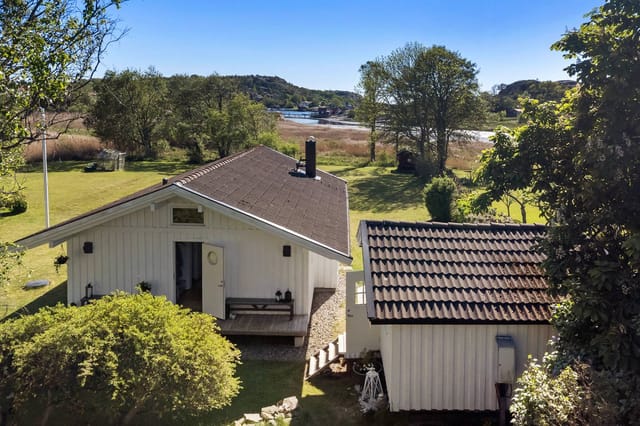
Lakefront view and main house

Picture this: it's a Friday evening in late June, and you've just pulled off the E18 onto the quiet lane that winds through the birch trees toward Mellansundet. The windows are down. The air smells of pine resin and lake water. By the time you step out of the car, the stress of the week genuinely feels like it happened to someone else. That's what owning a place like this does to you. Mellansundet 5 sits in one of those rare pockets of Swedish lakeside life that doesn't announce itself on any tourist map. This is a 40-square-metre, two-bedroom holiday cottage on the shores of Lake Mälaren—Scandinavia's third-largest lake—less than 50 metres from the water's edge, yet only a short drive from the centre of Västerås. It was built in 1967, and it carries that era's sensibility: compact, considered, nothing wasted. It's in good condition and genuinely move-in ready, the kind of place you can arrive at on a Thursday night with a bag of groceries and immediately feel at home. The interior is arranged so that every square metre pulls its weight. Two bedrooms, a shower room, a kitchen with enough counter space to actually cook in, and a living room with large windows that frame the surrounding greenery like a painting that changes with the seasons. In July those windows glow with green light filtered through mature deciduous trees. By late September, the same view turns amber and rust. When snow sits on the branches in February, you'll understand why Swedes invented the concept of mys—that particular indoor coziness that has no real English translation. The conservatory is the room that catches most people off guard. It's a glass-enclosed extension that acts as a buffer between indoors and out—warm enough to sit in with a coff ... click here to read more
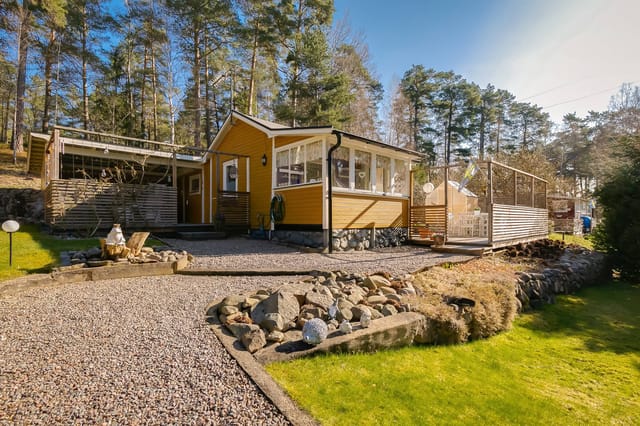
Exterior view of the cottage

Early Saturday morning in Ljungbyhed, the air carries something you can't quite name — pine resin, damp earth, maybe the faint sweetness of wildflowers along the stream that cuts through the back of the plot. The wood-burning stove is still warm from the night before. You pull on a jacket and step outside onto 1,400 square metres of your own ground, and for a moment, Sweden feels like the best decision you've ever made. This three-bedroom house at Prästmöllan 1032 sits in the quiet countryside of Klippans kommun in northern Skåne, one of Sweden's most quietly compelling regions. It's not a showpiece — it's better than that. It's a genuinely liveable, recently updated home with a big plot, mature surroundings, and one of Sweden's finest national parks less than ten minutes away by car. At 65,500 EUR, it's one of the more honestly priced second home opportunities in Scandinavia right now. The house itself covers 70 square metres of main living space plus an additional 10 square metres of secondary area — compact but well-organised, the kind of layout that encourages you to actually be outside rather than rattling around indoors. Five rooms means you have real flexibility: three bedrooms, a sitting room anchored by a wood-burning stove that's been inspected and approved, and space left over for however you like to work or unwind. The bathroom was fully renovated in 2022, with clean modern fittings that feel considered rather than just functional. The roof was replaced with new felt in 2024. An air-to-air heat pump, also installed in 2024, handles both heating in winter and cooling in summer. Municipal water and sewage connections were completed in 2022. These aren't cosmetic updates — they're the expensive, structural thi ... click here to read more
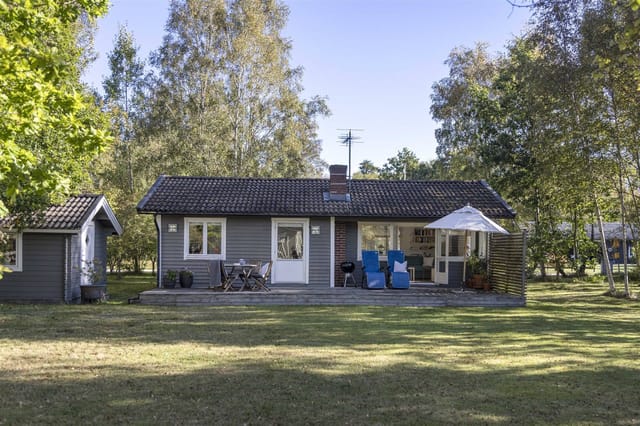
Front view of the house

Early on a Saturday morning in July, you pour a coffee in the kitchen—light streaming through leaded glass panes, the faint smell of birch from last night's fire still hanging in the air—and push open the double glass doors onto a sun-drenched wooden deck. The trees are still. Somewhere down through the pines, Hanskrokaviken glints. You have nowhere to be. This is Högslingan 55 on Ingarö, and owning it feels a little like exhaling. Ingarö sits in the outer reaches of the Stockholm archipelago, part of Värmdö municipality, roughly 50 kilometers east of the city center. The island is not the wild, ferry-only kind of archipelago that takes half a day to reach—it's connected, reachable, and deeply livable. Bus 433 from Eknäsvägen delivers you to Slussen in about 50 minutes, which means a Friday evening escape from central Stockholm and a Sunday evening return is genuinely uncomplicated. For international buyers flying into Arlanda or Bromma, the drive out via the E18 and Route 222 takes around an hour, winding past boathouses, spruce forests, and roadside wild strawberry patches in summer. The house itself is compact in the best possible way. Thirty-three square meters sounds small on paper, but the renovation here was done with real intention. White-painted walls bounce light around the rooms, and the decision to paint the deep window niches in dark forest green was a bold one—it works completely. The leaded windows throughout give the cottage a kind of quiet personality. Exposed ceiling beams, light wooden floors, a kitchen designed in a practical U-shape with room to actually cook: this is a place where someone thought carefully about how people live in small spaces, then built accordingly. The wood-burning stove in th ... click here to read more
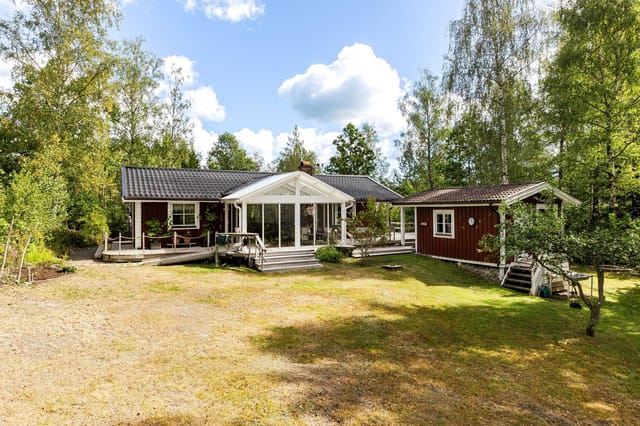
Exterior view of the house and garden

Stand at the end of your own jetty at six in the morning. The water in Tanumskilen is so still it mirrors the granite cliffs on the far shore. A cormorant dries its wings on a rock nearby. Your coffee is getting cold back on the terrace. You don't care. This is what owning Klätta 1 A and B actually feels like—and there is genuinely nothing else like it on the Swedish west coast market right now. Set on its own private peninsula in the Bohuslän archipelago, just outside Tanumshede in Västra Götaland county, this is an 8.3-hectare coastal estate comprising two fully winterized residential houses, a private boat and swimming jetty, and direct frontage onto some of the most sought-after sailing water in Scandinavia. The shoreline sits roughly 100 meters from the front doors. Four bedrooms, two bathrooms, 167 square meters of indoor living space, and an additional 62 square meters of utility area across the two interconnected properties—together they form a compound that works equally well as a private family retreat or a genuinely viable coastal business base. The Bohuslän coast has been pulling people north from Gothenburg for generations, and for good reason. This is the Sweden of salt-bleached wooden boathouses, hand-painted red cottages perched on polished rock, and harbors where the morning catch gets weighed while the fog still sits low on the fjord. Grebbestad, about 8 kilometers east and reachable in ten minutes by car, is the kind of town where the oyster boats come in at the Grebbestad Fiskmarknad and you can eat those oysters an hour later at a table overlooking the quay. In July, the harbor fills with wooden sailing vessels for the annual gatherings that attract classic boat enthusiasts from across the Nordic c ... click here to read more
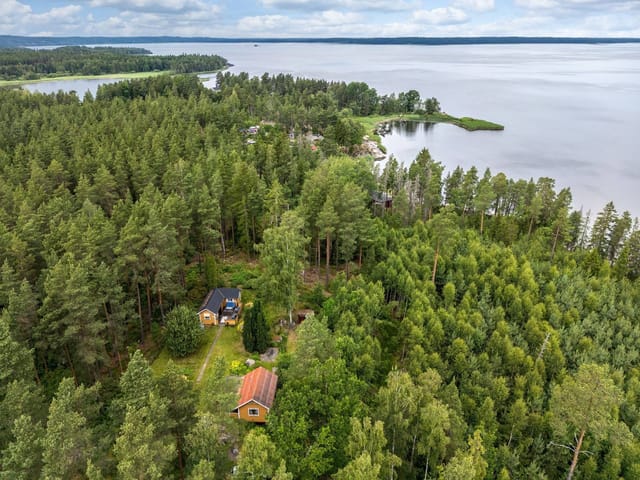
Main house and sea view

Step outside on a January morning and the ice on Storsjön stretches further than you can see, perfectly groomed, with the faint scrape of skate blades drifting up from the plowed track that runs just 100 meters from your front door. In summer, that same shoreline smells of warm pine resin and lake water, and your private boat is already tied up at the berth, ready to go. This is Ångersnäsvägen 30 in Årsunda — a 2020-built year-round house in Sandvikens kommun that genuinely earns the word "practical" without ever feeling dull. Built four years ago to current Swedish energy standards, the 74-square-meter main house is single-level, which matters more than people expect. No stairs to navigate after a long ski day, no awkward layout to work around when you're hosting family for midsummer. The open-plan kitchen, dining, and living space flows naturally, and the large windows pull in so much Nordic light during summer that the interior almost glows. On a grey November afternoon, that same layout means a single source of warmth fills the whole space quickly and evenly — a small but real advantage in this climate. The kitchen is fully fitted with modern appliances and enough counter space to actually cook in, not just reheat things. The dining area handles a proper table for six without crowding anyone. Two bedrooms, proportioned sensibly — one for a double bed with room to spare, one flexible enough to swap between guest room, kids' room, or a quiet place to work when the rest of the house is busy. The bathroom has been finished with clean, contemporary fixtures and practical storage. Nothing over-engineered, just a house that works. What makes this property a genuinely interesting purchase is the guest cottage sitting sepa ... click here to read more
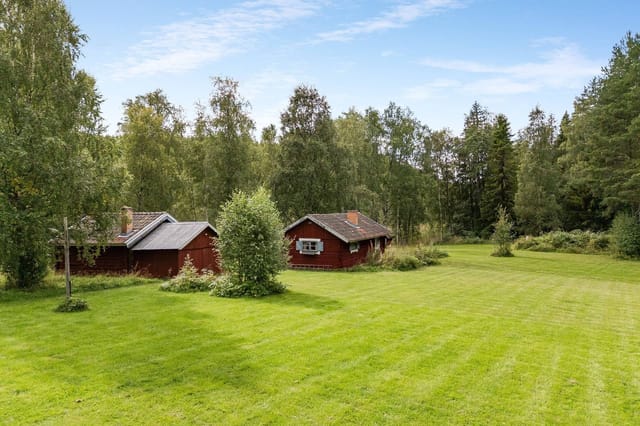
Front view of the house and garden

Step outside on a July morning in Joesjö and the air hits you differently. It's cold even in midsummer, sharp with pine resin and the faint iron smell of the stream running beside the lappkåta. The silence isn't empty—it hums with birdsong, the soft creak of the cabin settling in the warmth, and about 250 meters through the trees, the sound of Övre Jovattnet lapping at its stony shore. This is Swedish Lapland at its most honest. No curated Instagram version of it. The real thing. The cabin at Joesjö 318 was built in 2005 and it wears its age lightly—well-kept, solid, move-in ready. From the moment you walk through the door, the ceiling grabs your attention. It rises all the way to the roof ridge, opening the living space upward in a way that feels genuinely generous for a 70-square-meter footprint. Large windows pull the forest inside without you having to go anywhere. The kitchen flows naturally from the living room, and you can watch the lappkåta sitting quietly across the stream while you wait for the kettle to boil. There are two bedrooms on the main level—calm, practical, well-proportioned. Above them, a loft adds sleeping space for kids or visiting friends, the kind of flexible setup that makes a mountain cabin feel like it can absorb however many people turn up. The bathroom has a sauna. Of course it does. This is Sweden. But it's worth saying clearly: finishing a day of hiking up Norra Storfjällets trails and stepping into that heat is not just pleasant. It's transformative. Your legs stop arguing with you. Everything quiets down. Directly across from the main cabin, on its own separate plot included in the sale, stands the lappkåta. This traditional Sami-style structure is something genuinely rare to find in ... click here to read more
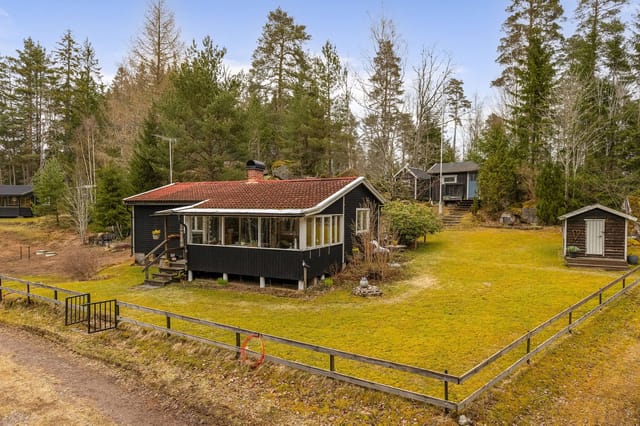
Exterior view of the main cabin

Sometime around midsummer, the sky above Ödeborg Stommen never fully darkens. By ten at night there's still a warm amber glow sitting low over the meadow to the west, and the only sound is the occasional rustling of birch leaves and a woodpecker working somewhere deep in the tree line. That's the daily reality of owning this 1837 Swedish torp cottage — not a concept, not a marketing angle, just a genuinely quiet piece of Västra Götaland that costs less to run per year than most city dwellers spend on coffee. Set on a 1,736 square meter plot along the rural road at Ödeborg Stommen 5, just outside Färgelanda, this single-bedroom country home sits in a part of Sweden that doesn't get overrun in July. The Bohuslän coast draws the crowds — Strömstad, Smögen, Grebbestad — but this corner of inland Dalsland stays calm. You share the landscape with red-painted farm buildings, elk at the forest edge, and the occasional tractor. For buyers hunting a vacation home in Sweden that feels genuinely off the beaten path rather than performatively rustic, this is the real thing. The cottage is compact at 30 square meters, split across two rooms, and that's precisely the point. There's no maintenance burden here, no sprawling house demanding weekends of upkeep. A wood-burning stove handles cool evenings with the satisfying crackle that central heating simply cannot replicate. An air-to-air heat pump — controllable via smartphone — means you can turn the place on before you arrive in October and step into a warm room after a two-hour drive from Gothenburg. Running costs for the entire year run to roughly 4,200 SEK. For context, that's around €370. That's it. The robotic lawn mower handles the garden autonomously, so your weekends here sta ... click here to read more
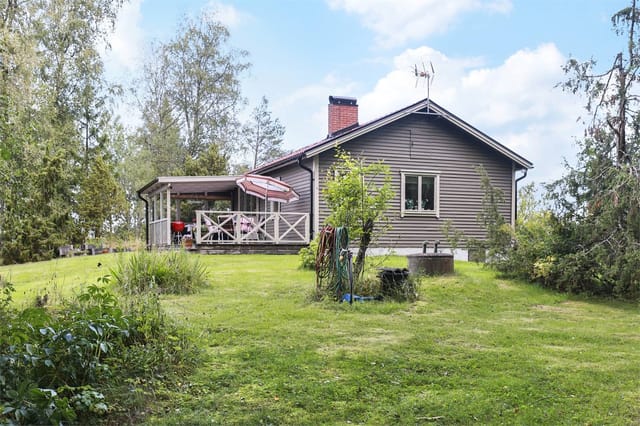
Front view of the cottage and garden

The first morning you wake up at Nedersta 6, you'll hear it before you see it — hooves shuffling in the straw, the low whinny of a horse greeting the pale Swedish dawn through the frosted stable window. Step outside and the air carries that particular mix of pine, damp earth, and hay that no city has ever managed to replicate. This is life on 1.5 hectares of Swedish countryside, and once you've had a taste of it, a regular apartment somewhere will feel like a compromise. Set on a generous freehold plot of 15,054 square meters just outside Västerås, this three-bedroom country home dates to 1900 and has been kept in genuinely good condition — not a cosmetic flip, but the kind of careful upkeep that means the bones are solid and the systems are current. The Kenrex septic system was replaced in 2013. Fiber internet runs to the house. The insulated, heated water pipes in the stables won't freeze when January in Mälardalen decides to turn serious. Somebody here thought practically, and it shows. Inside the main residence, the kitchen anchors daily life the way a good kitchen should. A traditional wood-burning stove sits at its heart — functional, not decorative — and on a grey October afternoon, with soup on the hob and the terrace door cracked open to the smell of wet leaves, it's the kind of room that earns the word "home" properly. The ground floor flows from kitchen to living and dining areas in an open layout that works well for a family coming in from a morning's riding, muddy boots deposited in the practical mudroom near the guest WC. A fireplace in the living room handles the deep cold of February with ease. Direct access from the ground floor leads out to a covered terrace, which matters here — Swedish summers are g ... click here to read more
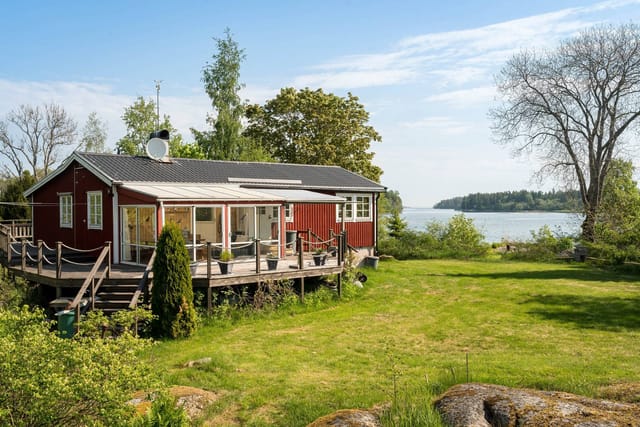
Front view of the main house and stables

Step outside on a July morning in Hallstavik and the air smells like warm pine resin and wet grass. The forest starts just beyond the wooden fence. Coffee in hand, you sit on the deck and watch a thrush work its way through the raised beds. This is not a fantasy—this is a Tuesday. Sandgropsvägen 26 is a red-painted Swedish cottage from 1887 sitting on a 1,860-square-metre plot that has been shaped, planted, and cared for over many years into something genuinely worth seeing. The garden alone would justify the visit. Gravel paths thread between fruit trees, mature perennials, and raised planting beds that produce through late spring all the way into October. There's a small greenhouse where you can start seedlings in March while snow is still piled against the fence outside. A guest cottage sits separately on the plot—useful whether you have friends coming for midsommar or you need a quiet room away from everything to read, paint, or work. Inside the main house, the kitchen sets the tone immediately. Open shelving, beadboard paneling, natural light coming through small windows at an angle that makes the whole room feel like it belongs to a different century—in the best way. Nothing is showy. The materials are honest and the proportions are right. You can cook a proper meal here: Swedish classics like raggmunk with lingonberries or a slow-simmered fish soup made from whatever the local fishermen brought into Grisslehamn that morning. The living room next to it is quiet and warm, the kind of room where you sit down intending to read for twenty minutes and look up two hours later. Soft colors, natural textures, windows facing the garden. Upstairs is more compact but well thought out. A newer bathroom handles the practical ... click here to read more
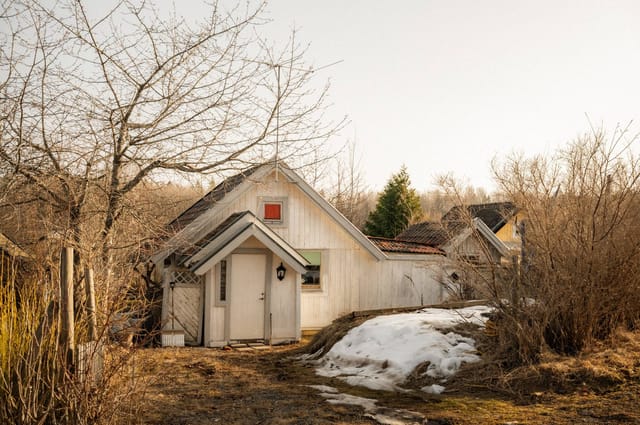
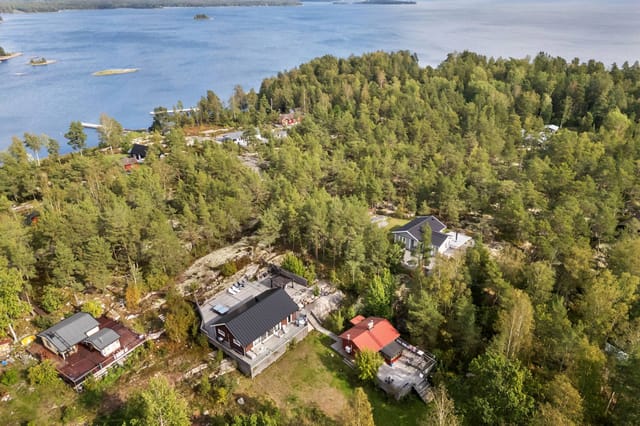
Front view of the cottage and garden

Step outside on a July morning and walk 300 meters through the trees in your bathrobe. That's how close Lake Kolmaren is. The water is clear, the dock is quiet, and you're back at the kitchen table with coffee before anyone else in the house has stirred. This is the kind of thing that happens when you own a place on Boängsvägen in Spillersboda — and it happens every single day you're here. The house sits at the end of a cul-de-sac in the Frötuna-Spillersboda area of Norrtälje municipality, roughly an hour north of Stockholm by car or SL bus. It borders a public green area on one side, which means no future neighbor crowding in. The plot runs to 2,262 square meters — a generous spread by any measure — and it moves through the property in layers: a southwest-facing terrace catching afternoon sun, flat grass wide enough for a proper game of kubb or badminton, then rocky outcrops that push up through the ground and form natural sheltered spots where you can sit with a book without anyone finding you. The apple trees are old and reliable. Currant bushes produce more than any one family can eat. In August, you'll find wild blueberries and lingonberries along the forest edge without walking more than a few minutes. Come September, the same forest throws up kantareller — chanterelles — in quantities that make you wish you'd brought a bigger basket. Lilacs bloom hard in May and fill the downstairs rooms with scent when you leave the windows open. Inside, the house is 64 square meters across three bedrooms, which is compact but genuinely well-used. The living room has a soapstone wood-burning stove — not a decorative one, a real working heat source that makes late-October weekends here entirely viable. Large windows look out ov ... click here to read more
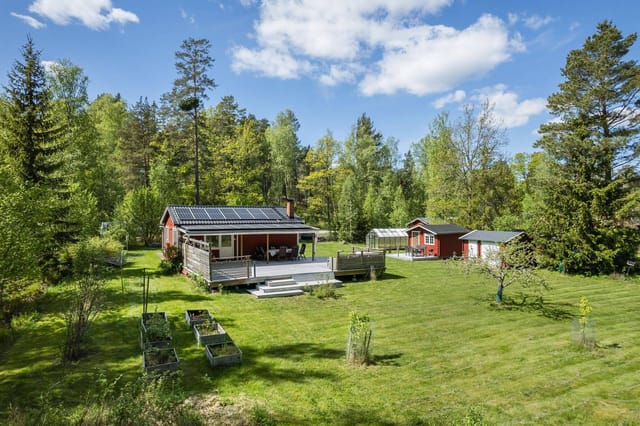
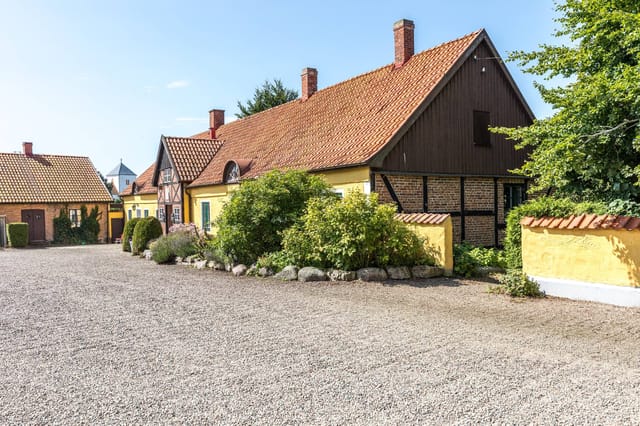
Front view of the house and garden

Step outside on a Tuesday morning in early October, and the air carries that particular Swedish countryside smell — pine resin, damp grass, and horse. The paddocks at Fjuckby Solvallen 146 are already alive by seven o'clock, and from the kitchen window of the 1929 farmhouse you can watch the whole scene unfold without putting down your coffee. This is the kind of property that has a pulse. Set on just over 3.3 hectares of long, well-arranged land on the quiet outskirts of Storvreta — about 15 kilometers north of Uppsala — this is a working equestrian estate with serious bones, genuine rental income streams, and enough residential flexibility to make it work for almost any buyer's vision. Four bedrooms in the main house, two bathrooms, two additional apartments, a convertible cottage, and a nine-box stable complex. That's the bare-bones version. The reality is considerably richer. The main residence was originally built in 1929, extended in 1980, and sits at a comfortable 157 square meters. It wears its age well. The living room centers around a soapstone stove — the kind that holds heat for hours long after the fire has died down — and large windows pull in the low northern light that makes Swedish interiors feel cinematic in winter. The kitchen has solid wood cabinetry and modern appliances, and it functions the way a country kitchen should: generous counter space, room for multiple people, the sense that you could feed ten without breaking a sweat. Bedrooms are properly sized. Not the optimistic "double" measurements you sometimes see in older rural properties, but genuinely roomy spaces. The two bathrooms are well-appointed and practical, which matters when you're running a property with tenants, boarders, or exten ... click here to read more

Main house and stables

Step out onto the deck at Söderstig 3 on a July morning and the Gulf of Bothnia is barely a two-minute walk away. The air carries that particular mix of pine resin and salt water that you only get along this stretch of the Gävleborg coast. The soapstone stove inside still holds a little warmth from the evening before. This is what owning a holiday home in Axmar actually feels like — unhurried, deeply restorative, and about as far from city noise as you need it to be. Axmar sits on the Hälsingland coastline, roughly 40 kilometres north of Gävle and about a 2.5-hour drive from Stockholm. It is not the kind of place that shows up on tourist maps, and the people who live here — both year-round and seasonally — tend to like it that way. The village has developed quietly around its harbour, its community association, and the kind of neighbourly traditions that are increasingly rare. Midsommar here is the real thing: a maypole goes up near the marina, someone brings out a speaker, and the long Nordic evening stretches past midnight with no one particularly in a hurry to go anywhere. The house itself sits on a 1,520-square-metre plot on Söderstig, a quiet residential road lined with similar summer properties and year-round homes. The building has been methodically updated over recent years — new roof, new windows, a new front door and patio door, and an air-source heat pump that keeps running costs manageable in the colder months. None of these are flashy improvements, but they are exactly the kind that matter: the ones that mean you arrive in May and everything just works. Inside, the ground floor runs as an open plan from kitchen to living room, which gives the 75-square-metre main house a sense of space that the floor area ... click here to read more

Exterior view of Söderstig 3

The first thing you notice on a summer morning at Älgholmen 7 is the quiet. Not the artificial quiet of soundproofing, but the real kind — wind through pine trees, a wooden hull knocking softly against the dock, maybe a cuckoo somewhere out over the meadow. You've just made the ten-minute boat crossing from Åva Marina, the engine off now, your coffee still warm in your hand. This is what it feels like to own here. Älgholmen is a small, privately held island in the outer reaches of the Haninge municipality, sitting at the edge of the Dalarö archipelago about 45 kilometres south of Stockholm. Getting here requires a short boat ride, and that small friction is exactly the point. The moment you leave the mainland dock, the week detaches itself from you. The island is shared among fourteen property-owning households, all members of Älgholmens vänner — Friends of Älgholmen — a community association that collectively maintains the shared trails, beaches, and clubhouse. It has the feel of a private enclave that somehow never tips into exclusivity or pretension. People actually talk to each other here. The property itself has a footprint that makes sense for extended family or a close group of friends. The original house anchors the plot — its former living room now serves as the master bedroom, anchored by a fireplace that gets genuinely used on cool September evenings when the archipelago light goes golden and the temperature drops fast. The kitchen is laid out for real cooking: wide surfaces, a rustic functional design, nothing fussy. From the kitchen window you catch tree-framed glimpses of open water, and on calm evenings the smell of the sea drifts through if you leave it open. The 2012 extension changed the character of ... click here to read more

Exterior view of the holiday home on Älgholmen 7

Stand on the south-facing terrace at Törnbotten 113 on a late June morning and you'll understand immediately why Öland has been pulling people across the Kalmar Strait for centuries. The meadows ahead of you stretch all the way to the treeline of Mittlandsskogen, Sweden's largest contiguous deciduous forest. Swallows cut low over the grass. The only sound is wind moving through the stone wall that borders your plot. It's 7am and you're already outside, coffee in hand, with nowhere to be. This is a genuinely rare find. An architect-designed, newly built home on a Swedish island that gets more sunshine hours than almost anywhere else in the country — and it's priced as a vacation home purchase, not a mainland city premium. The house at Törnbotten 113 sits in Färjestaden on the island of Öland, connected to the mainland city of Kalmar by the 6km Öland Bridge — one of the longest bridges in Europe and, frankly, one of the more satisfying drives you'll ever make, with the Baltic spreading out on both sides. The architect behind this home is M. Rutensköld, winner of both the Red Dot Award and the Swedish Design Award. That pedigree shows in every decision made here, from the passage between the two building volumes — a direct nod to the traditional rad byar, the row villages that define Öland's historic landscape — to the vitriol-treated wood facade that will weather gradually to a soft silver-grey, the way old Öland barns do. This isn't a house trying to look Scandinavian. It actually is. Inside, the ceilings climb to five metres at their peak. Natural light doesn't just enter the house — it moves through it, shifting from the south-facing living areas in the morning to the north and east-facing loft windows by afternoon. ... click here to read more

Exterior view of Törnbotten 113, main house and annex

Step outside on a July morning, coffee in hand, and the air already smells like warm pine and cut grass. The Enviken community pool is a five-minute walk away, someone is dragging a kayak toward Vaxtunasjön down the road, and the Baltic is close enough that you can be on the water before the day heats up properly. This is Galoppbacken 4 — a solid, move-in ready holiday home in Bergshamra that gives you all of that, plus a 1,425-square-metre garden, a guest cottage, and a hot tub on the patio for when the sun finally goes down. Bergshamra sits in the heart of Norrtälje municipality, the great coastal retreat for Stockholmers who want archipelago access without giving up convenience. That matters for buyers thinking about rental income or resale: demand for holiday homes within 90 minutes of Stockholm has stayed remarkably firm, and this corner of Roslagen — the name locals use for the string of coastal parishes north of the capital — is especially popular because it combines genuine waterfront access with year-round infrastructure. The SL bus to Norrtälje town runs from a stop you can walk to in minutes, and from Norrtälje it's a direct ride into Stockholm. Practical, and that's the point. The house itself was built in 1978 and covers 58 square metres — compact, but thought through. The living room anchors the ground floor, and in winter the fireplace does exactly what a fireplace should do: it makes you want to stay inside with a book. There's also an air-source heat pump installed, so heating costs are reasonable even through January and February when Norrtälje can drop well below zero for weeks at a stretch. A covered terrace opens directly off the living room, and that covered part is key — Swedish summers are brill ... click here to read more

Exterior view of the house and garden

Picture this: a Saturday morning in late June, pale Nordic light filtering through hand-printed wallpaper at six a.m., the smell of birch smoke drifting up from the kitchen's wood-burning stove, and absolute silence outside — except for the soft shuffle of ducks settling onto the garden pond. That's what mornings feel like at this 18th-century country house in Stjärnhov, just outside Gnesta in Södermanland. It's a rare thing, a property that actually delivers on the rural Sweden fantasy rather than just hinting at it. The house sits on 4,299 square meters of mature garden in Herrökna Sofielund, a quiet hamlet surrounded by forest and farmland roughly 80 kilometers southwest of Stockholm. From the capital you're looking at just over an hour by car, or a train to Gnesta station followed by a short drive. For buyers based in Stockholm who want a proper country escape without the half-day journey, this area — locally called Sörmland — is something of an open secret. The land rolls gently here, dotted with red-painted timber houses, small lakes, and riding trails through spruce forest. No dramatic mountains, no coastal circus. Just unhurried Swedish countryside at its most honest. The garden alone makes this place worth serious attention. Whoever planted it thought long and hard: established fruit trees, raised vegetable beds, herb patches near the kitchen door, climbing roses over the wooden fence, and a pond with enough depth to attract frogs in spring and ice-skaters' shadows in February. Gravel paths loop between beds of peonies, hollyhocks, and what appears to be a small cutting garden for the house. It's the kind of garden that has its own rhythm through the seasons — you're not maintaining it so much as participating ... click here to read more

Front view of Herrökna Sofielund 1

The wood-burning stove is already crackling when you wake up on a Saturday morning in October, and through the big living room windows you can see frost on the grass and mist sitting low over the pines. By 9am you're pulling on boots and walking the 550 metres down to the dock at Korgil, thermos in hand, watching a grey heron stand absolutely still at the water's edge. This is what a second home in the Swedish archipelago actually feels like — unhurried, raw, and genuinely restorative in a way that a week in a hotel never manages to be. Mörtvägen 2 sits on a generous 2,353 square metre plot in Korgil, a quiet pocket of Norrtälje municipality roughly 90 kilometres north of Stockholm. Herräng itself is the kind of place most Swedes know mainly because of the Herräng Dance Camp — a legendary annual swing dance festival that transforms this sleepy coastal village every July into something quietly electric. The rest of the year, it belongs to the locals, the summer regulars, and anyone sharp enough to have bought a place here before word got out. The house dates from 1967 and measures 54 square metres — compact, yes, but the layout earns every centimetre. Two bedrooms. A living room anchored by that wood-burning stove. A kitchen big enough to actually cook in, not just heat things up. Large windows pull the garden and the treeline inside, and the open connection between kitchen, dining area, and living room means a household of four or five people can move around each other without friction. On summer evenings the whole ground floor flows out onto the wide wooden deck, where there's room for a proper outdoor table, a gas grill, and still space left over to stretch out on a sun lounger and do absolutely nothing. The guest h ... click here to read more

Front view of the house and garden

On a still July morning, you step off the wooden deck in bare feet, coffee in hand, and walk 350 meters through birch trees to the private sandy beach at Lejondalssjön. The lake is glassy and cold and yours. Nobody else is up yet. This is what owning a country home in Stentorp, Upplands-Bro actually feels like. Svärdsvägen 4 is a 1955 red-painted cottage that sits on 2,275 square meters of private garden in one of the most quietly coveted lake communities within striking distance of Stockholm. At 34 square meters, the main house is compact by any standard — but the Swedish tradition of small, well-planned living spaces was never better applied. Every square meter works hard. The living room centers on a wood-burning stove that keeps things genuinely warm during October evenings when the colors outside turn amber and rust. Large windows frame that garden and the tree line beyond it, so even on grey November days there's a sense of being inside a landscape painting rather than a house. The kitchen is straightforward and functional — enough counter space to cook a proper meal, enough room to not bump into whoever's doing the dishes. The single bedroom is calm and quiet, the kind of sleep you don't get in the city. Outside, the oversized deck is where life really happens in summer. Long dinners that drift into long evenings. Books abandoned after three pages. The garden behind it is half-wild, half-cultivated — mature trees providing canopy, open patches of lawn inviting a hammock or a kitchen garden if you're inclined. What separates this property from most Swedish country cottages is the additional infrastructure already in place. The separate guest cottage comes with its own bathroom, which means visitors are comfortab ... click here to read more

Front view of the cottage and garden

Step off the gravel path at Gudbyvägen 36 on a June morning and what hits you first is the quiet. Not the absence of sound exactly — there's a woodpecker somewhere behind the tree line, and a neighbor's dog doing its rounds — but the kind of quiet that makes Stockholm feel like a different world, even though you're only 25 minutes up the E4. This is Gudby. A pocket of Upplands Väsby where the houses have proper gardens, where the roads still have names that predate the suburbs, and where 2,662 square meters of your own land means you can walk barefoot across your own grass without seeing a fence for a good while. The 1955 cottage sitting on that plot is small — 20 square meters of honest simplicity — but the land it stands on is where the real story lives. The cottage itself is functional and in good condition. One room, one bathroom, the basics done right. It's not trying to be anything it isn't, which is part of what makes it work so well as a summer retreat or a base while you figure out what comes next. And what comes next is the interesting part. Municipal water and sewage are already connected at the property boundary — costs already covered by the current owners — which removes one of the more tedious hurdles for anyone thinking about development. The plot is potentially divisible too, a detail that opens up a range of possibilities depending on what direction you want to take this. Many neighbors along Gudbyvägen have already done exactly that. Started with an older summer cottage, renovated or built alongside it, and ended up with a year-round home on a generous piece of land that would cost multiples to replicate closer to the city. That trajectory is visible in the streetscape here — you see the mix of orig ... click here to read more

Exterior view of Gudbyvägen 36

On a quiet Tuesday morning in late June, you crack open the kitchen window at Gårdsvägen 2 and catch the faint salt smell rolling in off the Kattegat. The robotic mower is already doing its rounds across the grass. You've got nowhere to be until you feel like it. That's the whole point. Skummeslövsstrand sits on the Halland coast of southwestern Sweden, roughly halfway between Halmstad and Båstad — two towns that between them cover every practical need you'll ever have, from IKEA runs to Michelin-starred dinners. But the strand itself is a different pace entirely. A tight-knit summer community that swells with Swedish families every July, then exhales into a quieter, genuinely peaceful neighbourhood the rest of the year. The kind of place where you recognise faces at the local pizzeria on Strandvägen before the end of your first week. The house on Gårdsvägen dates to 1957 and carries just enough of that era — the compact, considered proportions of post-war Swedish construction — without feeling dated. It's been properly updated: new bathroom, fresh interior surfaces throughout, and a modern heat pump installed that handles both heating and cooling efficiently. This isn't a project property. You can arrive with luggage and start living. The winterisation work done here means the house holds warmth through a February coastal storm without fuss, which matters if you're thinking about long weekends in the off-season or using it as a genuine second home across all four seasons. Sixty square metres sounds modest on paper, and it is — but the layout earns every centimetre. The living area and kitchen work as a single open space, and the two bedrooms sit quietly toward the back. Large windows pull in the Swedish summer light ... click here to read more

Exterior view of the house and garden

Stand on the plot at Måsvägen 31 on a Tuesday morning in late May and the birch trees are already full and loud with wood pigeons. The water is just 500 meters away—you can't see it yet through the pines, but you can smell it. That particular mix of cold saltwater and sun-warmed granite that defines the Stockholm archipelago. This is Strömma, a quiet fold of Värmdö municipality where you don't arrive accidentally. You come because you've heard about it from someone who has a place out here and won't stop talking about it. The house itself was built in 1958 and it shows its age in all the right ways—solid bones, a low roofline that sits comfortably in the landscape, and windows that frame the surrounding greenery like paintings. Forty-three square meters, two bedrooms, one bathroom. It's compact, but it's fully winterized, which in this corner of Sweden means something real: you can be here in February when the ice on the canal turns blue-white and the thermometer drops below minus ten, and the house holds warmth. Swedes build for winter the way coastal Italians build for earthquakes. This place has been doing its job for over sixty years. What makes Måsvägen 31 genuinely different from most holiday properties in this price range isn't the house—it's the land and what you can do with it. The plot runs to 2,925 square meters, which is a serious piece of ground. It backs directly onto a large public green area, so the sense of space extends far beyond the legal boundary. And the building rights here are unusually generous: up to 250 square meters of building footprint (BYA), a total gross floor area of 360 square meters across all floors, a permitted height of 6.5 meters, plus additional outbuildings up to 80 square meter ... click here to read more

Front view of the house and garden

Early on a July morning, before anyone else on Estvägen has stirred, you walk the fifty steps down through the trees to Älgö's little beach and drop into water so clear you can count the stones at your feet. The pine forest is still exhaling the cool of the night. That's the daily opener here — and it's yours every summer for the rest of your life. Älgö sits in Stockholm's inner archipelago, four kilometers from Saltsjöbaden, which means you get the genuine Swedish island experience without surrendering urban convenience. The island is small enough that everyone waves to each other on the gravel tracks, yet large enough to disappear into the woods for a proper hour-long run without crossing your own path. It's the kind of place that sounds almost too good when you describe it to friends back home, until they come and see it themselves. The property at Estvägen 20 is positioned at the end of a quiet cul-de-sac, with forest pressing in on three sides. There are no through-traffic sounds, no overlooking neighbors. What you do hear: woodpeckers in the spruce, the distant clang of rigging from boats moored at the island's small jetty, and on clear evenings in late August, the faint percussion from the jazz evening that Saltsjöbaden's Grand Hotel still hosts on its terrace across the water. The plot itself stretches across 2,101 square meters — a proper piece of land for this part of the archipelago — and the sun tracks it from east to west without interruption, so somewhere on the property is always warm between May and September. The existing house is a 1957 Swedish sommarstuga of 28 square meters. Compact, functional, honest. It has the character of a building that has been genuinely used and genuinely loved: the kind of ... click here to read more

Exterior view of the holiday home and garden

Imagine waking up on a Saturday morning in September, the smell of pine drifting in through the bedroom window, the surface of Bullaresjön completely still. You pull on a sweater, put coffee on, and stand at the kitchen window watching the mist lift off the water. That's not a fantasy—that's a Tuesday here at Klageröd 5, in one of Bohuslän's quieter, less tourist-trampled corners. Bullaren sits in Tanums kommun, about 20 kilometers inland from the dramatic granite coastline of the Swedish west coast. If you know the area, you already know why people keep coming back. If you don't, here's the short version: it's the kind of place where your phone starts feeling irrelevant by mid-afternoon. The house itself is a single-story 78-square-meter property in solid condition—renovated, clean, and genuinely move-in ready. Two bedrooms, one well-fitted bathroom with a proper shower, and an open-plan living and dining area built around a wood-burning fireplace. That fireplace isn't decorative. Come November, when the temperature drops and the lake turns gunmetal grey, it's the center of the whole house. Evenings are spent there. Long weekends are organized around it. There's a reason Swedish interior culture puts such stock in the concept of eldstad—a real fire changes the character of a room entirely. The kitchen has been updated without losing the practical, unfussy character that Swedish country homes do so well. Enough counter space to actually cook a proper meal—and you will, because the local food culture here is built around doing exactly that. The village store in nearby Östad stocks local honey, smoked meats, and seasonal produce. In summer, the roadside stands along Route 163 sell strawberries and new potatoes by the ki ... click here to read more

Front view of the house and garden

Picture a Saturday morning in late June. The Swedish sun has been up since four, and by the time you pull on your jacket and step onto the wrap-around terrace with a mug of coffee, the birch forest at the edge of the garden is already doing that thing it does in Södermanland summers — throwing long gold light through the leaves while the air smells faintly of pine resin and damp earth. Lake Långhalsen is a four-minute walk down the path. Nobody else is awake yet. This is Utterspåret 11. It's a compact, honest house — 57 square meters built in 1979, maintained with genuine care, and set on a 1,620 square meter plot that gives you the kind of breathing room that's increasingly hard to find at this price point in Sweden. Two bedrooms, one bathroom, a kitchen that works, and a living room anchored by a wood-burning stove that you'll use far more than you expect once October settles over Nyköping and the lake mist starts rolling in each morning. The stove isn't decorative. Come winter, it's the heart of the house. The terrace wraps the exterior and has both open and covered sections — a deliberate design that Swedes know well. You want sun in May when the temperature is still erratic. You want shade in July when it isn't. You want cover in August when the afternoon rain passes through. The terrace handles all of it, and it's large enough for a proper outdoor table, a couple of sun loungers, and whatever outdoor project you get absorbed in over a long weekend. The plot itself borders forest on one side, with no immediate neighbours on that flank. The garden is flat, open, and generous — room for a vegetable patch, a trampoline, a fire pit, a hammock between the birches. The side building currently runs as a small workshop a ... click here to read more

Exterior view of Utterspåret 11