Houses For Sale In Europe With A Garden (page 7)

Houses for sale in europe - homestra offers the largest amount of european real estate with over 200,000+ properties, find any type of property within your budget from villas to country homes. buy or rent your perfect home in europe. (page 7)

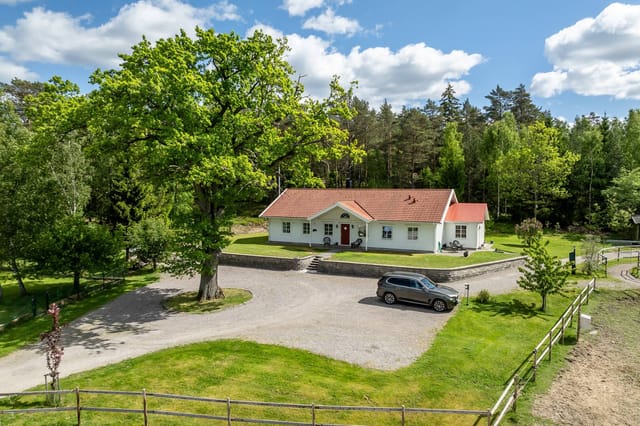
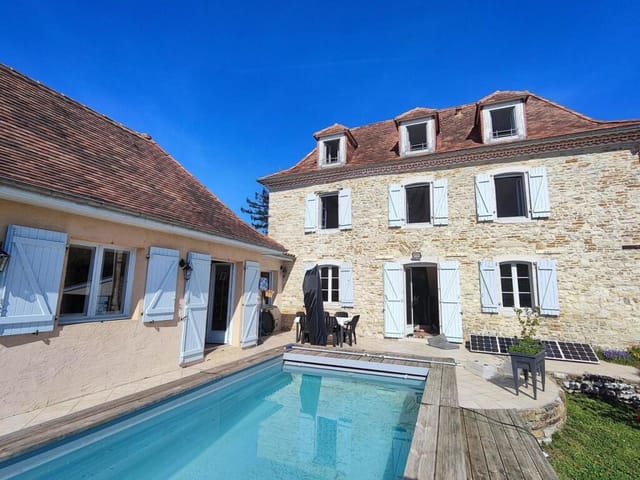
The beech trees lining Stigsbergsvägen are the first thing you notice — two rows of columnar trunks standing at attention, framing a gravel drive lit by cast iron lanterns. You pull in slowly because it feels like the kind of arrival that deserves a moment. The house sits elevated at the end, and on either side, paddocks stretch out in the late afternoon light with that particular Swedish stillness that Stockholmers spend years chasing. This is Bålsta country living at its most grounded — a real equestrian estate, a proper family home, and a life that moves at a pace the city simply can't offer. Built in 2007 and consistently upgraded since, the 172-square-metre main house has the feel of something that was thought through properly from the start. The living room ceiling soars open to the roof ridge — not in a showy way, but in a way that makes the space feel genuinely airy even on grey Swedish winter days. A wood-burning stove sits centrally, and on a Friday evening in January when the temperature drops and you've just come in from the stables, that stove becomes the entire point of the room. The kitchen was renovated in 2014 and it shows: clean lines, quality appliances, the kind of workspace where someone who actually cooks wants to spend time. The conservatory is the newest addition, finished in 2024, and it earns its keep every single month of the year. In late April, when the surrounding fields are just greening up and the birches are budding, it catches morning light in a way that makes a slow breakfast feel like something worth planning for. Come autumn, it becomes the indoor-outdoor room that keeps the season from feeling like a loss. The property runs on geothermal energy via a heat pump installed in 2023, p ... click here to read more

Front view of the main house and driveway

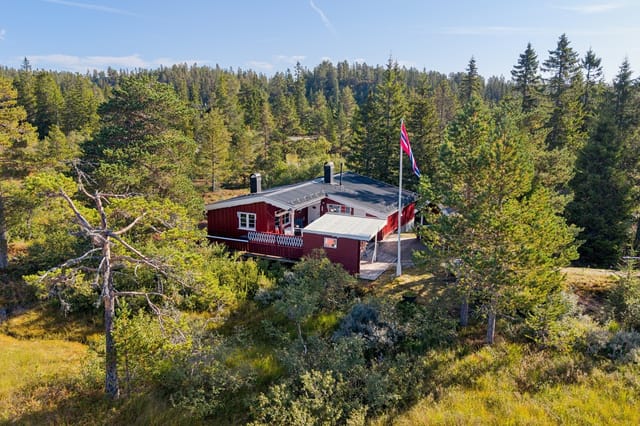
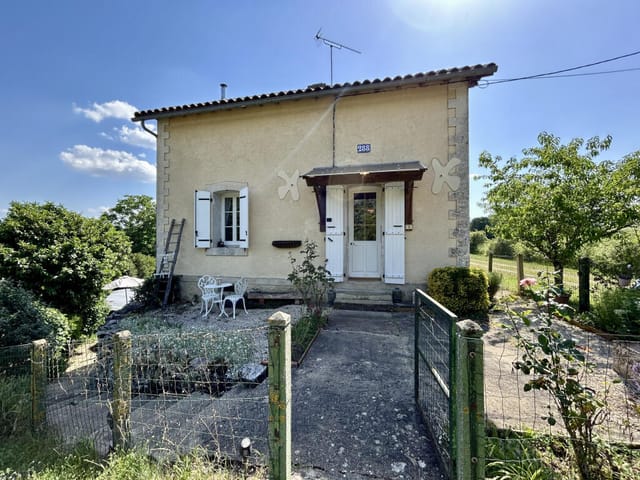
Imagine waking up at 686 meters above sea level to the smell of pine resin warming in the morning sun, pouring your first coffee, and stepping out onto a wide south-facing terrace where the only sound is birdsong and the occasional creak of the forest. No traffic. No neighbours staring over your fence. Just the Blefjell plateau stretching out in every direction, unhurried and entirely yours. This is the daily reality at Gampeflåsvingen 62 in Svene — a two-bedroom mountain chalet that sits quietly in one of Blefjell's most established and sought-after cabin communities, priced at €220,000. The chalet itself is 56 square metres of well-considered mountain living. It's compact in the best sense — everything has a purpose, nothing wastes space, and the layout flows naturally from the entrance hall into a living room that genuinely feels warm rather than just described that way. The ceiling height gives the room a lift you don't always find in mountain cabins, and the wood-burning fireplace anchors the whole space. On a grey February afternoon when the temperature drops and snow presses against the windows, that fire does more than heat the room — it transforms the cabin into exactly the kind of retreat people drive three hours from Oslo to find. The kitchen is practical and well-equipped, with enough cabinet space to store provisions for a week-long stay and a dining area large enough to seat a family without anyone feeling squeezed. Two bedrooms handle the sleeping arrangements with flexibility — the main bedroom for the adults, and a second room for children or guests. There's also a furnished room in the outbuilding which, while not registered for permanent use, functions perfectly well as overflow space for visitors or ... click here to read more

Main exterior view of the chalet

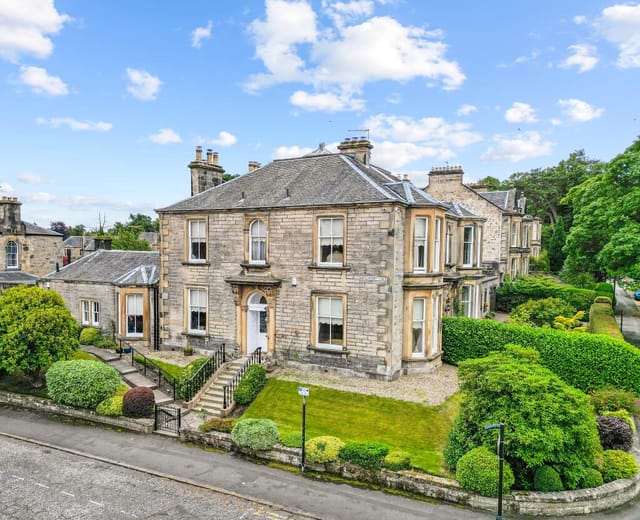
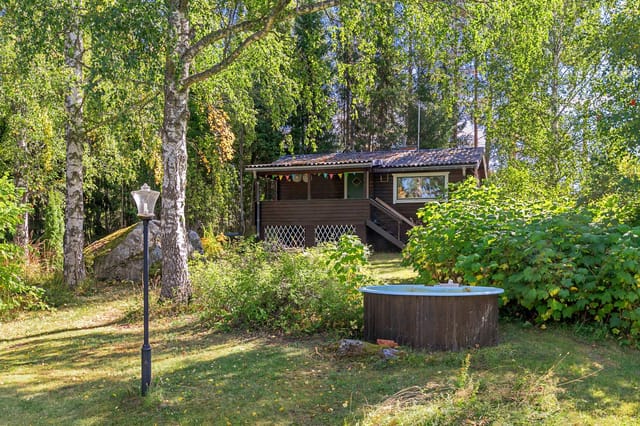
On a quiet Sunday morning in Kings Park, you open the bay window of the principal lounge and the smell of cut grass drifts in from Victoria Square below. A church bell somewhere near the Old Town counts nine. The stone walls of your private garden hold the cool Scottish air in while the first real sun of the day catches the cornice work above the fireplace. This is what life at Abercromby Place actually feels like — and it's the kind of thing you stop taking for granted very quickly. Built around 1900, this four-bedroom, four-bathroom Edwardian villa in one of Stirling's most consistently sought-after residential pockets has been cared for with the kind of quiet seriousness that period architecture demands. At 268 square metres across two floors, there's genuine room here — not the slightly optimistic room of a modern marketing brochure, but actual, move-around-freely, host-twelve-for-dinner room. The sort of space that makes long stays feel like settling in rather than camping out. Kings Park carries a distinct character, even by Stirling's standards. The streets are wide and tree-lined, the stone facades substantial. Neighbours tend to be professionals, academics connected to the University of Stirling just a few kilometres north, and families who've worked out that the city centre is a fifteen-minute walk but the noise doesn't follow you home. Estate agents talk about "prestigious addresses" until the phrase loses all meaning, but Victoria Square genuinely earns the description — it's the kind of green, open space that makes a bay window feel like a private box seat. The layout inside rewards a slow first walk-through. The entrance hallway sets the tone immediately: ornate cornicing overhead, decorative plasterwork ... click here to read more

Front view of the period villa

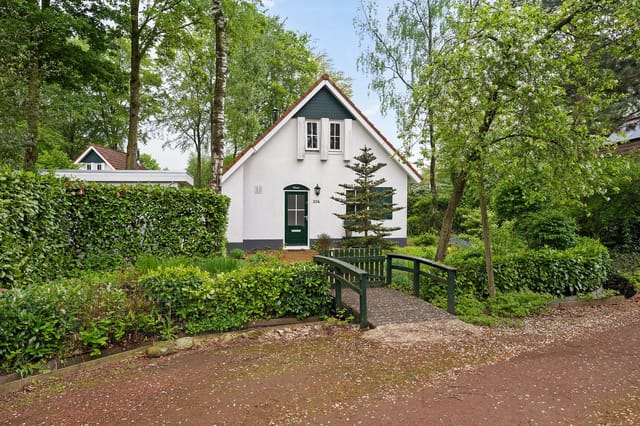
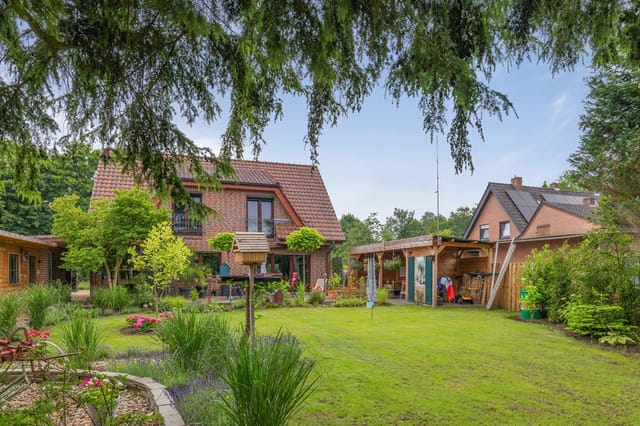
Early Saturday morning, you pull open the large sliding doors and the smell of pine and damp heather rolls into the living room. A wood stove is still ticking from the night before. There's no traffic, no city noise — just the soft creak of the garden gate and birdsong from the state forest that begins practically at the edge of the estate. This is what you bought the weekend for. Sitting on a 545 square meter plot on the Hunzebergen estate in Exloo, this detached two-bedroom recreational home is one of the more privately positioned properties on the park. Number 304 on the Valtherweg sits tucked away with a sheltered garden that manages to feel genuinely secluded rather than just screened by a hedge — not every plot here achieves that. It's a real feature, not a selling point dressed up as one. The house itself, type Odoorn, was built in 1992 and has been kept in genuinely good condition. Full insulation throughout — roof, walls, floor — along with double glazing and HR glass means it runs efficiently across every season, from frosty November weekends to warm July afternoons when the heathlands outside Exloo go purple. A Nefit combi-boiler installed in 2021 handles heating and hot water without drama. The home is completely move-in ready; bring your bags and a decent bottle of Drenthe gin and you're set. Inside, the layout is straightforward and works well. The hallway has a meter cupboard and a separate toilet, so the main bathroom — equipped with a shower-bath and washbasin — doesn't become a morning queue. The living room is the heart of the place: generous, light-filled, with a wood-burning stove that makes autumn evenings here something worth planning a trip around. The sliding doors open directly onto the garde ... click here to read more

Front view of Valtherweg 36-304

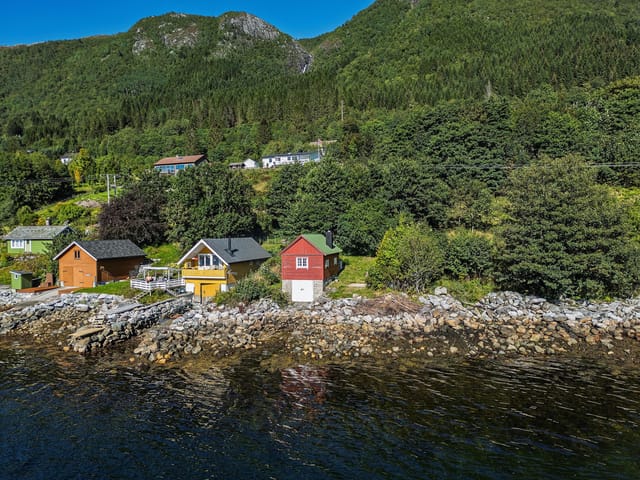
The first thing you notice is the silence. Not the absence of sound exactly, but a different quality of it — the soft slap of water against the boathouse hull, wind moving through the birch trees above the terrace, and if you're lucky, the distant cry of a white-tailed eagle riding a thermal over Hjørundfjorden. This is Liadal, a small coastal community tucked along the western Norwegian coast near Ørsta, and this modest fjordside chalet at Liadalsvegen 851 gives you direct, unhurried access to all of it. At 25 square metres, this isn't a property you come to for space. You come for the water. The lower level boathouse fits a vessel up to roughly 17 feet and comes equipped with an electric boat launch — you can have your boat on the fjord in minutes, not hours. That changes everything about how you spend a morning. Fishermen in this stretch of Hjørundfjorden pull up pollock, coalfish, and the occasional cod without leaving the bay. On calm summer evenings, the fjord surface turns to hammered copper in the low Arctic light, and a slow row out toward the open water with a thermos of coffee is something you genuinely don't forget. The cabin itself was built in 1958 and it carries that era honestly — solid timber construction, classic Norwegian hytte proportions, a living room with a decent ceiling height that makes the small footprint feel less compressed than you'd expect. There's a main bedroom, an entrance area with additional seating space, and a loft sleeping area above that works well for children or an extra guest. Two ground-level terraces face the fjord, and one of them catches the afternoon sun long enough to make it a proper place to sit, rather than just a ledge to stand on. The kitchen is functional rather th ... click here to read more

Welcome to Liadalsvegen 851 - a charming cabin with the fjord as your closest neighbor

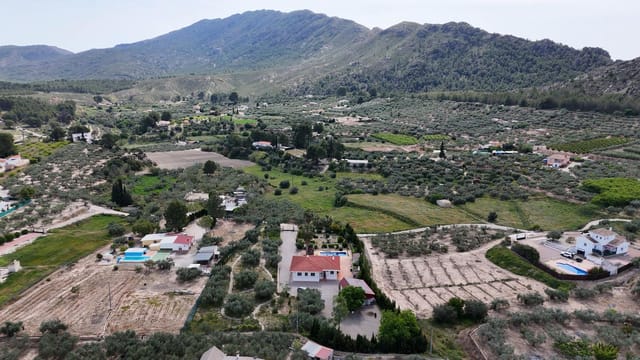
Step outside on a Tuesday morning in late October and pick a ripe mandarin straight off the tree. The juice runs down your wrist before you've even made coffee. That's what mornings feel like at this three-bedroom villa in El Chorreador, a quiet pocket of Calasparra where the hills roll into each other and the only sounds are birdsong, the distant trickle of the Segura river basin, and occasionally your neighbor — probably French or English, as a few expat families have quietly put down roots along this dead-end road over the years. Calasparra sits in the northwest corner of Murcia, far enough inland to feel genuinely rural, close enough to everything that you never feel stranded. It's not a resort town. There are no souvenir shops selling ceramic bulls. What it has instead is a weekly market on Thursdays where you can buy Calasparra rice — the only rice in Spain with two Denominación de Origen certifications — directly from local growers, and a food culture built around slow-cooked arroces, roasted lamb, and wine from the neighboring Bullas DO region. The Restaurante El Parque on Avenida del Rey Juan Carlos does a rice dish that locals argue about for days afterward. The property itself sits on a 5,060 m² plot — nearly two-thirds of which is productive garden — with a fully renovated 133 m² single-level house at its center. The renovation ran from late 2022 through spring 2024, which means everything from the roof to the plumbing to the window frames is essentially new. Not patched. Not cosmetically refreshed. Actually replaced and modernized. This matters for international buyers, because the last thing you want when you fly in for August is a failing pump or a leaky roof that nobody noticed for six months. The main ... click here to read more

Front view of the villa and garden

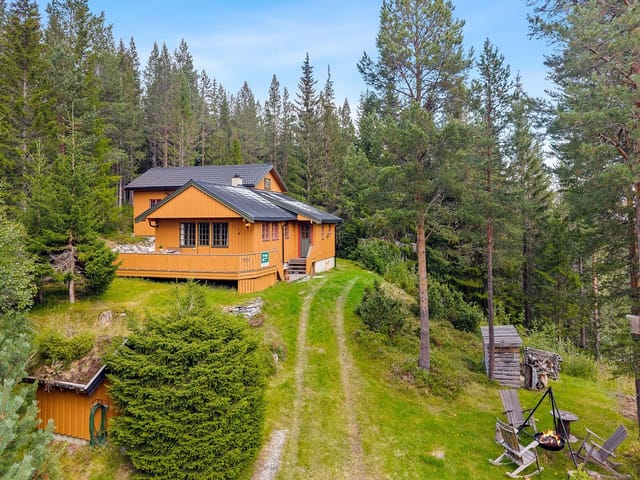
Step outside on a February morning and the only sound is the creak of snow under your boots and the faint hiss of wind through the spruce trees. The skis are already leaning against the outbuilding. The coffee is on. That's what mornings look like at Rennebuskogen 701. Sitting at 474 meters above sea level in the Rennebu municipality of Trøndelag, this four-bedroom Norwegian chalet is the kind of mountain property that feels genuinely far away from everything — because it is. Few neighbors. No traffic noise. Just 882 square meters of freehold land where the garden lawn gives way to wild terrain, and the surrounding forests stretch further than you'll ever need. The chalet itself covers 127 square meters of usable space, and whoever designed the layout clearly understood how families actually move through a mountain cabin. You come in through a tiled entrance hall with underfloor heating — immediately useful when you've just pulled off a pair of soaked ski boots — and straight ahead is a laundry room with its own toilet. Practical, unglamorous, and absolutely essential when four kids have been out in the snow all day. These kinds of details matter more than most listings admit. The main living room has high ceilings and large windows that pull in the Norwegian light, which in midsummer stays golden until nearly eleven at night. There's a wood-burning stove at the heart of the room — not decorative, genuinely necessary — and dimmable downlights that let you shift the mood from bright family dinner to quiet evening with a book. The space opens naturally into the dining area, where a long table can seat the whole extended family without anyone sitting sideways. This is a room built for winters in Norway, for card games an ... click here to read more

Welcome to Rennebuskogen 701 and this charming leisure property! Photo: Interior photo by Jon Kristian Haukdal

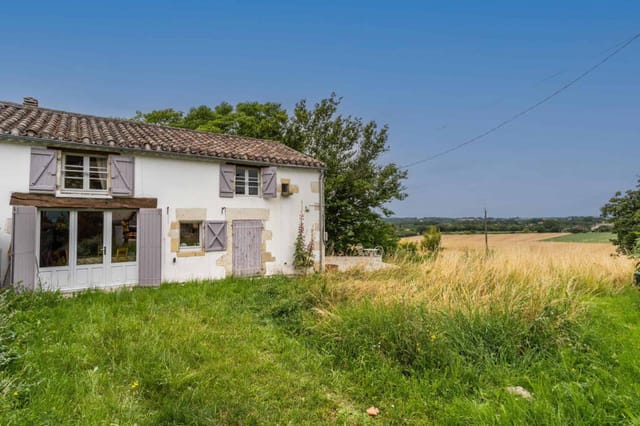
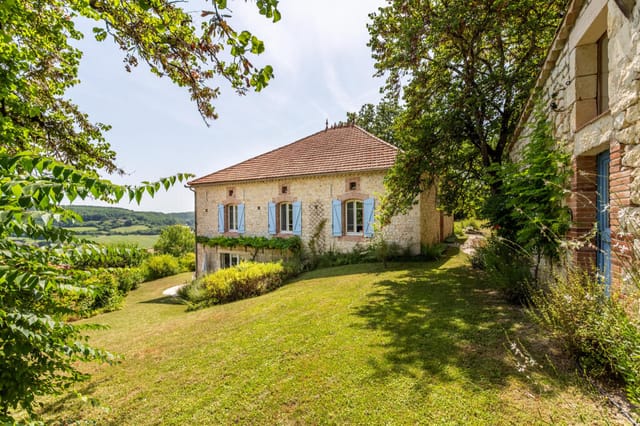
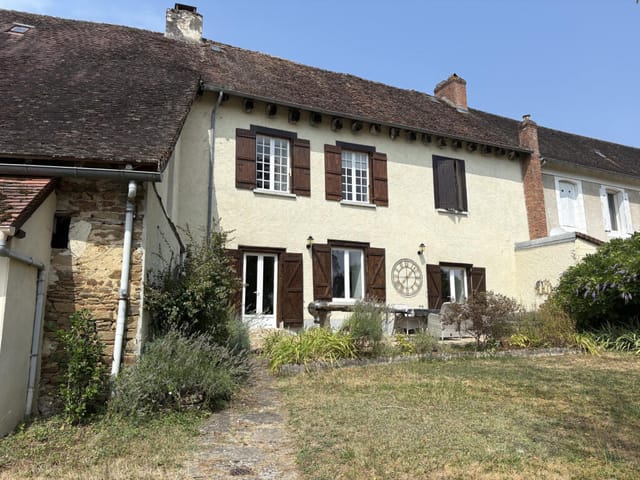
On a still weekday morning in Bourg-de-Visa, the smell of fresh bread drifts from the boulangerie four minutes' walk up the lane before you've even thought about making coffee. That's the pace of life here — unhurried, rooted, real. This 1850s stone barn, once a working forge, has been carefully converted into a two-bedroom house that sits quietly behind a stone wall on the village edge, its garden opening up to rolling Tarn-et-Garonne countryside that stretches further than you'd think possible for somewhere so easy to reach. Midi-Pyrénées is one of those parts of France that doesn't announce itself loudly. No famous coastline, no ski resort posters plastered at Charles de Gaulle. What it has instead is the kind of slow, unselfconscious rural beauty that people spend years searching for and rarely find — and Bourg-de-Visa sits right in the heart of it. The village has genuine life to it. A weekly market, a café where the same retired farmers have been occupying the same chairs since the 1980s, and those summer night markets that run through July and August: outdoor tables, local wine, grilled meats, children chasing each other between the stalls until well past dark. It's the France visitors imagine and tourists rarely stumble across. The house itself carries its history well. The original stone walls are thick enough to keep rooms cool through the heat of a Quercy summer — and this corner of France runs hot from June through September, with long golden evenings that make the tiled terrace off the kitchen feel like an extension of the living room. Step through the gated entrance off the lane, and the first thing you notice is the well at the centre of the lawn, flanked by established trees that throw proper shade. The ... click here to read more

Picture 1

Step off a private lane — maintained by the town hall, used by absolutely no one but you — and suddenly the noise of the world just stops. That's not a figure of speech. Standing on the covered terrace of this early 19th-century stone farmhouse in the Tarn-et-Garonne, the only sounds you'll reliably hear are the wind moving through the established gardens and, on summer evenings, the faint hum of cicadas. Three hectares of countryside roll away in every direction, and there isn't a neighbor in sight. This is the kind of property that people describe to friends at dinner parties and watch their eyes go wide. A real farmhouse, built from local stone sometime in the early 1800s, with the bones to prove it — thick walls that hold the cool in August, a sitting room dominated by a stone fireplace with a log-burning stove, beamed ceilings that have watched two centuries of life pass beneath them. And yet none of it feels like a museum. The kitchen is modern and properly fitted with integral appliances. The bathroom is stylish rather than retrofitted. Oil central heating keeps winter comfortable, and a solar hot water system means the sun does useful work from May through September. This is a farmhouse you can actually live in, without a renovation project hanging over your head. The layout gives you room to breathe. Four bedrooms plus a dedicated study means the property functions just as well for a family with kids needing their own space as it does for a couple who want a guest room and a home office. The sitting and dining room flows naturally toward the large covered terrace outside — the kind of shaded outdoor space where lunch starts at one o'clock and somehow it's four before anyone notices. A built-in barbecue makes a ... click here to read more

Picture 1

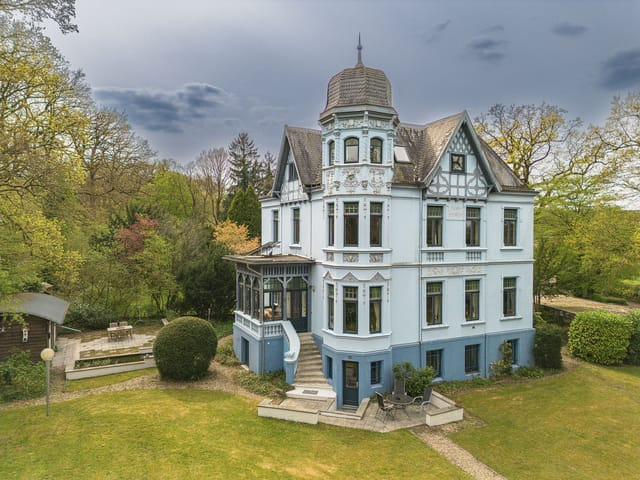
Early morning in Schüttorf, and the light comes through the conservatory glass in long, slow diagonals — the kind of light that makes you stand still with your coffee and just look. Outside, dew sits on the old trees. Nothing moves. This is what daily life feels like at De Blauwe Villa, a monumental early-20th-century Jugendstil property on Lehmkuhle 2 that carries more personality per square metre than most buildings carry in their entire existence. Let's be honest about what this place is. It's 384 square metres of crafted, layered architecture spread across four levels including a full basement, containing 11 bedrooms, 5 bathrooms, and rooms so distinct in character they almost seem to belong to different eras. The famous hunting room alone — panelled walls, carved oak, built-in cabinetry with details that take time to notice — could anchor any conversation about what German craftsmanship once looked like at its most self-assured. You don't see rooms like this in new builds. You barely see them anywhere anymore. The Jugendstil movement, Germany's answer to Art Nouveau, valued organic forms, decorative integrity, and the idea that a building should feel alive. De Blauwe Villa — The Blue Villa, as it has long been known locally — carries all of that forward without apology. High ceilings pull your eyes upward. Large windows frame the park-like garden like paintings that change with the season. The ground-floor salons connect and flow into one another in a way that makes entertaining feel effortless and private retreat feel equally natural. The conservatory is the heart of everyday life here. Glass on multiple sides, direct access to the terrace and garden, daylight that shifts from pale gold in the morning to deep am ... click here to read more

Front view of Lehmkuhle 2

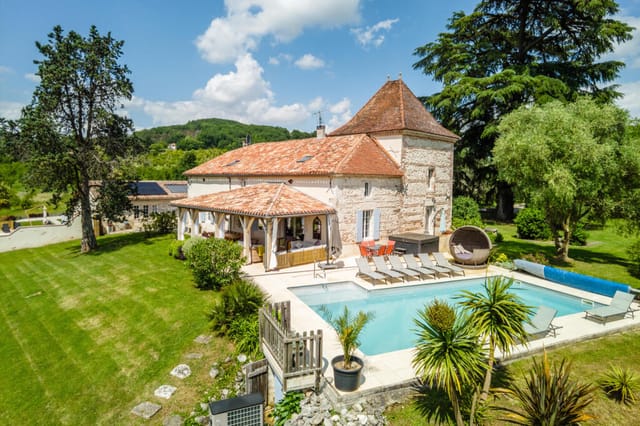
On a clear morning in high summer, you can stand on the balcony of this farmhouse with a coffee going cold in your hand and watch the mist burn off the Quercy Blanc valley below. The fields turn from silver to gold. A church bell somewhere in the direction of Lauzerte counts out eight strokes. Nothing else moves. That's the daily opening act here — and it never gets old. This is a proper stone farmhouse complex in the Tarn-et-Garonne, the kind of property that took generations to build and a great deal of luck to find in this condition. Set in a quiet hamlet just minutes from two of the region's most characterful bastide towns, the estate spans a generous 349 square metres of living space across a main farmhouse, two guest cottages, a stone-vaulted cellar, a substantial barn, a separate study with shower room, and a secluded swimming pool surrounded by mature gardens. Five bedrooms, three bathrooms, move-in ready, and priced at €480,000. The maths are compelling. The lifestyle is better. The farmhouse itself does what good old stone buildings do — it keeps you cool in July and warm in January without much effort. Walls half a metre thick have their advantages. Inside, original terracotta floors run through the ground floor, overhead beams show their age in the best possible way, and the wood-burning stove in the living room is not decorative — it earns its keep from November through March. The kitchen has been updated for real use: long lunches, big pots of cassoulet, Sunday afternoons that stretch until the light goes. French doors open onto the balcony, which faces due south across the valley. That view is the property's most persuasive argument for ownership. The practical bones of the place have been thoroughly ad ... click here to read more

Picture 1

Step outside on a Tuesday morning and there's a 400-year-old Lebanese cedar throwing dappled shade across the lawn. The church bell in Dolmayrac has just struck eight. The smell of coffee drifts from the kitchen through the open French doors, and somewhere across the valley, someone is already cutting hay. This is not a fantasy version of southwest France — this is what Tuesday actually looks like from this estate. Set in the Lot-et-Garonne, one of the quietly underrated departments of Aquitaine, this grand stone manor house sits within its own immaculate park and comprises three independent residential structures: a six-bedroom main house, a three-bedroom gîte with private pool, and a one-bedroom cottage with its own swim-jet pool. Ten bedrooms and eight bathrooms across 530 square metres of living space, all in genuinely good condition and fully operational as an income-generating retreat business. The numbers, by any measure, are serious. The manor itself has the kind of bones you can't fabricate. Original stone staircases. Beamed ceilings that have absorbed three centuries of wood smoke. Exposed stone walls that stay cool even when the Gascon summer pushes past 35 degrees in July. But the previous owners weren't romantics living in the past — underfloor heating runs throughout, powered by a modern heat pump, and the kitchen has been fitted with granite worktops and fully integrated appliances. The living room's wood-burning stove is there because you want it, not because there's no alternative. A 10m x 5m heated saltwater pool sits beyond the covered terrace, the kind of pool where long lunches drift into early evening without anyone noticing or caring. The three-bedroom gîte operates entirely independently. Priva ... click here to read more

Picture 1

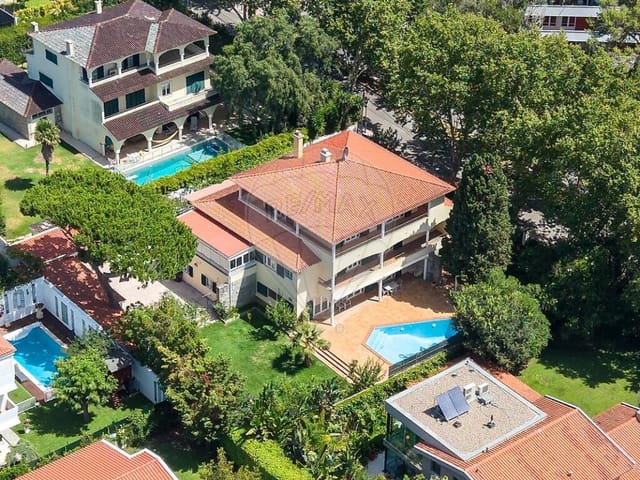
On a clear morning in Cascais, you can open the shutters and hear the Atlantic before you see it — that low, rhythmic exhale of waves that sets the pace for the whole day. This is the kind of place where the morning walk to Pastelaria Garrett for a galão and a pastel de nata feels like a ritual worth protecting, and where the light off the water at golden hour genuinely stops you mid-conversation. At 761 square metres across six bedrooms and eight bathrooms, this villa isn't just spacious — it's built for a life that runs at a different speed than the city. Cascais sits at the mouth of the Tagus estuary where it opens into the Atlantic, about 30 kilometres west of Lisbon along the most scenic coastal road in Portugal. The drive alone — hugging the cliffs past Estoril's casino, past the fishing boats at the marina, past weekend cyclists and surfers loading boards onto car roofs — tells you everything about why people have been coming here since Portuguese royalty made it their summer retreat in the 1870s. That history isn't abstract. You feel it in the 19th-century palace facades on Rua Frederico Arouca, in the Museu dos Condes de Castro Guimarães tucked behind a moat just ten minutes on foot from the old town, in the way the whole place slows down in August without ever feeling chaotic. The villa itself sits in good condition throughout — solid, well-maintained, and ready for you to move in or begin personalising to your own taste without the headache of renovation. Six bedrooms means flexibility that most holiday properties can't offer: room for three families, or a couple who wants dedicated guest suites and a home office that doesn't double as something else. Eight bathrooms eliminate every morning queue, every nego ... click here to read more

Picture 1

On a still morning in Coussac-Bonneval, the only sound you'll hear from the kitchen window is birdsong and the faint clang of the village church bell marking the hour. That's not a selling point — that's just Tuesday. This is a corner of rural France that hasn't been polished for tourists, and that's exactly what makes it worth your attention. This three-bedroom stone village house sits in the heart of Coussac-Bonneval, a quietly compelling commune in the Haute-Vienne department of Limousin, and it has been fully renovated without losing the bones that make it genuinely special. The original parquet floors are still there, worn smooth in the best possible way. The exposed timber beams cross the ceilings upstairs with the kind of presence you simply can't recreate. Two fireplaces anchor the interior, and a wood-burning stove in the living and dining room turns a rainy October evening into something you'd want to repeat every year. At 153 square metres spread across two levels, the house has real breathing room. The ground floor opens with an entrance hall that leads into a generous 39-square-metre living and dining space — French doors push open to a south-facing terrace, and in summer you'll barely bother eating indoors. The kitchen is fully fitted and functional, with a ground-floor WC keeping the layout practical. Upstairs, three bedrooms share two bathrooms, each with its own WC, plus a further separate WC — sensible for families or groups of friends who all need to be somewhere at the same time on a Saturday morning. Outside is where this property really opens up. The walled garden runs to 1,101 square metres, giving you genuine privacy without feeling like you're managing an estate. There's a paved terrace for lo ... click here to read more

Picture 1

Sunday morning in Puy-l'Évêque sounds like this: church bells rolling down from the medieval tower, the distant clatter of the weekly market on the square, and the faint smell of woodsmoke drifting across stone rooftops that have been standing since the 13th century. You're in the kitchen of a house built in 1887, coffee in hand, sunlight cutting through the original glazed vestibule and landing in stripes across the flagstone floor. This is the kind of morning people drive thousands of miles — or book a flight to Cahors — to find. Puy-l'Évêque sits high on a limestone cliff above the Lot River, one of those Quercy villages that somehow stayed real. It didn't get polished into a tourism showpiece. The boulangerie on Rue du Dr Malbet still sells the same walnut bread it always has. The Tuesday market brings farmers from the surrounding causse with duck confit, aged Rocamadour cheese, and Malbec from the Cahors appellation — vineyards that start just minutes outside the village limits. The Lot Valley is serious wine country, and if you're here in October during harvest, you'll understand why locals don't leave. This five-bedroom stone house sits at the center of that village, not on the periphery. You walk out the front door and you're already in it — the rhythm of Puy-l'Évêque life, the café terraces, the medieval lanes, the river views from the promontory a few minutes on foot. But step back inside and shut the electric gate and the outside world drops away entirely. The house itself is the result of a careful, expensive renovation carried out by owners who clearly lived here rather than just owning it. They kept the stone staircase — a genuinely handsome piece of 19th-century craftsmanship that anchors the entrance h ... click here to read more

Picture 1

Picture this: it's a Saturday morning in late June, and you're standing barefoot on the covered patio at Vreta 17, coffee in hand, watching the midsummer light filter through birch leaves so green they almost hurt to look at. The garden smells of damp earth and wild strawberries. Somewhere across the field, a cuckoo is at it again. You're fifty minutes from Stockholm, but you might as well be on another planet. That's the daily reality of owning this two-bedroom house in Hölö — a small, quietly compelling village in Södertälje municipality, south of the capital. This isn't a property that screams for attention. It earns it slowly, the way good places do. The house was built in 1972 and sits on a generous 2,730 square meters of land. Eighty-two square meters of living space doesn't sound massive on paper, but the layout is thoughtful enough that nothing feels squeezed. You walk in through what's currently used as a dining room — a flexible space that could just as naturally become an entry hall or a quiet work-from-wherever corner. The kitchen follows: wooden cabinet fronts, the smell of old pine, a stove and oven setup that handles everything from quick pasta to a slow Sunday baking session. The extractor fan hums. Bread rises on the counter. It works the way a kitchen should. The living room is the heart of this place, and the fireplace is the heart of the living room. Come October, when the birches outside turn amber and the nights close in fast, that fire becomes less of a feature and more of a necessity. Pull a chair close, crack a book, let the logs do their thing. A wooden staircase off the main room climbs up to a loft — not a grand space, but a genuinely useful one. An extra bed for a visiting friend, a readin ... click here to read more

Front view of the cottage and garden

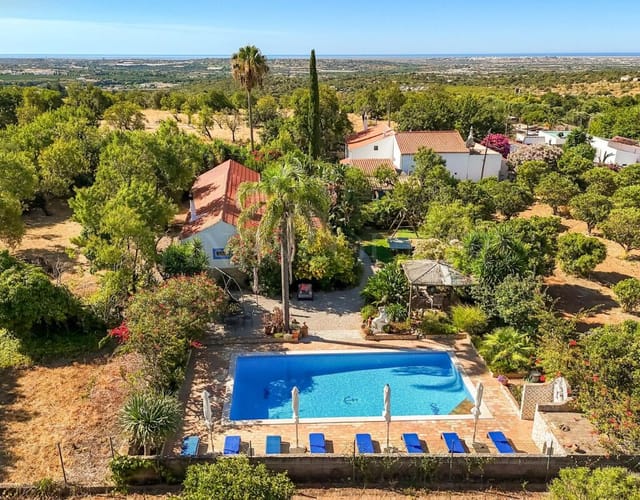
Step outside at seven in the morning and the air already carries something — woodsmoke from a neighbor's chimney, the faint sweetness of orange blossom, the sound of absolutely nothing else. That's Estoi. A hilltop village in the Algarve interior that most visitors drive straight past on their way to the coast, and which rewards anyone who stops with something rare: actual quiet, actual countryside, and a pace of life that the beach towns lost sometime in the nineties. This is a proper quinta. Not a villa that someone's decided to call a quinta for marketing purposes — a real, working estate that has been welcoming guests for more than 25 years. The whitewashed walls, the terracotta rooftiles, the cobbled paths winding between fruit trees and bougainvillea: none of it was installed to look authentic. It just is. Seven bedrooms are spread across four distinct structures. The main house has two bedrooms, a full bathroom, a generous living and dining room, a fitted kitchen, and a covered terrace where a barbecue sits ready beneath a vine-draped pergola. You eat outside here for about nine months of the year without thinking twice about it. Then there are three independent guest cottages: The Quinta, with two bedrooms, its own kitchen, living and dining rooms, and a rooftop terrace that catches partial sea views out toward the coast; Casa Avós, which has a mezzanine en-suite bedroom, a kitchen-diner, a sitting room, and a private patio screened by mature planting; and The Granja, an intimate studio-style space with its own kitchen and dining area. Each one is genuinely self-contained. Guests — or family members, depending on how you're using the place — have real privacy. The saltwater pool sits at 5 by 10 metres, which i ... click here to read more

Picture 1

The bread oven is still there. So is the wine press. Standing in the larger of the two stone barns on a warm June morning, with swallows threading in and out of the rafters above you, it doesn't take long to understand that this 1847 farmhouse near Beauville wasn't just built — it was assembled with the kind of patience and permanence that nobody bothers with anymore. That original stone sink in the kitchen still works. The cast iron roll-top bath still gleams. Some things, if they're good enough to begin with, don't need replacing. This is a three-bedroom farmhouse in the rolling countryside of Lot-et-Garonne, priced at €199,000, sitting on a generous 3,500m2 garden with a separate 1.2-hectare plot attached. Two stone barns come with the property. The house itself runs to 93 square metres. It's in good condition — not a ruin, not a renovation project from hell — but it carries that particular lived-in warmth that a period property only gets after a century and a half of occupation. A little refreshing here and there, and it would be exactly what it already nearly is: one of the most quietly singular farmhouses in this corner of southwest France. Approach along the lane — and it really is a quiet lane, the kind where you occasionally have to pull over for a tractor and nobody minds — and the first thing you notice is how the house sits in the landscape. The Lot-et-Garonne valley rolls out around it in every direction, the kind of view that you'd pay an architect a fortune to fabricate if nature hadn't already done it for free. Established trees frame the garden. Gnarled vines push along their rows. Box hedging holds everything together. There's a vegetable patch, multiple fruit trees, and a small terrace positioned, wh ... click here to read more

Picture 1

On a still February morning at Finntjønnveien 29, the only sound is the soft creak of skis clipping into bindings on the road outside. You had the fire going by seven, the heat pump already doing its quiet work, and now the whole Gisnadalen valley sits below you in a low winter light that turns the snow faintly orange. That's the rhythm this cabin runs on — unhurried, outdoors-forward, and genuinely comfortable in a way that many mountain properties in Norway never quite manage. Rennebu sits in the heart of Trøndelag, a municipality that tends not to feature in glossy ski resort brochures, which is exactly why the people who know it keep coming back. The village is serious mountain country without the crowds. The Trollheimen massif — one of Norway's most accessible yet underrated highland wilderness areas — is right on the doorstep. Cross-country trails thread out from the road directly in front of this property, meaning you can ski to the trailhead in under a minute from the front step. Oppdal's alpine lifts, including the runs at Vangslia and Stølen, are just fifteen minutes by car when you want the downhill fix. In the same drive, you can pick up provisions at the grocery store — so logistics here are simpler than you'd expect from a cabin that feels this far into the Norwegian hills. The chalet itself was built in 1981 and has been kept in genuinely good condition, updated where it matters without losing the honest, timber-framed character that makes old Norwegian cabins worth seeking out in the first place. Eighty-six square metres of indoor living space is arranged with real practicality — five bedrooms, two hallways, a tiled bathroom, and a living room with ceilings that open upward and make the whole space feel ... click here to read more

Welcome to Finntjønnveien 29 and this beautiful holiday property! Photo: Interior photo by Jon Kristian Haukdal

Step outside on a Tuesday morning and you can hear the market vendors setting up in Montaigu-de-Quercy — the clatter of trestles, the smell of roasting garlic and fresh-cut lavender drifting up the hill — and you're only five minutes away by car. That particular detail matters more than you might think. This is the Quercy countryside at its most liveable: genuinely rural, genuinely quiet, but never cut off from the rhythm of a functioning French village life. The property itself is a converted stone barn, originally built in 1867, and it carries that age well. The walls are thick — proper thick, the kind that keep the ground floor cool through a July afternoon without air conditioning. About 45 years ago it was turned into a family home, and it's been lived in and loved since. Today it sits in good condition with some cosmetic updating still ahead of it, which is honestly where the opportunity lies. The bones are exceptional. The scale of the rooms, the exposed timber beams, the traditional tomette floor tiles in the living area — these are things you'd pay a premium for in a newly built property and still not quite get right. Here they're original. At 152 square metres across four bedrooms and two bathrooms, there's genuine room to breathe. The kitchen has the kind of proportions that make sense for a long Sunday lunch — enough counter space, a connection to the covered terrace through a door that you'll probably leave open from May through October. That terrace faces out over the garden and the view beyond it: a broad sweep of Quercy countryside rolling toward the Lot valley, with Roquecor's medieval silhouette visible on a clear day. The living room has a wood-burning stove set into the wall, flanked by exposed ston ... click here to read more

Picture 1

Stand on the high ground of this 2.45-hectare plot on a quiet morning and you'll hear almost nothing — just cork trees moving in a soft Atlantic breeze and, very faintly, the sound of Aljezur's church bell drifting up from the valley. That's 1km away. It might as well be another world. This is western Algarve at its most honest. Not the golf resorts and poolside bars of the Algarve coast most people know, but the wilder, greener, rougher-edged version — the Costa Vicentina side, where the landscape is protected by Europe's most intact coastal national park, Parque Natural do Sudoeste Alentejano e Costa Vicentina, and where the beaches are the kind you actually have to yourself. Praia de Arrifana is 10 minutes by car. Praia da Amoreira, where a river mouth meets the Atlantic in an extraordinary wide-open estuary, is even closer. You won't find sunbed rental there. You will find surfers, herons, and the smell of salt and river grass. The plot itself is largely flat — genuinely so, not the "gently sloping" that Portuguese land listings sometimes use as a euphemism. Mature cork oaks and carob trees are scattered across the property, providing shade and giving the land a settled, established feel that young, cleared plots simply don't have. The fencing is in place. A water connection is already installed. Electricity runs at the boundary. And standing somewhere near the center of the land, already marked by decades of existence, is a ruin of approximately 140m² — the bones of a future home, with its footprint already licensed into the landscape. That last point matters more than it might seem. In the Costa Vicentina protected zone, building permissions are tightly governed. Having an existing ruin with a defined footprint ... click here to read more

Picture 1

On a clear morning, you can stand on the sandstone patio at The Coach House and watch the light shift across Snowdonia before your coffee gets cold. Yr Wyddfa catches the first pink of dawn, the Irish Sea glitters below, and somewhere down the lane toward Trefor's little harbour, a dog barks twice and then goes quiet. It takes about thirty seconds for you to stop thinking about anything else. That's the kind of place this is. The Coach House sits elevated above the village of Trefor on the northern edge of the Llyn Peninsula — a narrow finger of land pointing southwest into Cardigan Bay, designated an Area of Outstanding Natural Beauty and fiercely protected as a result. The views don't just face the sea. They take in Anglesey to the north, the full sweep of the Snowdonia range behind, and on the right day, Ireland smudged on the horizon. You can't manufacture that. You either have it or you don't. This three-bedroom converted stone residence was originally built as the coach house to Plas Yr Eifl, the grand home of the local quarry master. That history is still written into the bones of the building — the original stable door hinges preserved in the entrance hall, the whitewashed stonework, the reclaimed timber bressummer beam above the inglenook fireplace in the sitting room. Someone has taken enormous care here, not just restoring the character of the building but layering in the kind of finishes that make a holiday home function beautifully day to day: granite worktops in the kitchen, a Rangemaster range cooker, a wine fridge that never gets judged for being full, engineered oak floors throughout the ground floor, and a hand-crafted oak staircase rising to the first floor with the quiet confidence of something buil ... click here to read more

View

Step outside on a Tuesday morning in late September, coffee in hand, and look south from the upper terrace. The Lot Valley rolls away beneath you — golden light catching the limestone cliffs above the river, a combine working a distant field, and not a single rooftop interrupting the view. That's the daily reality of owning this 327-square-metre stone chateau outside Puy-l'Évêque, one of the most quietly compelling towns in the whole of southwest France. This isn't a property that announces itself loudly. It earns your admiration slowly — first the circular driveway curving through centuries-old cypress trees and clipped box hedging, then the sight of the main house itself, all honey-coloured stone and shuttered windows, set against a backdrop of pasture and woodland that stretches across 11.5 hectares of completely private grounds. No neighbours visible. No road noise. Just the occasional woodpigeon and the wind moving through the trees. The house reads differently room by room, which is part of what makes it so liveable. The kitchen is the anchor — high-ceilinged, stone-walled, fitted with built-in appliances but generous enough in scale that it never feels clinical. This is a room where you cook a cassoulet from scratch on a wet November afternoon, where guests inevitably end up congregating with wine glasses before dinner is even close to ready. A large living room runs off it, wooden floors worn to a warm patina, a marble fireplace at one end, French doors opening directly onto the garden. On summer evenings, that threshold between inside and outside basically disappears. A second sitting room, anchored by a stone fireplace with a wood-burning stove, is the kind of space that gets used hard in winter — darker, cos ... click here to read more

Picture 1

Sunday morning in the Quercy Blanc, and the only sound you can hear is the wind moving through the old walnut trees at the edge of the garden. No traffic. No neighbors. Just the particular silence that rural southwest France does better than almost anywhere else in Europe — the kind that makes city people stop mid-sentence and just listen. That's the daily reality of owning this 18th-century stone house outside Civray, and once you've felt it, a weekend here starts to feel less like a holiday and more like the life you should have been living all along. The house itself has had an exceptional steward. A designer owner poured serious money and craft into the restoration, which means you get the bones of a genuine 18th-century farmhouse — original terracotta floor tiles worn smooth by two centuries of use, exposed stone walls that stay cool even in July, a fireplace that fills the main living space with the particular smell of a wood fire on an October evening — combined with a kitchen that's genuinely modern and bathrooms that don't ask you to sacrifice comfort for character. That combination is rarer than it sounds. Most period properties in this part of France sit at one extreme or the other: either over-renovated into something generic, or authentically historic and functionally difficult. This one hits the balance. At 230 square meters, the layout is generous, and it's been configured with real intelligence. The property currently operates as two interconnected dwellings, separated by an internal doorway that can stay open or closed depending on who's visiting and when. The main section is a one-bedroom home with cathedral ceilings that make the space feel vast, a superb stone fireplace as the focal point, and a mod ... click here to read more

Picture 1

Sunday morning in Lorigné moves slowly. The kind of slowly you forget exists until you're standing barefoot on warm stone tiles, coffee in hand, watching mist lift off the fields while the pool thermometer already reads 28°C. By nine o'clock, the gîte guests are starting to drift toward the communal terrace, kids are splashing, and the scent of someone's croissants browning in an oven cuts clean through the morning air. This is the rhythm this property runs on — unhurried, productive in its own way, and deeply, genuinely French. Set in the commune of Alloinay in Deux-Sèvres, this 460-square-metre estate sits in the green heart of Poitou-Charentes, a region that doesn't shout. It earns attention quietly — through its cognac-country cousins to the southwest, the Marais Poitevin wetlands just forty minutes east (nicknamed the Green Venice of France for good reason), and a pace of rural life that has attracted a steady stream of northern European second-home buyers for the better part of three decades. The property itself is a compound in the truest sense: a fully renovated main residence with its own private heated pool, and a separate five-gîte complex operating as a going concern, sleeping up to 27 guests at peak capacity. Walk into the main house and the renovation speaks for itself without needing to brag. The ground floor opens into a wide kitchen and living space that handles a crowd comfortably — the kind of room where a dinner party for twelve doesn't feel squeezed. A separate lounge gives you somewhere to escape when you want it quieter. Underfloor heating runs throughout the ground floor, backed up by two log burners that turn January evenings into something you actually look forward to, and an air-source heat p ... click here to read more

Picture 1

Stand on the terrace on a still morning and all you hear is water. The mill pond catches the early light, dragonflies hover just above the surface, and somewhere in the old dovecote above you, something rustles. This is a property that slows time down—a genuine stone mill house with working sluice gates, wild grounds stretching over two hectares, and a silence so complete it takes a few days to fully settle into. Cordes-sur-Ciel sits about fifteen minutes up the road, its medieval bastide streets rising above the Cérou valley like something out of a fever dream. This 13th-century hilltop town—built by Raymond VII of Toulouse—draws visitors for its Gothic architecture, summer arts festival, and the kind of views that make people cancel their return flights. But you're not in Cordes. You're down in the valley, at the end of a long private driveway, in your own world. That distinction matters more than it might sound. The mill house itself covers 166 square metres of living space, built from the local warm-toned stone that defines Tarn architecture. It's been renovated thoughtfully—nothing stripped out for the sake of modernising, nothing left crumbling for the sake of authenticity. The original millstone greets you in the east entrance hall, and the bones of the building have been respected throughout. Three bedrooms, two bathrooms, a large fitted kitchen-diner with south, east, and west-facing views that stretch across the grounds, and a proper living room with a wood burner that earns its keep come November. The layout splits naturally between two wings. The west side, where the dovecote and barn have been incorporated, is where daily life happens: you enter from a terrace overlooking the mill pond, step into the kitc ... click here to read more

Picture 1

Stand on the terrace on a clear July morning and you can see the entire silhouette of Tournon-d'Agenais sitting up on its ridge—the church tower, the medieval ramparts, the rooftops catching the early light—while down below you, the saltwater pool glints and the Lot-et-Garonne countryside rolls away in every direction without a neighbor in sight. That view is the first thing you notice. It won't be the last thing you remember. This is a serious property. A 19th-century stone farmhouse of 297 square meters, a fully renovated guest cottage, a massive old tobacco barn, multiple outbuildings and workshops, a ten-car garage, and nearly two hectares of established gardens—all sitting behind a gated entrance on a quiet rural lane just minutes from one of the most photographed bastide towns in Aquitaine. Properties that combine this scale, this condition, and this setting in Lot-et-Garonne come along rarely. This one is move-in ready. The renovation has been thorough and thoughtful rather than cosmetic. Travertine floors run throughout the main house, cool underfoot in summer and warmed from below by an efficient heat pump system in the cooler months. Exposed stone walls and original oak beams have been kept exactly where they should be—everywhere—while the infrastructure underneath has been quietly modernized: double glazing throughout, an air circulation system, underfloor heating, radiators as backup. The bones of the 1800s, the comfort of the present. The main living space opens into a generous open-plan room with a soaring mezzanine above and wide glass doors that fold back onto the terrace. On a warm evening this isn't a room that ends at a wall—it spills outside. The covered dining room with its summer kitchen is where ... click here to read more

Picture 1

On a still July morning in Beauville, the kitchen window frames a view that looks like it was painted rather than photographed — rolling hills striped with sunflower fields, a pocket of woodland, a sky so blue it almost seems theatrical. You make coffee on the balcony off the main kitchen and hear nothing except wind moving through the linden trees below. No traffic. No sirens. Just that particular French country quiet that city people pay a lot of money to find, and usually don't. This is a rare one. A 19th-century stone house built for a local merchant who clearly had opinions — Bordeaux-faced stone door surrounds, hand-cut corner stones, proportions that tell you the builder wasn't cutting corners in any direction. The property has been in the hands of owners who understood what they had, and the restoration they've carried out is the kind that respects original character rather than erasing it. Exposed limestone walls, heavy timber beams, terracotta-tiled floors worn smooth by a couple of centuries of footsteps. It feels old in the right way — solid, warm, rooted. The main house runs across 251 square metres and lives well across its five bedrooms. The sitting room anchors the ground floor, large and unhurried, centred on a log-burning stove that earns its keep from October through to March when the Lot-et-Garonne mornings carry a real bite. The fitted kitchen is modern in the practical sense — properly equipped, well-designed — and opens onto a balcony where the habit of morning coffee will become a daily ritual you'll plan your whole schedule around. Double glazing throughout, solar panels, a heat pump, and oil heating mean running costs are sensible and the property is comfortable in every season, not just the p ... click here to read more

Picture 1

On a still morning in Friesland, you step off the wooden deck behind your chalet, untie the bow line, and push out onto open water before most of the world has had breakfast. The Langweerderwielen stretches ahead of you — a silver mirror of sky and reed beds, dragonflies hovering at the hull. This is the rhythm of life at Langwarderdyk 6-18, and it takes about four hours before you stop looking at your phone. Sint Nicolaasga sits quietly in the Frisian lake district of the Netherlands, a stretch of lowland water country that has been drawing sailors, cyclists, and nature obsessives for generations — not because anyone marketed it hard, but because it earns the devotion on its own. The famous Frisian Eleven Cities route passes through this region. The Sneekweek regatta, one of Europe's largest inland sailing events held each August in nearby Sneek, fills the waterways with white sails every summer. Come winter, when temperatures drop and the canals freeze, locals strap on their schaatsen and skate point-to-point between villages on routes unchanged for centuries. Owning a second home here isn't about a postcard view — it's about plugging into a way of life that genuinely slows time down. The chalet itself was built in 2011 in the form of a classic Dutch farmhouse, small in footprint but full of character. The thatched roof — a proper patent thatching — sets it apart from the moment you arrive, and it wears the surrounding Vegelin Woods like a natural backdrop. This is one of only 18 chalets in the complex, a deliberately small-scale arrangement that keeps the atmosphere close to private. No sprawling holiday park energy here. At 42 square metres across the ground floor, every centimetre has been considered: vinyl floori ... click here to read more
Front view of the thatched chalet

On a still morning in Lot-et-Garonne, you wake to the sound of absolutely nothing — no traffic, no sirens, just the occasional wood pigeon in the oak trees and the faint creak of old stone settling in the warmth of a rising sun. Step through the kitchen doors onto the raised deck with your coffee, and the land rolls away before you in every direction: sunflower fields, vine rows, a patchwork of green that shifts colour through the seasons. This is what 3.87 hectares of southwest French countryside looks like when it's yours. And it's considerably more than most people dare to imagine they could own. This 19th-century stone farmhouse complex in Montastruc — a quiet village tucked into the hills of Lot-et-Garonne, just south of the Dordogne border — is one of those rare properties that has genuinely been lived in and loved. Not flipped, not staged. The current owners have run a successful gîte business here for years and simply decided it was time to slow down. That means everything is already working. The guests have been coming. The infrastructure is in place. You're not starting from scratch. The principal house is where the story begins. Three bedrooms, contemporary interiors that don't try too hard — oak flooring in the main suite, built-in wardrobes you'll actually use, air conditioning for the deep heat of August, and an en suite bathroom that feels finished rather than rushed. The sitting room has a log-burning insert stove for January evenings when you want nothing more than a bottle of Côtes du Marmandais and a slow dinner. The kitchen is properly equipped: range stove, Belfast sink, wood worktops, modern fittings. There's a large covered terrace for long lunches that drift into the late afternoon, and a second ... click here to read more
Picture 1

On a clear morning, you can stand at the kitchen sink, look out past the garden fence, and watch mist lifting off the open fields while the kettle boils. No traffic. No neighbors in your sightline. Just rolling Cornish countryside stretching away under a sky that feels bigger than it has any right to. That's the daily reality at this converted barn in Burras — a small, quiet hamlet tucked between Helston and Redruth that most visitors to Cornwall never find. This is a proper barn conversion, the kind that took real care to get right. The Courtyard is a cluster of just five properties, and this one sits within it like it was always meant to be here — stone walls, exposed timber beams, and a vaulted ceiling in the main living space that lifts your mood the moment you walk in. The building's bones are old, the finishes are modern, and somehow the two things don't fight each other at all. The living and dining room is the heart of everything. At roughly 25 by 16 feet, it's a generous, dual-aspect space that draws light in from multiple angles throughout the day. The Scan Stove wood-burner sits against the granite wall like it's been there for centuries — and on a January evening when rain is hammering the Cornish hills, lighting it and opening a bottle of something good is one of life's simpler pleasures. Stairs from this room climb to a mezzanine level: currently used as a home office, it has that slightly tucked-away quality that makes you want to read, or sketch, or just think without interruption. A Velux window overhead pulls in the sky. The farmhouse kitchen is compact but genuinely functional, with a four-ring ceramic hob, double oven, integrated dishwasher, and a breakfast bar where someone always ends up perching ... click here to read more
Elevation

Stand at the west-facing terrace on a clear autumn morning, coffee in hand, and the River Severn stretches out below you like hammered silver, the Black Mountains a dark ridge on the Welsh horizon. The air up here on Selsley Hill carries woodsmoke and damp grass. Church bells from the village drift up faintly. This is what 440 years of considered living looks like. Stanley Park was built in 1584, and you feel that age the moment you step through the gothic-arched porch — not as museum mustiness, but as settled authority. The stone wants to be here. The timbers have stopped moving. Original mullioned windows throw slanted light across hardwood floors in a way that no architect could plan; it just accumulates over centuries. Yet whoever restored this house understood that grandeur without warmth is just a film set, so the restoration has been meticulous and honest — underfloor heating runs beneath flagstone on the lower ground floor, a state-of-the-art cinema sits behind a period door, and the wine cellar holds roughly 4,000 bottles in its original vaulted chambers. History and daily convenience, genuinely coexisting. The reception hall sets the pace immediately. Carved timberwork, ornate arches, decorative plasterwork, and a stone fireplace that has been burning things since the Elizabethans. Off the hall, the library invites quiet mornings with a book while the billiard room — richly panelled, properly proportioned — handles evenings when guests arrive and conversations run late. The grand ballroom, lit by a stained-glass skylight that washes the room in shifting colour depending on the hour, is the kind of space that makes you start planning occasions just to fill it. Dinner for fifty? A wedding? A New Year's party th ... click here to read more
Front view of Stanley Park

On a clear morning, standing at the front of this house with a coffee in hand, the Pyrenees sit low and blue on the horizon, their snow-capped peaks catching the early light. Behind you, half an acre of mature garden hums quietly — bees in the lavender, water catching the sun in the salt-treated pool. This is the kind of scene you stop and actually notice, not because it's unusual, but because you've just realised you own it. Salies-de-Béarn is one of those French towns that hasn't been polished up for tourists. It still works. The Wednesday and Saturday markets on the Place du Bayaà fill up with local producers selling Ossau-Iraty cheese, Bayonne ham cured in the town's own famous salt, and wine from the Jurançon vineyards a short drive east. The thermal spa baths — the Thermes de Salies-de-Béarn — draw French visitors for week-long cures, and have done for centuries, which means the town has good restaurants, decent bakeries, and a calm, purposeful energy that's hard to manufacture. There's a genuine medieval quarter here, with the characteristic half-timbered maisons salanoises leaning over the Saleys river. Wander up Rue des Moulins on a Sunday and you'll smell roasting duck before you see anything. The house itself sits close enough to town to walk for bread in the morning, but far enough out to feel genuinely rural. That's not an easy balance in a town this size, and it's one of the property's quiet strengths. The setting is peaceful without being remote — a practical distinction for anyone managing a second home from abroad. Inside, the renovation has been done with a sensible hand. The ground floor centres on a generous living and dining room, heated by a pellet burner that throws out serious warmth through th ... click here to read more
Picture 1

There's a particular kind of quiet you only find in the deep Poitevin countryside — the sort that isn't silence so much as a conversation between wind, birdsong, and the occasional church bell rolling over from the village. Standing on the elevated terrace of this former railway gatekeeper's house in the hamlet of Logerie, that quiet settles over you fast. And then you start wondering why you ever lived anywhere else. This is a genuinely rare find. The house was originally built to serve the old railway crossing that once ran through this corner of the Vienne department. The line closed decades ago, and in its place grew a green corridor — a long, tree-lined walking and cycling track that now stretches peacefully past the garden boundary. The history didn't disappear; it just got quieter. On mornings when the light comes in low and gold through the kitchen window, you can almost imagine the old gateman stepping out to wave down a steam locomotive. The property itself sits in good condition throughout, updated thoughtfully without gutting the period character that makes it worth caring about. The kitchen is the obvious centrepiece — a proper farmhouse-style space fitted with shaker-style units, deep work surfaces, and enough room to actually pull a chair up and eat in there without anyone feeling cramped. It looks out over the enclosed garden, which means you catch the changing light across the grounds while you're making coffee. That matters more than you'd think. Original wooden floorboards run through the living room, worn in just the right places. A wood-burning stove sits in the corner, which gets genuinely useful in December when the Vienne valley gets a proper chill, and a discreet air conditioning unit handles ... click here to read more
Picture 1

Picture this: it's six in the morning, the mist is still sitting low over Lake Lingan, and you're walking barefoot across dewy grass with a cup of coffee in your hand. A hundred meters later you're at the water's edge, the only sound a distant woodpecker and the quiet lap of the lake against the small shore. That's not a weekend fantasy—that's a Tuesday in Östervik. This two-bedroom holiday house in Östervik, part of Ockelbo municipality in the Gävleborg region of central Sweden, sits on a 3,453-square-meter plot that backs almost directly onto Lake Lingan. At €87,000 it's the kind of second home that makes financial sense before you've even factored in the lifestyle. The house itself is 42 square meters—compact, honest, and completely fit for purpose. Wooden panelling runs along the interior walls, warm against grey Scandinavian winter light. The open fireplace in the living room is the room's gravitational centre; on October evenings when the forest outside turns amber and copper, you'll understand exactly why Swedish design has always prioritised the hearth. The two bedrooms are small but sleep a couple or a family with young children without issue. The kitchen has what you need: workspace, appliances, a window that looks out into the trees. Simple. Deliberate. Exactly right for a place where life is meant to slow down. What genuinely sets this property apart from most holiday homes at this price point is the outbuilding with a proper sauna and shower. The Swedish ritual of sauna, cold water, repeat isn't a spa gimmick here—it's baked into the geography. You heat the sauna, you walk to the lake, you swim, you walk back. In July the water is warm enough to stay in for twenty minutes. In November, thirty seconds is y ... click here to read more
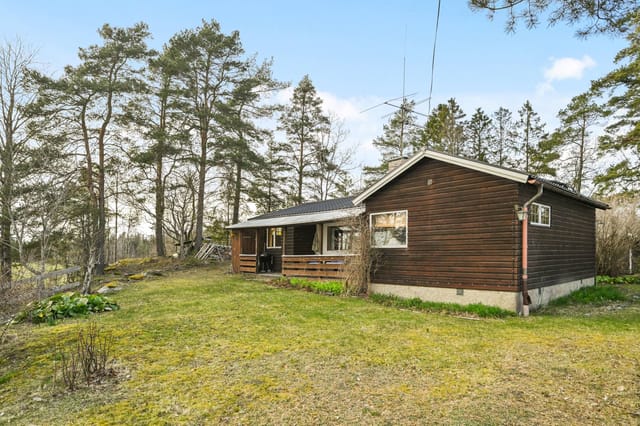
Exterior view of the holiday home

Step outside on a Saturday morning and you're standing on your own covered terrace, coffee in hand, watching mist lift off the pond while a pair of ducks argue quietly at the water's edge. Behind the garden, the trees are close enough that you can hear the wind move through them. Ahead, through the front gate, a narrow canal runs along Brückenstrasse — no through traffic, no noise, just the occasional cyclist drifting past. This is what daily life feels like at this three-bedroom detached house in Twist-Adorf, and honestly, it takes some getting used to. Twist sits in the Emsland district of Lower Saxony, a part of Germany that most international buyers haven't yet discovered — which is precisely why it's worth paying attention to. The Dutch border is five kilometers west. Groningen is about an hour's drive. Münster is reachable in under two hours. The area draws people who want to live close to nature without giving up access to real cities, and the cross-border dynamic makes it genuinely interesting for buyers from the Netherlands or anyone already familiar with the northern Dutch lifestyle. Property values here have held steady while remaining far more accessible than comparable plots in the Netherlands, and the combination of German build quality and generous land sizes is hard to find at this price point elsewhere in northwest Europe. The house itself was built in 1997 — solid, double-glazed, properly insulated — and has been partially renovated to a standard that means you're not walking into a project. The kitchen and central heating boiler were both replaced in 2024, which matters more than most listings admit. New heating systems and kitchens are the two things buyers most often have to budget for after purcha ... click here to read more
Front view of Brückenstrasse 49

Sunday morning in the Quercy Blanc and the kitchen smells of coffee. The French doors are already open—you pushed them wide at seven, when the air was still cool and the light was doing something extraordinary across the stone terrace. Somewhere beyond the garden wall, a tractor moves along the lane. That's it. That's the whole soundtrack. This 1849 stone farmhouse, converted from a traditional barn into a single-storey country home of real distinction, sits in a quiet hamlet just outside Montcuq-en-Quercy-Blanc, and life here moves exactly the way you always hoped it might. The house itself is 158 square metres of considered, unhurried living. It was clearly converted by people who understood what to keep and what to update. The original stone walls stayed. So did the heavy oak beams overhead in the living room, where a wood-burning stove sits inside a proper fireplace—the kind you actually want to light in November, not just look at. Travertine floors run throughout, cool underfoot in July, warmed by the gas central heating when the Lot valley turns grey in January. French doors open from the living room onto a covered stone terrace: evening drinks territory, with views across the gardens as the light fades behind the oak trees. The kitchen is the kind that makes you cook differently. Granite countertops, bespoke oak cabinetry, integrated appliances that stay out of sight, and another set of French doors—these ones facing a second covered terrace framed by original stone pillars. Lunch out there in late September, with figs from the garden and a bottle of Cahors Malbec, is not a hypothetical. It's just a Tuesday. Both bedrooms in the main house are genuinely well-proportioned and finished with the same restraint you ... click here to read more
Picture 1

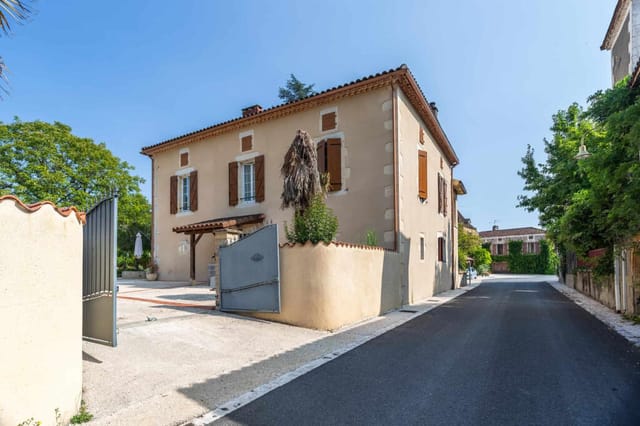
On a quiet Saturday morning in July, you pull back the curtains in the upstairs bedroom and the garden is already catching the sun. The pool is still. The neighborhood is unhurried. You take your coffee downstairs, slide open the door to the terrace, and decide that today, there is nowhere else you need to be. That is the rhythm Seggenstraße 21 sets from the moment you arrive. This 2015-built detached villa sits on the western edge of Meppen, a compact and genuinely livable Lower Saxony town straddling the Ems River in the northwest of Germany. It is not a place that gets written up in travel magazines, and that is part of the appeal. No tourist coaches on the streets, no inflated restaurant prices, no performance. What you get instead is a working, breathing German town with serious infrastructure, friendly locals who actually stop and talk, and a landscape of heathland, river meadows, and cycling paths that most of Europe would envy. The villa itself sits on a plot of 1,065 square metres, with 209 square metres of living space across three levels. Four bedrooms, two full bathrooms plus a ground-floor guest toilet, and a floor plan that genuinely earns the word flexible — not as a euphemism for awkward, but because it has been designed with real optionality in mind. One first-floor room comes fitted with a second kitchen and built-in appliances, making it a self-contained suite. Run it as a B&B room, house extended family in proper comfort, or use it as a long-term rental unit while you occupy the rest. The layout makes all of this straightforward. The swimming pool is the showpiece, and rightfully so. Private pools are uncommon in residential Meppen, which means this one carries genuine rarity value. Set in the lan ... click here to read more
Front view of Seggenstraße 21

Sometime around mid-morning, when the market stalls on the Place de la Truffière are still busy and the smell of fresh bread from the boulangerie on the main street drifts up through the valley, you step out of those iron gates onto one of Puy-l'Évêque's ancient limestone lanes. Coffee in hand. Nowhere urgent to be. That's the daily rhythm this place offers — and it's hard to put a price on that, though someone has, and it's €699,500. Built in 1769 and standing with the quiet confidence of something that has outlasted a lot of history, this maison bourgeoise sits right in the beating heart of one of the Lot Valley's most photogenic villages. Ten bedrooms. Seven bathrooms. A proper working courtyard. An adjoining mill with original machinery still intact. A pigeon tower. A heated pool. And a walled garden where lunch has a habit of becoming dinner without anyone particularly minding. Let's start with the main house, because it earns the attention. The stone staircase alone — worn smooth by centuries of use — sets the tone. Vaulted ceilings arch overhead in the ground-floor rooms, original fireplaces anchor the principal spaces, and the panelled doors and beamed ceilings give the whole place a warmth that no amount of interior design budget can manufacture from scratch. The kitchen manages the old-and-new balance well: modern fitted units and integrated appliances sit alongside an 18th-century built-in cupboard and a log-burning range cooker. It's practical and full of character in equal measure. The kind of kitchen where someone actually cooks, rather than just poses in. The two separate annexes are where things get genuinely interesting for buyers thinking about rental income or multigenerational living. The pigeon to ... click here to read more
Picture 1

The first thing you notice on a summer morning here is the silence. Not the dead kind — the alive kind. Swallows cutting arcs above the terrace, a faint breeze moving through the cork oaks, the pool's surface catching early light and throwing it back in slow gold ribbons. This is Santo Estêvão, a world away from the crowded beach resorts most people think of when they hear "Algarve," and this five-bedroom estate sitting on over 37,000 square metres of private countryside is exactly the kind of property that makes people rethink everything they thought they knew about where to put down roots in southern Portugal. Tavira is twelve minutes by car. That matters more than it might sound. Tavira regularly tops lists of Portugal's most liveable small cities, and unlike the resort towns further west along the EN125, it keeps its own pace. The Tuesday market on the riverbank spills into the surrounding streets — vendors selling blood oranges, smoked sausages from Alentejo, dried figs still on the branch. The Roman bridge over the Rio Gilão connects the old Moorish quarter to the newer town, and on weekend evenings, locals and expats alike fill the outdoor tables at Quatro Águas, eating whole grilled sea bream so fresh it still tastes of the Atlantic. Living near Tavira means being close to real Portuguese life, not a simulation of it. The estate itself sits behind full perimeter fencing on a plot large enough to feel genuinely rural — distant vineyard rows visible from the upper terrace, the scent of wild rosemary and cistus drifting in from the scrubland edges in late spring. Three sets of French doors open the main living space entirely to the outside, so that on the nine months of the year when the Eastern Algarve enjoys rel ... click here to read more
Picture 1