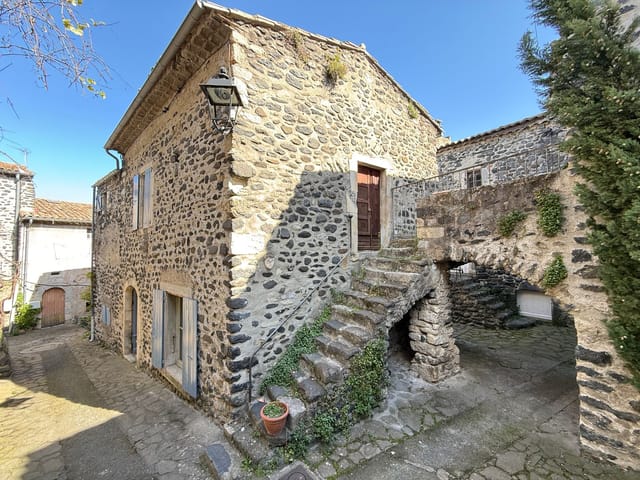
On a quiet Sunday morning in Alba-la-Romaine, you open the shutters and the smell of fresh bread drifts up from the boulangerie two streets over. Church bells knock out a lazy rhythm from the old campanile. Below, the stone-paved lanes are still cool in the shade. By nine, there will be neighbours at the cafe tables on Place de la Mairie, the morning market will be arranging itself around the old fountain, and you will have nowhere particular to be. That is the specific texture of life on Rue Chabrol — and this 113-square-metre village house puts you right at the centre of it.
Alba-la-Romaine sits in the southern Ardèche, about twenty minutes west of the Rhône valley and the A7 motorway. It is not famous in the way that Gordes or Les Baux-de-Provence are famous — and that is precisely its appeal. The village has earned its place on the list of France's most architecturally significant historic settlements without becoming overrun. The Château d'Alba crowns the basalt rock above the rooftops, medieval in its silhouette but built on Roman foundations that were themselves raised over a Gallo-Roman town. Active archaeological excavations still turn up finds on the edge of the village, and a small but genuinely interesting local museum — the Musée de l'Ardèche — displays mosaics and pottery recovered from the site. It is the kind of place where history is not performed for tourists; it is simply woven into the stone underfoot.
The house itself is on Rue Chabrol, steps from the village core. The ground floor opens around a vaulted room — proper barrel-vaulted stone, the kind that took craftsmen centuries to figure out and nobody builds anymore. It gives the kitchen and dining area a weight and atmosphere that no amount of in ... click here to read more